Showing posts with label ghosts. Show all posts

Friday, 12 August 2022

Eye Marvels - Joan Lennon

The last year or so I've been eye obsessed, as my cataracts got thicker and my outlook got blurrier. Two operations later (plus some months of having to be patient while my sight settled down) and I am thoroughly enjoying my shiny new eyes. But don't worry if you are squeamish - I'm not going to post a history of cataract surgery, fascinating (and toe-curling) though that is. Instead, I'd like to share with you J. H. Brown's fabulously-titled book Spectropia: or, Surprising Spectral Illusions, Showing Ghosts Everywhere, and of any Colour, published in 1865 by Griffith and Farran, whose offices were to be found in the Corner of St Paul's Churchyard (Entered at Stationers' Hall). 

It is a book about seeing ghosts.
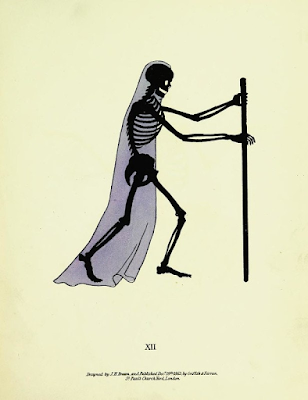
 

To see the spectres, it is only necessary to look steadily at the dot, or asterisk, which is to be found on each of the plates, for about a quarter of a minute, or while counting about twenty, the plate being well illuminated by either artificial or day light. Then turning the eyes to the ceiling, the wall, the sky, or better still to a white sheet hung on the wall of a darkened room (not totally dark), and looking rather steadily at any one point, the spectre will soon begin to make its appearance, increasing in intensity, and then gradually vanishing, to reappear and again vanish ; it will continue to do so several times in succession...
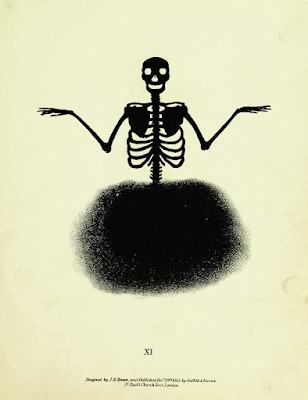

J.H. Brown created his book to speak out against the 'mental epidemic' of such 'absurd follies' as 'spirit-rapping and table-turning'. He goes on to explain the wonderful mechanics of the eye and its heightened deceivability. And then, on with the show!  
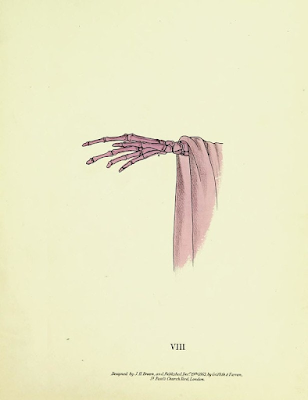


Thanks to The Public Domain Review it's possible for us to have a go at experiencing these surprising spectral illusions ourselves, here, even if we don't own a physical copy of the book - which, though it may not have been a absolute best seller, was still popular enough to go into a 4th edition.

Enjoy!


(I would love to have a read of some of Griffith and Farran's other publications, such as the New and Popular Books for the Young advertised on the back cover, including The Headlong Career and Woful Ending of Precocious Piggy and the slightly dodgy sounding The Loves of Tom Tucker and Little Bo-peep.)


Joan Lennon website

Joan Lennon Instagram

Friday, 6 May 2022

Local History - Celia Rees

Publisher: Amberley Books
 (Images Jamie  Robinson)

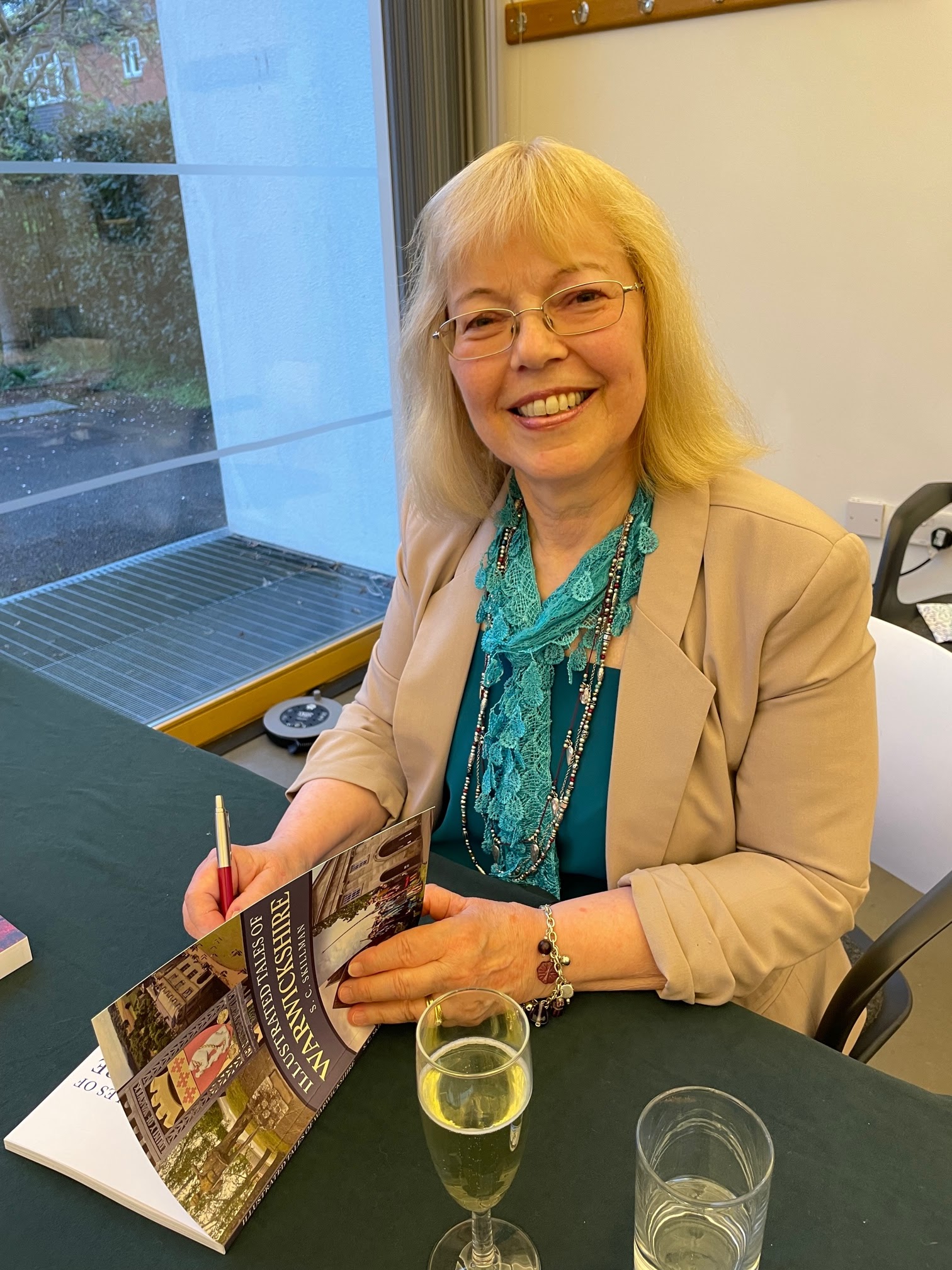
I was very excited recently to be able to go to a real, live event hosted by wonderful Warwick Books, my closest Indie bookshop. I went to hear Warwick writer, S. C. Skillman, talking about her latest book: Illustrated Tales of Warwickshire. This was the first live event I'd attended since before the pandemic, so it was nice to see the author in person talking about her book, answering questions and engaging with an audience. Zoom is a poor substitute, especially as the event took place in the Visitors' Centre of Hill Close Gardens, a rare survival of original Victorian gardens once used by Warwick townsfolk to escape from the crowded town. Once under serious threat from development, these gardens have been lovingly restored and still present a haven of birdsong, peace and quiet. If you are ever in or around Warwick, they are well worth a visit. 

Author - S. C. Skillman (Celia Rees)

I'm Warwickshire born and bred and I love local history and local stories, especially of the spooky kind. S. C. Skillman's previous book was entitled Paranormal Warwickshire, so it is not difficult to locate where her interest also lies. I have used local stories in my writing. The notorious St Valentine's Day murder of agricultural labourer, Charles Walton, on Meon Hill in 1945 was inspiration for my third novel, Colour Her Dead. The crime is unsolved to this day. Surrounded by a wall of silence, accompanied by whispers of witchcraft, carried out in a place with its own strange and sinister legends, the story has a prominent place in modern Warwickshire folk lore. I blogged about it here in 2012 and it is well covered in Illustrated Tales of Warwickshire in chapters, Tales of Warwickshire Witchcraft and Rural Crimes, with accompanying photographs of Lower Quinton, Charles Walton's home village hard by Meon Hill, and the hill itself.  

Meon Hill (Celia Rees)

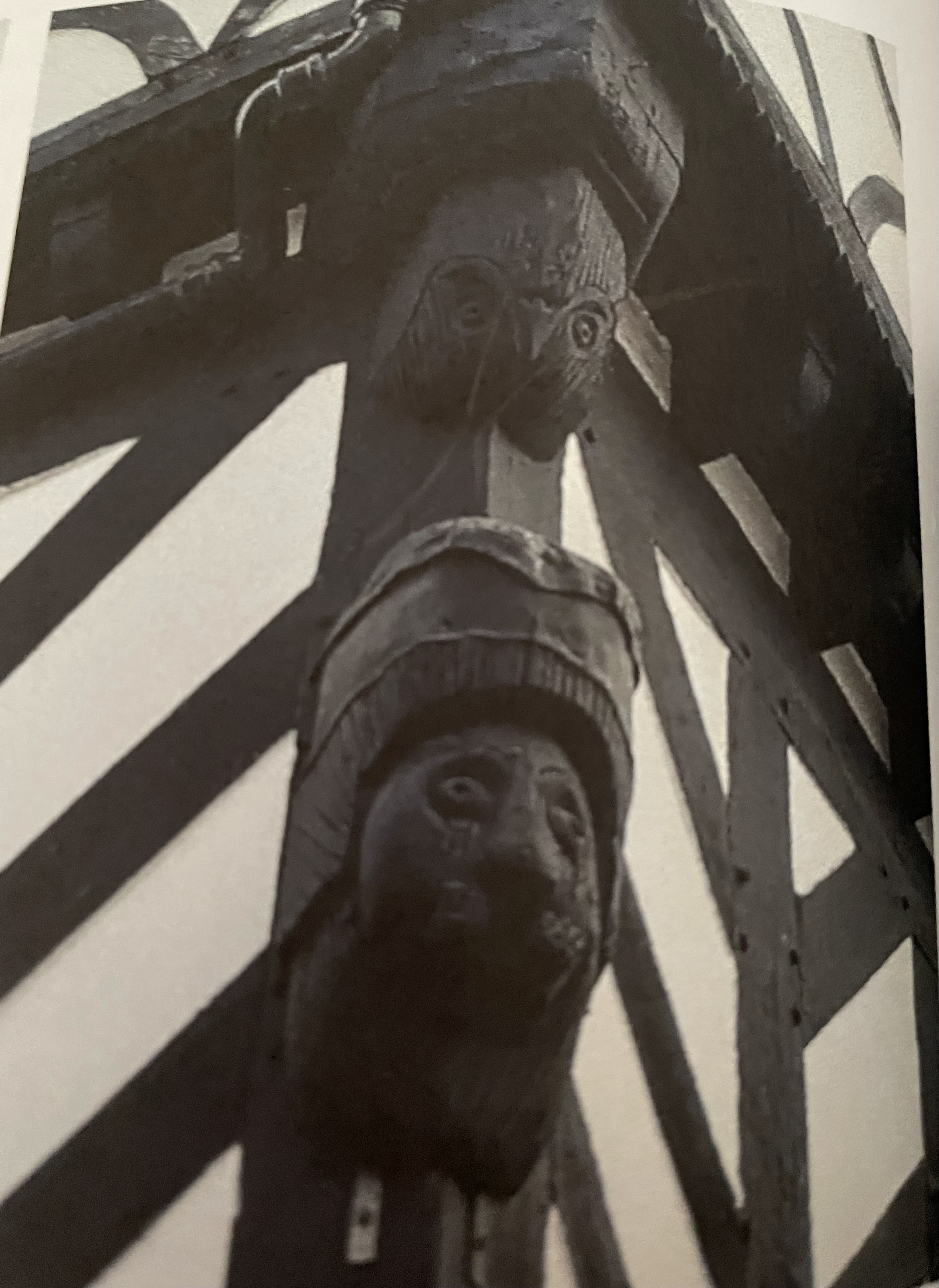
S. K. Skillman covers many of my own favourite places and stories. Some I already knew, others I didn't know at all. I had no idea, for example, that J.R.R. Tolkien had an association with Warwick town and may have referenced Warwick Castle in his work. Neither did I know that the Old Coffee Tavern in Warwick was haunted and I've never noticed the carving of Old Tom in the Market Square. I'll look out for it and other apotropaic carvings next time I'm in Warwick. 

Old Tom, Swan Street, Warwick (S.C. Skillman)

Illustrated Tales of Warwickshire ranges across the whole county and covers all sorts of fascinating local stories and legends, some from the deep past but others happening as recently as 2018 with a big cat sighting on the golf course of the Ardencote Manor Hotel.  The author covers Warwickshire notables, from William Shakespeare to Larry Grayson. Some famous, like Daisy, Countess of Warwick, others not so famous like traditional toymaker, Cyril Hobbins. 

I'd like to thank Warwick Books and Sheila Skillman for a fascinating evening in a magical place. I'm from Warwickshire, so I'm biased, but it was good to be reminded of the rich and varied history of this ancient county. The evening ended with a performance from a local Morris Side, Plum Jerkum. My family come from Warwickshire and this was what my brother called slivovitz, or any plum based schnapps,  Sheila explains that it was the name for a plum cider - something I've never tried. The cider was made from a local plum, the Warwickshire Drooper. My dad had a tree on his allotment and they are still dotted all over local allotments. I've never tried plum cider but they do make the most delicious jam!

Warwickshire Droopers
Plum Jerkum Morris Side (Terence Rees)

Celia Rees
www.celiarees.com
Insta: celiarees1
Twitter: @CeliaRees


Saturday, 13 July 2019

Markyate Manor – Home of The Wicked Lady

by Deborah Swift 

I am not the first writer to be inspired by the life and legend of Lady Katherine Fanshawe. The first novel based on her life was by Magdalen King-Hall who wrote a book called The Life and Death of the Wicked Lady Skelton in 1945. I have a copy and it is exciting reading, though long-winded in the telling by today’s standards. The book was a smash hit in its day and was made into a film - The Wicked Lady. 

The film starred Margaret Lockwood in the title role as a nobleman's wife who secretly becomes a highwayman to relieve her life of boredom. The mystery of why she would take such an extreme action was the sensation of its day – women were supposed to be safe at home doing the housekeeping! The film had one of the top audiences ever for a film of its period, 18.4 million – a staggering number. I can remember my mother talking about it as one of her favourite films.

It was such a hit that the film was re-made in 1983 and starred Faye Dunaway in the lead role, but the film was a total disaster and earned Faye Dunaway an award for the Worst Actress.

The legend is set in and around Markyate Manor. The name Markyate is derived from the Old English words mearc and geat and means 'the gate at the boundary', presumably the boundary between Hertfordshire and Bedfordshire. On the original site was a hermitage, which housed the nun Christina of Markyate. Known for being taken over by heavenly visions, she gathered quite a following and she founded a priory on the site under Benedictine rule. More about Christina's extraordinary life can be found here. 

The Priory did not fare well during the Dissolution and was demolished in 1537. The much more elaborate Markyate Manor was built on its footprint, although it is still sometimes known as Markyate Cell - the cell being the original hermitage. George Ferrers retained the name when he bought the land in 1548. The Ferrers family controlled this land when Markyate Cell was the home of Katherine Ferrers, also sometimes known as The Wicked Lady. 

Markyate Cell

After the death of her husband, Katherine’s mother re-married. The land was soon under the iron control of Katherine’s step-father, Sir Simon Fanshawe. Worse, at only twelve years old, Katherine was forced into an arranged marriage with his nephew, Thomas Fanshawe, so that he could retain control of the estate.
Picture from Project Gutenberg

After that, the story gets even more interesting as the legend credits Katherine with being a notorious highwaywoman. She lived in the house through the years of the turbulent English Civil War, much of it alone as her menfolk were away fighting. She finally died there, so the legend goes, having been mortally wounded trying to rob a coach on Nomansland. 

Her ghost has been seen dressed in highwayman clothes riding her horse at full gallop, and even in 1840 when part of the manor was destroyed by fire, the blaze was blamed on Lady Katherine. Whilst helping to put out the fire several locals said that they felt a ghostly presence and feared they were being watched by her ghost. But unsurprisingly, she is not the only ghost that haunts this building - in the late 1850s workmen repairing a wall saw the figure of a nun. Perhaps this was the anchorite Christina? The nun has been seen several times since, walking in an avenue near St John's Church.

In 1957 the bypass around Markyate was being built. A night watchman was sitting by his brazier one night when he looked up and saw someone warming their hands by the fire. The figure was that of a young man who promptly vanished as the night watchman was looking at him. Was this an appearance of Markyate's legendary Phantom who may also haunt Hicks Road and the High Street? Luton Paranormal Society
There has always been a mysterious young farmer associated with the legend, although I can find no trace of him in historical records. His name, according to local lore, was Ralph Chaplin. I have re-imagined him as a fiery young man who wants to change the old order by joining the radical Diggers Community. The legend of his relationship with Katherine led to the story-line for 'Spirit of the Highway'. I thought the history would appeal to young adults, with its touch of the paranormal, and be a good introduction for newcomers to the period of the English Civil War.

Like to know more about the legend? check out this article in the Daily Mail for a summary of the life and legend of Lady Katherine Ferrers (Fanshawe).
Deborah’s website 
Twitter @swiftstory

also worth looking up is Katherine Clement's excellent adult novel about the same legend, The Silver'd Heart.
Image sources: wikicommons unless cited

Wednesday, 13 March 2019

A Cumbrian Castle with hidden Jacobite history

by Deborah Swift

I'm really lucky in that I live close to many old houses and castles. One very close to my house is Sizergh Castle which has a fabulous tea room and lovely gardens.

The name Sizergh dates from the 9th century and was originally spelled sigaritherge, meaning Sigarith's pasture (sigarith is a female name.)

The castle has been home to the Strickland family for nearly 800 years, beginning in the 12th century, and is still lived in by them today. So well-connected were the family, that a Strickland was chosen to carry the English banner at Agincourt. During the Wars of the Roses the family were Yorkists, and in the succeeding generation were linked with the Parres of Kendal - the family of Catherine Parr, wife of Henry VIII.

The original medieval Great Chamber, now the dining room, contains portraits from when Lady Strickland acted as governess to James Stuart, 'The Old Pretender' in exile in Paris. There is one of the young James, and also a bust of Bonnie Prince Charlie (his son). For the first time this weekend a relic of this time, the glorious bedspread of James II will be on show at Sizergh. The bedspread, made in Goa India, is sumptuously embroidered with gold thread and portrays mythical birds and beasts, and was given to Strickland family by the King as a thank you for their loyalty. If you visit Sizergh in the next few weeks you can see it on display, and also hear the conservator talk about the conservation of rare textiles.
Read more here

But the Strickland family's support for the Jacobite cause led to a decline in their fortunes, and the castle could no longer be updated to current fashions.  Because of this, its core remains largely untouched, and we are able to stretch back in history all those years to see the original Elizabethan Manor House flanking the 14th Century hall and pele tower.


The photo below is from an article on the castle by Matthew Penmott, and I can heartily recommend his site on the Castles of Cumbria.
The Strickland Arms in the Parish Church, Kendal
The original Pele tower gave protection against scottish raiders. On the courtyard front is the Strickland Coat of Arms. The main entrance leads today into a Tudor Great Hall, which has since been adapted by different generations of the family into a series of smaller rooms. An Elizabethan corner block and wings enclose a courtyard, and on three sides of the castle the remains of a moat is visible even today.

Hard Times
In 1891 the ornate panelling from the Inlaid Chamber, along with various furnishings, was sold to the V& A for a thousand pounds, to raise cash to keep the house maintained. What a decision to make!


But now, after more than a century, and thanks to the Victorian and Albert Museum, the original panelling and stained glass which was tailor-made for the room at Sizergh, has now been returned home to the castle on permanent loan. (Pictures from The Guardian) The beautifully wrought panels were inlaid with English Poplar and “Bog” Oak to create a three dimensional effect of geometric and strapwork motifs.

Ghost of the Starved Lady

In the Pele tower, ghostly sobs denote the presence of a lady whose husband, before a raid by the Scots, locked her away in a room with an impregnable door - presumably to keep her safe. But her husband died and the terrified servants abandoned the place. The poor wife starved, and as she tried to claw her way out she went slowly mad. Her screams supposedly still haunt Sizergh on dark and spooky nights......

Apart from the attraction of the ghost, Sizergh Castle is managed by the National Trust and is well worth a visit - beautiful grounds and gardens too, along with more than a thousand years of history! If you go along in the next few weeks you will also be able to view some 17th Century Flemish tapestries, rare examples featuring stories from Plutarch, including the tale of Anthony and Cleopatra.

As many of you know, I have a keen interest in the 17th Century, and you can find my novels set in this era here, or on my website www.deborahswift.com

Saturday, 11 August 2018

Ghostly Oxford

Who doesn't love a good ghost story? And ghost stories abound in the city of dreaming spires. Now, I've never seen a ghost, but I know people (very intelligent and well-adjusted people) who swear that they have. So I'm willing to keep an open mind.


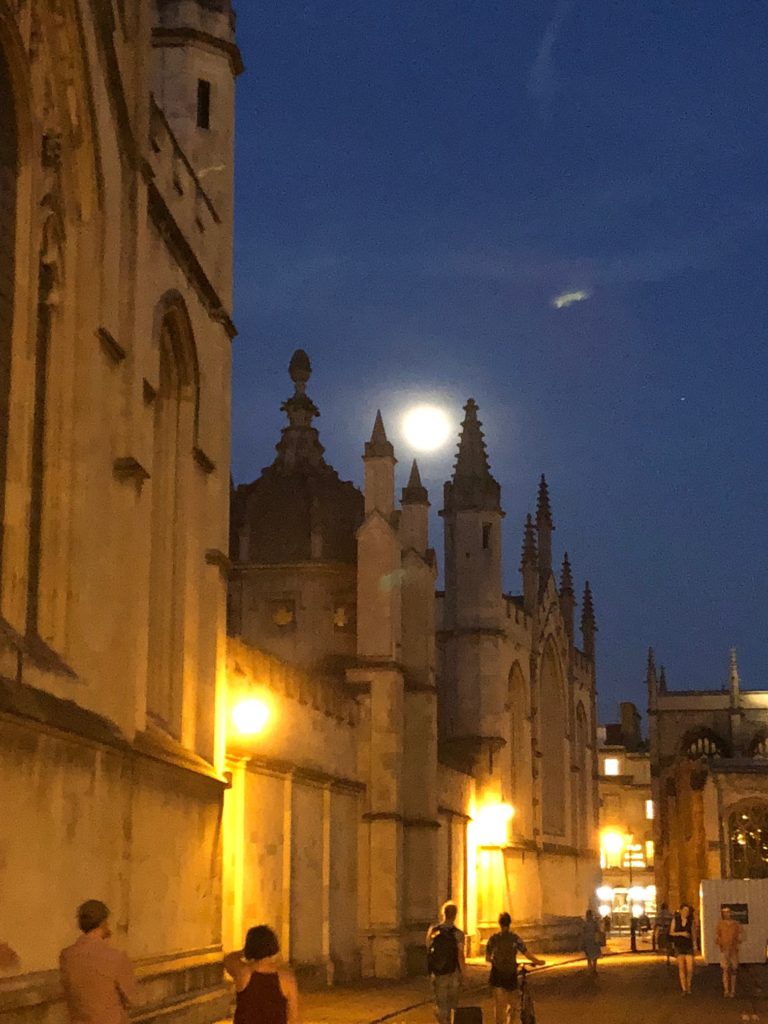
I'm not surprised that there are many supernatural sightings in Oxford. The city is amazingly romantic at night, when the day trippers have left and it is the haunt of students, Oxonians, the homeless . . . and hoards of teenaged foreign language students.


Merton College

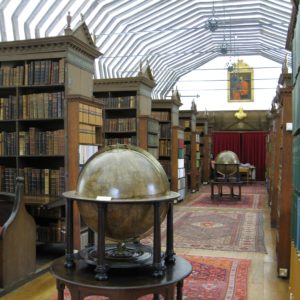
Lovely Merton College library (below) has the ghost of poor Colonel Francis Windebank, a Royalist who was executed by his own side in 1645, during the English Civil War.


It’s a sad story. Windebank was a young, newly married colonel in the Royalist army  and was appointed governor of Bletchingdon Park, near Oxford (below).  

In April 1645 he invited his young wife and friends for a ball at the house to raise their spirits (not the ghostly kind).  But a Parliamentarian spy may have been present, as during the ball the house came under attack by Cromwell’s forces. 

The house was well protected, and probably could have withstood the attack, but Windebank surrendered immediately. It is likely that he did so in order to protect the lives of his wife and friends.

Windebank went to explain to the King in Oxford (where the King had his headquarters), but his excuses were not accepted and he was tried by a Royalist court-martial for failing to protect Bletchingdon Park.

They took just three hours to find him guilty and sentence him to death by firing squad.

His execution took place against the length of town wall abutting Merton College. Windebank bared his chest to the muskets and exclaimed “God Save the King.”

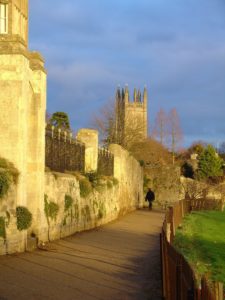
Windebank’s ghost haunts the site of his execution at Dead Man’s Walk, (above) which abuts Merton College, and has also been seen in the college library.

He’s a well known Oxford ghost, and is thought to haunt because of his lingering feeling of injustice at being executed for what he considered a chivalrous action.

It is also said that Colonel Windebank walks around on his knees. Rational thinkers (?) say that it is more likely that he is walking on the original (lower) ground level of the seventeenth century.


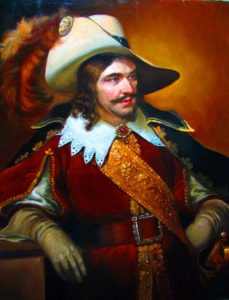
I couldn’t find a picture of poor Francis, but here’s a generic Royalist Cavalier, so if you’re wandering along Dead Man’s Walk, you’ll know what to look for.


Wadham College

In my husband's family Wadham is known as Wadham-Oh. His uncle was a student there in the '50s and when someone asked him what college he was a member of and he said "Wadham", the inevitable reply was, "Oh."

And yet Wadham is not a new college. It was founded in 1610 by Dorothy Wadham, in accordance with the terms of her late husband's will. She was the first woman not of the Royal family to found a college at Oxford.


The land she chose was originally the site of an Augustinian Priory. In those days its lovely gardens were a series of orchards and market gardens.
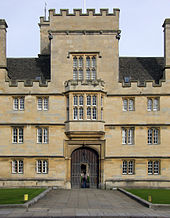
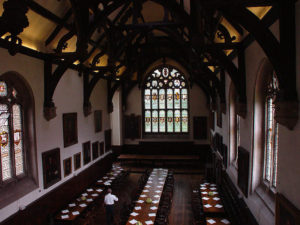
Perhaps this is why Wadham's well-known ghost is thought to be a priest. A white figure in robes walks from the chapel door (in the left-hand corner in this photo) across first quad and into the hall (in the right-hand corner, out of sight), and then across the hall to vanish just in front of High Table (below).

The ghost has been observed over the years by witnesses of veracity, including one head porter and two scouts. And the former Head-Steward, Mr Maurice Howes, would complain on a regular basis of hearing footsteps late at night from his office. They seemed to enter the hall, but never left it...
Augustinian Friar

  
I go to the College every year to see Shakespeare performed in the gardens. This year it was a lively production of Love's Labours Lost. In the interval I went from the garden, past the chapel door and into the first quad to visit the amenities, but I didn't see the resident ghost. 


New College Lane/Queen’s Lane


One of my favourite places at night in Oxford (and during the day) is the atmospheric New College Lane, which becomes Queen’s Lane once past New College. Down this winding lane the cavaliers rode on their way to do battle with Cromwell’s New Model Army.


Sometimes, they say, particularly on a windy autumn evening, you can hear the ghostly hoofbeats… 

And this is what was heard by an Australian tourist, as reported by the Oxford Mail in 2010:
http://www.oxfordmail.co.uk/news/8427740.Tourist_captures_spooky_image_on_camera/


Another tourist captured a ghostly image in that very lane (left). 

I have to admit to feeling a real sense of spookiness if I walk down that lane alone as dusk falls. The wind dances through the winding lane, picking up little sounds and magnifying them. It has a sense of timelessness that is compelling. 


St John’s College

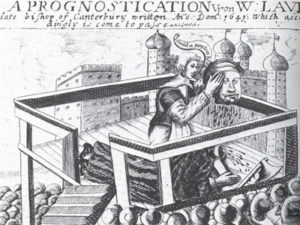
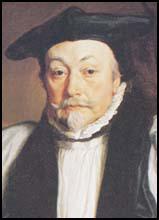
The distinguished College has a most distinguished ghost, Archbishop of Canterbury, William Laud, who was beheaded in 1645, after being impeached by the Long Parliament.

(The Long Parliament lasted from 1640 until 1660, and passed, among other acts, the first Habeas Corpus Act – which as a lawyer gets me quite excited, because a Writ of Habeas Corpus provides that the Crown must “certify the true cause” of imprisonment. It’s one of the fundamentals of English and Australian criminal law).

Here’s a particularly horrible depiction of Laud's execution:


Laud was educated at St Johns, and his bones are buried under the altar of the chapel.

His ghost has been known to disrupt students in St John’s College Library.

Some say he pulls his head from his neck and rolls it at people, others say he kicks it along the floor with a candle in his hand. Here’s the library where he plays football with his head.


Now those who read Harry Potter will recognise the similarity to Nearly Headless Nick. But Laud looks nothing like John Cleese. In fact, I don’t think the Archbishop looks like the ghostly sort, myself. I certainly don’t see him playing football with his head. (I’ve always seen him as an honourable man, on the wrong side of history.)


University College

The wonderfully named Obediah Walker (the ghost who walks – get it!) was the Catholic Master of University College in the seventeenth century.


He tried to follow James I into exile in France but was captured and imprisoned for ten years. When released he was a broken man and his ghost supposedly haunts Staircase VIII (where the Master’s residence used to be).


I could find no picture of Obediah, but here is Staircase VIII,
the place where Walker walks.


Christ Church College


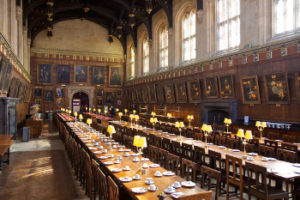
Oxford was a Royalist stronghold during the English Civil War. The King made the Christ Church College Deanery (below) his palace and held Parliament in its Great Hall (right).


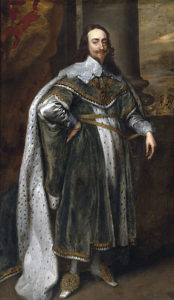
The spirit of King Charles I has been known to appear in the grounds of Christ Church College and in the Great Hall, sometimes with his head, sometimes without.


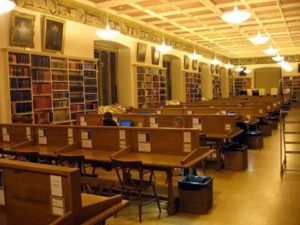
Apparently King Charles also appears in the Bodleian Library. While in Oxford, the King was denied leave to take books from the Bodleian in 1645. He has been seen at night running around in the upper reading room pulling books from the shelves reading one line and placing them back in an endless game of fortune telling, again sometimes with and sometimes without his head.


But that is not why I eschew the Upper Reading Room (above) and always do my study in the Lower Reading Room. I'd be quite chuffed to see a Royal ghost, actually...


Magpie Lane


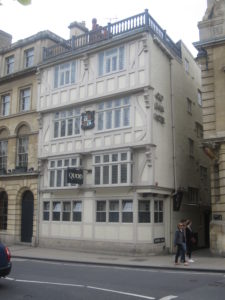
In the former bank that stands on the corner of Magpie Lane is now the Quad restaurant, and I had a lovely brunch there last Thursday.


Next door is the entrance to delightful Magpie Lane.

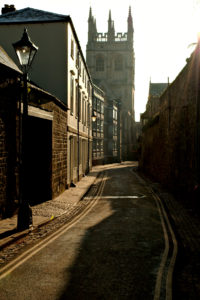
The lane leads to Merton Street and is reputedly haunted by the ghost of Prudence Bostock who died of a broken heart when her Cavalier lover ran away. She continues to roam the lane in the hope that he will return.

I've walked down this pretty little lane many times, and never has Dear Prudence come out to play (you have to be a Beatles fan to get that reference!!)