
How old were you when you were involved in the dig at Lullingstone?
I was 14 and 15 as it was in 1959 and 1960. I was born in 1944 and am 78 now.
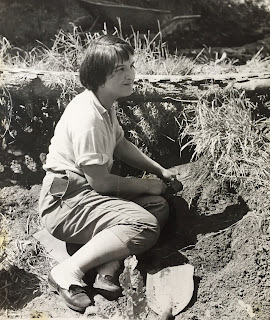
I love the photo of you on the dig!
Thank you. The story behind that is that the Daily Mail (I think) came down to do an article on the dig. I never actually saw the published article. After they had been and taken their photographs, Lieutenant-Colonel Meates, leader of the excavations at that time, gave me that photo so I assume it wasn't used in the article but they had distributed photographs that they had taken.

Absolutely. And how kind of them to realise that, at your age then, passing your O’ Levels was such a milestone for you and they wanted to mark that.
After O’ Levels I did A’ Levels in History, French and Latin. I then went to the University of Cardiff (which was then part of the University of Wales) to study History and Archaeology. In the first year we had to do three subjects so I did Latin but I very quickly gave up the Latin as it was beyond me! My Latin was never very good.
I am sure you are just being modest!
The funny thing was (my Latin mistress could not really get over this) that after I started digging at Lullingstone suddenly my Latin got an awful lot better. I am not sure I would have even passed my Latin had I not been on the dig, but suddenly I seemed to connect with Latin.
I love that you were inspired by Lullingstone and that you somehow channelled the Latin which you saw at the Villa. [Lullingstone Roman Villa boasts a beautiful mosaic which is accompanied by a Latin inscription – See earlier blog on Lullingstone .] I wonder if, even subconsciously, it spurred you on!


On the subject of gardens, do you recall if there was any sign of a garden at Lullingstone? Do you remember it being discussed?
No, not at all. Although it wasn’t something I was even thinking about at that stage, or I would have asked the question. It will mainly depend, of course, on the soil and whether you find evidence of holes where shrubs might have been or trenches dug. That could easily be destroyed by later ploughing, etc.
 I know they found various fruit tree pips and seeds in the kitchen area. I am sure there would have been some sort of garden but it is unlikely to have been quite as grand as Fishbourne!
As you know, it also depends on whether they are looking for it.
How lovely that a fellow digger, Frances, inspired you. It sounds like she was a great role model.
Definitely. She was always very good to me - I think she took me under her wing! Just like Mrs Rook did, which was rather nice. It’s been a lifelong friendship.

Frances was known as ‘Pixie’ on the dig and I asked her why and I think it was because she used to wear a hood and so that was what Mr Rook called her. She did a lot of sketches of us all while on the dig. Her sketchbook resurfaced in 2019 at the 70 year reunion of the diggers and she was really pleased to see it again.

Who else do you remember from the dig? For example, what was Lieutenant-Colonel Meates (‘Meates’) like?
I didn’t have a lot to do with him personally but of course he was around. My memory was that he was the sort of man who was quite polite to the women but might have told the boys what to do. He looked like a military man with his moustache and so on and his bearing. But I always got the impression that, although he wasn’t a trained archaeologist, he did the job well. I don’t know if there has ever been any criticism of him in his recording or his publishing. My impression at the time was that he knew what he was doing and he kept quite a well-run dig as far as I could tell. There was no messing about!
I think he lived in the Gatehouse at Lullingstone Castle at the time of the dig?
I think that is correct, just as Mr and Mrs Rook lived in some part of Lullingstone Castle too, although I don’t remember which part. I remember visiting them there with my Mum and Dad and I think it was a flat.
Mr and Mrs Rook were custodians of the site - how did that differ from what Meates was doing? Did they organise visits to the site, for example?
They were doing what the Ministry of Works did when they had a custodian on site – e.g. take the money from people coming in, give them some information about what was happening there and so on. I can’t remember when the Ministry of Works became involved but I do have a memory of Mr Rook wearing a uniform.

I read that you wrote to Meates and had a lovely reply from him. How did you first find about out him and the dig?
I went with Mum and Dad as a visitor as the dig was already happening. I probably spoke to Mr or Mrs Rook and asked if it was possible to join (I saw other young people there) and they probably said just write to Col Meates. I am sure that somewhere I have either a draft of my letter to him or his reply to me. At the moment I can’t find them but I am sure I will come across them again at some point!
I love the photos of Mr and Mrs Rook- and it is interesting how smartly everyone is dressed - quite different attire from a dig today! You also mentioned Jim and Hilda?
Jim used to smoke a pipe. He and Hilda were probably in their 40s.
Tony and Evelyn were the same sort of age as Frances who was about 5 years older than me. Evelyn was about 10 years older than him. I didn’t know them well but I remember them being there.


One of my personal favourites in the Villa is the wall-painting of the water nymphs. These are in a cult room (also known as the Deep Room) which was created c. AD 180, around the same time as the baths in the Villa and demonstrate the Villa owner’s reverence for water. The niche which housed the wall-painting was later covered up with plaster and could have escaped the excavators’ notice but, in a twist of fate, the site flooded mid-excavations and dislodged the plaster concealing the water nymphs. Do you remember anything about this?
I heard about that from Frances and, if I remember rightly, it was Mr Rook who discovered the water nymphs but I didn’t know the preamble to the discovery.

It was a fortuitous discovery and one which I think was rather magical, given it was a cult room to the water nymphs, and it was water that revealed them again. I think the Lullingstone owner would have loved that.
Yes, it was water ‘wot dunnit it’!
Have you been back to Lullingstone often since the dig?
Whenever we have had a holiday in Kent we have gone back – so a handful of times. The last time was in 2019 but, of course, we have had the pandemic since then. If we are in the area, I always want to go back and see it!
Does it look different? Does it bring all the memories back?
What is very different is that when we were digging there was no cover over it and when, many years ago that cover was put on, that was the biggest surprise and change that I had seen. When I was on the dig and we broke for lunchtime for our sandwiches, etc. we would sit at the top of the bank and you could look right down on the site so you could see all of it and then the river beyond it. Of course, you couldn’t do that now with the cover on but that was part of the magic of it – being there and being able to look down over the site and it was so beautiful to my mind – it was just something we did. I think it was just seeing the whole thing and just soaking it up – it was very atmospheric. I thought the cover was a brilliant thing to do because it preserved it. I also think it is a good exhibition inside – it gets the right balance between explaining to people who perhaps don’t know a lot about Roman archaeology but then also has panels which expand if you want a bit more information so it is well set out. It is a very good idea that it has been covered like that as that will preserve it and virtually the whole Villa is inside the cover.

Yes, it does almost feel like you are walking round someone’s home. With a bit of imagination, you feel like you are going round all the different rooms and I like the fact you can go upstairs to a first floor gallery and look down on the Villa.
Getting that view from above is very important to understand a place like that. We went to Vindolanda when we were at Hadrian’s Wall recently and I have been there before but to try and get a sense of the buildings when you are there and you are only on the same level as the foundations, I find incredibly difficult. Some buildings I could identify as a granary, etc. but on Countryfile recently they did a little bit on Vindolanda and they showed it from above, the aerial view, and then of course it makes so much more sense. You can see the road going into the fort and then its regular shape and the shapes of the buildings inside it but you don’t get that sense if you don’t see it from above.
I agree, and because a lot of the time it is just the foundations that are there, it makes it even harder, as you almost have to create a 3D image in your mind. You mentioned a granary, which reminds me to ask if you saw any of the Lullingstone granary when you were digging?
I don’t remember that - I wasn’t involved in that. I have seen that there was a granary from later reconstructions but I don’t remember the excavations of it.
If you had to choose your best memory of the whole experience, what would that be?
That’s a difficult one! I have no memory of any specific thing in terms of finding anything particular. I dug up some pottery but you can’t dig a Roman site and not turn up some pottery! I think what I remember was just that sense of being there and that connection – that was the main thing that I brought away, but it was my first dig so it reinforced the love that I have had of Roman archaeology ever since. I did excavations while at University – I was at Corbridge for a couple of weeks and for two years running I was on at the excavation at Winchester Cathedral on the Cathedral Green site with Martin Biddle. Then I was on an Iron Age dig at Oxford – we actually found an Iron Age skeleton which was very unusual, I believe. I was also involved with an Iron Age hillfort in Shropshire.
So Lullingstone was just the beginning!
That’s right – that was my real introduction so it has to be my favourite!
Which site in Roman Britain would be your second favourite?
That would have to be Fishbourne. We are Friends of Fishbourne Roman Palace and we do like going there very much, it is a great site.
This may sound like an odd question but one of the things I think about a lot at Lullingstone is who might have lived there. We don’t know for sure who lived there although we can speculate about the sort of person he or she was, whether the owner or inhabitant. Whoever that person (or family) was, someone did live there as their home and that is one of the things I love about the Villa most. Whenever I visit, I feel as if I am there as a guest, just like I might go to a friend’s house today, so there is an imaginary host there. Assuming that, if you could speak to that person what would you say to him/her?
That’s a very difficult question! It’s not one I have ever considered.
I wondered if you had imagined it as a 14 year old when you were there. It is something I think about a lot although I am not sure what I would say to them! I would have lots of questions for them, such as why they put the inscription on the mosaic and would just like them to talk to me about why they had done certain things.
Or perhaps you have some thoughts generally about the possible owner of the Villa?
It would be very interesting to know what sort of person was there. Obviously, they had enough depth of learning that they could put that inscription on that mosaic and also I am interested in the significance of the images on the mosaic. Presumably also the marble busts that they found in the Deep Room suggests that they were a bit more than your average family. Of course, we don’t know what the continuity of the family there was, or whether several families lived there. The fact that Christianity was introduced there is another factor again – does that represent a change of family? Or just a change of belief? There was also the temple-mausoleum at the top of the slope behind the Villa (which I was not involved in during the dig), although it is not visible to visitors today.

The skeleton of the man (but not the woman) who was discovered in the temple-mausoleum is on display in the Villa.
Were those people connected with the busts in the Deep Room? There are lots of questions it would be lovely to have the answers to about who lived there.
Wouldn’t it be brilliant to know who lived there! Although maybe that is also part of the appeal of the Villa: the mystery surrounding it.
I would also love to hear whoever lived at the Villa speaking Latin! Latin spoken by a Roman!
Absolutely! And did they pronounce their ‘v’ like a ‘v’ or a ‘w’?
Exactly! There has been so much written about that by people who think they know in subsequent centuries but nobody knows for sure, unless they have a recording.
There is something else that I have been trying to find an answer to in my research: whether the Villa owner/inhabitant actually composed the two lines of the inscription himself. There is a popular view that he did and I tend to subscribe to that, because we haven’t found those two lines anywhere else, they fit with the mosaic so he could have chosen the image and then written something specifically to accompany it. It is obviously someone who has had a Classical education, given the lines appear to have been inspired by Ovid and Virgil. It’s intriguing. I also love the way the lines are a bit wonky – they don’t look as if they have come from a pattern book, as the letters have been squashed in to fit. It’s amazing and the inscription still gets so much of coverage in academic papers and books, which is great.
.jpg)

It’s wonderful that you had such a lovely time, it’s given you a lifelong friendship with Frances, and it inspired you in your work. Lullingstone is hopefully going to be looked after forever so it is an amazing legacy that you have been part of it.
I hope so. It deserves it – it’s a great site.
It is amazing. A lot of school children still visit – they can dress up in Roman outfits and play Roman games, which always goes down a real treat!
Finally, is there anything we haven’t discussed that you would like to talk about?
I don’t think so. I am surprised how much we have discussed as I didn’t think our conversation would take very long! It has been nice talking about it, it has certainly made me think about it a lot more. I have very fond memories of my time there. I think it is also nice that the staff at Lullingstone value that as well – the fact they organised the reunion for the diggers in 2019 was a very nice tribute.
They definitely value what you all did. Part of what they are doing is carrying on looking after what you brought to light and discovered. Maybe there will be another reunion in 2024, which would be 75 years since the commencement of the excavations. That might be a good excuse to have a bit of a party at the Villa!
We’ll have to suggest it to them!
At the end of each season, Lieutenant-Colonel Meates used to host some sort of party. I don’t remember them at all, I would have been too young. Frances went to some of the parties but when it got to the stage where a bit too much drink was flowing, her parents collected her and took her home!
I was 14 and 15 as it was in 1959 and 1960. I was born in 1944 and am 78 now.
I love the photo of you on the dig!
Thank you. The story behind that is that the Daily Mail (I think) came down to do an article on the dig. I never actually saw the published article. After they had been and taken their photographs, Lieutenant-Colonel Meates, leader of the excavations at that time, gave me that photo so I assume it wasn't used in the article but they had distributed photographs that they had taken.

Anne excavating the well at Lullingstone Roman Villa in 1959, aged 14.
What I really like about it is that you have a pen and notebook in your pocket!
Yes I did, although I had forgotten that until you pointed it out! I have looked at that photograph a number of times. I am not sure what I was putting in the notebook, mind you!
You don’t happen still to have the notebook, do you?
Not that I know of, no. All I have dating from that time is my trowel. I used it on every subsequent dig that I went on. When I was accepted onto the Lullingstone dig, my Dad bought a trowel from a local ironmongers but it was too big so he had to cut it down for me to make it the right size for me to use on the dig. I know that I still have it somewhere!
Perhaps you should frame it! That’s a lovely story about your Dad. What did your parents make of your fascination with the dig? Were they interested in Roman things at all?
Absolutely. My Mum didn’t have any formal education over the age of about 14 but she was interested in lots of things and history was certainly one of them. I can’t remember a time when (well, we didn’t have a car when I was very little but, as soon as we were mobile) we weren’t going to places like Lullingstone. My Dad just went along with it! He did the driving and he was funny because he would go to these places and then pretend to do the guided tour afterwards - he was quite hilarious. But anyway, my Mum and Dad were totally happy about me being involved in the dig - otherwise they wouldn’t have kept taking me each week.
They must have been quite tickled because I think it is brilliant that you did it at that age. You have described the time you spent on the dig as a teenager as the ‘golden days’. My equivalent would be my teenage years spent at Greek summer school! But I would also have loved to have gone on a Roman dig! It is so hard to capture that feeling again.
Absolutely. It is part of being young. Your teenage years are quite formative in some ways (I don’t think you really know where you are going at that age) and so to go to Lullingstone and be involved was for me an amazing thing. For me it has always been that contact with original sources and, of course, in the end I went into archives (although that was partly because there weren’t at that time many jobs for archaeologists) and archivists were slightly better paid! The parallel is that if you are on a dig and handling artefacts, or handling documents as an archivist, you are in direct physical contact almost with those people who created either the artefacts or the documents and that means a very real connection with the past. That was very important to me.
Would you be able to tell me a bit about your career as an archivist and how it all started? You were doing your O’ Levels when you were involved with the dig.
Yes. I remember that when I passed my O’ Levels I was given a jewellery box as a well done present from Mr and Mrs Rook who were the custodians of the site at the time. I still have that jewellery box and I definitely know where that is as I take it every time we go on holiday. The Rooks were a lovely couple and I have strong memories of them - they were very nice, kind people and that’s what counts.
Yes I did, although I had forgotten that until you pointed it out! I have looked at that photograph a number of times. I am not sure what I was putting in the notebook, mind you!
You don’t happen still to have the notebook, do you?
Not that I know of, no. All I have dating from that time is my trowel. I used it on every subsequent dig that I went on. When I was accepted onto the Lullingstone dig, my Dad bought a trowel from a local ironmongers but it was too big so he had to cut it down for me to make it the right size for me to use on the dig. I know that I still have it somewhere!
Perhaps you should frame it! That’s a lovely story about your Dad. What did your parents make of your fascination with the dig? Were they interested in Roman things at all?
Absolutely. My Mum didn’t have any formal education over the age of about 14 but she was interested in lots of things and history was certainly one of them. I can’t remember a time when (well, we didn’t have a car when I was very little but, as soon as we were mobile) we weren’t going to places like Lullingstone. My Dad just went along with it! He did the driving and he was funny because he would go to these places and then pretend to do the guided tour afterwards - he was quite hilarious. But anyway, my Mum and Dad were totally happy about me being involved in the dig - otherwise they wouldn’t have kept taking me each week.
They must have been quite tickled because I think it is brilliant that you did it at that age. You have described the time you spent on the dig as a teenager as the ‘golden days’. My equivalent would be my teenage years spent at Greek summer school! But I would also have loved to have gone on a Roman dig! It is so hard to capture that feeling again.
Absolutely. It is part of being young. Your teenage years are quite formative in some ways (I don’t think you really know where you are going at that age) and so to go to Lullingstone and be involved was for me an amazing thing. For me it has always been that contact with original sources and, of course, in the end I went into archives (although that was partly because there weren’t at that time many jobs for archaeologists) and archivists were slightly better paid! The parallel is that if you are on a dig and handling artefacts, or handling documents as an archivist, you are in direct physical contact almost with those people who created either the artefacts or the documents and that means a very real connection with the past. That was very important to me.
Would you be able to tell me a bit about your career as an archivist and how it all started? You were doing your O’ Levels when you were involved with the dig.
Yes. I remember that when I passed my O’ Levels I was given a jewellery box as a well done present from Mr and Mrs Rook who were the custodians of the site at the time. I still have that jewellery box and I definitely know where that is as I take it every time we go on holiday. The Rooks were a lovely couple and I have strong memories of them - they were very nice, kind people and that’s what counts.
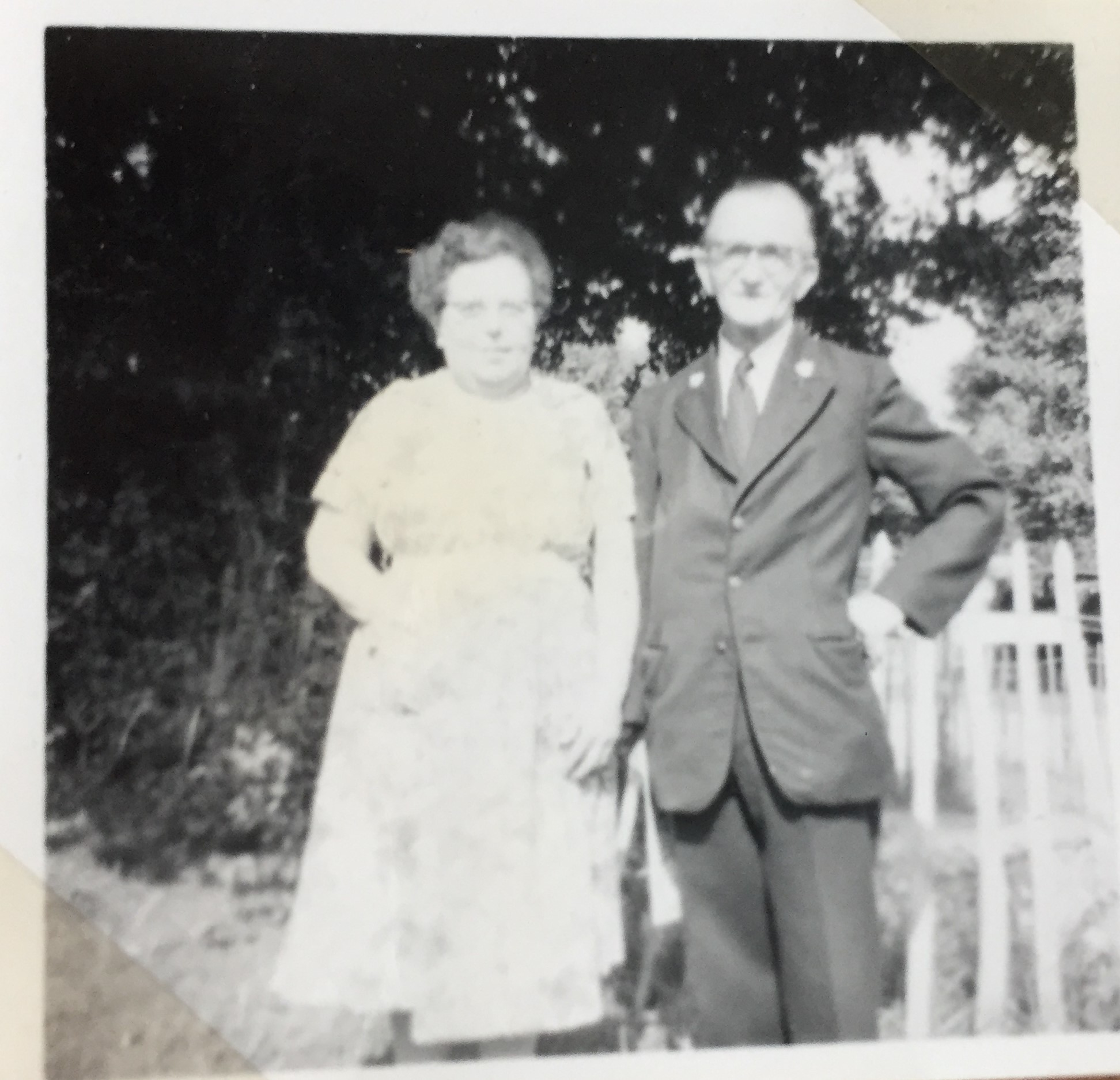
Mr and Mrs Rook, the first custodians of Lullingstone Roman Villa.
© Dr Anne Thick.
Absolutely. And how kind of them to realise that, at your age then, passing your O’ Levels was such a milestone for you and they wanted to mark that.
After O’ Levels I did A’ Levels in History, French and Latin. I then went to the University of Cardiff (which was then part of the University of Wales) to study History and Archaeology. In the first year we had to do three subjects so I did Latin but I very quickly gave up the Latin as it was beyond me! My Latin was never very good.
I am sure you are just being modest!
The funny thing was (my Latin mistress could not really get over this) that after I started digging at Lullingstone suddenly my Latin got an awful lot better. I am not sure I would have even passed my Latin had I not been on the dig, but suddenly I seemed to connect with Latin.
I love that you were inspired by Lullingstone and that you somehow channelled the Latin which you saw at the Villa. [Lullingstone Roman Villa boasts a beautiful mosaic which is accompanied by a Latin inscription – See earlier blog on Lullingstone .] I wonder if, even subconsciously, it spurred you on!

Europa mosaic, with Latin inscription (see further below). c. AD 330-60.
© Historic England Archive.
I think again it was that real connection because Latin was the language spoken by the people (or at least some of the people) who lived there.
At University after I gave up Latin I did Ancient History instead which is a lovely subject to do. In the second year I did Archaeology and History as I was studying for what was known as a ‘Mains degree’ and for that we focused on two subjects and I had already decided by then to go into archives.
I had met Frances Neale while on the dig and she was on the archive course at London University and she went on to a job at Bristol City Archives and so I had that at the back of my mind. Getting a job in archaeology was quite difficult in those days (mid 1960s) - there were slightly better prospects in archives. So I then did a diploma in archive administration at Liverpool University and got my first job at Berkshire Record Office in 1966, in Reading. I was there until 1971 by which time my husband and I had got married (in 1969) and then we went to get a job in Southampton and I got a temporary job in Hampshire Record Office. They created a job for me later which was very nice so I was an archivist there until the end of 1974. I then was away for 11 years when I had my children. I then had a short stint at Southampton archives then back to Hampshire Record Office in 1987. I was in post there until 2010 when I retired. So that is my career. But most of my work when I returned to the record office was business archives. It had a lot of interesting facets to it. It was the time in the 1990s when a lot of businesses were collapsing and so there was a lot of work to rescue archives in that period, talking to people whose situations had completely changed, due to privatisation and so on. It was very interesting to hear what people had to say about the situation.
So it was living history at that time, in a way.
Yes, almost. I started my PhD in 1994 - I was 50 when I started it - and I finished it in 1997. It was based on Southampton archives and medieval stewards’ accounts. The reason I started it sounds crazy! I did a university course in the history of science and technology - not that I am at all scientific or technological! It was just for interest.
That’s a good enough reason!
One of the things we had to do was a dissertation and mine was on whether Roman garden design had continued through to the medieval Roman period or if it had just been rediscovered. I had done some previous work using the medieval stewards’ accounts which were the financial records for the city and what it could tell me about the dockside cranes there. Southampton was a very important port in the fifteenth century - more important than London - mainly because it had trade coming in from the continent, especially Venetian ships. The two cranes there were town property used for unloading, and the stewards’ accounts record the expenditure of the town on repair and build. So I wondered what we could learn about their structure from references to repairs and rebuilding. There are very few cranes which survive from that period, none in this country at all. Germany has a few, the best known one being at Trier. The cranes in the end contributed a chapter to my thesis which was based on using the stewards’ accounts to say that Southampton contributed to its own success by managing its finances so well. Whereas the received thought is that Southampton just got jolly lucky. But they did things themselves like improving the financial system and maintaining and increasing their property so they could maximise income.
And you mentioned Roman gardens?
The book I used extensively on this topic was about the gardens of Pompeii by Wilhelmina Jashemski. The inspiration in this country came from Fishbourne Roman Palace because we have the plan of where the hedging had been planted and it was preserved in the ground there so they were able to replant where the hedges originally had been. There is some evidence of Roman gardens in this country but not very much.
At University after I gave up Latin I did Ancient History instead which is a lovely subject to do. In the second year I did Archaeology and History as I was studying for what was known as a ‘Mains degree’ and for that we focused on two subjects and I had already decided by then to go into archives.
I had met Frances Neale while on the dig and she was on the archive course at London University and she went on to a job at Bristol City Archives and so I had that at the back of my mind. Getting a job in archaeology was quite difficult in those days (mid 1960s) - there were slightly better prospects in archives. So I then did a diploma in archive administration at Liverpool University and got my first job at Berkshire Record Office in 1966, in Reading. I was there until 1971 by which time my husband and I had got married (in 1969) and then we went to get a job in Southampton and I got a temporary job in Hampshire Record Office. They created a job for me later which was very nice so I was an archivist there until the end of 1974. I then was away for 11 years when I had my children. I then had a short stint at Southampton archives then back to Hampshire Record Office in 1987. I was in post there until 2010 when I retired. So that is my career. But most of my work when I returned to the record office was business archives. It had a lot of interesting facets to it. It was the time in the 1990s when a lot of businesses were collapsing and so there was a lot of work to rescue archives in that period, talking to people whose situations had completely changed, due to privatisation and so on. It was very interesting to hear what people had to say about the situation.
So it was living history at that time, in a way.
Yes, almost. I started my PhD in 1994 - I was 50 when I started it - and I finished it in 1997. It was based on Southampton archives and medieval stewards’ accounts. The reason I started it sounds crazy! I did a university course in the history of science and technology - not that I am at all scientific or technological! It was just for interest.
That’s a good enough reason!
One of the things we had to do was a dissertation and mine was on whether Roman garden design had continued through to the medieval Roman period or if it had just been rediscovered. I had done some previous work using the medieval stewards’ accounts which were the financial records for the city and what it could tell me about the dockside cranes there. Southampton was a very important port in the fifteenth century - more important than London - mainly because it had trade coming in from the continent, especially Venetian ships. The two cranes there were town property used for unloading, and the stewards’ accounts record the expenditure of the town on repair and build. So I wondered what we could learn about their structure from references to repairs and rebuilding. There are very few cranes which survive from that period, none in this country at all. Germany has a few, the best known one being at Trier. The cranes in the end contributed a chapter to my thesis which was based on using the stewards’ accounts to say that Southampton contributed to its own success by managing its finances so well. Whereas the received thought is that Southampton just got jolly lucky. But they did things themselves like improving the financial system and maintaining and increasing their property so they could maximise income.
And you mentioned Roman gardens?
The book I used extensively on this topic was about the gardens of Pompeii by Wilhelmina Jashemski. The inspiration in this country came from Fishbourne Roman Palace because we have the plan of where the hedging had been planted and it was preserved in the ground there so they were able to replant where the hedges originally had been. There is some evidence of Roman gardens in this country but not very much.

Reconstruction drawing of Great Witcombe Roman Villa, with garden, in the fourth century AD (illustration by Ivan Lapper). © Historic England Archive.
On the subject of gardens, do you recall if there was any sign of a garden at Lullingstone? Do you remember it being discussed?
No, not at all. Although it wasn’t something I was even thinking about at that stage, or I would have asked the question. It will mainly depend, of course, on the soil and whether you find evidence of holes where shrubs might have been or trenches dug. That could easily be destroyed by later ploughing, etc.

Lullingstone Villa in its landscape, with imagined garden, in the later fourth century AD
(illustration by Peter Urmston). © Historic England Archive.
As you know, it also depends on whether they are looking for it.
How lovely that a fellow digger, Frances, inspired you. It sounds like she was a great role model.
Definitely. She was always very good to me - I think she took me under her wing! Just like Mrs Rook did, which was rather nice. It’s been a lifelong friendship.

Frances Neale, Anne's mentor and lifelong friend, on site at Lullingstone Roman Villa.
© Dr Anne Thick.
Frances was known as ‘Pixie’ on the dig and I asked her why and I think it was because she used to wear a hood and so that was what Mr Rook called her. She did a lot of sketches of us all while on the dig. Her sketchbook resurfaced in 2019 at the 70 year reunion of the diggers and she was really pleased to see it again.

Frances Neale's sketch of Anne busy at work during the excavations.
© Dr Anne Thick.
Who else do you remember from the dig? For example, what was Lieutenant-Colonel Meates (‘Meates’) like?
I didn’t have a lot to do with him personally but of course he was around. My memory was that he was the sort of man who was quite polite to the women but might have told the boys what to do. He looked like a military man with his moustache and so on and his bearing. But I always got the impression that, although he wasn’t a trained archaeologist, he did the job well. I don’t know if there has ever been any criticism of him in his recording or his publishing. My impression at the time was that he knew what he was doing and he kept quite a well-run dig as far as I could tell. There was no messing about!
I think he lived in the Gatehouse at Lullingstone Castle at the time of the dig?
I think that is correct, just as Mr and Mrs Rook lived in some part of Lullingstone Castle too, although I don’t remember which part. I remember visiting them there with my Mum and Dad and I think it was a flat.
Mr and Mrs Rook were custodians of the site - how did that differ from what Meates was doing? Did they organise visits to the site, for example?
They were doing what the Ministry of Works did when they had a custodian on site – e.g. take the money from people coming in, give them some information about what was happening there and so on. I can’t remember when the Ministry of Works became involved but I do have a memory of Mr Rook wearing a uniform.

Lullingstone Roman Villa during excavations, with viewing platform for visitors.
© Dr Anne Thick.
I read that you wrote to Meates and had a lovely reply from him. How did you first find about out him and the dig?
I went with Mum and Dad as a visitor as the dig was already happening. I probably spoke to Mr or Mrs Rook and asked if it was possible to join (I saw other young people there) and they probably said just write to Col Meates. I am sure that somewhere I have either a draft of my letter to him or his reply to me. At the moment I can’t find them but I am sure I will come across them again at some point!
I love the photos of Mr and Mrs Rook- and it is interesting how smartly everyone is dressed - quite different attire from a dig today! You also mentioned Jim and Hilda?
Jim used to smoke a pipe. He and Hilda were probably in their 40s.
Tony and Evelyn were the same sort of age as Frances who was about 5 years older than me. Evelyn was about 10 years older than him. I didn’t know them well but I remember them being there.

Lullingstone Roman Villa during excavations.
© Dr Anne Thick.
Were you supervised or just given a job to do?
I was just given a job to do. The one where the photo was taken was in the well, just starting it off in fact. I am sure someone came along and said what I should do but I don’t remember anyone in particular supervising me but that is not to say that someone wasn’t! I am sure they would not have just let me loose!
Perhaps they thought you were so efficient with your notepad and pen that you would be fine! I like your recollection of seeing Mrs Rook washing the mosaics and the mosaics coming alive.
Yes, as you know the site is on a slope, so we would be above and could look down and see her with her mop and the colours really came out brilliantly then. I don’t know if they would do that now but it worked at the time!
Apparently if you wet mosaics it’s a real trick to bringing the colours out.
Mrs Rook washed the mosaics periodically so that they looked nice for visitors - housework, if you like!
The mosaics are one of the things that many visitors get most excited about. As you may know, one of the four seasons is unfortunately missing. Do you remember that being discussed or when they uncovered the bit that was damaged?
That was all before my time.
I was just given a job to do. The one where the photo was taken was in the well, just starting it off in fact. I am sure someone came along and said what I should do but I don’t remember anyone in particular supervising me but that is not to say that someone wasn’t! I am sure they would not have just let me loose!
Perhaps they thought you were so efficient with your notepad and pen that you would be fine! I like your recollection of seeing Mrs Rook washing the mosaics and the mosaics coming alive.
Yes, as you know the site is on a slope, so we would be above and could look down and see her with her mop and the colours really came out brilliantly then. I don’t know if they would do that now but it worked at the time!
Apparently if you wet mosaics it’s a real trick to bringing the colours out.
Mrs Rook washed the mosaics periodically so that they looked nice for visitors - housework, if you like!
The mosaics are one of the things that many visitors get most excited about. As you may know, one of the four seasons is unfortunately missing. Do you remember that being discussed or when they uncovered the bit that was damaged?
That was all before my time.

Bellerophon on Pegasus, spearing the Chimaera, surrounded by the four seasons. c. AD 330-60.
© Historic England Archive.
I heard about that from Frances and, if I remember rightly, it was Mr Rook who discovered the water nymphs but I didn’t know the preamble to the discovery.

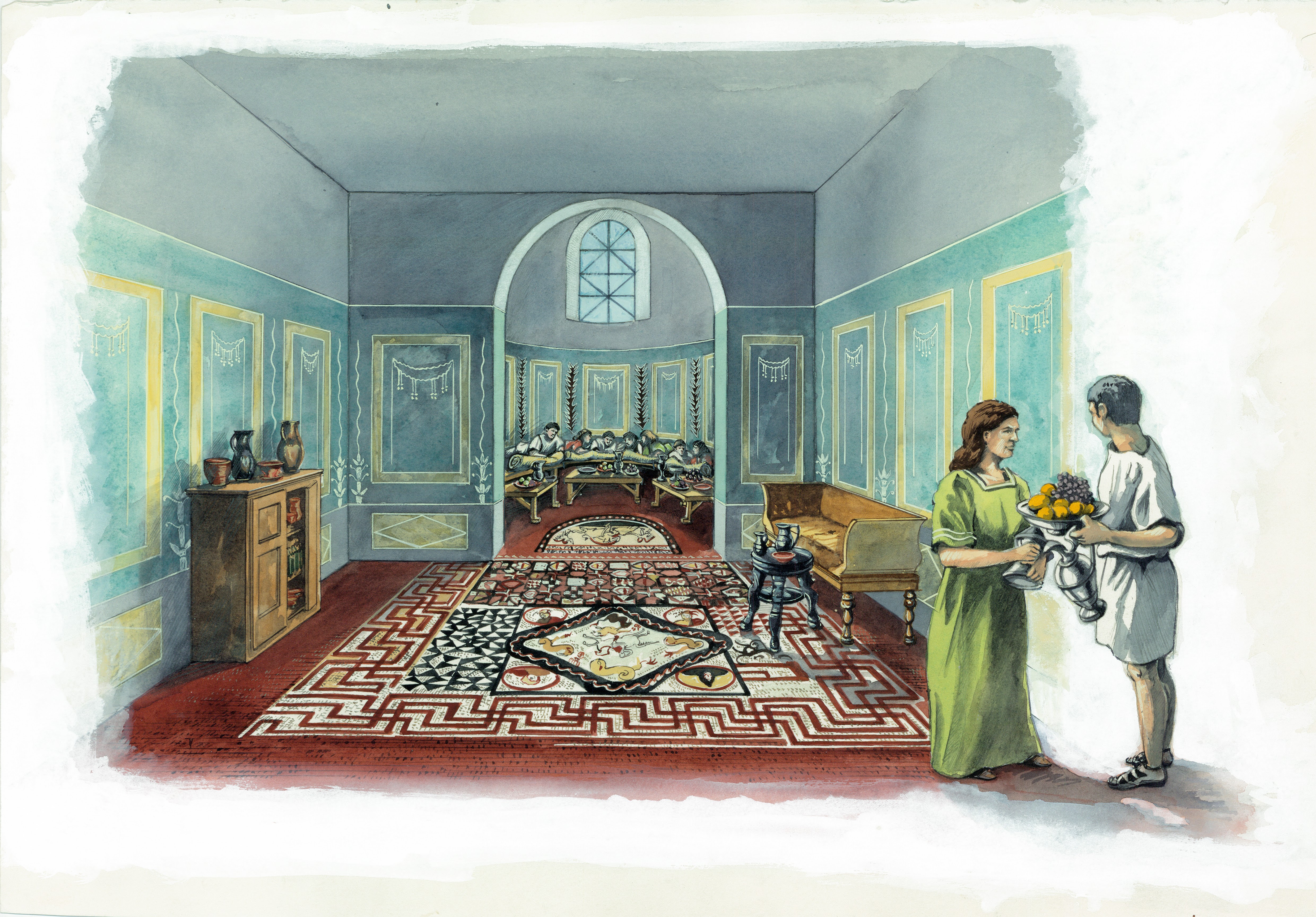
Reconstruction of ‘Deep Room’ shown at underground level, c. AD 380
(illustration by Peter Dunn/Richard Lea). © Historic England Archive.
Yes, it was water ‘wot dunnit it’!
Have you been back to Lullingstone often since the dig?
Whenever we have had a holiday in Kent we have gone back – so a handful of times. The last time was in 2019 but, of course, we have had the pandemic since then. If we are in the area, I always want to go back and see it!
Does it look different? Does it bring all the memories back?
What is very different is that when we were digging there was no cover over it and when, many years ago that cover was put on, that was the biggest surprise and change that I had seen. When I was on the dig and we broke for lunchtime for our sandwiches, etc. we would sit at the top of the bank and you could look right down on the site so you could see all of it and then the river beyond it. Of course, you couldn’t do that now with the cover on but that was part of the magic of it – being there and being able to look down over the site and it was so beautiful to my mind – it was just something we did. I think it was just seeing the whole thing and just soaking it up – it was very atmospheric. I thought the cover was a brilliant thing to do because it preserved it. I also think it is a good exhibition inside – it gets the right balance between explaining to people who perhaps don’t know a lot about Roman archaeology but then also has panels which expand if you want a bit more information so it is well set out. It is a very good idea that it has been covered like that as that will preserve it and virtually the whole Villa is inside the cover.

Lullingstone Roman Villa during excavations.
© Dr Anne Thick.
Yes, it does almost feel like you are walking round someone’s home. With a bit of imagination, you feel like you are going round all the different rooms and I like the fact you can go upstairs to a first floor gallery and look down on the Villa.
Getting that view from above is very important to understand a place like that. We went to Vindolanda when we were at Hadrian’s Wall recently and I have been there before but to try and get a sense of the buildings when you are there and you are only on the same level as the foundations, I find incredibly difficult. Some buildings I could identify as a granary, etc. but on Countryfile recently they did a little bit on Vindolanda and they showed it from above, the aerial view, and then of course it makes so much more sense. You can see the road going into the fort and then its regular shape and the shapes of the buildings inside it but you don’t get that sense if you don’t see it from above.
I agree, and because a lot of the time it is just the foundations that are there, it makes it even harder, as you almost have to create a 3D image in your mind. You mentioned a granary, which reminds me to ask if you saw any of the Lullingstone granary when you were digging?
I don’t remember that - I wasn’t involved in that. I have seen that there was a granary from later reconstructions but I don’t remember the excavations of it.
If you had to choose your best memory of the whole experience, what would that be?
That’s a difficult one! I have no memory of any specific thing in terms of finding anything particular. I dug up some pottery but you can’t dig a Roman site and not turn up some pottery! I think what I remember was just that sense of being there and that connection – that was the main thing that I brought away, but it was my first dig so it reinforced the love that I have had of Roman archaeology ever since. I did excavations while at University – I was at Corbridge for a couple of weeks and for two years running I was on at the excavation at Winchester Cathedral on the Cathedral Green site with Martin Biddle. Then I was on an Iron Age dig at Oxford – we actually found an Iron Age skeleton which was very unusual, I believe. I was also involved with an Iron Age hillfort in Shropshire.
So Lullingstone was just the beginning!
That’s right – that was my real introduction so it has to be my favourite!
Which site in Roman Britain would be your second favourite?
That would have to be Fishbourne. We are Friends of Fishbourne Roman Palace and we do like going there very much, it is a great site.
This may sound like an odd question but one of the things I think about a lot at Lullingstone is who might have lived there. We don’t know for sure who lived there although we can speculate about the sort of person he or she was, whether the owner or inhabitant. Whoever that person (or family) was, someone did live there as their home and that is one of the things I love about the Villa most. Whenever I visit, I feel as if I am there as a guest, just like I might go to a friend’s house today, so there is an imaginary host there. Assuming that, if you could speak to that person what would you say to him/her?
That’s a very difficult question! It’s not one I have ever considered.
I wondered if you had imagined it as a 14 year old when you were there. It is something I think about a lot although I am not sure what I would say to them! I would have lots of questions for them, such as why they put the inscription on the mosaic and would just like them to talk to me about why they had done certain things.
Or perhaps you have some thoughts generally about the possible owner of the Villa?
It would be very interesting to know what sort of person was there. Obviously, they had enough depth of learning that they could put that inscription on that mosaic and also I am interested in the significance of the images on the mosaic. Presumably also the marble busts that they found in the Deep Room suggests that they were a bit more than your average family. Of course, we don’t know what the continuity of the family there was, or whether several families lived there. The fact that Christianity was introduced there is another factor again – does that represent a change of family? Or just a change of belief? There was also the temple-mausoleum at the top of the slope behind the Villa (which I was not involved in during the dig), although it is not visible to visitors today.

Lullingstone Villa with temple-mausoleum behind, in the late third century AD
(illustration by Peter Urmston). © Historic England Archive
The skeleton of the man (but not the woman) who was discovered in the temple-mausoleum is on display in the Villa.
Were those people connected with the busts in the Deep Room? There are lots of questions it would be lovely to have the answers to about who lived there.
Wouldn’t it be brilliant to know who lived there! Although maybe that is also part of the appeal of the Villa: the mystery surrounding it.
I would also love to hear whoever lived at the Villa speaking Latin! Latin spoken by a Roman!
Absolutely! And did they pronounce their ‘v’ like a ‘v’ or a ‘w’?
Exactly! There has been so much written about that by people who think they know in subsequent centuries but nobody knows for sure, unless they have a recording.
There is something else that I have been trying to find an answer to in my research: whether the Villa owner/inhabitant actually composed the two lines of the inscription himself. There is a popular view that he did and I tend to subscribe to that, because we haven’t found those two lines anywhere else, they fit with the mosaic so he could have chosen the image and then written something specifically to accompany it. It is obviously someone who has had a Classical education, given the lines appear to have been inspired by Ovid and Virgil. It’s intriguing. I also love the way the lines are a bit wonky – they don’t look as if they have come from a pattern book, as the letters have been squashed in to fit. It’s amazing and the inscription still gets so much of coverage in academic papers and books, which is great.
.jpg)
Europa mosaic (detail of inscription). c. AD 330-60. © Historic England Archive.
We are also lucky that the mosaicist was literate or careful enough that when he put in the inscription he got it right as there are examples where the mosaicist didn’t have the skill to put down what he was given to do and has got it quite wrong.
Quite. In some ways it is probably best that it is that part of the mosaic that was undamaged. It is, of course, a shame that we lost one of the four seasons but we can quite easily imagine what would have been there whereas who could have guessed the inscription? I am so intrigued by the whole site and I am always dabbling a bit and updating my research into it so it has been fascinating to hear first-hand a bit more about the dig and I am really grateful to you. I also wanted to say thank you for taking part in the dig because, although you said you didn’t find anything specific, you excavated part of the Well, and you contributed in so many other ways too. For people like me researching the site, we couldn’t have done any of that if it wasn’t for you and all the volunteers and your hard work all those years ago so I think you are all owed a huge thank you.
Well, it was fun! I wouldn’t have done it if it hadn’t been fun!
Quite. In some ways it is probably best that it is that part of the mosaic that was undamaged. It is, of course, a shame that we lost one of the four seasons but we can quite easily imagine what would have been there whereas who could have guessed the inscription? I am so intrigued by the whole site and I am always dabbling a bit and updating my research into it so it has been fascinating to hear first-hand a bit more about the dig and I am really grateful to you. I also wanted to say thank you for taking part in the dig because, although you said you didn’t find anything specific, you excavated part of the Well, and you contributed in so many other ways too. For people like me researching the site, we couldn’t have done any of that if it wasn’t for you and all the volunteers and your hard work all those years ago so I think you are all owed a huge thank you.
Well, it was fun! I wouldn’t have done it if it hadn’t been fun!

Illustration of the baths, including the well (far left) which Anne excavated, at Lullingstone Roman Villa, Kent as they may have appeared in the late third century AD. (Illustration by Peter Dunn/Richard Lea.) © Historic England Archive.
I hope so. It deserves it – it’s a great site.
It is amazing. A lot of school children still visit – they can dress up in Roman outfits and play Roman games, which always goes down a real treat!
Finally, is there anything we haven’t discussed that you would like to talk about?
I don’t think so. I am surprised how much we have discussed as I didn’t think our conversation would take very long! It has been nice talking about it, it has certainly made me think about it a lot more. I have very fond memories of my time there. I think it is also nice that the staff at Lullingstone value that as well – the fact they organised the reunion for the diggers in 2019 was a very nice tribute.
They definitely value what you all did. Part of what they are doing is carrying on looking after what you brought to light and discovered. Maybe there will be another reunion in 2024, which would be 75 years since the commencement of the excavations. That might be a good excuse to have a bit of a party at the Villa!
We’ll have to suggest it to them!
At the end of each season, Lieutenant-Colonel Meates used to host some sort of party. I don’t remember them at all, I would have been too young. Frances went to some of the parties but when it got to the stage where a bit too much drink was flowing, her parents collected her and took her home!

Thank you to Dr Anne Thick for kindly giving the interview to the History Girls and for permission to use her photographs of the dig. Thank you also to Mr Gordon Thick, and to Emma Freeman, Site Manager at Lullingstone Roman Villa.
Thank you to Historic England Archive for permission to use the images of Lullingstone Roman Villa.
 @carolinetutor
Website: www.carolinetutor.co.uk
LinkedIn: Caroline K. Mackenzie
Thank you to Historic England Archive for permission to use the images of Lullingstone Roman Villa.
 @carolinetutor
Website: www.carolinetutor.co.uk
LinkedIn: Caroline K. Mackenzie



.jpg)
.jpg)


