Showing posts with label Classics Club. Show all posts

Friday, 13 March 2026

‘It’s all Greek to me’: the story behind my Pocket GCSE Greek Etymological Lexicon by Caroline K. Mackenzie


I have just completed a little book with a rather long title, Pocket GCSE Greek Etymological Lexicon. It is being published by Bloomsbury Academic and is sister to the Pocket GCSE Latin Etymological Lexicon which I wrote in 2022. It seems like yesterday that I wrote a History Girls’ Blog on the Latin Lexicon: tempus fugit.

Both books were written with GCSE students in mind but their purpose is just as much to showcase the beauty and ubiquity of these ancient languages, so the lexicons may also appeal to logophiles (‘logos’ meaning ‘word’ and ‘phileo’ ‘I love’). The GCSE vocabulary lists provide a finite list of words to work on: 450 in Latin and 409 in Greek, which was just right for this project.

To accompany the words we wanted to include illustrations and I am very fortunate that one of the members of my Classics Club, now a good friend, is a local artist, Barbarann Lang. Barbarann has exhibited work at many galleries including the Royal Academy and I had seen first-hand her beautiful paintings. So I was delighted when Barbarann agreed to create 20 illustrations for the lexicon. As Barbarann began, she became so inspired by the Greek that 20 illustrations increased to 32 and, thanks to the skill and vision of Bloomsbury and our typesetters, RefineCatch, all 32 are included in the lexicon. The illustrations really bring the Greek words to life and it seems fitting to unveil a few of them here. Hand-delivering Barbarann’s beautiful book of illustrations to the Bloomsbury offices was one of the most important and enjoyable tasks in producing the lexicon.

Bloomsbury’s London office © Caroline K. Mackenzie
Barbarann’s book of illustrations is on the table, hidden in the ‘Classics Club’ bag, the design for which is also one of Barbarann’s creations

Christopher Nolan’s much-anticipated film of the Odyssey is being released in July this year. I am not sure if the characters will be speaking any Greek but the film may inspire some audiences to read Homer’s Odyssey either in translation or even the original Greek. Homer’s Iliad was behind the 2001 film Troy in which the character of Achilles was played by Brad Pitt and it was that character who inspired Barbarann’s illustration for ‘soldier’.

'stratiotes’ (soldier) illustration © Barbarann Lang
‘strategos’ (general or commander) gives us the word strategy

Greek derivatives give us the names of many subjects on the school curriculum, e.g. biology from ‘bios’ (life) and ‘logos’ (study, story, account), geography from ‘ge’ (earth) and ‘grapho’ (I write), mathematics from ‘math-‘ (the past tense of the verb meaning I learn). The letter ‘π’ has an important role in school Maths lessons. You may also recognise the Greek letter ‘μ’ (mu) to indicate ‘microgram’, or ‘μg’, which appears on cereal packets, prescriptions and vitamin bottles.

During the recent pandemic (meaning affecting ‘all people’), the Greek alphabet was used by the World Heath Organisation (‘WHO’) to label key variants of the virus that causes COVID-19. WHO issued a press release explaining that it had ‘assigned simple, easy to say and remember labels… using letters of the Greek alphabet’ because ‘scientific names can be difficult to say and recall, and are prone to misreporting.’  [Ref. below.]

On the subject of the alphabet, please don’t let that deter you from dipping into some Greek! (The word ‘alphabet’ itself derives from the names of the first two letters in the Greek alphabet, ‘alpha’ and ‘beta’.) In the introduction to the lexicon, the Greek alphabet is set out in full (24 letters) together with the English equivalents and a pronunciation guide. It is easier to learn the Greek alphabet than you may think and is, indeed, a very satisfying exercise. As Cicero reminds us in his book How to Grow Old our mind is a muscle that must be exercised as we get older and Cicero’s protagonist declares that he is teaching himself Greek in his old age. A good alternative to Sudoku, perhaps? In this blog, I have transliterated the Greek and I leave you to try the alphabet challenge another day.

‘geron’ (old man) illustration © Barbarann Lang
‘geron’ combined with ‘iatros’ (doctor) gives us the word ‘geriatric’
Cicero recommends learning Greek to keep one’s mind healthy in old age

You will know the word ‘aristocracy’, which derives from ‘aristos’ (best, very good) and ‘cratos’ (rule) but lesser-known is the word ‘kakistocracy’. ‘kakistos’ means ‘worst’ or ‘very bad’ and therefore a kakistocracy is a ‘government by the least suitable or competent citizens of a state’ (definition from Oxford Languages English Dictionary on Google).

Writers may enjoy some of the literary terms derived from Greek such as ‘oxymoron’, a figure of speech by means of which contradictory terms are juxtaposed, for various effects, e.g. ‘bitter-sweet’ (Sappho, Fragment 130). (Thank you to Kevin in Classics Club for this excellent example!) In Greek ‘oxymoron’ means ‘clever-stupid’ or ‘sharp-blunt’ and is an oxymoron itself. The term ‘hyperbole’ derives from ‘hyper’ (beyond, exceeding) and ‘bol’ from ‘ballo’ (I throw or fire at) – a great origin for a word meaning excessive exaggeration. It was thanks to one particular writer that I had a suggestion for the first Greek word in the lexicon, ‘agathos’ (good). I had asked one of my tutees, named Sophie (Greek for ‘wisdom’), to help me think of a derivative and, after careful thought, she replied ‘Agatha Christie’s books are really good’.

Writers may worry that they suffer from ‘cacoethes scribendi’, an uncontrollable desire for writing or getting one’s work into print, literally ‘a bad habit for writing’. The ‘scribendi’ derives from the Latin verb ‘scribo’ (I write). Politicians are perhaps afflicted with ‘cacoethes loquendi’, an uncontrollable desire for talking, especially for giving speeches, literally ‘a bad habit for speaking’. The ‘loquendi’ derives from the Latin verb ‘loquor’ (I speak). To complete this tricolon of bad habits I came across a phrase, ‘ego-surfing’, which means searching for one’s own name on the Internet (‘ego’ meaning ‘I’ in both Latin and Greek.)

I was also delighted to discover the phrase ‘chronique scandaleuse’: a story or gossip full of scandal, or unsavoury ‘tittle-tattle’, deriving in part from the Greek word for time, ‘chronos’ (hence chronology, anachronism, synchronise, etc). This pairs nicely with a new word I learned for the Latin Lexicon: ‘quidnunc’. It refers to an inquisitive, gossiping person - the Latin literally means ‘what now?’.

Gardeners often mention the ubiquity of Latin in horticulture and Greek also plays a part here: an aspidistra is an evergreen plant with shield-like long, tough leaves, ‘aspis’ being the Greek for ‘shield’. Rhododendron derives from ‘rhodon’ (rose) and ‘dendron’ (tree). ‘Hippeastrum’ is the name of a group of plants, including the Amaryllis. It is possible that the name was given due to the flowers resembling a horse’s head, as ‘hippos’ means ‘horse’. ‘Hippos’ also gives us a derivative which is a firm favourite among my tutees: hippopotamus, literally a horse of the river (‘potamos’).

‘hippos’ (horse) illustration © Barbarann Lang
‘hippos’ gives us words such as ‘hippodrome’ and ‘hippopotamus’

‘potamos’ (river) illustration © Barbarann Lang
‘potamos’ gives us words such as ‘hippopotamus’ (horse of the river)

A favourite derivative of my own is ‘cryptozoology’: the study of and search for (potentially mythical) creatures, such as the Loch Ness monster. The Greek words are ‘crypto’ (I hide) ‘zoon’ (creature) and ‘logos’ (study). I was also delighted to discover that ‘theobroma’ is the name of a group of flowering plants including the cocoa tree, ‘theobroma cacao’, the beans of which are used to make chocolate. Theobroma means ‘food of the gods’ – no wonder chocolate tastes so good.

On the subject of food, I wonder if you or any of your friends are a ‘deipnosophist’: someone whose dinner-table conversation is erudite. The term derives from Deipnosophistai, the title of a work by Athenaeus (c. AD 200) and is a combination of ‘deipnon’ (dinner) and ‘sophos’ (wise).

‘deipnon’ (dinner) illustration © Barbarann Lang
A ‘deipnosophist’ is someone whose dinner-table conversation is erudite (‘sophos’ means ‘wise’)

Medicine abounds with Greek terminology. Anything ending in ‘iatric’ signifies medical care or treatment such as ‘geriatric’ (see above) and ‘paediatric’ from ‘pais’ (child). I enjoyed learning this fun fact: the ‘pylorus’ is the opening, or gateway, from the stomach to the intestines, from ‘pyle’ (gate). The condition of having a ‘phobia’ is from the Greek word meaning fear, giving us xenophobe from ‘xenos’ (foreigner), arachnophobia from ‘arachne’ (spider) and triskaidekaphobia, literally fear of three plus ten, i.e. thirteen. Anatomy can be useful when studying Greek and Roman sculpture, too: one of the most famous statues of Aphrodite (Roman name, Venus) is titled ‘callipygian’ meaning ‘with beautiful buttocks’. 

You may have been watching the Winter Olympics and Paralympics recently. Not only did the Olympic games themselves originate in Greece but the word ‘Paralympics’ owes its name to the Greek language, ‘para’ meaning ‘beside’ or ‘parallel to’. In these games athletes, from ‘athlos’ (prize) often put themselves through agony, from ‘agon’ (contest or trial), to be the best.

The final proofs for the lexicon have arrived for checking and, as I scanned the pages, one particular entry struck me as rather autobiographical (‘autos’, self, ‘bios’, life, ‘grapho’, I write), and I wondered if my subconscious had directed my choice of derivatives…:

phil or -phile (suffix meaning ‘lover of’ or ‘loving’) bibliophile (book-lover), Hellenophile (Greek-lover), linguaphile (language-lover), logophile (word-lover), oenophile (wine-lover)

It is perhaps therefore appropriate that the cover image depicts the interior of a ‘kylix’ (drinking bowl) which would have been used at a ‘symposium’, or drinking party. When the lexicon is published I shall definitely be toasting it with a glass of Bacchus, a locally grown wine named after the Greek and Roman god of drinking, theatre and parties. ‘Cheers!’


Pocket GCSE Greek Etymological Lexicon by Caroline K. Mackenzie is available for pre-order: https://www.bloomsbury.com/uk/pocket-gcse-greek-etymological-lexicon-9781350572119/
Publication date: 9th July 2026 Ebook and 6th August 2026 Paperback.

With many thanks to everyone at Classical Studies Bloomsbury, especially Alice Wright, Lucy Batrouney, Lucy Springett, Sophie Beardsworth and Sarah Ruddock; to Merv Honeywood and his team at RefineCatch; and to Barbarann Lang.

Thank you also to Caroline Lawrence, Dr John Taylor, Dr Margaret Mountford and Dr Daisy Dunn.

www.carolinetutor.co.uk

Ref: https://www.who.int/news/item/31-05-2021-who-announces-simple-easy-to-say-labels-for-sars-cov-2-variants-of-interest-and-concern.


Friday, 14 March 2025

A taste of Homer, Virgil and Ovid by Caroline K. Mackenzie

Five years ago, almost to the day, in March 2020, the pandemic had taken hold and daily life as we knew it was turned upside down. Everyone scrambled to find ways of keeping in touch, since meeting up in person was out of the question, and plans that had been made had to be abandoned. And so my Classics Club, newly formed and a weekly event in the picturesque Pavilion of Burwash Common migrated to Zoom instead. We had no idea how long the restrictions, or our reading material, would last so agreed simply to continue meeting for as long as everyone wished.

One of our members recently mentioned that we are about to celebrate our fifth birthday – tempus fugit, as Virgil observed. When Classics Club was just one year old, I wrote a History Girls' blog about its origins. Now, five years in, seems a good time to reflect on the works we have read and to share some of the highlights.

It is almost impossible to pick the ‘best bits’, as each week we have read something that resonates, entertains, surprises or even comforts us. Therefore, I decided to flick through my well-worn copies of each of the books and to stop where I noticed the most scribbles in the margin, or perhaps highlighted sections of the text, and have chosen from those pages a selection of passages which I hope you will enjoy. If you are new to Homer, Virgil and Ovid, this may give you a flavour of the style and subject matter of these wonderful poets and, I hope, tempt you to read more.

All quotations are taken from the Penguin Classics series, the cover images of which I have included for each work. I have chosen this set of translations as they were the first versions of these poems which I read and have therefore been on my bookshelves for as long as I have been studying and teaching Classics. But the variations between translations and the difficulty of choosing just one for each Greek or Latin work was the topic of a History Girls’ blog I wrote last year.

As these passages are simply a taster, I have not attempted to summarise the stories of the epics or provide a detailed background. Some of the themes, such as the Trojan War, or characters from Greek mythology, such as the Cyclops, may be familiar in any event. However, for each one I have noted whether the original poem was Greek or Latin and the approximate date when the poem was composed and/or completed. The dates for Homer’s epics are approximate and the source of much academic debate.

Homer’s Iliad - Greek - around 750BC


Homer’s characters often utter observations which have a distinctly proverbial flavour, such as this musing by one of the warriors on the battlefield outside Troy:

The generation of men is just like that of leaves. The wind scatters one year’s leaves on the ground, but the forest burgeons and puts out others, as the season of spring comes round. So it is with men: one generation grows on, and another is passing away. (Book 6: 146-9.)

Or this:

…whatever we do, the fates of death stand over us in a thousand forms, and no mortal can run from them or escape them…
(Book 12: 326-7.)

Homer is also known for his vivid and striking similes. The Trojan prince, Paris, whose love affair with Helen was the cause of the Trojan war, is cleverly captured with this simile:

Paris did not dally long in his high house, but once he had put on his glorious armour of intricate bronze, he dashed through the city, sure of the speed of his legs. As when some stalled horse who has fed full at the manger breaks his halter and gallops thudding across the plain, eager for his usual bathe in the lovely flow of a river, and glorying as he runs. He holds his head high, and the mane streams back along his shoulders: sure of his own magnificence, his legs carry him lightly to the haunts where the mares are at pasture. So Paris, son of Priam, came down from the height of Pergamos, bright in his armour like the beaming sun, and laughing as he came, his quick legs carrying him on. (Book 6: 503-14.)

Similes are also used to heighten the pathos of a scene. Note here the reference to Menelaos, the Spartan king and husband of Helen, now in the thick of the Trojan war and trying to reclaim his wife from Paris:

As when a woman stains ivory with crimson dye, in Maionia or Caria, making a cheek-piece for horses. It lies there in her room, and many horsemen yearn to have it for the wearing: but it waits there to be a treasure for a king, both horse’s finery and rider’s glory. Such, Menelaos was the staining with blood of your sturdy thighs, and your legs, and your fine ankles below. (Book 4: 141-7.)

A simile is used to great effect to describe the leader of the Greeks, and brother of Menelaos, Agamemnon:

Agamemnon rose to speak, letting his tears fall like a spring of black water which trickles its dark stream down a sheer rock’s face.
(Book 9: 13-15.)

Words, so important in Homer’s oral tradition, are often likened to nature:

But when he released that great voice from his chest and the words which flocked down like snowflakes in winter, no other mortal man could then rival Odysseus
. (Book 3: 221-3.)

Nestor the sweet-spoken, … from his tongue the words flowed sweeter than honey.
(Book 1: 247-9.)

Homer’s Odyssey - Greek - around 725BC


Odysseus returns home to Ithaca after twenty years of absence: 10 years at the Trojan war and 10 years making his tumultuous journey home. He is disguised but his faithful dog recognises him:

As they stood talking, a dog lying there lifted his head and pricked up his ears. Argus was his name. Patient Odysseus himself had owned and bred him, though he had sailed for holy Ilium [Troy] before he could reap the benefit… in his owner’s absence, he lay abandoned on the heaps of dung from the mules and cattle which lay in profusion at the gate…. But directly he became aware of Odysseus’ presence, he wagged his tail and dropped his ears, though he lacked the strength now to come nearer his master. Odysseus turned his eyes away, and, making sure Eumaeus did not notice, brushed away a tear….. As for Argus, the black hand of Death descended on him the moment he caught sight of Odysseus – after twenty years. (Book 17: 291-305… 326-7.)

Odysseus is cunning, crafty and has a way with words. The word-play in the following episode is one of his more famous tricks. The Cyclops has just eaten alive some of Odysseus’ companions and washes them down with wine. Odysseus is narrating the story:

The Cyclops took the wine and drank it up. And the delicious drink gave him such exquisite pleasure that he asked me for another bowlful. “Give me more, please, and tell me your name, here and now – I would like to make you a gift that will please you. We Cyclopes have wine of our own made from the grapes that our rich soil and rains from Zeus produce. But this vintage of yours is a drop of the real nectar and ambrosia.”…

“Cyclops,” I said, “you ask me my name. I’ll tell it to you; and in return give me the gift you promised me. My name is Nobody.”…

The Cyclops answered me from his cruel heart. “Of all his company I will eat Nobody last, and the rest before him. That shall be your gift.” He had hardly spoken before he toppled over and fell face upwards on the floor, where he lay with his great neck twisted to one side, and all-compelling sleep overpowered him. In his drunken stupor he vomited, and a stream of wine mixed with morsels of men’s flesh poured from his throat.
(Book 9: 353-9… 364-74.)

Odysseus and his men seize the opportunity and drive a sharpened olive stake, heated in fire, into the Cyclops’ single eye, blinding him. He shrieks and calls for help from his fellow Cyclopes who gather outside his cave and ask what is wrong and whether somebody is trying to kill him. The conversation that follows goes like this:

“O my friends, it's Nobody’s treachery… that is doing me to death.”
“Well then," came the immediate reply, "if you are alone and nobody is assaulting you, you must be sick… and cannot be helped.” (Book 9: 408, 410-11.)

Odysseus’ trick has worked, just as the Trojan horse trick worked, another of Odysseus’ cunning plans, which brought an end to the ten year Trojan war. That story was not told by Homer but by our next poet, Virgil, in his epic poem, the Aeneid.

Virgil’s Aeneid - Latin - 19 BC


Virgil’s use of personification is perhaps best showcased in this wonderful description of rumour. An ancient take on ‘fake news’:

Rumour did not take long to go through the great cities of Libya. Of all the ills there are, Rumour is the swiftest. She thrives on movement and gathers strength as she goes. From small and timorous beginnings she soon lifts herself up into the air, her feet still on the ground and her head hidden in the clouds…. Rumour is quick of foot and swift on the wing, a huge and horrible monster, and under every feather on her body, strange to tell, there lies an eye that never sleeps, a mouth and tongue that are never silent and an ear always pricked. By night she flies between earth and sky, squawking through the darkness, and never lowers her eyelids in sweet sleep. By day she keeps watch perched on the tops of gables or on high towers and causes fear in great cities, holding fast to her lies and distortions as often as she tells the truth. (Book 4: 173-88.)

Book 4 is dedicated to the story of Dido and Aeneas. If you only have time to read one book of the Aeneid, this might be the one to pick. It inspired Purcell’s opera Dido and Aeneas which includes the haunting and exquisite Dido’s Lament. Virgil’s account hints at the tragic ending with this observation:

Love is a cruel master. There are no lengths to which it does not force the human heart.
(Book 4: 412.)

Ovid’s Metamorphoses - Latin - AD 8


Perhaps what sets Ovid apart from Homer and Virgil is his wit and rather mischievous take on popular myths. He can certainly rival his predecessors in beautiful narrative and storytelling but this passage demonstrates his comic portrayal of the man-eating monster, the Cyclops, named Polyphemus, whom we met above. In Ovid’s version, Polyphemus has fallen in love with a beautiful nymph, Galatea, and attempts to win her affections:

The wild Polyphemus was combing his prickly locks with a mattock, attempting to trim his shaggy beard with a pruning-hook, and trying to look less fierce when he gazed at his face in a pool…. (Book 13: 765-7.)

“Truly, I know myself, I recently saw my reflection in pure clear water and liked the image that met my gaze…Don’t think me ugly because my body’s a bristling thicket of prickly hair….I’ve only one eye on my brow, in the middle, but that is as big as a fair-sized shield. Does it matter?” (Book 13: 840-1, 846, 851-2.)

Ovid invites sympathy for Polyphemus and shows his romantic side when Polyphemus attempts to woo Galatea with promises of gifts: 

“My orchards are groaning with apples, my trailing vines are swollen with grapes, both golden yellow and purply red; I am storing each harvest for your delight.” (Book 13: 812-4.)

Sadly for Polyphemus his love is unrequited and, to add insult to injury, his beloved Galatea is smitten instead with ‘a beautiful boy of sixteen, with the first smooth down on his cheeks’ (753-4) – quite the opposite of a huge, hairy monster. Polyphemus’ romantic side soon turns to anger when he is rejected and he issues this threat about his love rival: 

“I’ll draw his guts from his living body, then tear it to pieces and scatter his limbs all over the fields and the waves where your home is.” (Book 13: 865-6.)

This sounds more like the Cyclops we met in Homer.

What next? Greek plays - 5th century BC


It is hard to follow the works of Homer, Virgil and Ovid but, inspired by our theatre trips to West End productions of Oedipus (two different ones within just a few months) and Elektra, Classics Club will spend the summer term reading Greek tragedies written by the playwrights, Aeschylus, Sophocles and Euripides. One of our members discovered this lovely edition with 16 plays in total: how will we choose which ones to read together? Perhaps we shall simply read them all.


Friday, 13 September 2024

Latin - Lost in translation? By Caroline K. Mackenzie

You may recall from an earlier blog I wrote for the History Girls that Autumn is my favourite time of year. This September is no exception. A further source of joy and optimism this year is the recommencement of my Classics Club after our summer break.

As I prepare for the first class of term, in which we shall continue to read Ovid’s masterpiece, Metamorphoses, I find myself wondering once again whether we can ever do justice to the original Latin when we read the text in translation. As a group, we generally follow the same translation as this makes it easier when we take it turns to read aloud (just as Latin poetry was intended to be read) and I have usually researched and recommended a particular translation that I think the group will enjoy. But to add to the fun and interest, some of the group religiously follow a different translation (perhaps a copy they had at school, or indeed in the case of one member of our group, a German translation passed down to her from her grandfather, complete with scribbled notes in the margin). Others prefer to read the text onscreen (the class is on Zoom so we are all online in any event) and this combination of sources has thrown up some varied and fascinating translations, allowing us all to compare notes on the different versions.

For this blog, therefore, I thought I would show you some examples of how differently a particular passage can be translated depending on the date, style and personal preferences of the translator. I am continually curious as to what extent are they true to Ovid’s original poem, and how much (if any) is lost in translation…

The translation that I chose was by David Raeburn, a wonderful and inspiring Classicist who lived into his 90s and was translating and directing Greek plays even as a nonagenarian. I first met him when I was a shy 16 year old and he encouraged me to take part in one of his Greek plays – no-one else could have persuaded me to get on stage but his enthusiasm, kindness and passion for Greek somehow did the trick! So I probably had a slightly biased view towards using his translation over others as, whenever I read it, I can almost hear his voice on the pages. However, that may partly also be because, as he explains in his introduction to his translation (published by Penguin Classics), he finds it helpful to think of each of the 15 books of the Metamorphoses as a ‘unit of performance’. He even calculated that it would take around 70 minutes to recite each book (‘a reasonable length of time for a reciter to hold an audience’s attention’) and I have no doubt that he will have practised reciting the lines many times to check he was happy with the metre, the language and the general Ovidian flavour of his translation (a bit like a chef constantly tasting as he stirs the pot). 

Further, I was also aware that for the previous texts we had read in Classics Club (including the epic poems by Homer and Virgil) the translations I had recommended happened to be prose and some of the group were keen to read a verse translation which they felt would be truer to the original. Ovid’s Metamorphoses is also an epic poem, written in the same metre as The Iliad, The Odyssey and The Aeneid, so I felt justified in going with Raeburn’s verse translation on more than just a personal level.


Before we dive into some extracts from the three main translations we have been discussing in Classics Club, it might be of interest to note the dates of the translations and the ages of the translators at the date of publication. This is because we often recognise in their choice of words either a colloquial phrase or a contemporary expression that ‘gives away’ the language of that translator’s time and generation.

Raeburn’s Penguin Classic translation was first published in 2004 when he was about 77 years’ old. (Retirement did nothing to damper his love of Classics.)

The other edition I always have on my desk when discussing the text is my Loeb. The Loeb Library is an iconic collection of Classical texts, with Greek or Latin on one side of the page and its English translation on the other. Most Classicists love to have a selection of these on their bookcases; the Latin ones are in red dust jackets, the Greek in green, and together they look fabulous! The Loeb edition of Ovid’s Metamorphoses was first published in 1916 and the translator was Frank Justus Miller, Professor in the University of Chicago. As with many Loebs, the date of publication probably explains the frequency throughout of words and phrases such as, “ ‘tis”, “naught”, and “thou mayst”.


An excellent translation that was brought to my attention by a member of the group accessing it online is that of A.S. Kline, a poet, author and translator. Coincidentally his translation was published the same year as Raeburn’s, 2004. Kline was born in 1947. His translation (along with many other of his works) is freely available online but I have enjoyed listening to it so much in class that I ordered a hard copy of the book. I still can’t resist the feel, the smell, and the sight of the printed word. The hardback has a dashing black, white and red dust jacket so it will look lovely next to my Loebs…


Without further ado, here are some examples from these three translations. I am also including the Latin in case you would like to have a go at your own translation. Even if you don’t speak Latin, I am sure you will recognise some of the words thanks to the many English derivatives we have from Latin.

Metamorphoses 5.132-3
First, a quote from a fight scene in the story of Perseus:

Ovid:
huius in obliquo missum stetit inguine ferrum:
letifer ille locus.

Raeburn:
Rich as he was, he was struck by a javelin thrown from the side
in the groin, that sensitive place…

Loeb:
Into his groin a spear hurled from the side struck;
that place is fatal.
(Note – no comment on the victim’s wealth here. Raeburn has added that into his translation above as if making a proverbial comment).

Metamorphoses 2.151-4
Next is an extract from the story of Phaëthon, the teenage boy who recklessly begs his father to lend him his chariot for a day. His father is the Sun god and the disastrous consequences which follow after he reluctantly agrees to his son’s request are full of pathos and drama.

Ovid:
statque super manibusque datas contingere habenas
gaudet et invito grates agit inde parenti.
Interea volucres Pyrois et Eous et Aethon,
Solis equi, quartusque Phlegon hinnitibus auras
flammiferis inplent

Raeburn:
Standing aloft, he excitedly seized the featherweight reins,
and shouted his thanks from the car to his worried and anxious father.
Meanwhile the sun god’s team of winged horses – Fiery, Dawnsteed,
Scorcher and Blaze – were impatiently filling the air with their whinnies

Loeb:
standing proudly, he [‘the lad’] takes the reins with joy into his hands, and thanks his unwilling father for the gift. Meanwhile the sun’s swift horses, Pyroïs, Eoüs, Aethon, and the fourth, Phlegon, fill all the air with their fiery whinnying

I love Raeburn’s anachronistic use of ‘car’ as it immediately brings to mind the modern teenager rushing off with the keys to their parents’ sports car. I still remember the look of concern on Dad’s face when he first loaned me the keys to his car not long after I had passed my driving test. I was 17. Mind you, it was a Morris Minor and I don’t recall it went much faster than 30mph even if I had wanted it to – I had to ‘double de-clutch’ which felt like an antiquarian move even back then. I don’t recall any of my peers having to learn that manoeuvre.

Notice also that Raeburn has translated the Greek names of the Sun god’s horses. A brilliant touch. The Greek names have been retained in the Loeb. By comparing the two, you can probably spot some Greek derivatives here!

Metamorphoses 5.281-2
Third, a quote from the story of Minerva and the Muses:

Ovid:
‘nec dubitate, precor, tecto grave sidus et imbrem’
(imber erat)

Raeburn:
“You mustn’t refuse to shelter under my roof in this shocking
downpour” (the weather was dreadful);

Loeb:
'do not hesitate to take shelter beneath my roof against the lowering sky and rain’ – for rain was falling - …

Kline:
'don’t be afraid, I beg you, to seek shelter from the rain and the lowering skies' (it was raining);

Kline has been truest to the simple statement in Latin, ‘it was raining’. Raeburn has got a little carried away here but perhaps that is just his love of drama showing through.

Metamorphoses 5.451-2
Fourth, from Calliope’s Song:

Ovid:
duri puer oris et audax
constitit ante deam risitque avidamque vocavit

If you read the Latin aloud, the second line will resonate with hard ‘c’ and ‘qu’ sounds – rather like a cackle or coarse laugh. The ‘dental’ sounds of the repeated ‘t’ in that line add to the effect.

Raeburn:
an insolent, coarse-looking boy strolled up in front of the goddess,
burst into laughter and jeered, “What a greedy female you are!”

Note Raeburn’s invention of direct speech when there is none in the Latin. Again, his love of theatre and vivid delivery of lines may have played a part here.

Loeb:
a coarse, saucy boy stood watching her, and mocked her and called her greedy.

I love the choice of ‘saucy’!!

Kline:
a rash, foul-mouthed boy stood watching, and taunted her, and called her greedy.

Proverbs
Latin and Greek epic poets sometimes include phrases which sound like proverbs (and indeed on some of the original manuscripts we occasionally have notes made by the ancient commentators confirming the common use of such proverbs).

Here are some proverbial style snippets from the Metamorphoses:

Ovid: 2.447
heu! quam difficile est crimen non prodere vultu!

Raeburn:
How difficult not to betray our guilt in our facial expression!

Loeb:
Alas, how hard it is not to betray a guilty conscience in the face!

Kline:
Alas! How hard it is not to show one’s guilt in one’s face!

Note Raeburn has omitted the ‘heu’ = ‘alas’. Does it sound too old-fashioned perhaps? How else could we translate ‘heu’?

Ovid: 2.416
sed nulla potentia longa est

Raeburn:
no one’s favour is lasting

Loeb:
no favour is of long duration

Kline:
no favor lasts for long

This could apply to so many contemporary situations, political and otherwise.

So I wonder what you think? How do the translations compare? Do you prefer one particular style over the other, or is each example different? As you can imagine, we have lively discussions in Classics Club over which is the best. Do any of them live up to the Latin? Translations are, of course, for many readers the only way to access the text and Ovid himself, I feel, would approve of this. Perhaps each translation of his epic poem could appropriately be regarded as simply yet another metamorphosis. After all, his closing lines in the poem are (as translated by Raeburn):

‘the people shall read and recite my words. Throughout all ages,
if poets have vision to prophesy truth, I shall live in my fame.’

We shall be reading and reciting Ovid’s Metamorphoses this coming Monday at 10.30am, and again at 3pm and every Monday thereafter during term time, until Spring 2025. All translations welcome!

Classics Club runs on Zoom every Monday during term-time (morning group 10.30-midday, afternoon group 3pm-4.30pm). For more details, contact Caroline through her website.


Friday, 18 March 2022

Rutland Roman Villa - the story of a remarkable discovery. By Caroline K. Mackenzie.

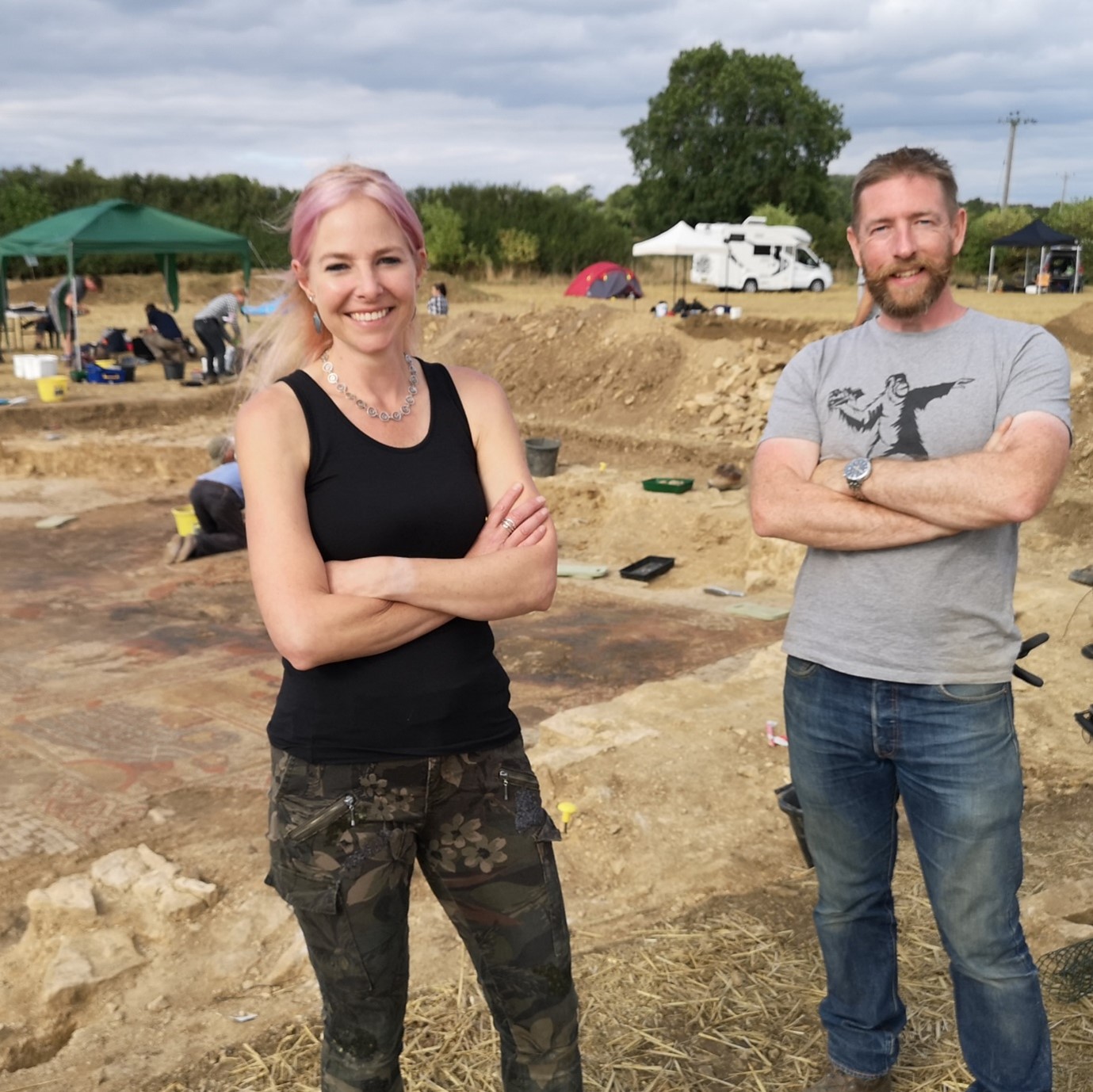
Professor Alice Roberts from BBC Two's 'Digging for Britain' and Jim Irvine, who discovered the Roman Villa and its mosaics. © Jim Irvine.

A chance discovery during a walk in the fields during lockdown became breaking news in late November 2021. Jim Irvine, engineer and son of a farmer, realised that he had stumbled across a Roman Villa, complete with stunning mosaics which have been hailed as ‘the find of the century’. The Villa complex is believed to have been occupied between the 3rd and 4th century AD, probably by a wealthy individual with a knowledge of classical Greek and Roman literature.

The remains of the mosaic measure 11m by almost 7m and it is thought to have been the floor of a large dining or entertaining area where it would have been designed to impress visitors to the Villa. Three panels tell the story (almost like a cartoon strip) of Achilles’ battle with Hector at the conclusion of the Trojan War. Mosaics appeared in private and public buildings across the Roman Empire, and often depicted characters from mythology and history. However, the Rutland mosaic is so far unique in the UK (and one of only a few across Europe) in showing scenes from Homer’s Iliad. Homer’s epic poem, based on events in the Trojan War, was composed in the 8th or early 7th century BC. The mosaic also depicts Hector's body being ransomed for gold, a scene not in Homer's Iliad but in a lost version of the Trojan War by the Greek playwright Aeschylus (who lived in the 6th to 5th century BC).

Caroline K. Mackenzie spoke with Jim Irvine about the story behind the headlines, the serendipity of a swarm of bees, and the thrill of being part of BBC Two’s ‘Digging for Britain’ with Professor Alice Roberts.

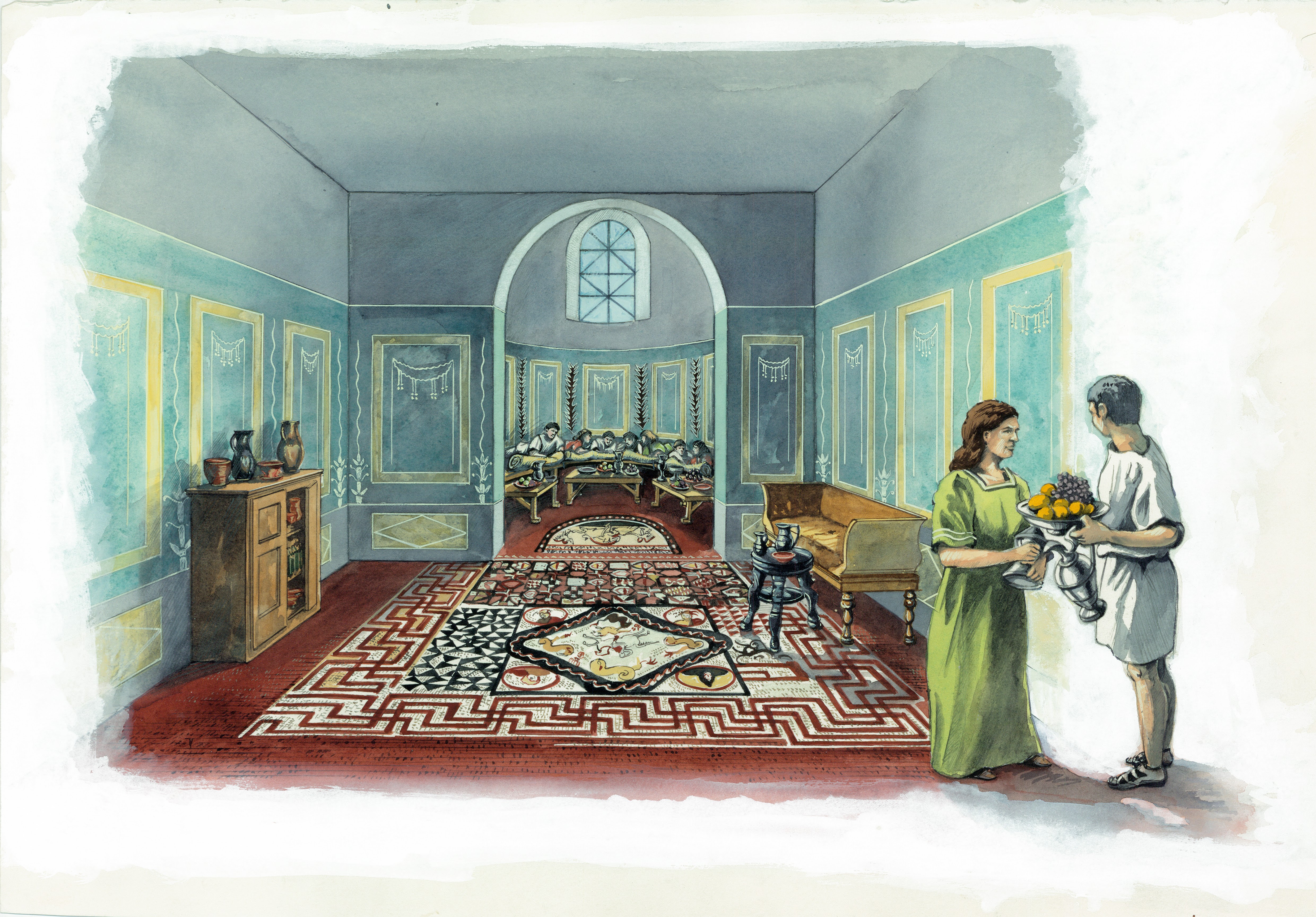
Reconstruction of the dining and reception area at Lullingstone Roman Villa c. AD 330-60. (See earlier blog on Lullingstone.) The mosaic at Rutland Roman Villa may have been designed for a similar setting. (Illustration by Peter Dunn.) © Historic England Archive.

Please could you tell me a little bit about yourself and how long you and your family have been farming the land?

My Dad’s family own the farm. He and his brother own the land between them and my Dad is the tenant farmer. I have been working on the farm since I was a kid and I have walked in the field where the Roman Villa is for over 30 years.

I am an engineering director of a company in the hydrogen production business. So my actual farming activities are really limited now to evenings during harvest and/or weekends when my Dad needs me to chainsaw up a tree or fix a broken combine harvester!

Please could you tell me the story of how you first discovered the initial signs of a Roman site?

It was a bit of an adventure! During lockdown when six people were allowed to get together, my wife and I and our two daughters saw quite a lot of my parents as they live only a few miles away. One sunny day in the summer of 2020, during that particularly dry period, we decided to go and lark about in the river. As we were going down to the river we had a bit of a run-in with some local bees which the local beekeeper has there and we all got stung. My wife tumbled onto the ground and I had to pull the bees out of her plaits - it was all quite disconcerting.

After we had played in the river, we decided we probably should not go back past the bees again. We decided to walk around the bottom of the field on the other side. The crop had not grown by the river because in the winter of the previous year there had been some flooding. There was about 10m of bare soil which we were trudging along. This is where I spotted a few bits and pieces which were the sorts of things you might see in a local museum: a piece of pottery, part of a hypocaust [a system of central heating in a building that produces and circulates hot air below the floor of a room], and even some oyster shells. Although I could reconcile the piece of pottery with some building rubble from the Victorian house across the river, I couldn’t reconcile the oyster shells as I was pretty sure they had never grown in Rutland!

The orange bits of tile were the first bits that jumped out at me because the rest of the ground is brown with bits of limestone strewn across it from the subsoil. As soon as we started looking closely at the ground, we started noticing more bits. If you walk across the field today, even in the stubble, you can’t really go five paces without spotting some broken bit of building material, or a bit of pot, or a tessera [a small block of stone, tile, glass, or other material used in the construction of a mosaic]. In retrospect I am slightly annoyed at myself as I consider myself to be quite an observant person - how did I not notice this before?!

The field is used for cereal - it gets cultivated, it grows, is harvested, and is re-cultivated. Usually, the best time to discover any hidden artefacts in a field is just after the field has been ploughed and after some heavy rain which washes all the soil off anything like pottery, stone and glass. But in this instance, it was the specific conditions on that small patch of field where the flood had not allowed the crop to grow that led to the discovery. The combination of lockdown, the bees, and the right conditions all conspired to illuminate this find to me. And I have some lovely honey in the cupboard so I forgive the bees for stinging us!

Jim digging in the field under the watchful eye of one of his daughters. © Jim Irvine.

What happened next?

I brought a few bits home and photographed them. I did a lot of work to find out why they might be there. I looked at LiDAR [a detection system which works on the principle of radar], old maps, and the thing that really illuminated it was the overhead Google maps photo which revealed a very obvious crop mark along the outline of the building - you couldn’t miss it! This was also a fluke as the photo was from June 2018, which was when we had a long, hot summer so the crop mark was clearly evident. I looked back at the historical imagery right back to the 1990s, taken at all different times of the year, and there was no evidence of any crop marks at all.

I texted my Dad to ask if he had ever noticed any big bits of stone in the field while ploughing it and he said he had seen a couple of bits. So I sent him the picture!

I then went to where I thought the crop mark was in the field and looked around to see what the topology was like. I walked around the tramlines and looked in the gaps where there were no crops. I found a few more oyster shells on the surface in the mixed-up plough soil. I even dug a small trench along one of the tramlines but didn’t really find anything. At this point the crops were about one month off being harvested, which distorts the heights and makes it hard to see the ground levels.

I kept badgering my Dad to get on with harvesting the wheat! It was towards the end of lockdown and one day we decided that instead of going to the beach we would go to the field. We took the kids and went with some folding chairs, a sunshade, and a picnic. I worked out where I thought the wall would be, based on the crop mark, the GPS on my phone and the position of features like the tram lines in the field, the trees and hedges.

I have always been interested in archaeology generally, but I have never studied it. I had a rough idea of what I thought a Roman Villa might look like, with a courtyard surrounded by buildings with covered areas. But because the crop marks indicated a building with apses, I was thinking more of a medieval building or a church. I had never seen an apse on a Roman Villa, but I had never really looked that closely.

This time when I dug a trench, I found some small tiles at the bottom of the hole - they were tesserae measuring around an inch square. I still didn’t consider it was Roman. I had in my mind it was medieval as there are so many medieval buildings here in Lincolnshire and Staffordshire.

In a portion of the trench I dug, the soil changed to a lighter colour - more like mortar. The soil is quite loamy - limestone mixed with soil - so is easy to dig when it is dry. I dug a couple of feet down making a hole not quite a foot square and there were about 30 tiles at the bottom. I had thought I would find a wall but instead it appeared to be a path around the outside of the building. My Dad came with a pickaxe and some brushes, and we expanded outwards until we reached a number of small tesserae joined together and a pattern started to emerge. We were pretty shocked.

This was the guilloche [a pattern of interwoven strands, resembling rope, often used as a border in Roman mosaics] around the outside of the figured mosaic. We went a bit further and exposed what transpired to be a depiction of a foot and so worked upwards to reveal more of the figure. I should add that we were exceptionally careful as we worked. We only uncovered the bit that was easy to uncover. The Romans did a spectacular job of creating a level floor. I put my mobile phone on it with a Level App and it was completely level in both directions. This made it very easy to dig because you knew what level to put in your spade without digging into the floor. We uncovered quite a bit of the mosaic but stopped where the mosaic had clearly been damaged by something or other - it was sinking down a bit.

As the mosaic was uncovered, the depiction of a face appeared. © Jim Irvine.

When did you realise you needed to call in some archaeologists?

Having discovered some of the mosaic panels, we decided we needed to tell someone about it. After various initial phone calls, such as to the museum in Peterborough, I ascertained that I needed to report it to the Leicestershire Historic Environment Record Officer, Helen Wells. I put a presentation together outlining all the above with photos, and we talked through it all on a video call. Interestingly, someone else had spotted the crop mark and recorded it about a month before I had. Helen suggested we arrange a field walk.

A couple of days later, Peter Liddell, the former county archaeologist, came to the site together with John Thomas and Dr Jen Browning, both from ULAS (University of Leicester Archaeological Services). I remember the four of us peering into the hole that I had dug.

How long did the excavations take and what were the most exciting discoveries?

In the summer of 2020, they secured funding which accommodated some geophysics and an archaeological dig with the help of some volunteers. David Neal, a mosaics expert, came and sketched the portion of the mosaic that was uncovered. I was fortunate enough to be able to help out and was asked to drive the digger. What is great is that they have kept me involved throughout. My Dad doesn’t like reading emails so I am the point of communication for everybody - a bit like the PR guy! It has certainly kept me busy.

I have learned so much having been actively involved in excavation in both years, 2020 and 2021. I have a trowel and I now know how to clean a mosaic and how to record it, having worked with the archaeologists.

There was also the involvement from the BBC Two ‘Digging for Britain’ team led by Professor Alice Roberts. John Thomas at ULAS has worked with them before so the producers contacted him to ask if he had anything going on at that moment. He said “Actually, yes!”. I had the opportunity to work with the Digging for Britain team throughout and we were fortunate that they gave the discovery a lot of airtime - almost half a show was dedicated to it.

David Neal drawing and recording the mosaic. © Jim Irvine.

I gather you had to keep it all secret - that must have been hard!

It was probably the worst kept secret in the area! A lot of my friends knew it was going on and we did have a number of visitors to the site but they all had to keep quiet about it. We were fortunate in that it is quite an inaccessible area so people probably wouldn’t notice it just driving past. Now of course the mosaic has been reburied for its ongoing preservation.

In the first year of excavations it was only open for four or five weeks. The archaeologists came back later to do some further excavation on the other areas of interest such as parallel ditches - a lot of the artefacts were at the bottom of the ditches.

We had uncovered about one third of the room with the mosaic in 2020. In 2021, the plan was to dig a much bigger trench over the whole area. That was when the rest of the room was uncovered and it transpired that the mosaic was about 11m by 7m.

Reconstruction of the dining and reception area at Lullingstone Roman Villa c. AD 330-60. (See earlier blog on Lullingstone.) The mosaic at Rutland Roman Villa may have been designed for a similar setting. (Illustration by Peter Dunn.) © Historic England Archive.

The mosaic itself is a remarkable discovery. Although there are other Roman mosaics in Britain, this is the only one we know of so far depicting scenes from the Trojan War. The three panels show Achilles and Hector fighting from their chariots, Achilles dragging Hector’s corpse around the walls of Troy and finally Hector’s father Priam ransoming his son’s body for gold. Do you recall the moment when the scenes were identified and their significance was realised?

I had a long call from the Leicestershire county archaeologist, Richard Clark. After we had revealed the three panels which each showed a portion of the story, they were able to figure out what it was because of the various details such as the horses, and Priam’s Phrygian cap [an attribute often used in classical Greek iconography to identify Trojans as non-Greek]. Richard explained it to me really clearly and I thought “Wow - that is amazing” because this is a story that has endured from Greek times, through Roman times right up until the present day - you can even watch Brad Pitt in a film about Troy!

This part of the mosaic depicts the ransoming of Hector's body for gold by his father Priam, identifiable by his (red) Phrygian cap. Priam is second from the right in this image. © Jim Irvine.

Was this your first introduction to Homer and his stories of the Trojan war? If so, has it inspired you to learn more about the Classical world and/or Roman Britain?

Being an engineer, I don’t have time to read stories. But I had seen the film about Troy! However, my Classical education is limited. When I was a kid I used to read factual books rather than any mythology books. It is only as I have got older that I have been more interested in History and this discovery is a really good focal point for me. I think Homer’s Iliad is a massive volume and probably beyond my capability to read.

[CKM interrupts to say that a good translation is accessible to anyone - it is quite simply a great story. CKM enthusiastically waves a copy of Homer's Iliad at her computer screen and urges Jim to read it.]

OK - I’ll do that! I don’t feel like I am doing my job properly unless I read it!

My interest in this is really what does this tell us about the Roman people at the time and how they interpreted the Iliad. Did they get this from a pattern book and tell the mosaicist that they wanted these three pictures? Or was it someone who knew about the Iliad and had it written down somewhere and said, “I want you to represent that story for me”? For me, the people aspect is thrilling.

Absolutely. I have been reading Homer's Iliad with my online Classics Club reading group throughout lockdown (see earlier blog on Classics Club) and it is amazing to think that people in Roman Britain may have been reading and enjoying the same story as we are today. Although I haven’t gone as far as commissioning a mosaic floor, one member of the reading group who is an artist created a lovely painting for me depicting, guess what, Hector and Achilles in battle, with the Trojan horse in the background. It seems our desire to have images in our homes of the stories we love has not changed in 1600 years!

Looking forward, are you able to tell me about the future plans for further excavations?

It will depend on funding of course. Historic England and ULAS are co-ordinating some more excavation this year but the plan is not yet formalised. I understand they are expecting to uncover a lot more in terms of square metres than previously.

The whole site has phases of archaeology across it. There are potentially some roundhouses, rectangular buildings, a bath house, and aisled buildings, etc.

Illustration of the baths at Lullingstone Roman Villa, Kent as they may have appeared in the late third century AD. (Illustration by Peter Dunn/Richard Lea.) © Historic England Archive.
Rutland Roman Villa may also have had baths. 

What would be your dream discovery on your land?

Gold. (Only joking!)

For me, my main interest is what is the state of preservation of the other parts. I am thinking from an engineering point of view here. Next to the field is an area of unfarmed land of about one acre which is just left wild as it is completely inaccessible - it has not been farmed since big machinery came along. It has trees and brambles on it and is in a horrendous mess - anything underneath it will have roots through it. I am fascinated to learn more about the history of the site from the time when whoever owned it with the mosaic ceased to occupy the site and how it has been maintained as it is today.

My personal view is that for the preservation of things like the mosaic, which is only two foot deep and well within root damage depth, for it not to have been damaged and the walls still to be there must mean it has been continuously inhabited or maintained as farmland since it had a building on it. That is the only way it wouldn’t get destroyed by vegetation over time. We have literally just shaved the top of everything through farming but everything else is pretty much as it was when it fell down. I can’t wait to see it all.

At the end of the last excavation, we discovered another mosaic in an adjoining room to the main mosaic room, and we just exposed the corner of it. There also appears to be a tiled corridor which may be the next part of the building which was in great condition

Is there any chance the mosaic of Hector and Achilles will be uncovered again?

It is well preserved. The first year it was covered in a special washed sand, then a membrane and soil on top of that. When [Professor] Alice [Roberts] brushed off the sand it was exactly as we had covered it up before. I was really emotional about that as I had been thinking about it the whole time, for a whole year, and I hadn’t seen it except for the picture on my phone which I look at every day. So seeing it come back again was a moment of “Wow, this is really great.” We cleaned it last year and it looked amazing. When the sand came off, as you can see in the footage, it looked spectacular and that was really what it looked like. Preservation in situ is the best way to look after these things - it’s not going anywhere. The cost of putting a building over it and having tourist access would be millions of pounds. It is well recorded with photos and David Neal’s drawings. Also, the local museum is going to have a virtual exhibit.

Professor Alice Roberts cleaning the sand from the mosaic. © Jim Irvine.

What was the most exciting part for you of it all?

Driving the digger. (Only joking - again!)

It was great to do the TV and to meet the professionals, [Professor] Alice [Roberts] is really nice, and she knows her stuff about bones! I had the chance to work with her while she was on site and it was very interesting as I had never worked on anything like that before.

The thing that has been most interesting is to have been asked to be involved in the excavations and fieldwork with bio-archaeologists. How many people get to excavate and clean a Roman mosaic? I am quite privileged. I think more people have been on TV or driven diggers than have excavated mosaics!

I would love to do more because you have to really think about what you are doing and understand what you are poking your trowel around to make sure you don’t damage anything. I am pretty careful when it comes to working with small things like this but I can also tell when something is robust and is made to be strong. Working in the field and working directly on the mosaic was great - I was there whenever I got the chance. I cleaned Hector’s face and Priam’s feet goodness knows how many times - not many people can say that!

It must have been an amazing discovery for your daughters as well! Has it inspired either of them to become archaeologists?

My youngest daughter wants to become a palaeontologist but for them it has been rather matter of fact. She is at primary school and her class are learning about the Romans and mosaics. They all wrote to me asking me to tell them something about my experience, which was really nice. This is why I like doing talks about the Villa as I love to tell people about the discovery and to get people interested. It is something that I never thought I would be interested in and I think everyone should have the opportunity to engage in this sort of history.

We have a lot to thank you for, not only for discovering the Villa, but also for being so enthusiastic and keen to share the discovery.

The news broke on the Thursday and the following day when I went to work in my garden shed/home office, I telephoned my boss to ask if I could have half a day off as I had to meet ITN and BBC in a field to do an interview. It was then non-stop for a week. It was great and another new experience for me. As well as learning about history and being involved in an archaeological dig, I was then doing media stuff which I had never done before. The last two years have been a massive thrill for me.

It’s amazing to think that the Roman Villa and its incredible mosaic have been under our feet for a long time and we had not noticed the signs until recently. But my interest and awareness have significantly improved and changed such that I look at every piece of farmland slightly differently now.

*****************************************************

Post script: While writing up this interview, I reflected on the circumstances that led to this remarkable discovery, and the serendipity of the swarm of bees. Stories of bees seemed strangely familiar. I then remembered that in Book 2 of the Iliad, Homer describes the Greeks gathering for a council as resembling a mass of bees ‘swarming out from a hollow in the rock in a never-ending stream’. Later, in Book 12, a Trojan warrior describes two Greek warriors defending the entrance to their fortifications as fierce insects defending their nests: ‘But now, like… bees who have made their houses by a rocky path, and will not leave their hollow home, but face the men who come to hunt them and fight to defend their babies, so these men… will not give way from the gates’. [Translations: Hammond, Penguin Classics.]

What a lovely twist of fate, therefore, that bees played a part in the discovery of the Rutland Roman Villa and its stunning mosaic of Hector and Achilles in battle. Homer’s comparisons of the Greeks with bees and the bees’ role in leading Jim Irvine to the mosaic of Achilles (perhaps the most famous Greek warrior of all) provides yet another link between the stories of 8th century BC Greece, the inhabitants of the Roman Villa in Britain in the 4th century AD, and the family who own the land today.


Many thanks to Jim Irvine for kindly giving the interview to the History Girls and for permission to use his photographs of the dig.
Thank you also to Historic England Archive for permission to use the images of Lullingstone Roman Villa.

@carolinetutor
LinkedIn: Caroline K. Mackenzie