It is World Book Day today - World Book Week/Fortnight for many writers - as schools and libraries up and down the land get into the spirit of the celebration and invite us to get out of our jammies/big sweaters/baggy jeans/slippers/the house. And, frequently, onto public transport where we, blinking in the sudden light, meet the wide world in a small space.
Be gentle with us.
(Some of the advice below may appear to come from another world, but many of us live in other worlds a lot of the time, so it seemed appropriate.)
I love Mrs Humphry. (I've posted before about her Manners for Women and Manners for Men and barely scratched the surface of her awesomeness.) Listen to her words from the 1897 edition of Manners for Men on omnibus travel -
"True courtesy ... will prevent a man from infringing the rights of his neighbours on either side by occupying more than his own allotted space. Very stout men are obliged to do so, but at least they need not spread out their knees in a way that is calculated to aggravate the evil. Nor need they arrange themselves in a comfortable oblique position, with the result of enhancing the inconvenience ... Even a thin man can take up a quantity of room by thus disposing himself at an angle of forty-five ...
The morning paper may be converted into an offensive weapon in the hands of the rude and careless ... Newspapers are rather unwieldy things to turn and twist about in a limited space, but this very circumstance affords a man an opportunity of displaying his skill in manipulating the large, wide sheets without dashing them in the face of his nearest neighbour, or knocking against anybody in a series of awkward movements that a little care could easily convert in leisurely, graceful ones ...
It can never be out of place for a man to give up his seat in favour of the old and infirm, or for a woman with a baby in her arms. But such matters as these belong to the region of heart and mind beyond mere manners, and it is useless to suggest any line of action on such subjects. The impulse must come from within."
And, moving from bus to train, and forward a decade or two -
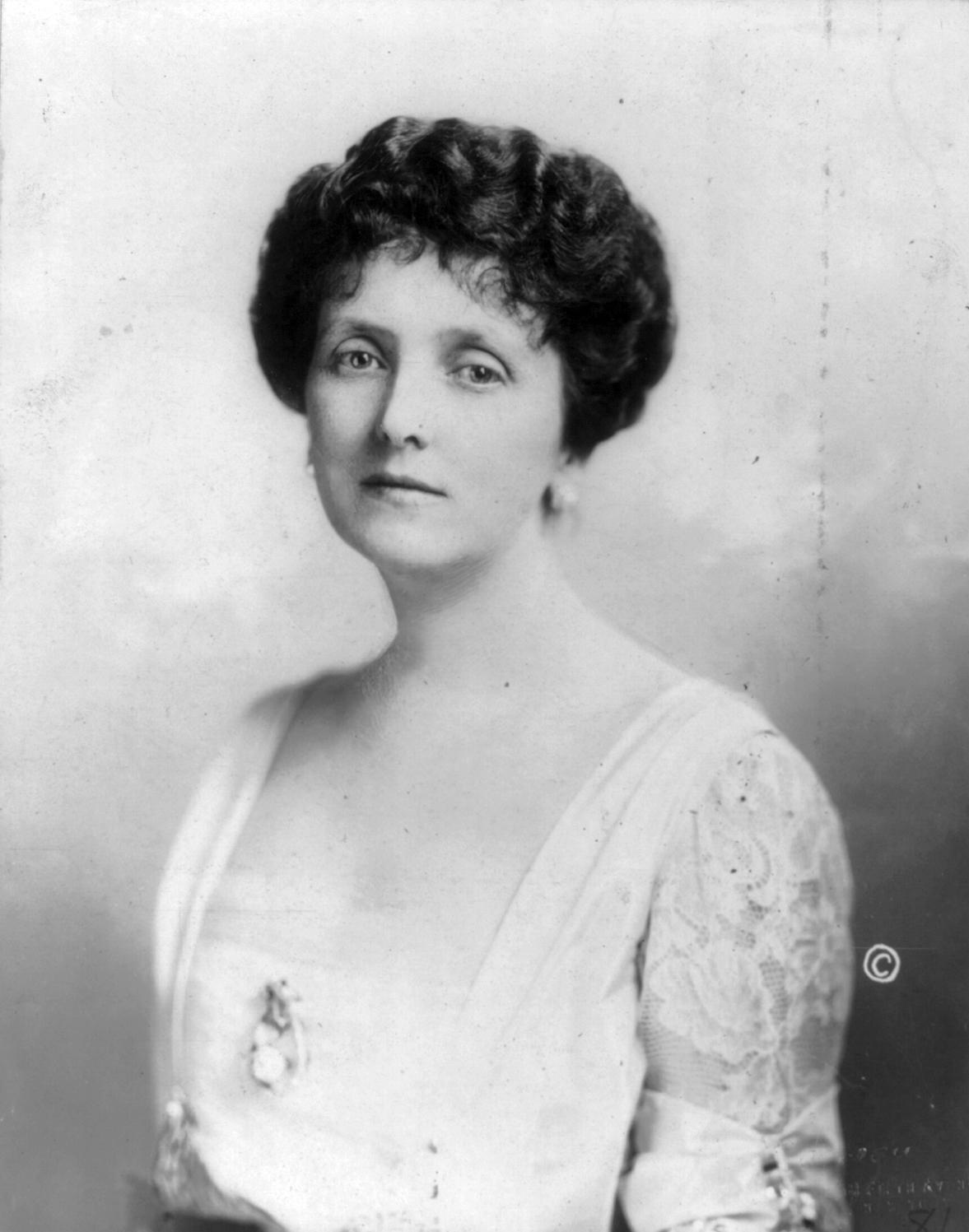
(Miss Emily Post 1912)
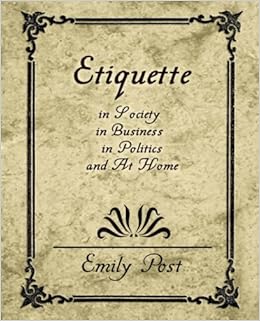
Miss Emily Post's Etiquette in Society, in Business, in Politics, and at Home has been revised and reprinted many times, but I like the 1922 original best. And out of all her words of advice, I'd like to select these for your consideration as you pack your leather valise -
"On a railroad train you should be careful not to assail the nostrils of fellow passengers with strong odors of any kind. An odor that may seem to you refreshing, may cause others who dislike it and are “poor travelers” to suffer really great distress. There is a combination of banana and the leather smell of a valise containing food, that is to many people an immediate emetic. The smell of a banana or an orange, is in fact to nearly all bad travelers the last straw. In America where there are “diners” on every Pullman train, the food odors are seldom encountered in parlor cars, but in Europe where railroad carriages are small, one fruit enthusiast can make his traveling companions more utterly wretched than perhaps he can imagine."
Just a thought.
(If you want to browse more in Miss Post's or Mrs Humphry's books and don't have well-thumbed copies on your shelf, you can do so here - and here - but be politely warned - they are incredibly addictive!)
Joan Lennon's website.
Joan Lennon's blog.
The 1890s in Britain was a time of exciting and often confusing change, particularly for young women. This was true in the area of manners as much as anything else. Fortunately, there was no shortage of eager helpers on hand offering hints on how to navigate the minefield of lady-like behaviour. One of my favourites is Mrs Humphry (author of Manners for Men, a book about which I posted last month).
According to Mrs Humphry, things were definitely looking up for the female of the species.
"The happy girls of the century-end have not such good reason for wishing to be boys as their mothers, and, more still, their grandmothers, had in their young days."
For one thing, the modern girl has escaped "The tyrannous needle [that]swallowed up their youth ... fancy-work plays no part whatever in her cheery, breezy, young existence. Very often she ignores even the needle of ordinary life, and her thimble knows her so little that it will not come when it is called. It has been left in waste places."
And, for another, "thank goodness, the piano is going out of fashion for girls in the best circles ... to the great easement of humanity."
But that didn't mean it was all plain sailing, just a walk in the park, a lark, a laugh ... In fact, Mrs Humphry dedicates seven pages to this very subject: Chapter 4 - Learning to Laugh - since these breezy modern girls just don't know how to do it nicely. At the theatre, for example:
"For every one whose laughter is melodious, there will be found a dozen who merely grin and half-a-dozen whose sole relief is in physical contortion. Some of the latter bend forward, folding themselves almost double, then spring back again, and repeat this jerky and ridiculous movement afresh at every joke. Others throw their heads back in a way that disagreeably suggests dislocation. ... Cachinnations in every key resound on all sides ... Cackling suggestive of the farmyard, and snorts not unreminiscent of pig-styes, produce variety. As to the grins, very few of them can be, in the remotest sense of the word, described as pleasing ... the exhibition of whole meadows of pale pink gum is inconsonant with one's ideas of beauty."
(And if all that doesn't make you so self-conscious you might never laugh again, then nothing will.)
So many things to avoid, from unfortunate centre-pieces ("I never like to see slippers as flower vases on the dinner-table.") to inappropriate weeping ("Crying is no longer fashionable. It has followed fainting into the moonlight land of half-forgotten things.") to bicycling on the wrong side of the road ("... thousands of bicyclists belong to a class which is ignorant of the charms of horse exercise, and they may be unaware that the rule of the road is exactly the opposite to that which guides pedestrians on the footpath.")
And yet there is so much to be glad of too, and, at the end of the day, "Can anything in the world be nicer than a really nice girl?"
Now where's my thimble ...
(This post is recycled from my own blog, several years back.)
Joan's website.
Joan's blog.
In the third Slightly Jones Mystery - The Case of the Cambridge Mummy, young Victorian scallywag Matthew Bone gets taken in hand by Miss Sally Forth to be taught manners. So I needed to learn some first. I went looking for late 19th century etiquette books and found ...
... Mrs Humphry.
I love Mrs Humphry. When I first got my hands on Manners for Men I kept sitting down to read it, and then leaping up to find some boy to read it to!
"Listen to this!" I kept yelping.
"At the breakfast table unkempt hair, untended finger-nails, and a far from immaculate collar are occasionally to be seen ... the ill-bred young man may be traced from room to room by the litter of newspapers and magazines he leaves behind him ... In this young man's own room there is chaos. The maids have endless trouble in clearing up after him ... His handkerchiefs, his socks, and collars are lying about in every corner of the room. He is too indolent even to put his boots outside the door at night that they may be cleaned in the morning. To save himself trouble he bangs all the doors instead of gently latching them."
Tell me about it, Madge.
But she is sincere in her desire to help these young hooligans and sympathises with their awkwardness and fears. Take dinner parties, for example:
"To converse with a perfect stranger is always one of the initial social accomplishments to be learned, and it is not at all an easy thing at first. It needs practice. Ninety men out of every hundred offer a remark upon the weather; but unless there had been something very extraordinary going on in the meterological line, it is better to avoice this subject if possible ..."
But what then?
"I have known a good beginning made with some such remark as, "Do you know everybody here?" This leads perhaps to the acquisition of some information as to the other guests ... The floral decorations often lead up to conversation. The colours of the flowers remind one of pictures, and the lady on one's right may be asked if she has been to any exhibitions that may be open. If so, what pictures she liked best. Does she paint? Has she read the novel of the hour? What does she think of it? Does she bike? At this rate our novice gets on swimmingly, and may safely be left to himself."
She is also happy to answer more specific questions on how to proceed:
"A young man once asked me if it would be etiquette to offer an unknown lady an umbrella in the street, supposed she stood in need of one. I replied, 'No lady would accept the offer from a stranger, and the other sort of person might never return the umbrella.'"
Sometimes it is enough to gently point out an area of weakness:
"It requires some expertness and practice for a man with a moustache to take soup in a perfectly inoffensive manner. The accomplishment is worth some trouble."
Mrs Humphry may have the knowledge, but she makes clear that there is more to becoming a well-mannered gentleman than just reading her book:
"If manners are not practised at home, but are allowed to lie by until occasion calls upon their wearer to assume them, they are sure to be a bad fit when donned."
You can't argue with that.
And rest assured that Mrs Humphry did not leave the ladies to wander without assistance in the minefield of late Victorian etiquette. Next month, Manners for Women! I invite you, as politely as I know how, to join me then.
(This post is recycled from my own blog, several years back.)
Joan's website.
Joan's blog.