Showing posts with label family history. Show all posts

Friday, 19 August 2022

Is this even the right place? Sheena Wilkinson


Last week my husband, his three sisters and I set out to walk to their late mother’s home place – the small one-storey farmhouse where she had been born and reared until she married in 1962, in a place known locally, though not on any maps,  as the Muck (which doesn't sound pretty, but possibly comes from the Irish for pig). Shortly afterwards, the house was abandoned. It may already have been run down; the lane was too far from the road; it was the sixties, and the appetite was for new bungalows, not damp old cottages. There are so many places like it all over Ireland. Their skeletons have become one with the landscape – houses fallen into roofless walls, walls tumbled into ditches and buried under ivy and nettles. I wrote about it here a couple of years ago. ( https://the-history-girls.blogspot.com/2019/03/history-where-there-isnt-by-sheena.html


But this was different: this was a house whose descendants still live in the same area. And yet my husband had never been here in his life. There was uncertainty as to whether we even had the right place, much checking of the landscape against her long-ago stories – could that be the hollow where the dog fell through the ice and drowned? Was that the path she would have taken up to school? We discarded the other two or three abandoned houses in sight – that one was too big; that one too small, only a byre, and the other one still had a roof and walls so did not fit my late mother-in-law’s description of ‘a ruin’. 


The August landscape was stunning – we had walked up a lane bursting with wild raspberries and honeysuckle, leading to a land of undulating green drumlins, yellow fields of stubble, with the dark shadow of the Mournes in the background. A piebald cob and his friends grazed the field where the house lay derelict, fresh dung suggesting that they used its walls for shelter. We clambered over nettles and stones, marvelled at the tree growing right up through what might have been an outhouse, argued about which way round the house faced, looked up with some trepidation at what was left of the roof – would it withstand our visit? 


How could you not have been here before? I demanded. Surely you were interested in where your mammy grew up? I suppose, for a child, a long walk up a lane to an empty house wasn’t that exciting. But I could have stayed all day, trying to reconstruct the house in my mind, noticing how the stone walls had been panelled over at some stage; trying to work out if the room we stood in was a living room or a bedroom -- the small fireplace suggested the latter; wondering what would have hung from the hooks which clung stubbornly to the remains of a door. The people who lived here died before I married into this family, but I knew their names and had seen their photographs. 


How long does a house sit derelict before it stops being sad and starts being interesting?


I don’t think it ever stops being sad. 


I don't blame my husband for not making the pilgrimage earlier, when his mother could have filled in the blanks for us. Not all children are budding History Girls, as I had been, pestering Mummy for stories of the olden days – her girlhood in the fifties and sixties, and my granny for tales of the real olden days – she was born in 1908. The houses they told me about – the big house in Irish Street, Downpatrick where my granny took in lodgers; my other gran’s more modest terraced house in east Belfast – are long gone too, and not reclaimed by the kindness of nettles and grass, but demolished and built over. 


I will return to the Muck. It's not my family history, not really, but these old houses and their secrets are everyone's history. 


Friday, 18 February 2022

Why didn't I ask more questions? by Sheena Wilkinson

Since I became a History Girl I have often wished I had paid more attention to the stories my gran and great aunt Annie  told me. As a child I had an endless fascination for ‘the olden days’ but I didn’t know then how much my creative and intellectual life as an adult would revolve around women’s social history. So many times, writing novels set in the Belfast of their youth, I’ve thought of them, growing up in the streets I was describing. Without them and their stories, I might not have grown up to become someone who wrote historical novels.

Gran and Aunt Annie c. 1920 

Recently, having married at the unfashionably late age of 53, I’ve been considering, not their long-ago childhoods, but their young womanhood between the two world wars. Aunt Annie never married, became the spinster daughter keeping house for her widowed mother and unmarried brother, with what reluctance or enthusiasm I will never know. I never asked. I didn’t know I would  become fascinated by spinsters, or that I would spend decades of my adulthood uncoupled and independent, like Aunt Annie.  

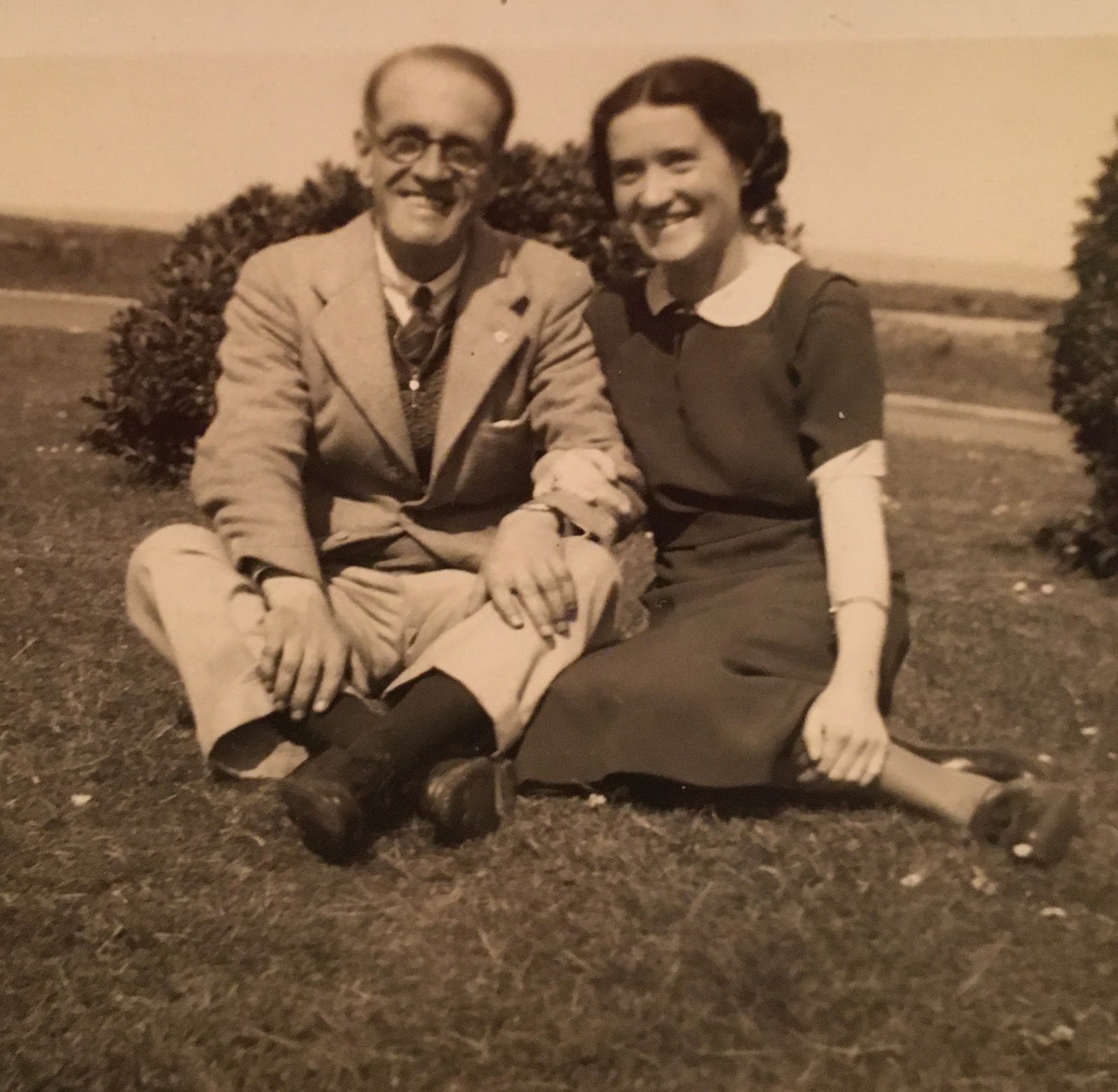
Gran married during World War 2; she was in her thirties, Granda a little older. This was above average for the times, and, again, I don’t know why. I know that Granda, the oldest son, had family responsibilities; perhaps they precluded him leaving home and marrying earlier. I have no idea if he and Gran had a long courtship or if they had had previous sweethearts.  Why didn't I ask? When I cleared out some old photos recently I found many of Gran in the 1930s with a jolly-looking crowd of young adults from the Christian Endeavour. They seemed to go on lots of jaunts and picnics and in more than one photo she seemed to be close to a young man who wasn’t Granda. But again, I don’t know. These might have been simply pals. Gran and her chum Ellie married brothers, Granda and Uncle Gordon, but I don’t know who introduced whom. I don’t know if Aunt Annie, three years younger and destined not to marry, was jealous or indifferent, if she had suitors, heartbreaks and disappointments or if she always planned the single life. I don’t know if her proclivities, if she ever explored them, were for girls or boys. I do know she would be extremely shocked at my writing such a thing. 


Gran and Granda -- not yet engaged
 

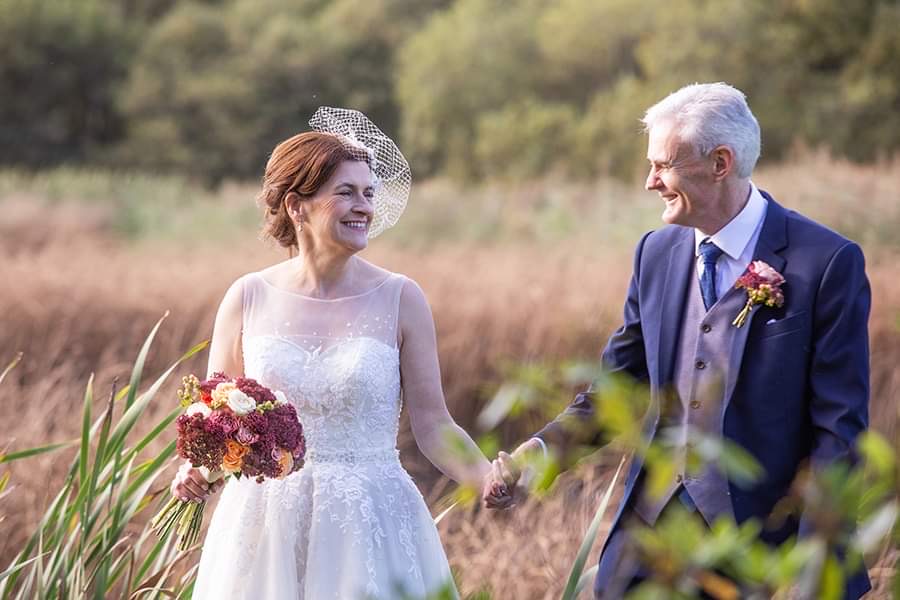
I’ll never know now, and it doesn’t matter. But getting married at 53 after 24 years of living alone and about 20 years of single celibacy has made me think a lot about marriage trends, and about what leads to some people being coupled while others stay alone. In my own case, I married an old friend who had been widowed. Which in itself sounds quite old-fashioned. 


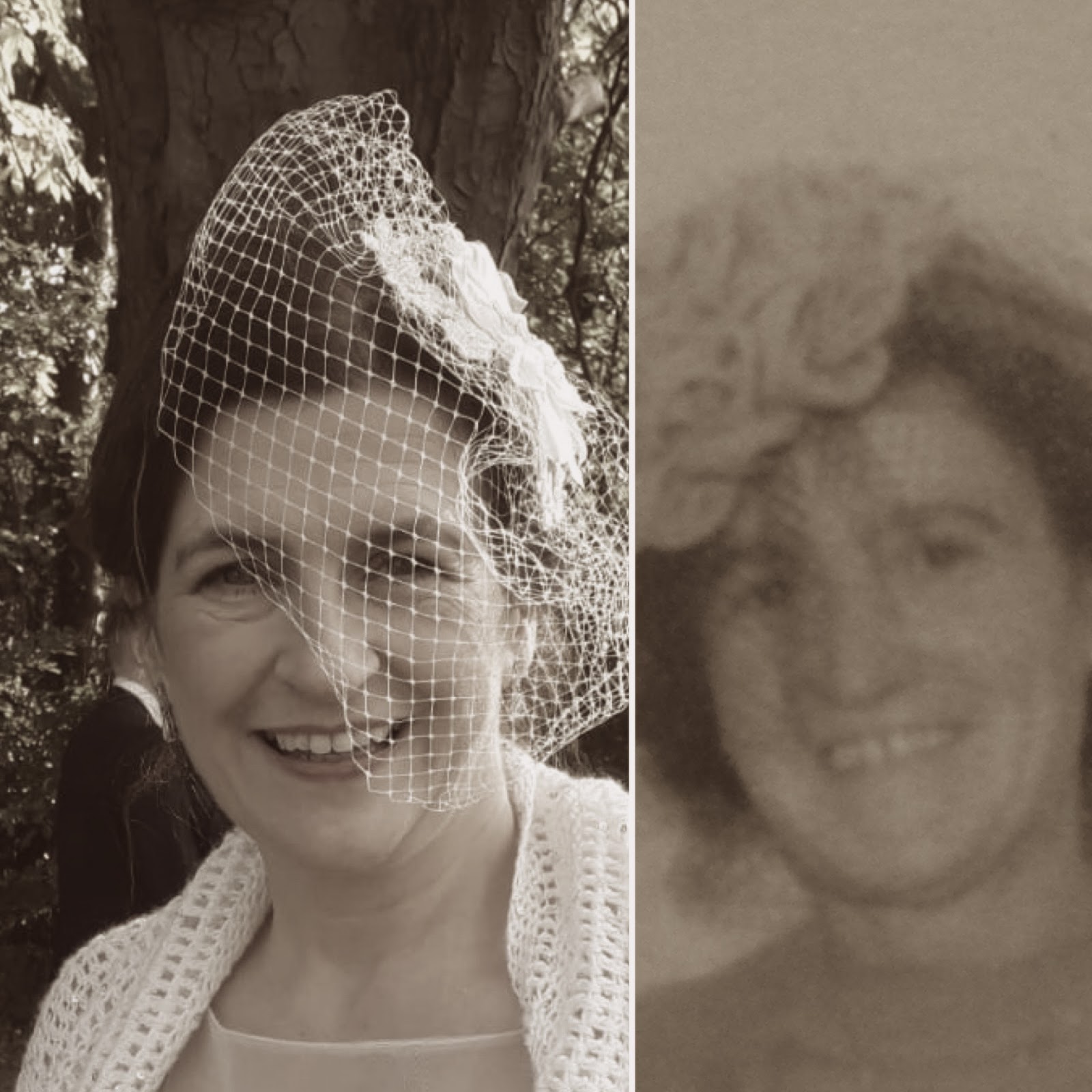
When Gran was my age I hadn’t been born, but photos from the 1960s show that she was certainly preparing for the grandmotherly stage of life. She was grey-haired, comfortably plump, wore a pinny and devoted herself to the domestic and the church. Every year I look more ridiculously like her, and nowhere is this clearer than in our respective wedding photos, even though she is almost twenty years younger.


Two brides, 2021 and 1942

Gran married in a pretty but serviceable frock she would get good wear out of. Not only was it wartime but at 35 she would have considered it unseemly to go for something more bridal. I don’t know what she would have made of me at 53. Mutton dressed as lamb, probably. My hair is dyed to disguise the grey, I am over a stone lighter and a dress size smaller than I was in my thirties, and I run and go to the gym partly to keep Gran’s matronly figure at bay.  I chose a vintage-style wedding dress that was probably a bit young for me but it was pretty and flattering so I didn’t care. Perhaps that’s the biggest difference between our generations: the not-caring-what-people-think. I am very domesticated, it’s true – I made my own wedding cake and the shawl I wore over my dress, so perhaps she wouldn’t have entirely disapproved.


Friday, 19 November 2021

Keeping our heritage alive


'I need to know its story!' declared my daughter one weekend recently, as she prowled about the house, picking up this and that ancient object that had first settled into her consciousness when she was small.


'Where did this come from?' she asked, holding up a black and white quill box.


Knowing the provenance of objects and their "story" is in her training as an archaeologist, and her working life, in a major British university's museum service.


‘Tell me.’ She didn’t add, 'Before it’s too late,’ but that of course is the subtext to her desire to “know”.


I’m not terribly ancient but time marches on, and I understand only too well what happens if you don’t ask questions when minds are lucid enough to recall the answers. They eventually become so dimmed that recall is impossible and then, at length, of course the minds have gone altogether and the opportunity for enlightenment is lost.


I know. I allowed it to happen with my own parents.


It’s easy enough, amidst the hustle and bustle of the present, and concern about the future, to let the past slip away into obscurity. Does it matter? On one level, perhaps not, not with all the crises and dilemmas of twenty-first century life occupying our consciences and jangling our nerves.


But, if we focus only on the present (and the future), and overlook the past, the day may come when there’s no one left with the memories to bring it back to life.


We have many artefacts in our house, most gathered over my lifetime and my husband’s. A number of them are truly ancient: my husband is a geologist with an enduring fascination for the form and wonder of rocks and fossils. Artworks of varying forms and old books have also been garnered over the years. The value of these objects is not of course measured in monetary terms but in their beauty, or in their particular fascination – in the sheer pleasure they give us, not in owning them but in simply being able to enjoy them.


All these objects will, I am sure, in time claim our children’s interest.


But, right now, it is the “old things” that arrived in our house through inheritance from earlier generations that are attracting my daughter’s particular interest. None are I think especially valuable monetarily, but several are pretty old, and are certainly intriguing. And my daughter wants to know where they came from, how and when they were acquired, both originally and by me, and how they fit into the family’s history. In other words, their “story”.


However, to my shame and deep regret, I don’t know all the answers, because I failed to ask the questions when I had the opportunity. 


Let me choose just three of these objects to tell what little I do know…


Ebony elephants

Ebony elephants


The rightmost elephant is not the largest of the elephants that I remember. When I was a child, they lived in my maternal uncle's house, parading across the wide brick hearth in his spacious dining room. Of course your perception of the size of objects as a child is distorted by your own small stature, but I am certain that a four-year-old could sit easily on the largest elephant in that room. Where that one went, I do not know.


But my mother, and later I, acquired these four. The largest, at 10.5 inches (27 cm) high to the top of his head, is very heavy. The tusks, toenails and eyes are ivory. Were they made in India? Possibly in the nineteenth century? I suppose so, but I regret to say that I don’t actually know. My maternal grandfather had a wanderlust as a young man. He was a hairdresser (“Monsieur Arthur, Coiffeur”) and chiropodist who travelled the world on ocean-going liners, tending to the feet and crowns of some famous people. (I have a photograph signed by Jan Smetana, the composer, addressed to M. Arthur! Not that Arthur was my grandfather’s name but I suppose it sounded hairdressery at the time?)


Anyway was it grandfather who brought the elephants back to England? It’s hard to imagine how, logistically. Would the “ride-on” elephant have even fitted inside his trunk? (Sorry, no proboscidean allusion intended.) Yet, how else did they get back to England? How frustrating it is not to know the answer! So my daughter has to be content to know that they have been in her family for at least a hundred years, and have lived in the consciousness of at least three generations, her grandmother, her mother and her. That is as much story as we have about these proud beasts. What a dreadful pity. And what a loss, not to know much more.


Quill box

Quill box


Here is another object that might (or might not) have come to England in the luggage of my maternal grandfather, the itinerant hairdresser. It has been in my consciousness since I was very small and is one of my daughter's favourite objects. I actually knew nothing of the origins of the box, but Wikipedia tells us:


 “Porcupine quill boxes are decorative trinket boxes, which are finely inlaid with ivory discs and porcupine quills between bands of ebony. They were highly valued for their rich timbers and intricate craftsmanship.”


The boxes were produced in Ceylon (now Sri Lanka), largely between 1850 and 1900, originally made for English residents but, by the late nineteenth century, a thriving export trade for such artefacts had grown up. Apparently there is one in the Victoria & Albert Museum, in London, which was given to Queen Victoria.


The number of ivory dots and their close proximity together are a good indication of a valuable box. The finest boxes may have an ivory disc positioned every one fifth of an inch (0.5 cm) on all of the ebony borders. By contrast a lesser box may have dots one inch (2.5 cm) apart or more. I guess that’s ours! 


Wikipedia says that boxes with broader quills are less valuable than those with fine quills, and some quills have distinct dark and white bands and others are with plain white. 


Our box is 6 inches (15.25 cm) by 4 inches (10 cm), but they were commonly made up to 11 inches (28 cm), and some could be even larger. It was commonplace for the timber used to be poor and therefore warp, but this is not the case with ours. It is well over 100 years old but the wood looks as sound and blemish free as the day it was made.


Knowing that these boxes were made in Ceylon, we deduced that perhaps my grandfather picked up this box on his travels. But did he ever go to Ceylon? Might my third object give us a clue…?


Postcard album

Postcard album 

Postcard album


The three hundred cards in this postcard album date mostly from between 1900 and 1907, although the earliest I have spotted is 1899. They are a mix of postcards sent by my maternal grandfather to members of his family, those sent to him by relatives and friends, and postcards with interesting images but no addressee or message. Many are cards my grandfather sent to his girlfriend (my grandmother) then, later, his wife (same lady) and first child (that maternal uncle of mine with the elephants), from wherever he was working. Sometimes that was in England, and often abroad. So, to some extent, the cards are a record of his travels. The cards that were sent to him also contribute to the record, because the addresses given for him are in many different places around the world.


I will confess here (this blog post really is a sorry outpouring of guilt!) that I have not so far taken the time to curate, as they say, these cards. They are slotted into the album in no particular order, and have certainly been that way for decades… If I could at least organise them into date order, I would gain a better picture of my grandfather’s journeying.


Part of the “problem” of curating them, however, is that many of the cards’ messages are written in Danish. My grandfather was from Odense, in Denmark, my grandmother from Schleswig-Holstein. I don’t speak Danish… And the writing on the cards is often miniscule, as the writer strove to fit as much message as he (nearly all “he”, I think) possibly could around the image. In many cases it is also quite faded. Well, they are 120 years old… I really would like to know what they say, because quite a number of the Danish ones include family photographs. (Interesting that you could use such a photograph in those days to make a postcard…)  In this example, I do recognise some of the individuals: one of my grandfather’s brothers is standing on the left, and my maternal great-grandparents are in there too. But I don’t know what the message says… One day (!) I really should ask one of my Danish cousins to translate…


However, the Danish thing is a slight red herring, as the dates are not "in Danish" and I could at least take that first step...


Anyway, in my view, it is a rather wondrous thing, this album. In many cases, the messages aside, the pictures alone are intriguing, giving a window onto the differing cultural lives of the times and, in some cases, on the history of the place. Such as a series of cards from Switzerland and another series from Chinatown, New York, and a number of cards sent by my grandfather from Kingston, Jamaica in April 1907, showing the effects of the earthquake in January, which killed 1000 people.


Anyway, I introduced the postcard album to you with premise/promise that perhaps it might tell us if my grandfather went to Ceylon, where he could have purchased that quill box... So my daughter scoured the album for a card sent from Ceylon, and she found one! But, frustratingly, it wasn't from my grandfather at all but sent to him, and the sender was not I think a relative but a friend. Did that man bring the quill box back from Ceylon? Or is that postcard just another exasperating red herring... I will never know. 


The History Girls are writers, mostly, though not all, writing fiction, either invented (but historically authentic) worlds about entirely fictional characters (like me), or reimagined lives of real individuals. Basically, we are all storytellers. Which is what makes my tale here rather sad. Despite my being “a storyteller”, I have failed to keep my own story, that of my family and my predecessors, alive. I have permitted it to wither, not through lack of interest but simply lack of purpose. I must make an attempt to address some of the withering at least. And, just as importantly, I must ensure that the stories of those things I do know about, the artefacts that we have gathered together through our lives, are not lost. So when, decades hence, a grandchild asks the question about the 160 million-year old ammonite or the Greenlandic soapstone sculpture or the hardwood African mask, he or she can be told how it was they came into the family.

Friday, 20 August 2021

Something Old by Sheena Wilkinson

1. Christening Robe

It was ivory, with frills. Not quite exquisite lace – nylon had just come in. Daddy wore it in 1946; I wore it in 1968 and my sister in 1969. 

Bundled to the back of the hotpress to make space for brushed nylon nighties and flannelette candy-stripe sheets, it was not quite an heirloom, but too good for a doll’s frock. One day your children will wear it, Mummy said.

It lived on in my hotpress, with Egyptian cotton sheets and Ikea duvet covers. Not quite forgotten, but an occasional silky reminder that my life was single and childfree and that someday I would have to do something with it.

I moved house. I am getting married but I am quite old. If there are ever step-grandchildren, they will want their own christening robes. I hang it off the edge of the guest room bookcase, and if it looks a little odd, like a headless ghost baby, I am not quite ready to admit that.


2. Lace Petticoat

Gran gave it to me when I was eighteen. It is about seventy years old. The cotton is still white and crisp, the pleats and tucks and lace immaculate but for a little wear and tear. I wear it as a skirt. I pose around college feeling exquisite and romantic.


It too has languished in the hotpress, hiding among pillowcases. I wash, iron and starch it. I note the extra wear on the frothy lace from my catching the hem in my DM boots. And the little gingham ties I made to hang it up with. It is over a hundred years old. I hang it with my ordinary clothes in my new wardrobe. Maybe I will wear it sometime.


3. Gran’s Hair Ribbons

Or Aunt Annie’s. Or Sadie, their big sister who died at sixteen. They are ivory, but perhaps they were white when they were slipped into the family bible over a hundred years ago. I imagine I have seen them in the sepia photos of the three sisters in the 1910s, but they seem smaller and less exuberant than those.

Perhaps they were indeed Sadie’s, pressed carefully in the bible as a memento. There is nobody to tell me and they are a shock to find, so silky and delicate and patient. 


I launder them very carefully. I am going to sew them to the stole I have crocheted for my October wedding day. Something old.

Friday, 19 February 2021

Belfast 1921 by Sheena Wilkinson

 A photo can tell you so much. 

When I was writing Hope against Hope, set in Belfast and along the new Irish border in 1921, I spent a lot of time walking round East Belfast and trying to see it as it would have been one hundred years ago when I placed my fictional girls' hostel there.  I also pored over old photos. Some streets and buildings – terraced houses, churches and mission halls and shops – haven’t changed too much, but there are new housing estates where once were factories; new motorway links and huge junctions have replaced back allies and tramlines.


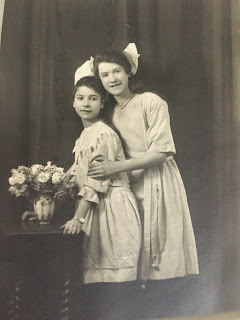
Belfast in 1921 was on fire – often literally. Northern Ireland, which commemorates its centenary this year, was born from compromise and conflict, an expedient solution to an age-old problem. It was not really designed or expected to succeed; many would argue that it has not. But this is not a political post. This is about two little girls who had their photo taken in East Belfast in the early 1920s – it might not have been 1921, but I like to imagine it was because of the novel. 


Their names are Frances and Annie Duff. Frances is about thirteen and Annie nine or ten. They are my grandmother and my great aunt. They smile out, both with the expressions I remember so well from their later lives as elderly women. (They both lived into their nineties.)  They are well dressed, with the extravagant hair bows I remember from early school story illustrations. Both wear pearls and Annie has a wristwatch. This is clearly An Occasion. 


I like to think that it is June 1921 and that they are all dressed up to go and see the King and Queen open the first Northern Irish parliament at City Hall, as thousands of other unionists did. But possibly not. Gran, an inveterate teller of Stories of the Olden Days,  never mentioned such an outing. But then I knew nothing of this visit myself until I did the research for 
Hope against Hope, so perhaps I just didn’t ask the right questions. When I look closer at their frocks – all their lives they would call dresses frocks -- I see that they are fashionably short, but with huge hems –  made to last. They contrast with the lace edgings of their best frocks in the photo taken some years before – and I think this is not just a change in fashion, but a change in family fortunes. Their mother, Fanny, made their clothes, and took in sewing after their father died – which I believe was in between the two photos. As was the death of their big sister Sadie. 


Unlike the first photo, which was definitely taken in a photographic studio, I fancy this one was taken at home in Beechfield Street. I imagine that I remember that very vase, that little table with its barley-twist legs, but both would have been commonplace in 1921, so they may well have been in a studio.  Wherever they are, I do know that outside was a troubled city, disturbed by rioting and burnings. I know their local Catholic church was attacked in 1920, and that same year, thousands of Catholic workers were run out of the shipyard where Frances and Annie’s father and brothers worked. Nothing of that shows in the photo, but then neither does the tragedy even closer to home – except that Frances, now unexpectedly the Big Sister instead of the middle one, leans rather protectively into Annie – perhaps she is thinking of how fragile a sister’s hold on life can be. Or perhaps she is just doing what the photographer asked: all her life she was a gentle and compliant woman, unlike her granddaughter.


My favourite scene in Hope against Hope is a garden party, where the girls of the hostel at the centre of the story invite neighbouring families for tea, sports and entertainment. Of course I know that’s not where Frances and Annie are going, a treat after the family deaths, a distraction from the troubled city outside their front door. Because I made it up.


But without Gran’s stories, and photos like this, I couldn’t have. 


Friday, 12 June 2020

What's in a Name ? by Judith Allnatt


What's in a name? Well, often quite a nod to history. Our own names often tell us something of the occupations off our ancestors, as in Potter, Shepherd, Smith (blacksmith) and Whitaker (white acre).  Some, of course, would be difficult to guess. Who would have known that the first name Gary means 'spear-carrier',  Kimberley 'a wood clearing' or  Everard 'strong boar'?


Some names have suffixes that suggest the nature of an occupation. 'Wright' means someone who makes something, as in Wheelwright or Wainwright, 'wain' being short for 'wagon'. Suffixes can also imply gender. The surname Webb was commonly used for a male weaver. The suffix 'ster' was often added for a female labourer, as in 'Webster'. Words on this pattern have even entered the language as nouns.  'Spinster' no doubt originated from an occupation commonly taken up by single women needing to support themselves. Prefixes can also be revealing. 'Fitz', from Old French,  means 'son of', as in Fitzpatrick or Fitzgerald, or in the case of Fitzroy the (illegitimate) son of the King (Roi).

When choosing names for characters, novelists generally think carefully about the nature of the character and the impression they want to create. Thomas Hardy, in Far from the Madding Crowd, introduces his character, Gabriel Oak, through his robust clothes and steady nature but his name also underpins this impression. A man named after an archangel and the sturdiest of English trees must surely be a moral benchmark and a reliable, all round solid chap.


Sometimes historical research can lead a writer to a name that chimes with their idea of a character.When I was writing The Silk Factory, set in the early 1800s, I drew on the history of John English, the overseer in the silk manufactory in my Northamptonshire village. He was described by the outraged schoolmaster of the time as 'an inhuman taskmaster'. Like Gabriel Oak, John English seemed far too traditional and forthright a name for a character who was to cruelly exploit and mistreat his workforce. I would have to rename him. In researching the industry, I read about weaving  workshops in Spitalfields in London and how nets would sometimes be set up on the rooftops  to catch songbirds to sell. A bird catcher was known then as a 'fowler' - the perfect name for the silk master overseeing a workforce trapped in a stuffy attic working sixteen-hour days.

John English also had a mysterious past. An advert in the Northampton Mercury offered a reward of ten guineas for his capture as he was accused of several felonies, including theft and cruelty. It said: 'He has many wounds upon his head and in different parts of his body, wears a wig and the general turn of his conversation is directed to Travelling, Voyages, Mechanics and discovering Mines and the North-West passage.' Because  of this, I wanted a first name that had elements of mystery and exoticism. I chose 'Septimus', the name used for a seventh son, a role imbued with mystery in fairy tales through the ages. 'Septimus  Fowler', I felt would be a character that the reader would recognise as villainous from the moment of his introduction.

We don't tend to think about the origins or meanings of names as we use them in everyday life. They've become commonplace over the generations through their frequent use. However, I think perhaps we sometimes have an unconscious awareness of their associations. When writing A Mile of River, which features a farmer obsessed with expanding his land and controlling his family, I drew a blank for his name. After a night sleeping on it, I came up with the name 'Henry Garton'. It seemed to click although I couldn't have said why. Looking up the meanings I found "Henry - head of the household" and "Garton - a fenced farm, a walker of boundaries". A salutary lesson on trusting one's writerly instincts!

No wonder many peoples have superstitions about telling a stranger their names. Perhaps they have a sense that to do so is to part with more information about themselves  than they would like to give. What's in a name? Quite a lot it would seem.

Friday, 13 September 2019

Family Furniture

My parents are hoping to move house soon, which means downsizing. Suddenly some of the furniture that’s been, well, part of the furniture for my whole life is under threat. It won’t all fit in the new house, and most of it is too big for my own wee home, which is adequately furnished already anyway. There is talk of Getting a Few Quid for that big old sideboard, and Aunt Annie’s Edwardian mahogany wardrobe. That’s if anyone actually wants such monstrosities these days. 


Belfast, early 1920s when Granda was first working
I’m a terrible sentimentalist about objects, and I found myself worried especially about that wardrobe, carefully brought from her family home by my good old spinster aunt and installed, incongruously, in her tiny council flat in the 1970s. Polished every week. How would it feel sad and unloved at the back of the Oxfam furniture shop, or in a skip? 

Which made me start to think about my own furniture. It’s a mish-mash – a few nice antiques bought in richer times (before being a writer!), some bookcases hand-made by my late father, and plenty of ordinary modern stuff that I wouldn’t miss if I had to dispose of it. Nothing with as much family history as Aunt Annie’s wardrobes.

Except the bookcase in the study. I remember this from my grandparents’ home, where it lived in The Good Room. At some stage it passed on to me and for many years, in my twenties, it was the only decent piece of furniture I had. 


It looks like an ordinary glass-fronted mahogany bookcase, but my understanding is that it began life as a display cabinet in a shoe shop where my grandfather worked. He was a bright boy who had to leave school at fourteen to help support his family. He studied at night school to become a chiropodist, but as far as I know the shoe shop was his first job. I’m not sure how he got hold of the display case – was the shop offloading old furniture, or maybe closing down? Did he have to pay for it? He can’t have had much spare cash, so maybe he was able to get it for a few pence a week. Was he proud of it? Its position in his eventual marital home would suggest so. 

Granda filled the bookcase with his library of theology books, Charles Dickens, and an array of reference books. (Granda's Google). In my home it houses school stories by Elinor Brent-Dyer and Dorita Fairlie Bruce. Granda would have considered these very frivolous but I think they’re perfect for his bookcase. He left school in about 1918, just before these books started to be published. His little sister Olive might well have been given titles like Dimsie Goes to School at just the same time as Granda brought home the bookcase. 

I don’t know if I’ll ever move house – in all likelihood I will, some day – and there’s plenty of furniture I’ll be able to send to a charity shop without a thought. But the bookcase, or display case, which Granda got from an unknown Belfast shoe shop about a hundred years ago, will be staying with me. 

Wednesday, 6 February 2019

Lessons From My Spinster Aunt

It’s 1975 and I’m spending the day with Aunt Annie in her little council flat. She’s very old (actually, she’s 64 but I am seven) but good fun. She shows me how to knit dolls’ clothes and lets me drink tea even though I am a child. We walk to Stewart’s supermarket on the Belmont Road, and Aunt Annie buys Cadbury’s mini chocolate rolls and Kimberley biscuits. I’m looking forward to getting home because I know she’ll open them and put the kettle on. We share a sweet tooth, and a love of tea, cats and reading. She favours Mills and Boon, but hides them behind a cushion when the minster or my granda come to call. Whether this is because they would consider them racy, or whether she doesn’t want to be seen as sadly yearning for romance, I am too young to ponder. I just think it’s delicious fun and a bit like me reading under the bedclothes.

Annie (far left) with sisters Sadie and Frances
On the way back up the Belmont Road road we bump into an acquaintance – let us call her Betty – and I settle myself in for a long wait, because Aunt Annie likes to chat and I know not to interrupt. Unlike my grandparents, Aunt Annie does not dote on me, though she likes me well enough. She doesn’t know that she is about to give me one of the most valuable lessons of my whole life.

Betty looks into Aunt Annie’s string bag and sees the mini rolls and biscuits. (This is two decades before Aunt Annie will be diagnosed with Type 2 diabetes.) 

‘Oh,’ she says. ‘You’re good to yourself.’ Clearly she does not approve. 

‘Indeed and I am,’ says Aunt Annie. ‘And if I’m not, who will be?’ She is not apologetic. She makes no excuse. She likes what she likes. I am seven and I will never forget. 

Aunt Annie is a spinster. I know what that means –  a woman who has never had a husband – but I have no idea WHY. I am a tactless and inquisitive child but some delicacy suggests that this is something not to ask. The word spinster is redolent of disappointment, of chances lost and time going by. Later I study women’s history and realise that sometimes it is more sinister than that: that single women have often been the object of suspicion and derision. 

Annie as a teenager 
Aunt Annie is short and round with a button nose and soft white hair. In old photos she looks at least as pretty as her married sister and chums, so I can’t put her spinsterhood down to lack of physical charm. When I’m older and learn about the First World War and the generation of women whose sweethearts were lost, I think, Aha! Aunt Annie! But as she was born in 1911, that’s nonsense. In fact it would be more likely that she could lose a sweetheart in the Second World War. But as far as I knew that wasn’t the case. By then she was housekeeping for her brother John, in the terraced house they had grown up in in East Belfast. Her parents both died young, her siblings were married or emigrated or dead. What else would she have done? Only once, in her eighties, she told me that she had always wanted to emigrate to Australia but knew her duty was to stay with brother John.

When Uncle John died in 1960, Annie would have been 49, a year younger than I am now. I don’t know if she felt free: she adored him so she’s much more likely to have felt bereft. She didn’t go to Australia, but she went out and got a job as a school cook and took to reading Mills and Boon. She was busy in the church and had lots of friends. When soldiers were posted to her street in 1970 she made them cups of tea. She moved herself and the solid Edwardian furniture she’d inherited into a tiny flat two miles away when the troubles came too close to her door. Her teapot, like mine today, rarely got the chance to cool down except overnight. You’re just like your Aunt Annie, my Gran used to say about my fondness for tea. I still have her teapot though the enamel is too worn inside for me to use. 

Aunt Annie's teapot 

Aunt Annie died in her nineties, six weeks after her sister, my gran, over forty years after her brother. Now I too am fifty and unmarried. Sometimes I call myself a spinster and people say, Oh don’t! It sounds awful. So pathetic. And I think of my spinster aunt, and her string bag full of chocolate mini-rolls and the lesson she taught me that day in 1975 – that of being good to yourself. Of self-worth and independence. And I’m proud to be a spinster like her, and I remember her today and every time I treat myself well. 


Annie (far left), sister Frances (far right) with some friends 

Sunday, 6 January 2019

Other People's Rubbish or The Charm of Ephemera

It started with a button jar. ‘I can’t quite bear to throw it out,’ my friend Susanne said, ‘but I must be sensible…’

I was a strange child. I hung round at the end of jumble sales to buy the ragtag rubbish toys that hadn’t sold. One-eyed cats; amputee teddies, once a knitted doll of such startlingly bad execution that my own eight-year-old knitting skills were better. I never paid more than 5p and often the kind churchy ladies would give me the toys for nothing, because, ‘Sure, they’ll only go in the bin’ – at which I would cover the toys’ poor ears (if they had them). When I read Little Women I identified with Beth March’s retinue of mutilated dolls (though it was animals I favoured: I remember a particularly forlorn woollen cat.) 

As an adult I have learned to harden my heart. I am a cruel thrower out of letters, shredder of old photos and packer-off-to-the-charity-shop of faithful old frocks. For that reason perhaps Susanne asked me to help her pack up the large house, once her childhood home, she is moving away from. ‘I know you’ll be sensible and not let me hang on to sentimental rubbish,’ she said. 

It is easy to be sensible about the death notices of other people’s relations; the pages of O level notes; the baby clothes; the costume jewellery worn by other people’s aunts. The rubbish pile was satisfyingly higher than the keeping pile. We were good at this unsentimental business!

But the coins. Her father had been an enthusiastic collector of coins, and who can resist a silver sixpenny bit, especially the Irish one with the dog on it? Such classic design could not in conscience be thrown out.
 
And the old Brownie badges? I have no idea what happened to my own Brownie badges (I left in 1978) but I could not bear to think of Susanne’s being discarded. As for the collection of china horses – no, no, no! They had such trusting faces! As for those adorable little cotton handkerchiefs with the horses’ heads on them – why, they were exactly like the ones people in pony books used to get in their Christmas stockings. And they took up no space really. 

I left Susanne’s house with a bursting carrier bag full of, well, other people’s rubbish, really. But fear not, gentle reader: this is not a matter of sentiment. This ephemera will work for its keep. I have several workshops on historical fiction to give in the next few months and who knows what flights of fancy might be inspired by that bag of coins, or the ARP badge or the mid-century dolls’ house furniture?


And the button jar of course. I have never quite forgiven myself for letting my own granny’s button box go. I’ll look after this one better. 


Thursday, 6 December 2018

Did Fanny Vote? by Sheena Wilkinson

In just over a week, on 14th December 2018 it will be the centenary of the election where some women in Britain and Ireland had the right to vote for the first time in a parliamentary election.

Last week in Dublin I saw commemorative posters of Constance Markievicz on almost every lamp-post. Markievicz was of course the first woman elected to Westminter, though as an Irish Republican she never took up that seat, recognising Dáil Eireann instead. I knew then that I’d have to find something fresh to say about the 1918 election for my upcoming History Girls post.


commemorative posters in Dublin 
Fresh? How? I’ve been living with this date for over two years, since I started writing my 2017 novel Star By Star which focuses on that election. I’ve done suffragist-themed events from Aberdeeen down to London, and from Derry to Kerry. I've written lots of relevant articles and blogs. I’m pretty much electioned-out, especially as during that time I also found myself campaigning in real life during both NI Assembly and UK Westminster elections. 


So today I’m thinking not of Constance Markiewicz, not even of Winifred Carney, who stood for Sinn Féin in an east Belfast seat she hadn’t a hope of winning, but of an obscure woman in a terraced parlour house in that same East Belfast electoral ward.

Fanny Duff 
Fanny Duff was my great-grandmother. I know very little about her. She was, according to my grandmother, her daughter Frances, a gentle and quiet woman. She brought up a large family. She saw her sons off to good skilled shipyard jobs like their father, and one to emigration. Two daughters went into shirt factories, and one died in her teens. Fanny was widowed young, and took in sewing to help provide for the family. She died suddenly in 1936, the day after my grandmother's 28th birthday. 

Was Fanny eligible to vote in 1918? I assume so. She was over 30, and married to the householder of a respectable three-story terrace house whose rateable value would have been over the necessary £5 threshold. 

She lived in an area that was then more mixed than it is today, but even so it was a safe unionist seat and Fanny’s family were unionists. The newspapers -- it is most likely the Duffs read The News Letter -- were full of exhortations to vote and instructions on how to do so. I love the idea of her defying family tradition – and possibly her husband, James, and casting her vote for a woman, feminism trumping tribal identity, but that was even less likely in 1918 Belfast than it would be today, and there is no evidence that Fanny was a feminist. 

Maybe she didn’t vote at all. In December 1918 the flu pandemic was still raging. It affected both the election campaigns and turnout. Fanny may have been nursing one of her children, or have been ill herself. Or she may have been well but reluctant to queue up at a crowded polling station and risk infection. 

I talked to my own granny a lot about what we both called the olden days. But I never asked about that election day when she was ten years old. I never asked if her mother went to vote or if politics was talked about in the house. There can be nobody alive now who remembers Fanny Duff, who died in 1936. She’s just one more working class woman who may, or may not, have played a part in that historic election. But she was my great-grandmother, and next Friday, on the 14thDecember, I choose to think of her striding proudly down Beechfield Street, perhaps on her husband’s arm, perhaps alone or with a group of neighbours, ready to cast her vote for the first time.