Showing posts with label the writing life. Show all posts

Thursday, 2 August 2018

The Perambulator in the Hall: Writing with Children Before CBeebies - by Anna Mazzola

I love my children, and know how lucky I am to have them. But I also love writing, and writing and young children are not necessarily compatible. Hence summer holidays pose a challenge.

There has been much discussion in recent years about how modern writers deal with the so-called ‘pram in the hall’, but I began to wonder how writers occupied their children in the days before Peppa Pig. And how did families and writing intersect?


The gender divide


Asked recently how she had had produced so much work with two children, author Lauren Groff replied: ‘I understand that this is a question of vital importance to many people, particularly to other mothers who are artists trying to get their work done, and know that I feel for everyone in the struggle. But until I see a male writer asked this question, I’m going to respectfully decline to answer it.’

It’s true, of course, that women are still asked this question far more than men, but go back a century or two and no would even have considered asking a male author about his work/life balance. The time-honoured way of writing with children was to have a dutiful wife to look after them, and ideally a hoard of servants. Charles Dickens had ten children. Tolstoy had thirteen. I don’t believe anyone ever asked them about their childcare arrangements.

Mark Twain’s children weren’t allowed anywhere near his study and would ‘blow a horn if they needed him’. Thomas Mann angrily removed any child who disturbed his work. However, E.B White said he often wrote in his living room 'despite the carnival that is going on all around me.' George Orwell’s adopted son remembers him as a ‘hands on’ father who looked after him following his mother's death. After JG Ballard lost his wife to pneumonia in 1964 he brought up their children alone while continuing with his writing, and his children remember him as a kind and dedicated father. These were still, however, the exceptions.

From kitchen tables to different contintents 


For women, historically the primary caregivers, the situation varied greatly. During 19th century, some female writers had wealth that enabled them to pay for nursemaids or governesses to occupy their children while they wrote. However, that was not always the case. Elizabeth Gaskell often wrote at the kitchen table, with her children around her. Frances Trollope, who began writing at age of 53 to support her sick husband and six children, sat down at her desk each day at 4 a.m. and completed her writing in time to serve breakfast.


Some writers left their children with others for long stretches in order to write. Daphne Du Maurier left her young daughters with a nanny and their grandmothers for many months so that she could finish Rebecca. She once wrote, ‘I am not one of those mothers who live for having their brats with them all the time.’

Enid Blyton, though she wrote of idyllic childhoods, seems to have had little time for her own children. In her memoir, A Childhood At Green Hedges, Enid Blyton’s youngest daughter recalls that, ‘Most of my mother’s visits to the nursery were hasty, angry ones, rather than benevolent. The nursery was a lonely place.’

Some took it a step further. Doris Lessing, in her autobiography, Under My Skin, writes of ‘committing the unforgivable’ and leaving her ten-year-old son, John, and six-year-old daughter, Jean, to grow up with their father in Rhodesia. But, as ever, the full story is more complex. The woman who once claimed ‘No one can write with a child around’ in fact kept her young son Peter with her and continued to care for him throughout his life.

Similarly, though Muriel Spark acquired a reputation as un-motherly for leaving her son with his mentally ill father in order to pursue her writing career, the reality seems to have been far more complicated and painful.

The prize for deserting ones children in order to write in fact goes to a man: Jean-Jacques Rousseau abandoned all five of his children at foundling hospitals. And then of course wrote Emile, a novel lauded for its insights into the nature of children.


Carving out space


Most writers, however, did what we all do, which is to try to carve out writing time from our daily lives.

Some wrote at night. Ursula Le Guin said, ‘I would go up to the attic, and work 9:00 to midnight. If I was tired, it was a little tough. But I was kind of gung-ho to do it. I like to write. It’s exciting, something I’m really happy doing.’ Toni Morrison began writing as a single mother to two young children. 'Writing was something for me to do in the evenings, after the children were asleep.'

Others, like Trollope, woke ridiculously early in the morning. Sylvia Plath rose at 5am when the sedatives wore up and wrote until her children woke up. Within two months she had produced nearly all the poems that comprised Ariel.

Adapting writing 


Many writers had to alter their working practices or style in order to fit around family life.

When, in the 1780s, Hester Thrale was criticised for having written Anecdotes of Dr Johnson rather than a full biography, she countered that 'if one is to listen all Eveng and write all Morning what one has heard; where will be the time for... having one's children about one?'

Others used the constraints of family life in order to create. Celia Fremlin's brilliant Hours Before Dawn came from her sleep-deprivation following her second baby. Alice Munro has said that she began writing short stories because as a young mother she had no time to write novels: ‘When you are responsible for running a house and taking care of small children, particularly in the days before disposable diapers or ubiquitous automatic washing machines, it’s hard to arrange for large chunks of time.’

Shirley Jackson told herself stories while doing the laundry. ‘All the time that I am making beds and doing dishes and driving to town for dancing shoes, I am telling myself stories,’ she said in one of her lectures. According to Jackson’s biographer, ‘The idea for “The Lottery” came to her while she was grocery shopping with her daughter Joanne, then age 2. After they came home, she put away the groceries, put the child in her playpen, and wrote the story.’ One can only assume she didn’t much like the other shoppers.


Now it’s not just the women who have to adapt their writing to family life. Michael Chabon and his wife, Ayelet Waldman, have four children and share the childcare so that they can both write. Karl Ove Knausgaard has said, 'When I started to write I thought I had to be isolated. I went to lighthouses in the sea, and uninhabited islands. But then I had children and I realised I had to do it at home. I’ve never written as well as I have since having children.'  In a recent interview, Robert Harris also dismissed the notion that you had to write somewhere remote, saying, ‘You really need domestic routine and life going on around you, I think.’

I question, however, whether their domestic routines involve small children regularly coming up to their desks demanding that they locate small plastic toys or separate a fight. Perhaps I should do as another (unnamed) writer does: hang a sign on the door saying, 'Only knock in the event of blood.'


__________________________________________________________

Anna Mazzola is a writer of historical crime fiction. And a mum.

https://annamazzola.com
https://twitter.com/Anna_Mazz


Monday, 28 November 2016

Wall to Wall by Julie Summers

I have just spent a magical, exhausting but immensely rewarding week as a tutor on an Arvon Foundation non-fiction course. As I write I am sitting up in bed in what used to be John Osborne's study at the Hurst, his home for the last years of his life. It is one of the most beautiful places I have ever spent time in though I have scarcely been beyond the front door. The study is large and sparsely furnished. The only true reminder of his presence is his leather topped writing desk at which I have sat every morning and evening reading work submitted by the students. While I am no believer in ghosts or spirits, it certainly feels slightly unreal and mystical to be inhabiting the same space as the great man. I suspect that much else in the room has changed since his day and I am sure there was no green Exit sign with a running man and an arrow on the wall... But I digress.
The Arvon Foundation was set up by two poets, John Moat and John Fairfax, and Antoinette Moat who helped buy the first Arvon property, Totleigh Barton in Devon. The original aim was to provide time and space away from school for young people to write poetry. Today residential courses take place in one of three houses situated in remote rural locations in Devon, Shropshire and Yorkshire. Over the last almost fifty years it has helped countless writers to spend time honing or developing new skills or simply learning to come to terms with how they wish to express themselves, whether through poetry, prose, drama or non-fiction. The recipe is simple: take up to sixteen people of mixed age, background, ability, ambition and sex. Shut them up in a remote house - in this case in the heart of Shropshire - with two tutors and plenty of food and see what happens. The structure of the course is up to the tutors but fits into a framework that has been well tried and tested: the mornings spent in a workshop and the afternoons writing or attending half hour tutorials with one or other of the tutors. It doesn't sound like hard work when written down but it is intense, let me tell you, especially from the tutor's point of view.
All meals are enjoyed together and the evening meal is prepared by the students, with washing up and table laying done in teams. Inevitably the table talk focuses on writing so in the event the only time you are not either thinking, talking about working on writing is when you are asleep. At least that was the case for me. Yet it was hugely enjoyable and something I would do again if I were asked. While it would be out of order to name names, we have been lucky enough this week to work with a dozen fabulous writers who each has a major project they want to bring to a wider audience. Stirring tales from family history were predominant and I have enjoyed learning about the author, Charles Lee, who wrote down the Cornish language; a trio of women connected with the Garden City movement and bawdy women in history to name but three.
There is something energising about being with a group of people who are wholly focused on writing historical non-fiction. It reminds me of the immense richness and variety of possibilities there are to focus on an aspect of real life and bring it out in written form. I admire writers of fiction for their ability to conjure up worlds in their heads but I am equally in awe of writers who can corral and tidy up the messiness of life and show it to us in ways that make some sense, drawing strings together to weave a story that does more than just lay down facts, dates and names. In one of our workshops we looked at the old chestnut: oral history. To write historical non-fiction is to some extent to be an eyewitness to history. Yet as anyone knows, to claim to have the only view on an historical event is to ignore the human mind's ability to process what it sees, hears, feels, smells and senses. I remember chairing a panel one this topic a few years ago at a literary festival and concluding that one person's view can differ so radically from another's that it is as if they had witnessed two different events.
We tried this out in a controlled experiment at Arvon this week. The results were nothing short of hilarious. On the evening prior to the exercise, so just over twelve hours earlier, four members of the group, including my fellow tutor, Ian Marchant, had performed a reading-with-actions of a fourhanded play written by Charles Lee and first performed in 1913. The resulting accounts from both players and audience were so diverse as to make me wonder whether we had all been in the same room together. The only thing that convinced me that we had was the overwhelming sense of place and atmosphere. That is something that often links people's experiences and - if they are unfortunate to suffer a bad or dangerous one - can form lifelong and exclusive closeness. I suspect in the case of our experience any allusion to the Revered Becksmith will just raise a broad grin of recognition. I knew the experience of teaching on an Arvon course would be a good one but I had no idea beforehand just how rewarding it would be. I cannot remember enjoying the company of a dozen or so fellow writers as much as I have this week and I return to my desk and the second half of my book - now known thanks to my 'colleague' (as he always addressed me) Ian Watt as the Shitty First Draft. If you ever fancy an indulgent sojourn with fellow writers, I cannot recommend an Arvon course highly enough, either as a tutor or a student. The staff at the centres are wonderful, supportive and unflappable and make the whole experience easy to enjoy. But it is the writers who make it special and memorable. It has reminded me of the joys and pitfalls of writing historical non-fiction and how the joys win every time.

Wednesday, 17 August 2016

"Blah, Blah, Blah . . ." or Points about Writing Life learnt from Shakespeare. By Penny Dolan


(As August is the silly season and History Girls are surely in a holiday mood, today’s post is a non-academic diversion plus a few thoughts that mumbled into my mind. A more sensible HG post should arrive in time for 17th September.)


“Blah, blah, blah!” – exact context later – is how this post starts, and it is partly about some writing points learned from Shakespeare or, more accurately, whilst watching BILL, a fictional comedy about Shakespeare’s lost early life.

Created by the Horrible Histories team, BILL echoes the “historical” style of Python or Blackadder, with members of the company playing several roles. The film is light-hearted fun although one can also play the slightly smug-faced game of spotting the Bard quotes and historical references.

The plot is simple: young Bill - full of dreams, vanity and confidence - sets off to make his artistic name in London, leaving his wife and children behind in rural Stratford-on-Avon. Meanwhile, King Philip of Spain is hatching a dastardly Catholic plot against Protestant Elizabeth and arrives with his men on a disguised diplomatic visit. What better way could there be to get close to the Queen than to stage a play in her honour and invite along? Surely nothing can . . .

The enticing play, of course, first has to be written, and at the end of a series of errors, entanglements and revelations, young Bill unexpectedly gains the favour of Queen Elizabeth I, a little financial security, and the “William Shakespeare” of that image is born.

Some of the best Horrible History moments included:
-         Bill the dreamer, losing his bundle-on-a-stick of belongings as he enters the filthy, crowded and violent city.
-         the man in an iron gibbet who chats to all passers-by
-         the over-eager plague-wagon pushers
-         the leather-clad King Philip of Spain - a man of many moustaches – practising his sword-skills. 
-        the sudden appearances - and disappearances - of  cunning Spymaster Walsingham.
-         the hidden war-room of the Catholic insurgents.
And additionally
-  Queen Elizabeth, played by Helen McCrory, displaying Big Royal Attitude as well as ghastly teeth and make-up, who alone is worth a mention on the History Girls blog.


As well as  Occasional interior images of the Globe Theatre.

I admit that BILL was neither deep nor soul-changing, but the film felt right for some cheering-up on a grey afternoon. The film made good holiday viewing with older children a second time around too. Besides – and the point of my HG post – is that all the way through the script, Bill is learning useful things about the work of being a writer. 

And here are some of Bill’s useful life-lessons.
*Bill, unwilling to conform to the lute style of the local music group Mortal Coil, leaves Stratford and sets off to find fame. Moral: Sometimes you have to believe in your own talent and set off in other, more solitary directions – and sometimes it’s best not to upset everyone at home when you do.

*Bill, starry eyed, arrives in London, trying to find where it’s all happening. Moral: Try to find out about the networks and structures of one’s craft but be wary: not every offer that comes along will be beneficial.

*Meanwhile, Lord Crawley, who plans to win Queen Elizabeth’s favour by writing a play, decides it will be easy. “It’s just talking written down,” he declares. Too soon, and under pressure, he discovers Blah, blah, blah . . .  (followed by a big, angry sigh of exasperation) God, writing is HARD!Moral: Writing is not as easy as some people think it is, nor done at all as quickly as one might expect.

*Bill, in an enthusiastic frenzy, writes an over-blown script crammed with every “Shakespeare” plotline we recognise. Moral: Bill’s crazy first draft isn’t perfect. He has to shape it into something that makes sense to his audience, but those discarded ideas can be used for another story or another genre.
 
*“You’re a writer. I’m a writer too!” young Bill declares, sitting closer to Christopher Marlowe. Despite Marlowe’s own troubles, he spends time helping Bill to structure his play, “modelling” how to work hard on a project. Moral: A good mentor is invaluable to a young writer, especially when they demonstrate how to work like a professional.

*Unfortunately, Christopher Marlowe, although a “successful playwright”, is already fatally troubled by debts. He tells young Bill. “There’s no money in it. I can’t even buy a house without borrowing money I can’t pay back.”  Moral: Writing doesn’t often bring a cosy, profitable life. Nor, for Marlowe, does Spying.

*Bill’s early “acting career” (within this film) shows him dressed as a tomato in the market, handing out leaflets promoting the eating of vegetables. Marlowe, alongside, appears dressed as a cucumber. Moral: Bill has big dreams but he has to do less noble work before he hits the big time, even if his family are horrified.


*Bill, struggling to write a new play, despairs and feels he doesn’t know what or how to write. Moral: Bill learns to “write what you know”, drawing on his own knowledge and emotions, even though his plot might be set in an enchanted wood.

Finally, Bill learns to be alert to other people’s agendas too, especially when they involve barrels of gunpowder and plots against the Queen.  

Moral: Make sure you have good ending!

Released to celebrate Shakespeare’s 2015 anniversary, the BILL DVD brought some enjoyable “holiday” moments this summer, including the glimpse into the scriptwriters thoughts on the world of writing.
  

Now that the visitors have left, I’ve peeped back into the world of “Bill” again, as I am reading SHAKESPEARE’S RESTLESS WORLD: AN UNEXPECTED HISTORY IN TWENTY OBJECTS BY DR NEIL MACGREGOR. An interesting collection, only just begun – and I had never quite realised the precise importance of calling one’s theatre “The Globe” at that moment in time.

And, yes, the Mortal Coil do “shuffle off” and John Gerard’s Herbal, written in 1587, dismissed tomatoes as “poisonous and of rank and stinking savour”, so this would have been a very trying task for a young and hopeful actor.

Penny Dolan

Wednesday, 5 February 2014

Vermin and Vellum - Joan Lennon

It's no secret that I find having a sleeping cat near me when writing to be both soothing and inspiring, in equal measure.  When I've read about how, in medieval scriptoria, monks shared their literary space with cats, I've thought, Aw, that's sweet - them and me and our furry muses ... not thinking about any other reasons to keep a cat.  I know the Pangur Ban poem which begins - 

I and Pangur Bán, my cat 
'Tis a like task we are at; 
Hunting mice is his delight,
Hunting words I sit all night.

and still I didn't twig.

It's obvious, of course.  Medieval monks, working away at their beautiful illuminated manuscripts, had enemies other than just Nordic types going a-viking.  They were painstakingly inscribing their letters and images onto lunch.


                                                      (© Corpus Christi College Cambridge, MS 214, fol. 122r)

That manuscript has been thoroughly gnawed and nibbled on.  (Though the mice have shown a certain restraint.  Or is it just a question of generous margins?)  It was, therefore, an excellent idea to have in your scriptorium at least one cat.  Some, perhaps, larger than others ...


                                                                 (image from wikipedia)

(Okay, I know, I know, it's a lion and it's there because St Jerome took a thorn out of his paw - but it's such a lovely picture ...)


But, as anyone who's ever tried to shoo a cat off a keyboard will know, cats and writing do not always go together so peacefully.


(image from National Geographic)

Inky paws skitter across the page - or sometimes something worse ...


                                                        (© Cologne, Historisches Archiv, G.B. quarto, 249, fol. 68r)

Make the image a bit bigger - that's a cat the cheesed-off monk has drawn, not a donkey, and those accusing fingers are pointing at potent, pongy, moggy pee.  It's enough to make a good man curse.

Hic non defectus est, sed cattus minxit desuper nocte quadam. Confundatur pessimus cattus qui minxit super librum istum in nocte Daventrie, et consimiliter omnes alii propter illum. Et cavendum valde ne permittantur libri aperti per noctem ubi cattie venire possunt.
Here is nothing missing, but a cat urinated on this during a certain night. Cursed be the pesty cat that urinated over this book during the night in Deventer and because of it many others [other cats] too. And beware well not to leave open books at night where cats can come.
Well, it's good advice.  Vermin and vellum may not mix, but cat pee really doesn't enhance anything at all.


Joan Lennon's website.
Joan Lennon's blog.


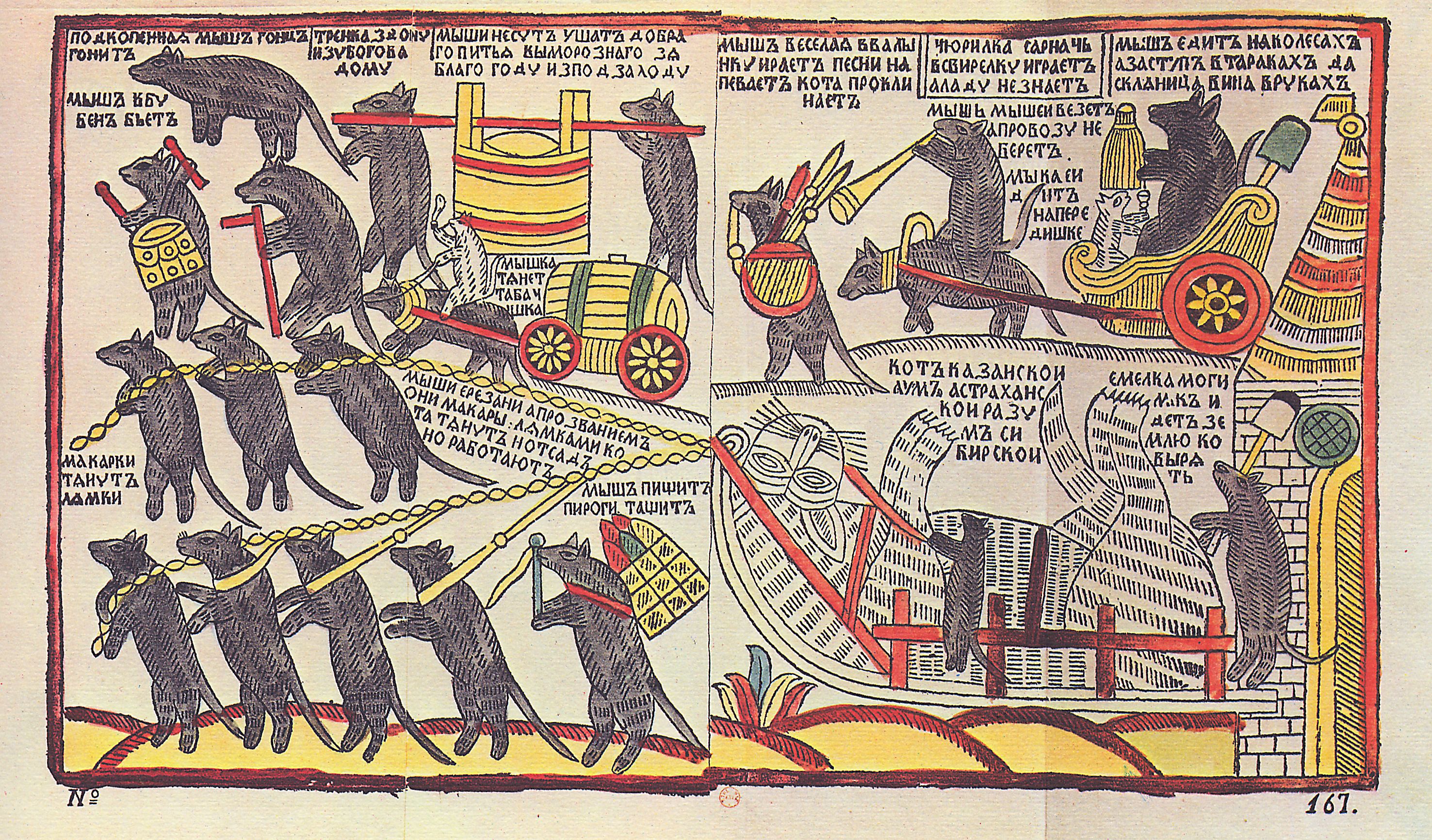
P.S.  It was not only monks who had grudges against cats.  If, instead of nibbling the vellum, the vermin had engaged in some art work of their own, they might very well have come up with something along the lines of this 18th century Russian print -


(image from wikipedia)

I'll not be showing this to my cat.  She's a sensitive soul.