
Friday, 12 May 2023
Just how Depraved was Ancient Rome? By L.J. Trafford
This summary is not available. Please
click here to view the post.

Friday, 5 May 2023
The Coronation - Inevitably! - Celia Rees
 |
| Coronation Mug - 1953 |
I'm not a royalist, by any means, but as my allotted History Girls post falls the day before the Coronation, I didn't think that I could ignore this great national occasion. Whatever one's thoughts are about the monarchy (and I have views) this is the History Girls Blog after all and the ritual which is the coronation reaches back deep into history. The order of service and the liturgy extends back to the 10th Century and the ultimate roots of the ritual lie in the Bronze Age, as explained by Tom Holland on The Rest Is History, the superb podcast he shares with Dominic Sandbrook. If you don't already listen, you are missing a treat.
 |
| Coronation Mug - 2023 (attr.Adèle Geras) |
By tomorrow evening, I will have witnessed two coronations. I was three when Elizabeth was crowned Queen in 1953. The world is very different now. For me, this is neatly illustrated by the different coronation mug designs. There are plenty of mugs for this coronation of traditional design but in 1953 this 2023 design would have been unimaginable.
So very much has changed between now and then. The 1953 Coronation is my clearest early memory. All the neighbours crowded into the McCauley's sitting room because they were the one of the few families in the street with a television. It was in the corner of the room, encased in a polished wooden cabinet. The screen was very small, the picture black and white and very fuzzy (but that might have been the McCauley's set). I'd never seen television before. I went to see where the horses' legs were then I decided I didn't like it and hid behind the settee. I was eventually coaxed out to sit on my father's knee and watch what seemed like an endless procession of soldiers, sailors, coaches and men on horses. The parading of our own armed forces and those of the Commonwealth.
For Charles' coronation, the procession through London has been shortened, parred down, modernised. The ceremony inside Westminster Abbey, however, will remain the same. The robes, regalia, the order of service, go back at least a thousand years. There are two changes: ambergris has been omitted from the holy oil (to make it vegan friendly) and the central ritual, the anointing, will take place behind a screen, not under a canopy. Screen or canopy, the anointing of the monarch with holy oil goes back to the Old Testament, a ritual so sacred that it is kept away from public eyes. In 1953 it was not even televised. All this reminds us that we live in a monarchy and that the monarch is marked out from the rest of us by God. Awesome, in the true sense of the word, and profoundly odd - an ancient mystery being carried out in the twenty-first century.
To mark the coronation of Queen Elizabeth II, children were given little models of the State Coach as souvenirs. Time and wear have taken a toll on these mementoes but they were much prized and a few have survived. I still have mine and so does my friend, Rachel.
 |
| Coronation coach - attr. Rachel Bagley |
Coronation Day, 1953, it rained but everyone went out in the afternoon to celebrate this great occasion. There was an ox roast in the park and a street party which was moved into the Mills' garage when the rain intensified. There were sandwiches, cake, jelly, peaches and evaporated milk. There will be street parties tomorrow, although fewer than in 1953. How will the table differ? I doubt there will be jelly and evaporated milk. No crisps in 1953, no nibbles of any kind. Apparently, the popular 2023 celebratory choices are Quiche and Fizz, unimaginable in 1953, but Coronation Chicken is up there with them.
 |
| 1953 Street Party |
1n 1953, Coronation Chicken had only just been invented by celebrated cookery writer Constance Spry for the official Coronation Luncheon. It has since become a stalwart of the buffet and a popular sandwich filling. This concoction of chicken, mayonnaise, apricot jam (or mango chutney) and curry powder will be served at street parties on Saturday (see above), a tenuous link to the last coronation. A very 2023 hack on the Coronation Chicken is M&S's Coronation Scotch Egg. A delicacy not dreamed of in 1953.
 |
| Coronation Chicken |
 |
| M&S Coronation Scotch Egg |
Enjoy the Coronation of Charles III however you choose to celebrate it and bon appetite!

Friday, 28 April 2023
VISITING HARRY'S HARROGATE by Penny Dolan
I am sure that many History Girls have acted, in one way or another, as historical guide for a location, an event, or on a specific study trip. Sharing your enthusiasm with others can be a real pleasure. However, it can also be interesting to be part of an audience being guided around too. All that role demands is your attention, an amount of physical strength and speed of foot, and perhaps a pen and a neat and handy note book.
Last Sunday, spurred on by idle curiosity, I took a guided tour around my own home, the spa town of Harrogate. I had often seen small groups gathered by the War Memorial, directly opposite the famous Betty’s Tearooms, macs and bags marking them out as visitors. I had also seen, close by, on a tasteful notice-board, details of Harry’s Free Walking Tour.
Who was Harry, I wondered and what did he have to say about the place?
I joined the queue. Exactly on time, a cheerful man strode across the Parliament Street crossing, wearing a neat blue waistcoat, smart shorts and good walking boots and wielding a tall wooden pole, topped by an unmistakeably easy-to-spot blue and yellow disc, He rested his staff against the flower beds, stretched out his hand in greeting and introduced himself, asked for people’s names in return. His enthusiasm indicated we were in for a good time.
Once, twenty years ago, when we first moved to the town, there were venerable people who were the Harrogate Town Guides. They were, I believe, knowledgeable and independent-minded individuals who were probably under the auspices of the excellent Chief Librarian, who was a local historian. They gave their time up on a voluntary basis and were, as far as I know, part of the life of the town. However, somebody official – a councillor or tourism expert or someone, inspired by the new mood of accountability - decided that the Guides should be brought into some kind of formal group. Maybe they were offered helpful training? Given a set script? Handed forms and rotas to fill in and suchlike? Whatever happened, the result was simple. The Guides stepped away from the new requirements and never returned. Gone. Is that not an excellently tempting scenario, whether true or not?
Anyway, the space they left was there for Harry to fill, freelance and under his own rules, all these years later.
Last Sunday, most of his ‘guests’, as Harry called us, were weekenders from around the North of England. Often his guests are from other countries: one woman there was a Canadian, visiting partly because her RAF parents met in Harrogate during WWII. I liked the way Harry had of making everyone feel welcomed and involved and when I awkwardly admitted being local, he simply beamed and asked what I liked best about the town. Clearly, Harry’s Walk was going to be a briskly positive experience for everyone.
While we stood on a patch of damp grass, Harry quickly described the wider geographical context: what lay to the north, south, east or west of the town. After crossing the road, we paused again. This time he ran us through the area’s early history. We heard of Romans in York; Vikings sweeping down from Lindisfarne, the rule of the Anglo-Saxons, the arrival of William of Normandy’s knights and the building of nearby Knaresborough’s historic Castle, now a picturesque ruin overlooking the gorge of the River Nidd. Harrogate, meanwhile, was little more than a hamlet in a marshy area within the Forest of Knaresborough.
Then, in 1596, William Slingsby, a local gentleman who had visited
other spas, discovered a local spring that had similar health giving
properties. Over the period a variety of springs or wells were
discovered, some sweet and some ‘stinking’ water and Harrogate started to grow. Even so, a large area of common grassland known as The Stray was retained and restricted, and still sweeps distinctively through the middle of our town.
Harry, and his amiability, had certainly kept the interest of the crowd. He led us down Montpelier Hill, indicated Slingsby’s Gin Shop, pointed out the now-empty newspaper office where ghost signs still promised a weekly List of Visitors to the town. We passed the famous Harrogate Toffee shop, skirted the Crown Hotel and turned down a cobbled street an iconic Harrogate setting that often appears in tv dramas about Yorkshire, especially any where there is a posh narrative thread.
Meanwhile, we arrived outside the pretty Pump Room, now a museum. On one wall was a push-button spout and stone basin: this was the old sulphur-water well. Despite the smell, the water was – and sometimes still is - considered an effective digestive treatment, yet nobody reached forward to take a sip from the small glass Harry offered.
Sometimes, as he talked, Harry unrolled a long strip of cloth that was wound around his pole, revealing copies of old printed images from Harrogate’s history: a swift and useful way of sharing information with his small group of listeners. Harry had found most of the pictures while studying in the local history section of the town library in preparation for his walks.
Harry then escorted us around the grassy space known as the Crescent Gardens, pointing out the Royal Baths, once a renowned hydrotherapy centre but now a Chinese restaurant, and told us about the Turkish Baths, the only remaining part of the Royal Baths complex in operation. Although the entrance was tucked away from where we stood, he unrolled a picture of the lavish tiled interior, suggesting it as a place worth visiting, although maybe not for this Sunday afternoon’s visitors as booking and swimwear are essential.
Across the road was the Royal Hall, a grand concert and reception hall. Back in 1903, it was ‘The Kursall’ or ‘Cure Hall’, with entertainment seen as a cure for low spirits. The name was changed before the First World War.
Harry then described about something that I would have been delighted to witness: there are, though I had never noticed them, two tall green goblet-like structures high above the entrance to the Royal Hall. Once, he explained, great jets of orange flame burst upwards from these goblets to show visitors that the next entertainment was about to begin. How stunning a sight that must have been! The hall was renowned for its early use of gas lighting, thanks to an incredible local entrepreneur, Mr. Samson Fox, mentioned in one of my past History Girls posts.
Harry pointed out the Majestic Hotel behind, higher up the hill, often seen in the background to a popular Harrogate travel poster and then we walked steadily on, past the now-empty Town Council Offices, built in 1930, towards The Old Swan, that most historic of Harrogate’s hotels, and renowned as the location of ‘missing’ crime writer Agatha Christie’s rediscovery.
I admired the ease and professionalism with which Harry handled the group, sending one person ahead to wait, marking a specific point, while he brought the general crowd and any stragglers firmly and merrily along, chatting and answering questions all the while.
Harry had been a butler and was always involved in hospitality: from childhood within his parents pubs through to a career that included looking after prestigious guests at The Ritz in London and, more recently, as a manager at a Betty’s Tearoom in Yorkshire. Each of these posts demanded more and more hours indoors. Now Harry was doing what he liked best: enjoying life out in the fresh air and sharing his love of his adopted town of Harrogate with visitors.
Harry looped us back, past the Mercer Art Gallery with free entry to all its exhibitions, and in to the Valley Gardens. We strolled through a beautiful, well-kept and old-fashioned grounds with its formal flower beds, a covered Promenade, a winding stream, boating pond, a small elegant cafe, and more, still overlooked by the ornate towers of what was once the Royal Baths Hospital. As we walked, he explained that Harrogate was home to several governmental organisations during World War II, especially the RAF.
Winston Churchill was a frequent visitor to Harrogate too. I once heard tales of Winston running races in his bath chair down the steep curve of Cornwall Road, but was that true? Would the library know? Back we turned, back in the direction of the War Memorial, glancing across at the back of the old Winter Gardens. This buildin, now the grandest pub interior in the Wetherspoon’s chain, is well worth a quick glance inside if you can add a moment's imagination.
One has to grab the good moments and still-existing sights in this tourist town now. Sadly, many of the town’s public buildings have been sold, or are up for sale or for redevelopment. What the town will look like in the future, I did not know and I did not want that grim thought to be part of the day’s experience. Onward.
The last stretch wound through the charming shopping area known as the Montpelier Quarter, then up the hill again. The walk had lasted about an hour and twenty minutes, moving at a happy pace, and had included more information than included here. It was also free, although donations were accepted.
Harry ended his Walk with the heart-rending story about the solitary young Swiss immigrant who, in 1907, came to Yorkshire, eventually founding Betty’s famous Cafe. It was a most suitable ending and maybe if you are ever in town, you can join Harry’s Walking Tour, and hear the tale from Harry himself?
Additionally, what made the guided walk valuable to me, though I knew much of the history, was the space and time it gave to reflect on Harrogate, and to appreciate its odd but interesting past.
Even if it was told by a History Boy.
Penny Dolan
Friday, 21 April 2023
Portrait of Omai - Sue Purkiss
In recent months, you may have read about a drive to keep in Britain a portrait by Sir Joshua Reynolds of a young Polynesian man called Omai, or Mai. The portrait, painted in 1776 or thereabouts, carries the massive price tag of fifty million pounds. The owner is unknown: the price, apparently, is in line with market values. It is at present at the National Portrait Gallery. The government blocked an export licence for the painting for some months on the grounds not just of its quality, but also of its historic significance. No British buyer, or consortium of buyers, was able to raise the full price: but it seems that a deal has been brokered with the J Paul Getty Museum in California, whereby the painting will alternate between that museum and the NPG. It's not ideal for a painting to be shipped across the ocean - but perhaps, in a way, it's fitting: because that's exactly what happened to its subject.
 |
| Joshua Reynolds' portrait of Omai. |
So who was Omai, and why is he such a significant figure? Well, he was a young man in his early twenties, who came from a Polynesian island called Huahine, not far from Tahiti. His father had been killed during ongoing disputes with another island, Bora Bora, and he wanted revenge. We would have known nothing about him had it not been for the fact that in the 1770s, Captain James Cook, highly-skilled navigator and map-maker, was exploring the Pacific. Specifically, he had been tasked by the British Government with mapping the Transit of Venus, an important astronomical event. Observations of this occurence would be highly valuable for future calculations, and needed to be made from a number of sites all over the world - including in the south seas.
 |
| Captain James Cook an official portrait from 1777. |
Now at this time, little was known about the vast Pacific Ocean or the lands which bordered on it. But Cook had just returned from a voyage to the area, and he and the gentleman botanist, Joseph Banks, who had accompanied him, were the talk of the town because of their thrilling and exotic discoveries. They had spent a good while on the island of Tahiti - or Otaheite, as it was first known to them. Banks in particular had thrown himself into the Tahitian lifestyle with great enthusiasm, taking full advantage of Tahitian society's very different approach to sexual mores in particular. Tahiti seemed to the British sailors like Paradise, with its balmy climate, its lush and beautiful vegetation and seas, and its friendly people. When Cook recived the commission to map the transit, and realised he needed to establish a base in the South Pacific to do so, he knew that Tahiti was the perfect place. And so a second voyage to the south seas was planned.
It was on this second voyage to Tahiti that Cook met Omai. (Omai was the name by which he became known in London: at home he was called Mai, or Mae.) Omai wanted to sail with the British when they set off for home, in the hope of acquiring weapons with which to subdue the Bora-Borans.
Cook himself was not very enthusiastic about the idea. On the first voyage, Cook had agreed to the request of another Tahitian to go with the Europeans when they left: this was Tupia, a skilled navigator and clever individual who knew the islands well and acted as a translator. But on this second voyage, he didn't see the point of taking Omai, who was a pleasant young man but had no particularly useful skills. And perhaps too he foresaw some of the problems that might arise from transplanting Omai from his home to the inconceivably different environment of London.
(Tragically, Tupia and his son had both died without ever reaching Britain: Cook was very careful of the health of his crew, and had taken various measures which successfully combatted the dreaded scourge of scurvy. But when his small fleet stopped at Batavia on the way home for essential repairs and to take on fresh food, they found it to be an unhealthy, disease-ridden place. Not a man had been lost to sickness before they arrived there, but now fever swept through the crew. Many died, including Tupai and his son, and most of the others, including Cook, were weakened by sickness.)
Cook eventually agreed that Omai could come on board. He didn't travel on Cook's ship, The Resolution, but on an accompanying ship, Adventure, commanded by Thomas Furneaux. When he arrived in London, he was taken up enthusiastically by Banks and introduced in society, and quickly became all the rage. London was thrilled by the expoits of Cook and Banks, and by all these exotic new discoveries: it was a thoroughly exciting time when science and art were blossoming, and Banks, young, wealthy and charismatic, (who had not been with Cook on his second voyage), was at the centre of it all. Omai was introduced to the King, George 111 - apparently taking his hand and declaring 'How do, King Tosh!' The King must have been charmed, because he gave Omai an allowance, which enabled him to buy clothes, furniture, a suit of armour and heaven knows what else. And of course, there were the portraits: not only the one by Reynolds, but others, including this one of Omai, Banks and Solander, a fellow botanist and great friend of Banks. Omai must have seemed to a sensation-hungry society like the physical embodiment of the new lands which were being 'discovered': and it couldn't have hurt that he was tall, handsome, and charming.
 |
| Omai, Banks and Solander - by William Parry |
But he was very young, and not surprisingly, his head was turned by all this attention. The plan had always been for him to be returned home after a few years, and Cook did indeed drop him off back in Polynesia on his third and final voyage to the south seas. According to Vanessa Collingridge, in her informative and entertaining biography of Cook, all did not go well. Cook surmised that Omai would not fit easily back into island life, and so it proved. He showed off his treasures to the islanders, and boasted of his expoits; for their part, they laughed at him and mocked his pretensions, and once he'd given away his newly-acquired riches, they abandonned hime. He hugged Cook when they parted, distraught at having to part from his friends. Cook did his best, had a house built for him and left him with various animals, but it was all to no avail: Omai died two years later - I have not been able to find out in what circumstances.
So what light does this shine on the historic signicance of the portrait? It's not simple, as issues to do with colonialism and empire never are. In an article in The Guardian (7/3/23), Simon Sebag Montefiore writes: 'The figure of Omai... possesses an idealised majesty of the 18th century's "noble savage" combined with a Roman senator's adlocutio dignity amid an idealised Arcadian landscape. Yet Omai's defiant and proud gaze makes him fearlessly himself. In other words, the portrait combines the confidence of Britain on the eve of world power, the majestic dignity of an adventurous Polynesian, the masterpiece of a genius - and the singular thrill of this incandescent meeting of all three.'
Yes, indeed. But I can't help thinking of the young man at the heart of it all. I suppose his experience was rather like that of a modern-day rock-star or footballer, who has to learn how to handle a sudden influx of huge wealth, adulation and fame. Some cope, others don't. Omai didn't.
And, although Cook respected the indigenous peoples he met - at least to start off with - and sought not to exploit them, he nevertheless left behind unwanted gifts - diseases, animals which he brought with the best of intentions but which had deleterious effects on the native flora and fauna - and so much else that the collision of two such different societies carried with it. Omai's fate can perhaps be seen as a symbol of all that, too: the meeting of indigenous peoples and Europeans has rarely ended well. As, indeed, it didn't for Cook himself: on his third voyage, tired, suffering from ill-health and far from the cool, thoughtful and respectful commander of his first two Pacific voyages, he lost control of a difficult situation and was killed.
Yes - there's a great deal behind the portrait of Omai.
I first became interested in Sir Joseph Banks and Captain Cook when I was researching my children's story about plant-hunting, Jack Fortune and the Search for the Hidden Valley. That period, at the end of the 18th century, is such an interesting one: and Banks was influential in so many ways.
Friday, 14 April 2023
The Sausage King by Laurie Graham
Had you been living in London in the
late 19th century William Harris’s little red carts would have been
a familiar sight. Drawn by Shetland ponies, they delivered Harris’s famous sausages
throughout the metropolis.
Harris, the self-styled Sausage King, started
his working life as a butcher’s boy in Woolwich, but soon set up on his own
account with a sausage stall in Old Newgate market. By all accounts his
sausages were very good, but his greatest talent was for self-promotion. He experimented
with recipes and listened to the opinions of his customers. He wrote his own
advertising copy. When sun bonnets for horses came into fashion, he provided
his ponies with little parasols. And on the basis that there is no such thing
as bad publicity, he enjoyed his frequent brushes with the law and his court
appearances.
Harris’s retail business expanded as
far afield as Brighton and Southend, with a sideline in restaurants (standing
room only) offering what was then a novel dish, Sausage & Mash. In Portsmouth he negotiated a contract to
supply the Navy. His was a big success story, but his personal reputation was mixed. He
was known for his Christmas-tide generosity, giving packs of sausages to firemen
and policemen in any of the cities where he had shops. As a family man he was arguably less loveable.

His sons were all named after him and numbered, Williams 1,2 and 3, to distinguish them. Similarly
his daughters were all named Elizabeth. He was a domineering father who kept
his sons out of school so they could learn the trade. When the School Board summoned
him and the case was reported in the press, he paid the fine cheerfully. It
was, he said, cheap advertising and worth every penny.

In 1897 Harris acquired a building lease for the site and constructed the building that now houses an unlovely Pret frontage. That building became the home of Harris’s large family and of his flagship store. There, ever
the showman, dressed always in a swallowtail coat, white tie, diamond shirt
stud and silk opera hat, he made and sold his celebrated sausages. And there he
died in 1912, finished off by a bout of bronchitis. Such was his fame that his death was reported around the world and the business, under the gaze of that wild boar, continued
until the 1950s.
Friday, 7 April 2023
A Brief Encounter ~ by Lesley Downer
Which is more beautiful, spring or autumn? That was a question bound to stir the interest of any sensitive young woman at the eleventh century Japanese court ...
 |
| A Heian lady's day ... |
It was October 1042. Across the world Edward the Confessor had just come to the throne and commissioned the building of a royal burial church, later to become Westminster Abbey. Beowulf’s epic battle with Grendel had been set down in writing, as had The Song of Roland.
In Japan courtly gentlemen were studying and writing poems in Chinese, which was to Japan as Latin was to the west, the language of educated people. Women learnt kana, a simple alphabetical form of writing, just enough to read and recite the sutras, which was all that women needed, or so men thought. The ladies of the court, however, were smart, sophisticated and very witty and they used the flowing kana script to record their lives, feelings and the often amusing events that occurred, in glorious detail.
One shy young woman was whiling away her years in the provinces, reading, dreaming and writing poems. She wrote an introspective, astonishingly modern account of her thoughts, feelings, regrets and sadnesses, so vivid that we can almost step into her silken shoes and imagine ourselves back in Heian Japan. The diary she wrote - in modern terms, a memoir - is called The Sarashina Diary. She is known only as the daughter of Takasue or Lady Sarashina, though that certainly wasn’t her name.
After many years in the provinces, when she was twenty six, our heroine was invited to the court of Princess Yūshi. On that momentous occasion she wore eight layers of gowns of alternating dark and pale chrysanthemum shades topped with a flowing robe of crimson silk. Eventually she was offered a position as a lady-in-waiting there.
On such a night as this ...
 |
| Court ladies and gentlemen spoke separated by screens so that the gentleman couldn't see the lady. |
The proper thing to do would have been to slip away or summon ladies of the proper status but that would have been awkward. There was nothing for but to respond to his remarks.
Lady Sarashina listened while her friend chatted with the man. She noticed that he was quiet and thoughtful, not flirtatious or forward like other men. He spoke poetically of the brevity of life, mono no aware, the sadness of things. He was a perfect gentleman, in fact.
Then he asked, ‘And who is your companion?’
Lady Sarashina spoke up modestly and the gentleman responded, ‘So there is still a young lady in this palace whom I do not know?’ He showed no sign of wanting to leave, she writes.
It was a starless night and a slight drizzle pattered on the leaves with a charming sound.
‘How beautiful the darkness is,’ the gentleman said. ‘If there’d been a full moon it would have been too dazzling.’ It would also have meant that that they wouldn’t have been able to talk. They could only talk because they couldn’t see each other.
It was then that he turned to the very topic that struck a chord with her, comparing spring and autumn. He spoke of the beauties of spring, when the sky is overcast and the moonlight seems almost to float on the mist. ‘That’s the time when it’s lovely to hear the soft notes of a lute, set in the key of the Fragrant Breeze,’ he said. Then he spoke of autumn, then winter, then asked them which season they most loved.
Her friend spoke up in favour of autumn so Lady Sarashina decided to champion spring. She answered with a poem:
asa midori hana mo hitotsu ni kasumitsutsu oboro ni miyuru haru no yo no tsuki
‘Glimmering green,
Seen through mist,
Merging with the cherry blossom too,
Dimly seen -
The moon on a spring night.’
In those days educated people readily composed poems; it was an essential accomplishment. But our heroine was no ordinary poet but an exceptional one.
 |
| A Heian lady's room complete with kicho screen |
Then he spoke of how he had once gone to the great shrine at Ise to attend the coming-of-age ceremony of the virgin priestess. Awe-inspiring though that experience had been, he said, this dark rainy night that they had spent together was every bit as unforgettable.
With that he left. They still hadn’t seen each other. She had no idea what he looked like, neither did she care. What drew her to him and demanded a place in her heart was his sensitivity, his manner, his poetry, his voice.
Such a fine gentleman could have no idea who she was, which was only proper, or so she thought.
‘Why should you remember it so well?’
 |
| Behind the screen ... |
The following year, nearly a year after that first encounter, she went to the imperial palace again for an all-night entertainment. She didn’t know that the gentleman was also there and, being of a retiring disposition, stayed in her room.
At dawn she pushed open the sliding doors onto the corridor. The moon was glimmering, very faint and beautiful. Then she heard footsteps on the veranda and that voice she had yearned for, reciting a sutra. He stopped in front of the open doors.
‘I never forget that night of softly falling rain,’ he said, ‘not for a moment, and the precious time we spent together!’
There was no time for a proper answer so she replied with a poem:
nani sa made omohi idekemu nahozari no ko no ha ni kakeshi shigure bakari wo
‘Why, I wonder,
Should you remember it so well?
It was only
An autumn shower
Falling on the leaves.’
Then his companions joined him and she retired to the back of her room without waiting for his answer. That morning she had to leave the imperial palace with the princess and her retinue.
Later her friend brought his reply: ‘If we should ever have another such drizzly night, I should like to play my lute for you, every melody I know.’
She yearned for such another meeting and waited and waited for such a chance. But it never came.
The following year, on a quiet spring evening, she heard that he had come to visit the princess’s palace. She and her friend crept out of their room hoping to meet him but the veranda was bustling with people and the reception rooms were full of ladies-in-waiting so they turned back. She guessed that he too had chosen that night to visit thinking it would be quiet. But he had left without seeing her because of the crowds.
Regretfully she composed a poem:
Kashima mite Naruto no ura ni kogare idzuru kokoro ha eki ya iso no amabito
‘Burning with passion
I yearned to row my boat out
To Kashima on the Bay of Naruto.
Did you know that,
Fisherman on the rocky shore?’
And that’s the end of the story. He never enquired who she was. He was too much of a gentleman to pry. His personality was perfect and he was far from an ordinary man, she writes, but time passed and neither called out to the other ...
The gentleman with whom our heroine had this brief encounter was Minamoto no Sukemichi (1005 - 1060). She was thirty three and he was thirty seven. He was of very high rank, far too grand to mingle with ordinary court ladies like her, and a famous musician and lute player.
Later our shy heroine and her diary became famous. Her poems, particularly the passionate poem about rowing out her boat, were celebrated and included in the imperial anthology, an extraordinary mark of distinction. Today everyone in Japan knows The Sarashina Diary. Ironically, grand though he was, Minamoto no Sukemichi’s name has come down to us only because he was the object of Lady Sarashina’s unspoken passion.
Lesley Downer is a lover of all things Asian and an inveterate traveller. She is the author of many books, including The Shogun’s Queen, an epic tale of love and death in nineteenth century Japan. For more see www.lesleydowner.com.
At dawn she pushed open the sliding doors onto the corridor. The moon was glimmering, very faint and beautiful. Then she heard footsteps on the veranda and that voice she had yearned for, reciting a sutra. He stopped in front of the open doors.
‘I never forget that night of softly falling rain,’ he said, ‘not for a moment, and the precious time we spent together!’
There was no time for a proper answer so she replied with a poem:
nani sa made omohi idekemu nahozari no ko no ha ni kakeshi shigure bakari wo
‘Why, I wonder,
Should you remember it so well?
It was only
An autumn shower
Falling on the leaves.’
Then his companions joined him and she retired to the back of her room without waiting for his answer. That morning she had to leave the imperial palace with the princess and her retinue.
Later her friend brought his reply: ‘If we should ever have another such drizzly night, I should like to play my lute for you, every melody I know.’
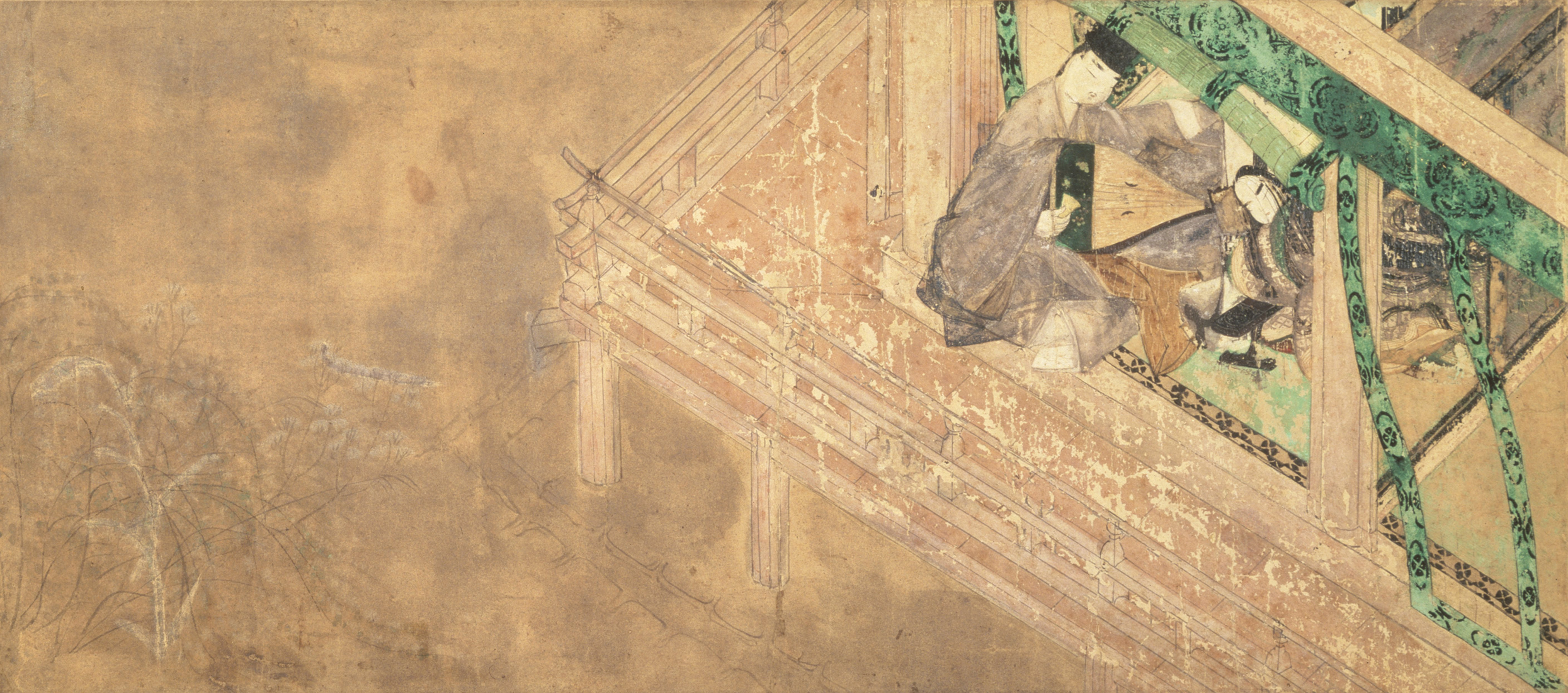 |
| 'I should like to play my lute for you ...' |
The following year, on a quiet spring evening, she heard that he had come to visit the princess’s palace. She and her friend crept out of their room hoping to meet him but the veranda was bustling with people and the reception rooms were full of ladies-in-waiting so they turned back. She guessed that he too had chosen that night to visit thinking it would be quiet. But he had left without seeing her because of the crowds.
Regretfully she composed a poem:
Kashima mite Naruto no ura ni kogare idzuru kokoro ha eki ya iso no amabito
‘Burning with passion
I yearned to row my boat out
To Kashima on the Bay of Naruto.
Did you know that,
Fisherman on the rocky shore?’
And that’s the end of the story. He never enquired who she was. He was too much of a gentleman to pry. His personality was perfect and he was far from an ordinary man, she writes, but time passed and neither called out to the other ...
The gentleman with whom our heroine had this brief encounter was Minamoto no Sukemichi (1005 - 1060). She was thirty three and he was thirty seven. He was of very high rank, far too grand to mingle with ordinary court ladies like her, and a famous musician and lute player.
Later our shy heroine and her diary became famous. Her poems, particularly the passionate poem about rowing out her boat, were celebrated and included in the imperial anthology, an extraordinary mark of distinction. Today everyone in Japan knows The Sarashina Diary. Ironically, grand though he was, Minamoto no Sukemichi’s name has come down to us only because he was the object of Lady Sarashina’s unspoken passion.
 |
| Two ladies, one playing the biwa lute, the other the koto. |
 |
Lesley Downer is a lover of all things Asian and an inveterate traveller. She is the author of many books, including The Shogun’s Queen, an epic tale of love and death in nineteenth century Japan. For more see www.lesleydowner.com.
There are three translations of The Sarashina Diary:
in Diaries of Court Ladies of Old Japan by Annie Shepley Omori and Kōchi Doi (1934)
in Diaries of Court Ladies of Old Japan by Annie Shepley Omori and Kōchi Doi (1934)
As I Crossed a Bridge of Dreams: Recollections of a Woman in Eleventh Century Japan, by Ivan Morris (1971)
The Sarashina Diary: A Woman’s Life in Eleventh Century Japan, by Sonja Arntzen and Itō Moriyuki (2014)
Illustrations:
I haven’t found any illustrations of The Sarashina Diary so have used illustrations of The Tale of Genji and other Heian works to give the mood of the period:
Picture 4: unknown author, Sei Shonagon, 17th century drawing, courtesy wikimedia commons
Illustrations:
I haven’t found any illustrations of The Sarashina Diary so have used illustrations of The Tale of Genji and other Heian works to give the mood of the period:
Picture 1: Murasaki Shikibu composing The Tale of Genji at Ishiyamadera by Yashima Gakutei (1786 - 1868), Gift of Charles Lang Freer, Freer Gallery of Art, Smithsonian, public domain, courtesy wikimedia commons and the Smithsonian.
Picture 2: Utagawa Hiroshige (1797 - 1858), Utsusemi from The Tale of Genji in 54 chapters, 1852, National Diet Library, public domain, courtesy wikimedia commons.
Picture 3: Genji monogatari emaki, 1130, owned by Tokugawa Art Museum Nagoya 1937, courtesy wikimedia commons
Picture 2: Utagawa Hiroshige (1797 - 1858), Utsusemi from The Tale of Genji in 54 chapters, 1852, National Diet Library, public domain, courtesy wikimedia commons.
Picture 3: Genji monogatari emaki, 1130, owned by Tokugawa Art Museum Nagoya 1937, courtesy wikimedia commons
Picture 4: unknown author, Sei Shonagon, 17th century drawing, courtesy wikimedia commons
Picture 5: Fujiwara Takayoshi, Genji monogatari emaki, Yadorigi chapter, 1130, owned by Tokugawa Art Museum Nagoya 1937, courtesy wikimedia commons
Picture 6, Kobo Shunman (1757 - 1820), Two ladies, one playing the biwa lute, the other the koto, 1815, H.O. Havemeyer Collection, Bequest of Mrs H.O. Havemeyer, Met Museum, public domain
Subscribe to:
Posts (Atom)