
Showing posts with label memoir. Show all posts

Friday, 7 April 2023

A Brief Encounter ~ by Lesley Downer

Which is more beautiful, spring or autumn? That was a question bound to stir the interest of any sensitive young woman at the eleventh century Japanese court ...
A Heian lady's day ...

Our story begins with some monks reciting Buddhist sutras all through a long, very dark night. Two young women had crept out of their quarters and lay down on the veranda outside the prayer hall to listen to their beautiful voices. Women were not supposed to be seen but it was dark enough that no one would see them.

It was October 1042. Across the world Edward the Confessor had just come to the throne and commissioned the building of a royal burial church, later to become Westminster Abbey. Beowulf’s epic battle with Grendel had been set down in writing, as had The Song of Roland.

In Japan courtly gentlemen were studying and writing poems in Chinese, which was to Japan as Latin was to the west, the language of educated people. Women learnt kana, a simple alphabetical form of writing, just enough to read and recite the sutras, which was all that women needed, or so men thought. The ladies of the court, however, were smart, sophisticated and very witty and they used the flowing kana script to record their lives, feelings and the often amusing events that occurred, in glorious detail.

One shy young woman was whiling away her years in the provinces, reading, dreaming and writing poems. She wrote an introspective, astonishingly modern account of her thoughts, feelings, regrets and sadnesses, so vivid that we can almost step into her silken shoes and imagine ourselves back in Heian Japan. The diary she wrote - in modern terms, a memoir - is called The Sarashina Diary. She is known only as the daughter of Takasue or Lady Sarashina, though that certainly wasn’t her name.

After many years in the provinces, when she was twenty six, our heroine was invited to the court of Princess Yūshi. On that momentous occasion she wore eight layers of gowns of alternating dark and pale chrysanthemum shades topped with a flowing robe of crimson silk. Eventually she was offered a position as a lady-in-waiting there.

On such a night as this ...
Court ladies and gentlemen spoke separated by screens 
so that the gentleman couldn't see the lady.
 
On that dark night, as Lady Sarashina and her friend were reclining on the veranda, a gentleman strolled by and stopped to engage the ladies in conversation. In the ordinary course of events our heroine would never have met a courtier of such high rank. She was far too humble to attend on high court nobles or senior courtiers, so lowly that such people would never even have known she existed.

The proper thing to do would have been to slip away or summon ladies of the proper status but that would have been awkward. There was nothing for but to respond to his remarks.

Lady Sarashina listened while her friend chatted with the man. She noticed that he was quiet and thoughtful, not flirtatious or forward like other men. He spoke poetically of the brevity of life, mono no aware, the sadness of things. He was a perfect gentleman, in fact.

Then he asked, ‘And who is your companion?’

Lady Sarashina spoke up modestly and the gentleman responded, ‘So there is still a young lady in this palace whom I do not know?’ He showed no sign of wanting to leave, she writes.

It was a starless night and a slight drizzle pattered on the leaves with a charming sound.

‘How beautiful the darkness is,’ the gentleman said. ‘If there’d been a full moon it would have been too dazzling.’ It would also have meant that that they wouldn’t have been able to talk. They could only talk because they couldn’t see each other.

It was then that he turned to the very topic that struck a chord with her, comparing spring and autumn. He spoke of the beauties of spring, when the sky is overcast and the moonlight seems almost to float on the mist. ‘That’s the time when it’s lovely to hear the soft notes of a lute, set in the key of the Fragrant Breeze,’ he said. Then he spoke of autumn, then winter, then asked them which season they most loved.

Her friend spoke up in favour of autumn so Lady Sarashina decided to champion spring. She answered with a poem:
asa midori hana mo hitotsu ni kasumitsutsu oboro ni miyuru haru no yo no tsuki
‘Glimmering green,
Seen through mist,
Merging with the cherry blossom too,
Dimly seen -
The moon on a spring night.’

In those days educated people readily composed poems; it was an essential accomplishment. But our heroine was no ordinary poet but an exceptional one.
A Heian lady's room complete with kicho screen

The gentleman savoured her lines, repeating them again and again. He replied with a poem of his own: ‘From this night on, so long as I have life, such a spring night will hold the memory of you and of our meeting.’

Then he spoke of how he had once gone to the great shrine at Ise to attend the coming-of-age ceremony of the virgin priestess. Awe-inspiring though that experience had been, he said, this dark rainy night that they had spent together was every bit as unforgettable.

With that he left. They still hadn’t seen each other. She had no idea what he looked like, neither did she care. What drew her to him and demanded a place in her heart was his sensitivity, his manner, his poetry, his voice.

Such a fine gentleman could have no idea who she was, which was only proper, or so she thought.

‘Why should you remember it so well?’

Behind the screen ...
The following year, nearly a year after that first encounter, she went to the imperial palace again for an all-night entertainment. She didn’t know that the gentleman was also there and, being of a retiring disposition, stayed in her room.

At dawn she pushed open the sliding doors onto the corridor. The moon was glimmering, very faint and beautiful. Then she heard footsteps on the veranda and that voice she had yearned for, reciting a sutra. He stopped in front of the open doors.

‘I never forget that night of softly falling rain,’ he said, ‘not for a moment, and the precious time we spent together!’

There was no time for a proper answer so she replied with a poem:
nani sa made omohi idekemu nahozari no ko no ha ni kakeshi shigure bakari wo
‘Why, I wonder,
Should you remember it so well?
It was only
An autumn shower
Falling on the leaves.’

Then his companions joined him and she retired to the back of her room without waiting for his answer. That morning she had to leave the imperial palace with the princess and her retinue.

Later her friend brought his reply: ‘If we should ever have another such drizzly night, I should like to play my lute for you, every melody I know.’
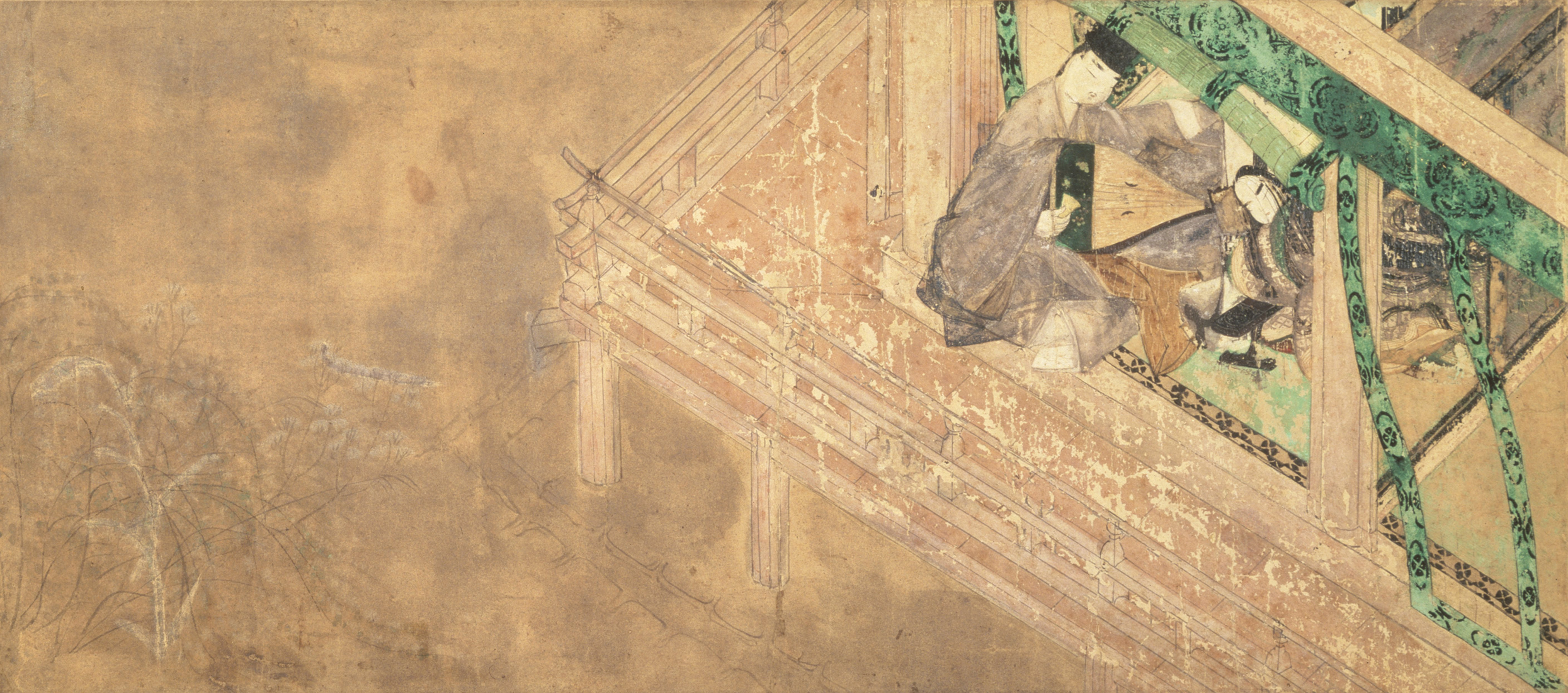
'I should like to play my lute for you ...'
She yearned for such another meeting and waited and waited for such a chance. But it never came.

The following year, on a quiet spring evening, she heard that he had come to visit the princess’s palace. She and her friend crept out of their room hoping to meet him but the veranda was bustling with people and the reception rooms were full of ladies-in-waiting so they turned back. She guessed that he too had chosen that night to visit thinking it would be quiet. But he had left without seeing her because of the crowds.

Regretfully she composed a poem:
Kashima mite Naruto no ura ni kogare idzuru kokoro ha eki ya iso no amabito
‘Burning with passion
I yearned to row my boat out
To Kashima on the Bay of Naruto.
Did you know that,
Fisherman on the rocky shore?’

And that’s the end of the story. He never enquired who she was. He was too much of a gentleman to pry. His personality was perfect and he was far from an ordinary man, she writes, but time passed and neither called out to the other ...

The gentleman with whom our heroine had this brief encounter was Minamoto no Sukemichi (1005 - 1060). She was thirty three and he was thirty seven. He was of very high rank, far too grand to mingle with ordinary court ladies like her, and a famous musician and lute player.

Later our shy heroine and her diary became famous. Her poems, particularly the passionate poem about rowing out her boat, were celebrated and included in the imperial anthology, an extraordinary mark of distinction. Today everyone in Japan knows The Sarashina Diary. Ironically, grand though he was, Minamoto no Sukemichi’s name has come down to us only because he was the object of Lady Sarashina’s unspoken passion.

Two ladies, one playing the biwa lute,
the other the
koto.


Lesley Downer is a lover of all things Asian and an inveterate traveller. She is the author of many books, including The Shogun’s Queen, an epic tale of love and death in nineteenth century Japan. For more see www.lesleydowner.com.

There are three translations of The Sarashina Diary:
in Diaries of Court Ladies of Old Japan by Annie Shepley Omori and Kōchi Doi (1934)
As I Crossed a Bridge of Dreams: Recollections of a Woman in Eleventh Century Japan, by Ivan Morris (1971)
The Sarashina Diary: A Woman’s Life in Eleventh Century Japan, by Sonja Arntzen and Itō Moriyuki (2014)

Illustrations:
I haven’t found any illustrations of The Sarashina Diary so have used illustrations of The Tale of Genji and other Heian works to give the mood of the period:

Picture 1: Murasaki Shikibu composing The Tale of Genji at Ishiyamadera by Yashima Gakutei (1786 - 1868), Gift of Charles Lang Freer, Freer Gallery of Art, Smithsonian, public domain, courtesy wikimedia commons and the Smithsonian.

Picture 2: Utagawa Hiroshige (1797 - 1858), Utsusemi from The Tale of Genji in 54 chapters, 1852, National Diet Library, public domain, courtesy wikimedia commons.

Picture 3: Genji monogatari emaki, 1130, owned by Tokugawa Art Museum Nagoya 1937, courtesy wikimedia commons

Picture 4: unknown author, Sei Shonagon, 17th century drawing, courtesy wikimedia commons

Picture 5: Fujiwara Takayoshi, Genji monogatari emaki, Yadorigi chapter, 1130, owned by Tokugawa Art Museum Nagoya 1937, courtesy wikimedia commons

Picture 6, Kobo Shunman (1757 - 1820), Two ladies, one playing the biwa lute, the other the koto, 1815, H.O. Havemeyer Collection, Bequest of Mrs H.O. Havemeyer, Met Museum, public domain


Saturday, 3 October 2015

Memoir vs fiction, by Y S Lee

Over the past two years, I’ve been reading memoirs from survivors of the Pacific War – that is, the Pacific theatre of the Second World War. Nearly all of them are awe-inspiring, and I’ve already blogged here about Freddy Spencer Chapman’s The Jungle is Neutral and Nona Baker’s Pai Naa: The Story of Nona Baker.

Refresher: historical sources are typically divided into two categories: primary (artifacts from or documents created during the time of the events in question) and secondary sources (an item that interprets and analyzes the primary sources). It’s a broad-strokes sort of distinction that makes putting together a bibliography more straightforward. Although memoirs are typically written after the events in question, they are generally classed as primary sources because their authors were involved in the relevant events.

However! Having recently read a fair amount of memoir, I’ve come to distrust its simple categorization as a primary historical source. This unease began with my first Pacific War memoir, Freddy Spencer Chapman’s The Jungle is Neutral (1949). It’s a brilliant book, packed with adventure and anthropological insight. Freddy’s voice is distinctive and charming, and while he shies away from emotional and psychological insight, I finished the book with a strong appreciation for his character (possibly too strong: my husband took to calling him "your historical boyfriend”).

Freddy Spencer Chapman

Still, I wondered how Freddy could possibly recall the terrifying and chaotic events of his three years in the Malayan jungle in such impeccable detail. This is a challenge in all memoirs. I am hard-pressed to remember what I ate for lunch three days ago, and in times of conflict or high excitement I often question, after the fact, my memories of what went down. Yes, Freddy kept detailed diaries while he was in the jungle, but on several occasions he was forced to destroy them because they were at risk of falling into enemy hands. His surviving diaries are held at the Pitt Rivers Museum, but they cover only a portion of his time in the jungle.

After reading Freddy’s memoir, I turned to Brian Moynahan’s recent biography of Freddy, Jungle Soldier: The True Story of Freddy Spencer Chapman, for context. Moynahan is a biased biographer – a longtime fan of Freddy who wants to burnish and prolong his hero’s fame. Even so, at one point, Moynahan points out a significant discrepancy between Freddy’s surviving diary and an event he describes in The Jungle is Neutral.


For publication, Freddy altered the event, probably in order to make it feel more dramatic. Moynahan disagrees with this decision, believing the original diary entry to be superior in terms of tension and the sheer danger of the situation. Either way, though, we now have a primary source (diary) imperfectly converted to a memoir - which is still technically a primary source. Yet we already know that it’s been corrupted. And if we have evidence of this with just one of Freddy’s surviving diaries, how many other events have been elided or embellished or just imperfectly reconstructed? We’ll never know.

This question becomes even more complicated when memoirs are written long after the events they describe and are mediated through others. Pai Naa: The Story of Nona Baker was first published in 1959, fourteen years after Nona Baker emerged from the Malayan jungle, contributed source material to Freddy Spencer Chapman’s official report on local Communist organizations, and returned to England.

Nona Baker is not credited as the author of her memoir!

Baker doesn’t mention keeping a jungle diary. Her narrative voice is quiet, wry, self-deprecating. She doesn’t in any way seek to portray herself as a heroine: rather, she insists that she was only “busily saving [her] own skin”. Perhaps this is why it took her fourteen years to produce a memoir, and why she distanced herself from the story even further: even though her narrative is written in the first person, the book is officially "by" Dorothy Thatcher and Robert Cross. To what extent is Baker’s voice really her own, here? And what sorts of artistic license have Thatcher and Cross taken with the shape of the story?

My last example today (though I have many more!) is actually a novel by Han Suyin (best known for her 1952 novel A Many Splendoured Thing, which was filmed as Love is a Many Splendored Thing and was also later adapted as an American soap opera). And the Rain My Drink is set during the Malayan Emergency of the early 1950s – the last days of the British empire in southeast Asia.

Han Suyin, the pen name of Elisabeth Comber

While And the Rain My Drink is technically fiction, Han Suyin inserts herself (using a name that is itself a pseudonym) into the novel as a character. This is a postmodern move which ought to undermine the ideas of narrative voice and the conceit of “truth” throughout the work. But the character Suyin tells her story in the first person, in conventional and realist terms. Because of this, and since the character Suyin’s biographical details map directly onto those of the author Han Suyin, the whole novel reads instead like a memoir of Han Suyin’s time in Malaya, with a few imaginative excursions. It presses the genre of memoir into the services of fiction - an act that points up the highly contrived nature of memoir itself.

Perhaps this is only appropriate – that we should end up in such an ambiguous tumult. A wide view of history will always include competing voices, and the line between fact and fiction begins to blur immediately upon examination. I’m thrilled to be feeling my way, step by careful step, in the company of such splendid adventurers.

---
Y S Lee is the author of the award-winning Mary Quinn Mysteries/The Agency Quartet (Walker Books/Candlewick Press).

Wednesday, 3 June 2015

Nona Baker, by Y S Lee

Hello, friends. I'm currently time-travelling in the colony formerly known as Malaya. I'm interested, specifically, in the Japanese occupation of Malaya during the Second World War and how different groups of Malayans responded to the threat.

Here in the west, many people don't learn about WWII's Pacific theatre of war at school. Certainly, my own education focused on France, Britain and Germany, with a dash of Russia and Italy, and a rousing finale by the United States of America. However, there was also a Pacific War and its Axis aggressor was Japan. The most famous incident in the Pacific War, the bombing of Pearl Harbour in December 1941, was just one part of a multi-pronged assault. On that same night in December, the Japanese simultaneously attacked Thailand, Malaya, Singapore, Hong Kong and the Philippines. The next month, the Japanese turned their attention to Burma, the Dutch East Indies, and northern Australia.

When the Japanese invaded Malaya in December 1941, the local population was an ethnic mixture of aboriginal peoples, Malays, Chinese, Indians, and a small percentage of white (mainly British) colonists who controlled the colony's industry, politics and, of course, wealth. In the prelude to one of military history's most ignominious defeats, the British failed to take the Japanese threat seriously. Their attitude is well represented by the the Governor of Singapore, Sir Shenton Thomas: when informed of the invasion, he reportedly said, "Well, I suppose you'll shove the little men off." Far from shoving the little men off, however, "Fortress Singapore" fell to the Japanese in just 70 days.

By the time the British surrendered to the Japanese in February 1942, nearly all white civilians had evacuated - and had done so, very conspicuously, at the expense of the local non-white population. One remarkable exception to the white flight was Nona Baker, "a parson's youngest daughter" from Dunstable, Bedfordshire.


Nona Baker first travelled to Malaya to keep house for her brother, Vin (V B C Baker), who was general manager of a mine at Sungei Lembing, "the single largest tin mine in the world". Before the war, her brother was the most powerful man in the region, universally called Tuan Besar, or "Big Master" in the Malay language. Nona became known as Missie. Vin Baker seems to have been a classic Victorian paternalist in his management of the mine and his workers. Nona believes that "he was a king and father to the people, and they certainly adored him".

When the Japanese invaded, Vin couldn't conceive of a British defeat. Even as the Japanese advanced rapidly south through Malaya, Vin refused to leave his community. He made plans to hide in the jungle with Nona: after all, it would be only a matter of weeks, or perhaps a couple of months at most. Three trusted workers built Missie and Tuan Besar a hut in the jungle and stocked it with a primus stove, paraffin and tinned food. Still, denial prevailed. When the Japanese Army rolled into Sungei Lembing, Vin and Nona were quite rattled: "In the hurry of our departure, I had seized the tool kit from the car and taken it with me, instead of carrying something which might have been of some use." They also forgot to bring any reading material, an omission they bitterly regretted during their long, idle days in hiding.

As it turns out, they weren't in hiding for a few weeks or months. Nona Baker remained in the jungle for THREE YEARS. Despite the danger of being caught by the Japanese or betrayed by spies, their faithful servants visited them every ten days in the jungle to bring them fresh food, coffee, paraffin and news. (The servants also had Vin's false teeth repaired, again at immense personal risk: the dentist who fixed the dentures recognized that they were made in Europe.) After the first year, Vin and Nona's supply of money ran out and they took the decision to go live among the orang bukit, or "hill people": a euphemism for camps of Communist guerrillas who lived in the jungle and actively resisted the Japanese occupiers.

Nona and Vin were welcomed by the Communists, both out of principle (Nona says that she never saw a refugee turned away by guerrillas, even when food was extremely scarce) and financial savvy (Communist leaders recognized that they could raise funds locally, using Vin's name). For three years, Nona and Vin lived as very few white people had ever done, in Malaya: on terms of relative equality with local people.

In 1944, Vin Baker died of illness - a combination of malaria, dysentery and beri-beri. He'd suffered from bouts of depression since going into hiding, and these must have contributed to his weakness. What's much more remarkable is that Nona Baker survived. She gives a few dutiful reasons for her persistence: wanting to demonstrate that not all British were cowards and quitters; looking after Vin; the need to tell her mother, after the war, how Vin died. But there must have been something beyond that - an essential desire to learn, to know, to live. Despite her self-effacing explanations, Nona Baker was an extraordinary woman.


The 1959 edition, published by Constable

Nona Baker was briefly famous after the war, when she was delivered into the care of Force 136 (the equivalent of SOE in Southeast Asia), contributed information to Freddy Spencer Chapman's report on local Communist organizations, and returned to England. But it was only in 1959 that she felt able to dictate a memoir of her time amongst the Communists. It's called Pai Naa: The Story of Nona Baker. (Pai Naa, the name she was given by the guerrillas, means something like, "White Nona".) Nona Baker remains the only documented white woman to have survived the war by living in the jungle. While it is true, as she admits, she was only "busily saving my own skin", it is remarkable to have her even-handed portrait of life amongst the guerrillas. It's an intimate record that otherwise wouldn't exist.

Monday, 28 July 2014

A Comic Strip War, by Clare Mulley

Can war be seriously examined through art inspired by American comic strips? As a biographer I am fascinated by the different ways in which human stories from the past can be effectively examined and presented, particularly when this touches on my own current area of interest, the Second World War. So I was captivated when a friend and neighbour, Brian Sanders, published a stunningly beautiful and evocative picture book memoir, Evacuee. Sandy, as I know him, is now working on the sequel, about his life in post-war London, and invited me over to have a look. 


If you are as stunned as I was by the cover of Evacuee, I should perhaps mention that Sandy has had a wonderful fifty-year career as a professional artist with commissions ranging from magazine illustration, Penguin book covers and postage stamps to being the official artist portraying the making of Stanley Kubrick’s 2001: A Space Odyssey during 1964-65, and designing the advertising poster for last year’s acclaimed television series, Mad Men. However, it is Sandy’s work portraying war, and the impact of war on lives, that fascinates me most.

As a young man, Sandy served in 45 Commando Royal Marines during the Suez Invasion and later in Cyprus. His irrepressible talent for capturing the scenes around him was soon noticed by the intelligence officer, and he was recruited into the Intelligence Section to record events, the movement of people and so on, as well as producing occasional private portraits. When he returned to Britain all his drawings were in his sea-kit bag, and had been stolen before he arrived. The only piece he has from this time is the one published in Soldier magazine, below, showing how far from reality the public image of life in the Libyan desert was at the time:


Tripoli 1957 


Sandy never sought a career as a war artist but commissions for various publications, and several series of stamps including those commemorating the 50th anniversary of the Second World War, naturally followed his experience and the trust placed in him as an artist who, as he put it, ‘had been there, and understood what war was’.


Some of Sandy's stamps commissioned to commemorate
the 50th anniversary of the Second World War


Now a pacifist, Sandy has always aimed to report historically rather than comment through his art, letting events speak for themselves. ‘I wouldn’t glorify war’, he told me, but ‘in fact I have advertised war, I have done pieces for Officers Magazine and so on’. It was only when he came out of the Royal Marines that he gained a new perspective on Britain’s involvement in Suez, and his attitude started to shift.

After a rich career in what is called ‘lifestyle illustration of the 1960s', Sandy is now taking a very different look at the Second World War, focusing on his own childhood as a London evacuee in Saffron Walden, a market town in Essex. Free from the constraints of commission or briefs, this is a very personal project, the impact of which comes from both its clear sincerity and its wonderful evocation of time and place.   


Sandy told me that his great blessing is that he has always known he had to draw. The Evacuee project began with loose sheets of pictures drawn from memories, and collected in a small black folder until he suddenly realized there was a book there. He found no problem remembering what he saw, and felt, as a child; ‘my problem is eliminating pictures, not finding them’, he told me. Soon he realized that the book was naturally going to be told from the perspective of his younger self in the form of the American comics that he had collected during the war, and long afterwards. In this way the book speaks directly to ‘children of all ages’, from three or four, up to 65 or 70; ‘the people who were there’. As a result Evacuee is great fun, with hundreds of wonderfully evocative visual details, and the echoing refrain that rang in his ears as a boy; ‘because there’s a war on’. And yet although Sandy’s own father survived the war, he makes a point of recording without unnecessary elaboration that those of two of his friends did not. 

Evacuee is an honest book and this, combined with the stunning art-work, is where its power lies. ‘It’s about the people that I love, that I loved at the time’ Sandy says simply. Although increasingly conscious from readers’ reactions that the book is seen as a much-loved contribution to social history, his intentions were always just to record and let the pictures speak for themselves. This is a world beautifully observed by a child and reproduced by his adult self, which is at once deeply personal and yet also gloriously familiar. ‘It is deliberately for everyone’ Sandy told me, but because it is his own story it is also compellingly authentic. Surely this is social history at its best.

Sadly Evacuee is currently sold out, but the good news is that as I left Sandy this afternoon he was heading to his studio to work on the sequel about his life in post-war London and Saffron Walden holidays. I will let you know when it is out, but here is a sneak preview of a page in progress: