
Showing posts with label diary. Show all posts

Friday, 7 April 2023

A Brief Encounter ~ by Lesley Downer

Which is more beautiful, spring or autumn? That was a question bound to stir the interest of any sensitive young woman at the eleventh century Japanese court ...
A Heian lady's day ...

Our story begins with some monks reciting Buddhist sutras all through a long, very dark night. Two young women had crept out of their quarters and lay down on the veranda outside the prayer hall to listen to their beautiful voices. Women were not supposed to be seen but it was dark enough that no one would see them.

It was October 1042. Across the world Edward the Confessor had just come to the throne and commissioned the building of a royal burial church, later to become Westminster Abbey. Beowulf’s epic battle with Grendel had been set down in writing, as had The Song of Roland.

In Japan courtly gentlemen were studying and writing poems in Chinese, which was to Japan as Latin was to the west, the language of educated people. Women learnt kana, a simple alphabetical form of writing, just enough to read and recite the sutras, which was all that women needed, or so men thought. The ladies of the court, however, were smart, sophisticated and very witty and they used the flowing kana script to record their lives, feelings and the often amusing events that occurred, in glorious detail.

One shy young woman was whiling away her years in the provinces, reading, dreaming and writing poems. She wrote an introspective, astonishingly modern account of her thoughts, feelings, regrets and sadnesses, so vivid that we can almost step into her silken shoes and imagine ourselves back in Heian Japan. The diary she wrote - in modern terms, a memoir - is called The Sarashina Diary. She is known only as the daughter of Takasue or Lady Sarashina, though that certainly wasn’t her name.

After many years in the provinces, when she was twenty six, our heroine was invited to the court of Princess Yūshi. On that momentous occasion she wore eight layers of gowns of alternating dark and pale chrysanthemum shades topped with a flowing robe of crimson silk. Eventually she was offered a position as a lady-in-waiting there.

On such a night as this ...
Court ladies and gentlemen spoke separated by screens 
so that the gentleman couldn't see the lady.
 
On that dark night, as Lady Sarashina and her friend were reclining on the veranda, a gentleman strolled by and stopped to engage the ladies in conversation. In the ordinary course of events our heroine would never have met a courtier of such high rank. She was far too humble to attend on high court nobles or senior courtiers, so lowly that such people would never even have known she existed.

The proper thing to do would have been to slip away or summon ladies of the proper status but that would have been awkward. There was nothing for but to respond to his remarks.

Lady Sarashina listened while her friend chatted with the man. She noticed that he was quiet and thoughtful, not flirtatious or forward like other men. He spoke poetically of the brevity of life, mono no aware, the sadness of things. He was a perfect gentleman, in fact.

Then he asked, ‘And who is your companion?’

Lady Sarashina spoke up modestly and the gentleman responded, ‘So there is still a young lady in this palace whom I do not know?’ He showed no sign of wanting to leave, she writes.

It was a starless night and a slight drizzle pattered on the leaves with a charming sound.

‘How beautiful the darkness is,’ the gentleman said. ‘If there’d been a full moon it would have been too dazzling.’ It would also have meant that that they wouldn’t have been able to talk. They could only talk because they couldn’t see each other.

It was then that he turned to the very topic that struck a chord with her, comparing spring and autumn. He spoke of the beauties of spring, when the sky is overcast and the moonlight seems almost to float on the mist. ‘That’s the time when it’s lovely to hear the soft notes of a lute, set in the key of the Fragrant Breeze,’ he said. Then he spoke of autumn, then winter, then asked them which season they most loved.

Her friend spoke up in favour of autumn so Lady Sarashina decided to champion spring. She answered with a poem:
asa midori hana mo hitotsu ni kasumitsutsu oboro ni miyuru haru no yo no tsuki
‘Glimmering green,
Seen through mist,
Merging with the cherry blossom too,
Dimly seen -
The moon on a spring night.’

In those days educated people readily composed poems; it was an essential accomplishment. But our heroine was no ordinary poet but an exceptional one.
A Heian lady's room complete with kicho screen

The gentleman savoured her lines, repeating them again and again. He replied with a poem of his own: ‘From this night on, so long as I have life, such a spring night will hold the memory of you and of our meeting.’

Then he spoke of how he had once gone to the great shrine at Ise to attend the coming-of-age ceremony of the virgin priestess. Awe-inspiring though that experience had been, he said, this dark rainy night that they had spent together was every bit as unforgettable.

With that he left. They still hadn’t seen each other. She had no idea what he looked like, neither did she care. What drew her to him and demanded a place in her heart was his sensitivity, his manner, his poetry, his voice.

Such a fine gentleman could have no idea who she was, which was only proper, or so she thought.

‘Why should you remember it so well?’

Behind the screen ...
The following year, nearly a year after that first encounter, she went to the imperial palace again for an all-night entertainment. She didn’t know that the gentleman was also there and, being of a retiring disposition, stayed in her room.

At dawn she pushed open the sliding doors onto the corridor. The moon was glimmering, very faint and beautiful. Then she heard footsteps on the veranda and that voice she had yearned for, reciting a sutra. He stopped in front of the open doors.

‘I never forget that night of softly falling rain,’ he said, ‘not for a moment, and the precious time we spent together!’

There was no time for a proper answer so she replied with a poem:
nani sa made omohi idekemu nahozari no ko no ha ni kakeshi shigure bakari wo
‘Why, I wonder,
Should you remember it so well?
It was only
An autumn shower
Falling on the leaves.’

Then his companions joined him and she retired to the back of her room without waiting for his answer. That morning she had to leave the imperial palace with the princess and her retinue.

Later her friend brought his reply: ‘If we should ever have another such drizzly night, I should like to play my lute for you, every melody I know.’
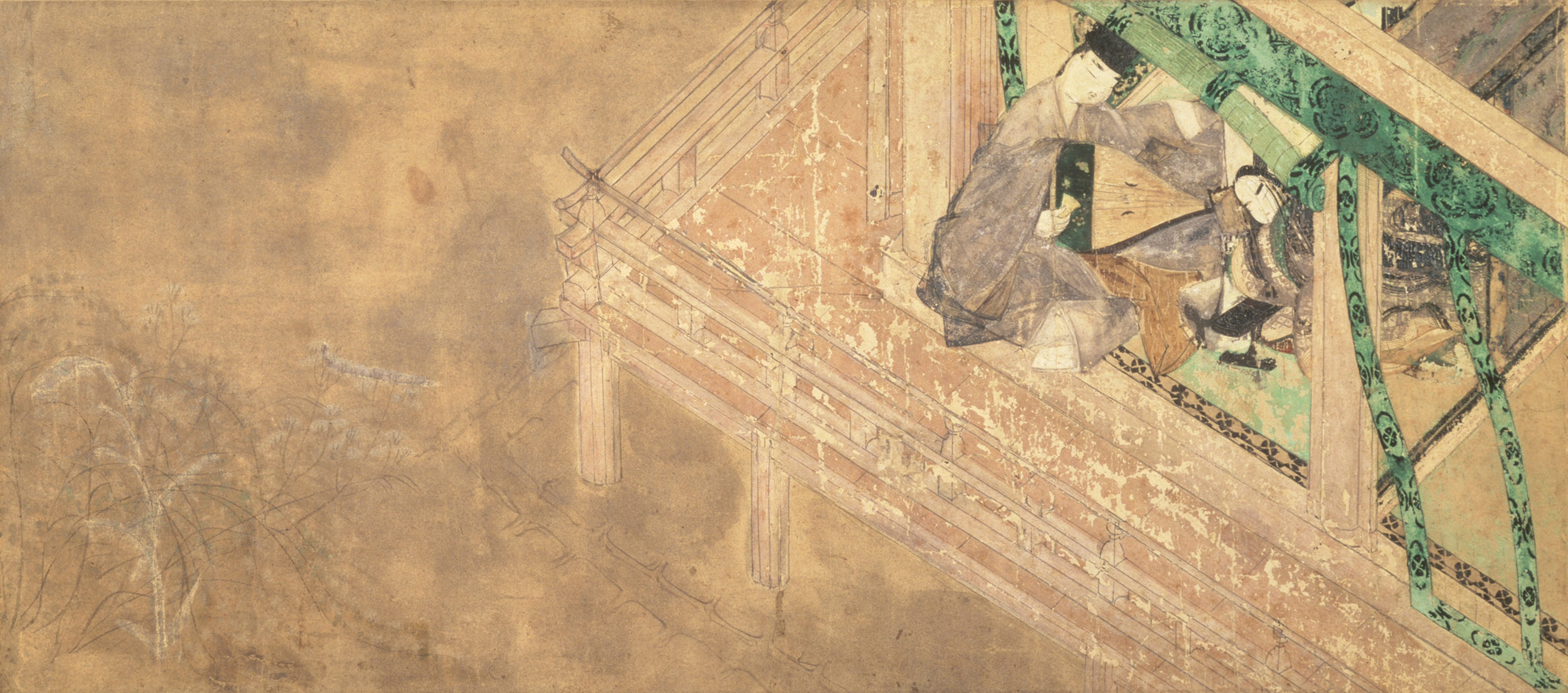
'I should like to play my lute for you ...'
She yearned for such another meeting and waited and waited for such a chance. But it never came.

The following year, on a quiet spring evening, she heard that he had come to visit the princess’s palace. She and her friend crept out of their room hoping to meet him but the veranda was bustling with people and the reception rooms were full of ladies-in-waiting so they turned back. She guessed that he too had chosen that night to visit thinking it would be quiet. But he had left without seeing her because of the crowds.

Regretfully she composed a poem:
Kashima mite Naruto no ura ni kogare idzuru kokoro ha eki ya iso no amabito
‘Burning with passion
I yearned to row my boat out
To Kashima on the Bay of Naruto.
Did you know that,
Fisherman on the rocky shore?’

And that’s the end of the story. He never enquired who she was. He was too much of a gentleman to pry. His personality was perfect and he was far from an ordinary man, she writes, but time passed and neither called out to the other ...

The gentleman with whom our heroine had this brief encounter was Minamoto no Sukemichi (1005 - 1060). She was thirty three and he was thirty seven. He was of very high rank, far too grand to mingle with ordinary court ladies like her, and a famous musician and lute player.

Later our shy heroine and her diary became famous. Her poems, particularly the passionate poem about rowing out her boat, were celebrated and included in the imperial anthology, an extraordinary mark of distinction. Today everyone in Japan knows The Sarashina Diary. Ironically, grand though he was, Minamoto no Sukemichi’s name has come down to us only because he was the object of Lady Sarashina’s unspoken passion.

Two ladies, one playing the biwa lute,
the other the
koto.


Lesley Downer is a lover of all things Asian and an inveterate traveller. She is the author of many books, including The Shogun’s Queen, an epic tale of love and death in nineteenth century Japan. For more see www.lesleydowner.com.

There are three translations of The Sarashina Diary:
in Diaries of Court Ladies of Old Japan by Annie Shepley Omori and Kōchi Doi (1934)
As I Crossed a Bridge of Dreams: Recollections of a Woman in Eleventh Century Japan, by Ivan Morris (1971)
The Sarashina Diary: A Woman’s Life in Eleventh Century Japan, by Sonja Arntzen and Itō Moriyuki (2014)

Illustrations:
I haven’t found any illustrations of The Sarashina Diary so have used illustrations of The Tale of Genji and other Heian works to give the mood of the period:

Picture 1: Murasaki Shikibu composing The Tale of Genji at Ishiyamadera by Yashima Gakutei (1786 - 1868), Gift of Charles Lang Freer, Freer Gallery of Art, Smithsonian, public domain, courtesy wikimedia commons and the Smithsonian.

Picture 2: Utagawa Hiroshige (1797 - 1858), Utsusemi from The Tale of Genji in 54 chapters, 1852, National Diet Library, public domain, courtesy wikimedia commons.

Picture 3: Genji monogatari emaki, 1130, owned by Tokugawa Art Museum Nagoya 1937, courtesy wikimedia commons

Picture 4: unknown author, Sei Shonagon, 17th century drawing, courtesy wikimedia commons

Picture 5: Fujiwara Takayoshi, Genji monogatari emaki, Yadorigi chapter, 1130, owned by Tokugawa Art Museum Nagoya 1937, courtesy wikimedia commons

Picture 6, Kobo Shunman (1757 - 1820), Two ladies, one playing the biwa lute, the other the koto, 1815, H.O. Havemeyer Collection, Bequest of Mrs H.O. Havemeyer, Met Museum, public domain


Wednesday, 13 February 2019

Researching with Seventeenth Century Diaries

by Deborah Swift

One good thing about the internet is that I have access to many documents online, that previously were only available to me through archives. The most valuable sources for me are diaries, in which I get a first-hand account of seventeenth century life. I have linked all the diarists in this post to their online diaries.

Etching by Robert Spence

The first diary I used was that of the Quaker, George Fox, because he appears in my first novel, and like many diaries of the time his diary was written because of a religious impulse, in which he was documenting his relationship with God. The original journal was revised before it was published and I found both editions interesting to compare.

Fox's journal was first officially published in 1694, by which time it had been substantially edited, and cleaned up. Parts of the journal were not in fact by Fox at all but were re-constructed by his editors keen to spread a message of clean and godly living. References to meetings in taverns, and the dissent within the Quaker movement have been expunged from the narrative. The diary portrays Fox as rather more saintly than he probably was, and always vindicated by God's providence. This is the problem with diaries published later (particularly by Victorians) - the temptation is always to clean them up, thus losing value for researchers like me. Only recently have we been able to read the 'naughty bits' in Pepys' Diary.

Many diarists of the seventeenth century were religious men. Though the diary of Roger Lowe is very much the diary of the common man, it still shows his refusal to conform to the re-established church. It gives us insights into a seventeenth century mercer's apprentice living in a Lancashire village. In his entries we discover that literacy was unusual in his community, and somewhat prized, because he sometimes offered to write letters for his neighbours. In October 1663 his friend John Hasleden told him;
"that he loved a wench in Ireland, and so the day after I writ a love-letter for him into Ireland". 
Can't help wondering exactly what he put! His diaries reflect the concerns of a working class man, not a member of the aristorcacy, and as such are especially valuable:

"Friday. dyed Alexander Potter 3d son to Cozen John Potter de Lilly Lane who in his life time was nevr supposd to have any genius a meer child yet now att his death called father & mother & prayd forgivenes of his faults in cheating them of a half peny and wished them to live in peace & that his sister Ellin would leave off swearinge & so dyed & without question is now att rest." (25th June 1675)

The diary of Roger Lowe of Ashton in Makerfield is preserved in the Leyland Free Library and Museum, in Hindley, Lancashire. Here is a link to pictures and more extracts.
 
Samuel Pepys began his diary in 1660 and continued to write it for ten years. His diary is arguably the best-known resource we have on London in the 17th century. It provides us with a fly-on-the-wall account of daily life in the period just following the Restoration of King Charles II, and includes passages on The Plague and The Great Fire. Here's a bit from the Coronation of Charles II, in which he confesses that in the middle of the proceedings he has to answer a call of nature. This is the joy of Pepys; the personal and the political are intertwined.
"The King in his robes, bare headed, which was very fine. And after all had placed themselfs - there was a sermon and the service. And then in the Quire at the high altar he passed all the ceremonies of the Coronacion - which, to my very great grief, I and most of the Abbey could not see. The crowne being put upon his head, a great shout begun. And he came forth to the Throne and there passed more ceremonies: as, taking the oath and having things read to him by the Bishopp, and his lords (who put on their capps as soon as the King put on his Crowne) and Bishopps came and kneeled before him.....But I had so great a list to pisse, that I went out a little while before the King had done all his ceremonies and went round the abby to Westminster-hall, all the way within rayles, and 10000 people, with the ground coverd with blue cloth - and Scaffolds all the way. Into the hall I got - where it was very fine with hangings and scaffolds, one upon another, full of brave ladies. And my wife in one little one on the right hand."
An awareness of the importance of national events also seems to have encouraged Roger Morrice, who began to keep an 'entring book' in 1678 after the Popish Plot which aimed to re-establish the Catholic Church by assassinating Charles II. The Popish Plot was a fictitious conspiracy concocted by Titus Oates that between 1678 and 1681 created massive anti-Catholic hysteria. Like Pepys' Diary, Morrice's diary  was written in shorthand, and so was only translated this century, and runs to more than a million words. (See this article )His diary begins in 1677 and ends in 1691, and so covers the reigns of Charles II, James II, and William and Mary.

Morrice was a clergyman who had been expelled from his parish after Charles II returned from exile. He shows us many incidences of political or religious unrest, like this example from 1666 showing the persecution of the Quakers:
"Upon Lords day the 17th October at Leicester, the Quakers mett together. There are some Soldiers quartred in the Town, and a Black that is Kettle Drummer to one Company went into the Quakers Meeting, and did as they did, sign, groan, and sing, &c. A little after came in a Captain and three or foure Soldiers, who brought ale and Tobacco pipes with them and sate down and smoked and drunk. The Captain drank the King’s health to a Quaker; the Quaker answered I thirst not; the Captain said it thou drinkest not my Master’s health, I will Cuckold they wife before they eyes. With that, the Captain and Souldiers rose up, and drew their Swords, Shut the doores, and used and abused the women much. Some of the young Girles are so affrighted their recovery is questioned." 

Morrice had a friend who was a Privy councillor and so was able to comment on the death of Charles II, a report that is somewhat controversial and indicates a return to Catholicism.
"On Thursday night a priest came up the back way. It was believed by all that he confessed the king, gave him extreme unction and that His Majesty died a papist."
Death of Charles II

But what of the women of this period? I can recommend the diary of Anne Clifford, a stubborn and independent woman who travelled great distances in her attempt to regain her stolen inheritance - which included Skipton Castle in Yorkshire along with Pendragon Castle, Brough Castle, Appleby Castle and Brougham Castle, all in Westmorland. Her relationship with her husband was strained, but her love for her estates never wavered:
'Upon the 5th my Lord went up to my closet and saw how little money I had left, contrary to all that they had told him. Sometimes I had fair words from him and sometimes foul but I took all patiently and did strive to give him as much content and assurance of my love as I could possibly. Yet I always told him that I would never part with Westmoreland upon any condition whatsoever.'
Though not strictly a diary, though written in her lifetime, a source I really enjoyed reading was the memoir of Anne Fanshawe, a Royalist during the English Civil War. As was common in that period, she gave birth to 14 live children and had six miscarriages. When her husband was taken prisoner at the Battle of Worcester she stood outside his window in the middle of the night in the rain to talk to him.  She also wrote a book of cookery and her recipe for ice cream is thought to be the earliest recorded in Europe.

Anne Fanshawe's Recipe for ice cream

Here is a passage from her memoirs about the arrival of the King:
"We had by the States' order sent on board to the King's most eminent servants, great store of provisions: for our family we had sent on board the Speedwell a tierce of claret, a hogshead of Rhenish wine, six dozen of fowls, a dozen of gammons of bacon, a great basket of bread, and six sheep, two dozen of neats' tongues, and a great box of sweetmeats. Thus taking our leaves of those obliging persons we had conversed with in the Hague, we went on board upon the 23rd of May, about two o'clock in the afternoon. The King embarked at four of the clock, upon which we set sail, the shore being covered with people, and shouts from all places of a good voyage, which was seconded with many volleys of shot interchanged: so favourable was the wind, that the ships' wherries went from ship to ship to visit their friends all night long."
Anne Fanshawe
Other diarists worth considering from this period are John Evelyn, Ralph Josselin and Robert Hooke. For women, try Celia Fiennes the great traveller, or Lucy Hutchinson's account of the English Civil War. I hope you have enjoyed my small foray into the many seventeenth century diaries available to us, and I hope it fuels more research! My novels featuring the hidden lives of the women in Pepys' Diary are available now from Accent Press.


Do nudge me on twitter @swiftstory to chat, or find me on my website.
All pictures are from Wikipedia, unless linked.


Saturday, 27 August 2016

History Exercise in a Hammock by Janie Hampton


This month I offer readers tips on how to get fit, ready for all that calorie-burning reading of history books that you plan to do this autumn. At the end of August you are tired from your holidays. You need to get your mind and body ready, but slowly and gently. Back in the 1980s Jane Fonda put us all to shame with her 'Feel the Burn' exercises. Now, with my patent Hampton History Hammock system, we can all stay fit, practice history and keep cool.
This Swedish lady by artist Anders Leonhard Zorn fell asleep in 1882 .
Will she wake in time for her History Exercise?
The hammock is a historic device, designed for people of all ages, shapes and temperaments. A hammock cradles and supports the back, neck and especially the brain. Hammocks help to relieve stress brought on by computers, stacking dishwashers and taking holidays.

Choosing the right hammock is crucial: it must be long enough to lie straight out in, and wide enough not to fall over the edge. Cotton hammocks are better than netting, which allows bits of your body to bulge through, leaving strange patterns on exposed areas. If the cotton is organic you will also feel smug, which  probably increases your intelligence too.

Attach your hammock to one or two strong trees. It should hang no more than 4 inches above the ground at the lowest point, when you are in it. This ensures that should it collapse, you don’t have far to fall. If you don’t have any trees, do not attach to a wall without a full survey – walls are inclined to bury people alive.
Always lie in the hammock in the direction that gives the best view. This should be away from guilt-inducing objects like the washing line, the shed with the lawn mower or your study with that half-read book waiting in it.
Before you start, place beside your hammock:
A book, quite a heavy one with very long words printed in small type.
A glass of iced water.
Optional bowl of strawberries.

Now for some action: Sit in hammock with legs together outside. Lift legs up and into hammock, and out again, keeping legs together. Do this once or twice, ending with both legs in the hammock. Try and remember the date of the Norman Invasion. Don't try too hard. And, rest. 
This lady in a hammock painted by James Tissot in 1879 had the right idea.
She is in the middle of the first exercise. Image courtesy of The Bridgeman Art Library.
 Warm up exercise: Lie down and feel every bit of your body go floppy. Think beautiful thoughts as you watch the clouds. Can you see an old man emerging? Does this remind you of the date of Napoleon's death? And, rest.

Oblique tummy stretch and underarm flattener: Keeping your legs straight, lean forward and touch your toes. If you can’t reach your toes, just wave at them, and say 'Hello'. Lift your arms up straight, and move them back over your head.
Do this a few times quite slowly. Or just do it once. Think of a number. Is it the same number as Henry VIII had wives? And, rest. 

Knee and bottom toner: Lift one bent leg and then the other leg up slowly. Pull back towards your head. Stop the moment it might hurt. Imagine you are a horse accompanying a Crusader. And, rest.

Waist curl trimmer: Pull knees up, and rock them from side to side. Roughly when was canned food first eaten? And, rest.

Groin and inner thigh strengthener: Bend knees. Pull legs up together, and then flop them apart. Wave your knees apart and together very slowly. Who first used chloroform during childbirth? And, rest.
This young lady has not read the instructions –
the Hampton History Hammock system
must always be carried out on your own. No man may help you.
Beating gravity with triceps stretch: Lift arms in the air and try to pull yourself up by grabbing the air with your hands. Admire the pretty patterns that the leaves make in the tree above you. What year was  an aeroplane first flown solo across the Atlantic? And, rest.

Nutritional exercise for energy boost: Without moving your body, allow arms to flop out of hammock. Wave them about until you make contact with the strawberries. Lift bowl of strawberries up and place on stomach. Now exercise your fingers: lift one strawberry at a time and place in mouth. Work those jaw muscles hard until the strawberry has disappeared. Repeat until bowl is empty. Think about the date when South American strawberries were first eaten in Europe. And, digest. 

This Wife of a British Colonial Officer should not have made these men carry her while she exercises. She should remain in one place, with her hammock attached to two trees.
Improved toner control for hamstring and bottom: Raise your legs in the air, and over your head, and touch the hammock behind you with your toes. Do this backwards and forward, very slowly. Or don't do it at all. Think of a year when Brazil won the World Cup. Just one will do. And, rest.

Warm-down exercise or biceps curl: Now lean out of the hammock and pick up your book. With bent arms, lift the book above your head and close your eyes. How many books are in the British Library? Lower your arms, and open your eyes. Lean out of the hammock, and place book on the ground. And, rest. And rest again.

Advanced cool-down exercise: Swing legs out of hammock and place feet either side of glass of water. Grasp glass firmly with both feet and lift back into hammock, tip glass towards face. Which year did Captain Scott reach the Antarctic? And, rest.

Final exercise to boost your will power: Get out of hammock, and return indoors. This requires considerable determination and commitment. It may take at least an hour to achieve and become more difficult with each Hampton History Hammock session.

In case of rain – do all exercises in your swimming costume.

Only do each exercise for as long as you feel like, and do not exceed 30 seconds. All these exercises require a positive attitude. Be persistent and you will succeed, possibly in time for the autumn.

To ensure success, make a graph showing how relaxed you have become. You can waste even more time by keeping a diary about your time spent in the hammock. Then, in 100 years your great grand-daughters can publish it. 
This luscious lady in pink by Irish painter John Lavery certainly knows how to relax.
She may even be learning some history at the same time.
Answer to questions: 1832; 8; 1810; Queen Victoria; 1927; 1714; 1958,1962, 1970, 1994 & 2002; 150 million; 1912.
Janie Hampton will demonstrate the Hampton History Hammock system of exercises on alternate Mondays, by appointment.