
Showing posts with label love. Show all posts

Friday, 7 April 2023

A Brief Encounter ~ by Lesley Downer

Which is more beautiful, spring or autumn? That was a question bound to stir the interest of any sensitive young woman at the eleventh century Japanese court ...
A Heian lady's day ...

Our story begins with some monks reciting Buddhist sutras all through a long, very dark night. Two young women had crept out of their quarters and lay down on the veranda outside the prayer hall to listen to their beautiful voices. Women were not supposed to be seen but it was dark enough that no one would see them.

It was October 1042. Across the world Edward the Confessor had just come to the throne and commissioned the building of a royal burial church, later to become Westminster Abbey. Beowulf’s epic battle with Grendel had been set down in writing, as had The Song of Roland.

In Japan courtly gentlemen were studying and writing poems in Chinese, which was to Japan as Latin was to the west, the language of educated people. Women learnt kana, a simple alphabetical form of writing, just enough to read and recite the sutras, which was all that women needed, or so men thought. The ladies of the court, however, were smart, sophisticated and very witty and they used the flowing kana script to record their lives, feelings and the often amusing events that occurred, in glorious detail.

One shy young woman was whiling away her years in the provinces, reading, dreaming and writing poems. She wrote an introspective, astonishingly modern account of her thoughts, feelings, regrets and sadnesses, so vivid that we can almost step into her silken shoes and imagine ourselves back in Heian Japan. The diary she wrote - in modern terms, a memoir - is called The Sarashina Diary. She is known only as the daughter of Takasue or Lady Sarashina, though that certainly wasn’t her name.

After many years in the provinces, when she was twenty six, our heroine was invited to the court of Princess Yūshi. On that momentous occasion she wore eight layers of gowns of alternating dark and pale chrysanthemum shades topped with a flowing robe of crimson silk. Eventually she was offered a position as a lady-in-waiting there.

On such a night as this ...
Court ladies and gentlemen spoke separated by screens 
so that the gentleman couldn't see the lady.
 
On that dark night, as Lady Sarashina and her friend were reclining on the veranda, a gentleman strolled by and stopped to engage the ladies in conversation. In the ordinary course of events our heroine would never have met a courtier of such high rank. She was far too humble to attend on high court nobles or senior courtiers, so lowly that such people would never even have known she existed.

The proper thing to do would have been to slip away or summon ladies of the proper status but that would have been awkward. There was nothing for but to respond to his remarks.

Lady Sarashina listened while her friend chatted with the man. She noticed that he was quiet and thoughtful, not flirtatious or forward like other men. He spoke poetically of the brevity of life, mono no aware, the sadness of things. He was a perfect gentleman, in fact.

Then he asked, ‘And who is your companion?’

Lady Sarashina spoke up modestly and the gentleman responded, ‘So there is still a young lady in this palace whom I do not know?’ He showed no sign of wanting to leave, she writes.

It was a starless night and a slight drizzle pattered on the leaves with a charming sound.

‘How beautiful the darkness is,’ the gentleman said. ‘If there’d been a full moon it would have been too dazzling.’ It would also have meant that that they wouldn’t have been able to talk. They could only talk because they couldn’t see each other.

It was then that he turned to the very topic that struck a chord with her, comparing spring and autumn. He spoke of the beauties of spring, when the sky is overcast and the moonlight seems almost to float on the mist. ‘That’s the time when it’s lovely to hear the soft notes of a lute, set in the key of the Fragrant Breeze,’ he said. Then he spoke of autumn, then winter, then asked them which season they most loved.

Her friend spoke up in favour of autumn so Lady Sarashina decided to champion spring. She answered with a poem:
asa midori hana mo hitotsu ni kasumitsutsu oboro ni miyuru haru no yo no tsuki
‘Glimmering green,
Seen through mist,
Merging with the cherry blossom too,
Dimly seen -
The moon on a spring night.’

In those days educated people readily composed poems; it was an essential accomplishment. But our heroine was no ordinary poet but an exceptional one.
A Heian lady's room complete with kicho screen

The gentleman savoured her lines, repeating them again and again. He replied with a poem of his own: ‘From this night on, so long as I have life, such a spring night will hold the memory of you and of our meeting.’

Then he spoke of how he had once gone to the great shrine at Ise to attend the coming-of-age ceremony of the virgin priestess. Awe-inspiring though that experience had been, he said, this dark rainy night that they had spent together was every bit as unforgettable.

With that he left. They still hadn’t seen each other. She had no idea what he looked like, neither did she care. What drew her to him and demanded a place in her heart was his sensitivity, his manner, his poetry, his voice.

Such a fine gentleman could have no idea who she was, which was only proper, or so she thought.

‘Why should you remember it so well?’

Behind the screen ...
The following year, nearly a year after that first encounter, she went to the imperial palace again for an all-night entertainment. She didn’t know that the gentleman was also there and, being of a retiring disposition, stayed in her room.

At dawn she pushed open the sliding doors onto the corridor. The moon was glimmering, very faint and beautiful. Then she heard footsteps on the veranda and that voice she had yearned for, reciting a sutra. He stopped in front of the open doors.

‘I never forget that night of softly falling rain,’ he said, ‘not for a moment, and the precious time we spent together!’

There was no time for a proper answer so she replied with a poem:
nani sa made omohi idekemu nahozari no ko no ha ni kakeshi shigure bakari wo
‘Why, I wonder,
Should you remember it so well?
It was only
An autumn shower
Falling on the leaves.’

Then his companions joined him and she retired to the back of her room without waiting for his answer. That morning she had to leave the imperial palace with the princess and her retinue.

Later her friend brought his reply: ‘If we should ever have another such drizzly night, I should like to play my lute for you, every melody I know.’
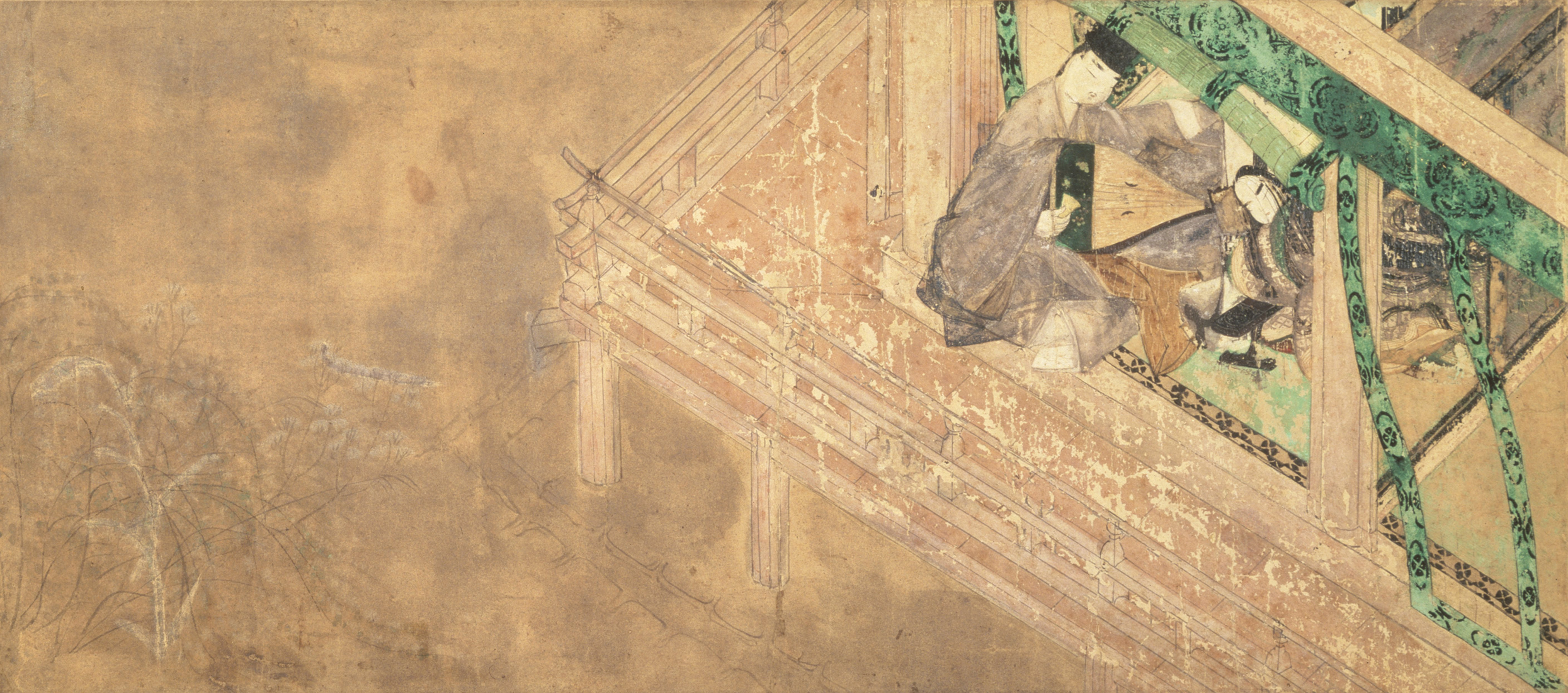
'I should like to play my lute for you ...'
She yearned for such another meeting and waited and waited for such a chance. But it never came.

The following year, on a quiet spring evening, she heard that he had come to visit the princess’s palace. She and her friend crept out of their room hoping to meet him but the veranda was bustling with people and the reception rooms were full of ladies-in-waiting so they turned back. She guessed that he too had chosen that night to visit thinking it would be quiet. But he had left without seeing her because of the crowds.

Regretfully she composed a poem:
Kashima mite Naruto no ura ni kogare idzuru kokoro ha eki ya iso no amabito
‘Burning with passion
I yearned to row my boat out
To Kashima on the Bay of Naruto.
Did you know that,
Fisherman on the rocky shore?’

And that’s the end of the story. He never enquired who she was. He was too much of a gentleman to pry. His personality was perfect and he was far from an ordinary man, she writes, but time passed and neither called out to the other ...

The gentleman with whom our heroine had this brief encounter was Minamoto no Sukemichi (1005 - 1060). She was thirty three and he was thirty seven. He was of very high rank, far too grand to mingle with ordinary court ladies like her, and a famous musician and lute player.

Later our shy heroine and her diary became famous. Her poems, particularly the passionate poem about rowing out her boat, were celebrated and included in the imperial anthology, an extraordinary mark of distinction. Today everyone in Japan knows The Sarashina Diary. Ironically, grand though he was, Minamoto no Sukemichi’s name has come down to us only because he was the object of Lady Sarashina’s unspoken passion.

Two ladies, one playing the biwa lute,
the other the
koto.


Lesley Downer is a lover of all things Asian and an inveterate traveller. She is the author of many books, including The Shogun’s Queen, an epic tale of love and death in nineteenth century Japan. For more see www.lesleydowner.com.

There are three translations of The Sarashina Diary:
in Diaries of Court Ladies of Old Japan by Annie Shepley Omori and Kōchi Doi (1934)
As I Crossed a Bridge of Dreams: Recollections of a Woman in Eleventh Century Japan, by Ivan Morris (1971)
The Sarashina Diary: A Woman’s Life in Eleventh Century Japan, by Sonja Arntzen and Itō Moriyuki (2014)

Illustrations:
I haven’t found any illustrations of The Sarashina Diary so have used illustrations of The Tale of Genji and other Heian works to give the mood of the period:

Picture 1: Murasaki Shikibu composing The Tale of Genji at Ishiyamadera by Yashima Gakutei (1786 - 1868), Gift of Charles Lang Freer, Freer Gallery of Art, Smithsonian, public domain, courtesy wikimedia commons and the Smithsonian.

Picture 2: Utagawa Hiroshige (1797 - 1858), Utsusemi from The Tale of Genji in 54 chapters, 1852, National Diet Library, public domain, courtesy wikimedia commons.

Picture 3: Genji monogatari emaki, 1130, owned by Tokugawa Art Museum Nagoya 1937, courtesy wikimedia commons

Picture 4: unknown author, Sei Shonagon, 17th century drawing, courtesy wikimedia commons

Picture 5: Fujiwara Takayoshi, Genji monogatari emaki, Yadorigi chapter, 1130, owned by Tokugawa Art Museum Nagoya 1937, courtesy wikimedia commons

Picture 6, Kobo Shunman (1757 - 1820), Two ladies, one playing the biwa lute, the other the koto, 1815, H.O. Havemeyer Collection, Bequest of Mrs H.O. Havemeyer, Met Museum, public domain


Wednesday, 14 February 2018

Deconstructing Love - by Lesley Downer

Valentine’s Day comes round again and we spend a day or two thinking about love. But what exactly is it? Is it a feeling as specific as hunger or pain, common to people the world over?

‘Love - whatever that means.’

In Japan until the late nineteenth century, there was no word that matched our western conception of love. There was koshoku, meaning ‘desire’, ‘lust’, ‘passionate physical love’, the madness that sweeps you off your feet when you’re least expecting it. But there was no word for romantic love - the love that inspired a gentleman to woo a lady then drop to one knee and propose marriage, that sent couples fleeing to Gretna Green in defiance of their parents’ wishes. Love and marriage didn’t go together like a horse and carriage.

Nor was there anything akin to the courtly love of the troubadours, the pure love of chivalrous knights who put a lady on a pedestal, suffered torments of undeclared passion, rode into battle with her scented glove tucked into his breast plate and would never have dreamt of sullying her with anything as vile as carnal thoughts.
Manami as a geisha

Love and marriage

Falling in love wasn’t something you wistfully hoped would happen. No one expected to meet the perfect person and live happily ever after.

Once they reached adolescence, boys and girls seldom met. The only men a young woman of good family would ever meet would be her brothers and other family members. People assumed their parents would arrange a marriage for them and trusted them to find a suitable husband or wife.
'Wives dressed demurely'
Ex-geisha Manami, now a wife


Once married, love was not something a man expected to feel for his wife. That would have been disrespectful (though sometimes couples who had had an arranged marriage did fall in love.)

Wives did not expect to enjoy sex. That was for procreation and it pretty much stopped once the requisite number of children were born. Respectable women dressed demurely in sombre colours. The women depicted in woodblock prints in flamboyant kimonos, their hair studded with hairpins, are ladies of the night, not respectable women.

It was not that Japanese didn’t fall head over heels in love. But when they did, they knew it was all too likely to end in disaster. And that made it all the more fatally attractive. Love was the forbidden fruit.

Love in the pleasure quarters

In Japan under the shoguns there was a place for everything and everything had its place. The place for love was the pleasure quarters. That was where a man went in search of the love and romance that was missing from his marriage. That was where he went to enjoy recreational, not procreational, sex.
A dream of romance:
tea ceremony in the pleasure quarters

To the government of the day, love was so tempestuous a force that it needed to be kept tightly under control. The pleasure quarters were walled cities of pleasure which grew into centres of culture, where a man could go and enjoy an afternoon of refined entertainment, tea ceremony and so on, before moving on to the more colourful activities of the evening.

There were women for all pockets, tastes and levels of society, from prostitutes who flaunted their wares through the bars of latticed rooms to celebrity courtesans who held salons. A man would have had to be very rich, very interesting and very persistent to have even a chance of bedding one of those, added to which the courtesans often exercised their prerogative of saying ‘No’, which sent their price into the stratosphere. 

And all this took place in a fabulous setting, hung with brocades and kimonos, surrounded by exquisite artefacts .

For men it offered a dream of romance with no strings attached. The pleasure quarters were diametrically opposed in every way to the everyday world of work and family. Courtesans and geisha didn’t cook or clean or do anything that would pollute them with the ‘stink of domesticity’. It was a sort of never never land, where a man could say and do pretty much anything he liked and it would be washed clean the next day.
'Lavish clothes':
Actress dressed as Edo courtesan

The courtesan’s job was to make the customer fall in love with her so that he would visit more and more frequently and spend more and more money. They were beautiful, witty, brilliant, accomplished. They wore lavish clothes. 

They danced, sang, chatted, talked intelligently about politics if the man so wanted. They flattered and flirted, and, if the man ever got the chance to find out, he’d discover they were brilliant in bed - all things that decent women like his wife never did. He would have been horrified if his wife had behaved like that. 

In fact the courtesan was completely out of his league, were it not for the fact he was paying for it. Money would buy this extraordinary woman, her smiles, her caresses, her swooning interest in everything he said. This gorgeous creature would persuade him he was brilliant, handsome, that she was madly in love with him. What man wouldn’t go for that?


Everything was there to enhance a man’s pleasure. The pleasure quarters were where you went to find aphrodisiacs - charred newt, eel, lotus root, dried rings of sea slug to fit over the penis. Grilled viper was also an aphrodisiac, as was the toasted fin of the fugu, the famous blowfish whose liver, kidneys, ovaries and eyes are deadly poisonous. There was always a titillating link between sex and death.
Fugu by Kawahara Keiga (1786-1860)

Courtesans wrote beautiful love letters. Some would offer a lock of their hair or a finger nail as proof of her love. And when the customer left the pleasure quarters in the morning she would escort him to the gates and be wiping away tears as he turned at the Looking Back Willow to feast his eyes one last time.

The key rule for women: never fall in love


The women of course were working. For them the difficult tightrope they had to walk was between playing at love without ever falling in love. But sometimes they did fall in love and it was invariably a disaster. It was always the wrong man, not the rich client who’d become a woman's patron and support her but a poor young clerk or a son whose father had marriage plans for him and who would disown him and disinherit him if he disgraced the family by running away with a courtesan.

When that happened many couples decided that the only way out was to die together, to commit ‘love suicide’, still to this day considered the ultimate demonstration of love. 


Lesley Downer’s latest novel, The Shogun’s Queen, an epic tale set in nineteenth century Japan, is out now in paperback. For more see www.lesleydowner.com.

Picture at top: 'Lovers walking in Snow' by Suzuki Harunobu (1725-1770), courtesy of wikipedia commons. Fugu: courtesy of wikipedia commons. All other pictures by me. 

Tuesday, 14 February 2017

Love, Sex and Romance in Old Japan - Valentine’s Day Special by Lesley Downer

Until the late nineteenth century, there was no word for ‘love’ in Japanese, no equivalent to the western concept of pure, ennobling, platonic love, the courtly love of chivalry. Love was the forbidden fruit. 

Tayu courtesan in Shimabara, Kyoto.
The Japanese acknowledged the strength of love, its power to subvert the existing order, and did all they could to tamp it down. Falling in love was seen as a madness that swept you off your feet, made you go off with someone totally unsuitable. Such folly could only lead to tragedy. Far from expecting to fall in love, as we do, men and women had marriages arranged by their families.

One of Japan’s most emblematic love stories is that of Tokubei and Ohatsu. Tokubei was a clerk, Ohatsu a famous and beautiful courtesan. Tokubei was far too poor to be able to spend a night with Ohatsu, let alone buy her out of servitude. And, as a courtesan, it was Ohatsu’s job to make men fall in love with her but never, never to fall in love herself.

Nevertheless Ohatsu fell for this poor clerk.

Somehow Tokubei managed to beg, borrow or steal the money to pay her ransom. But then he was swindled out of his savings. Realising they could never be together the two decided to run away to Sonezaki Shrine in the wood of Tenjin and kill themselves so they could be together in death. There he stabbed first her, then himself, in the throat.
Cherry blossom time in the
Yoshiwara pleasure quarters.
Utagawa Hiroshige. Los Angeles County Fund

The event caused a sensation. Their story was immortalised by the great playwright Chikamatsu Monzaemon (1653-1724). The play was first performed in the bunraku puppet theatre in 1703, the year of their deaths. The lines that the chorus sings as they walk into the forest are some of the most famous and moving in all of Japanese literature:

‘Farewell to this world and to the night farewell.
We who walk the road to death, to what should we be likened?
To the frost by the road that leads to the graveyard,
Vanishing with each step we take ahead:
How sad is this dream of a dream!’

Gravestone of Ohatsu and Tokubei.

The play inspired a spate of copycat suicides and to this day ‘love suicide’ a la Romeo and Juliet is still considered the ultimate romantic act.  

But this was not courtly love. Tokubei was in love with a real woman, not some distant idealised figure, and Ohatsu was equally in love with him.

Geisha, Pontocho, Kyoto
As I said, at the time there was no word in Japanese for pure idealised ‘love’ which has nothing to do with sex. The word koshoku meant both love and lust and everything in between. There was no distinction between the two. Love was not something you felt for your wife. That would have been disrespectful. Respectable married women were taught not to make themselves attractive - not to ‘tart themselves up’, if you like.

Then in the late nineteenth century western literature entered Japan. Translators came across the word and the concept of ‘love’ and realised that it referred to something different from ‘lust’, some pure, noble emotion which didn’t require physical gratification. To begin with they used the English word ‘love’, phonetically transliterated as rabu, and eventually coined a new word - ren’ai.

The Kiss by Auguste Rodin
 at Ny Carlsberg Glyptotek,
Copenhagen, photographer 
Yair Haklai 2010.

There was also no word for ‘kiss’. When Oda Jun’ichiro translated Edward Bowler Lytton’s Ernest Maltravers into Japanese in 1878, he was stumped by the phrase, ‘I should sleep well if I could get one kiss from those coral lips.’ He finally came up with, ‘if I could get one lick of your red lips’, which Japanese of the time found extremely amusing.

A woman named Sugimoto Inagaki Etsu records in her 1926 memoir, A Daughter of the Samurai, that when she set off for America in 1898, her mother warned her, “I have heard, my daughter, that it is the custom of foreign people to lick each other as dogs do.”

But all this does not mean that love and kissing did not exist in old Japan. They did; but as we have seen they had a different place in the order of things.

Geisha provided an outlet for romantic feelings - though, while a man might have strong feelings for a geisha, he was well aware that she was being paid. Kissing was part of a geisha’s repertoire of exotic sexual techniques. It was not something that decent women did.

Eventually the word ‘kiss’ was transliterated as kissu, the only Japanese word for ‘kiss’ used to this day. When Rodin’s statue The Kiss was erected in Tokyo in the 1930s, it caused a sensation. The kissing heads had to be wrapped in a scarf. There was no problem with the naked bodies.

So, as we have seen, in old Japan love and marriage did not go together ‘like a horse and carriage’. They had very little to do with each other.

Love belonged on the wrong side of the tracks - which made it all the more alluring. The system which the Tokugawa shoguns established and which lasted for more than 250 years, from 1603 to 1868, put a premium on order above all. There was a place for everything and everything in its place. The place for love was the pleasure quarters, where it would not pollute the decent world of work, wife and children.

The most famous of these was the Yoshiwara, a good way outside Edo (now Tokyo), across the marshes. It was a city devoted to pleasure - the pleasure of men. There was every human emotion there - pain and tragedy, romance and love - and everything was heightened and intense. It was a place reserved for all the emotional side of life, so that outside it people could get on with the serious business like having a family and working. It was Las Vegas, it was Hollywood - a glamorous world of fun and fantasy, where whatever a man did had no consequences.

There, if he could afford it, a man might spend night after night with a beautiful courtesan. She no doubt told him she loved and desired him - as she told plenty of other men - and he might well be completely in love with her. It would suit her purposes if he was. In the morning as he left the pleasure quarters he would turn at the Looking Back Willow to take a long last look as she stood waving, wiping away a tear if she was a particularly consummate actress.

But it would be the pinnacle of folly for her to fall in love with him or anyone else - unless she too wanted to walk the road of death along with Tokubei and Ohatsu.

Lesley Downer's new novel, The Shogun’s Queen, is published by Bantam. Find more information on her website, http://www.lesleydowner.com/

http://bit.ly/TheShogunsQueen

https://www.facebook.com/AuthorLesleyDowner/

@LesleyDowner

Friday, 10 June 2016

Spells, Pills & Plasters to Help a Lady Get Her Man – Michelle Lovric

BAIT, n. A preparation that renders the hook more palatable.

The best kind is beauty.

Ambrose Bierce (1842−1914)
The Devil's Dictionary, 1911. 

Binding spells were probably the first bait deployed when beauty alone failed to attract the desired mate. In Renaissance Italy, binding spells could be cast, for a fee, by ‘wise women’ or undertaken by ordinary women with the right information.

For example, a woman who wanted to be sure of her man would burn the tips of olive branches and dip them in holy water, chanting: 'As I bind this wood with this cord, so may the phallus of my lover be bound to me.' Then she would take the branches to the garden outside the church and plant them in the ground, chanting: 'As this wood cannot grow green again, so may not the phallus of my lover be inclined to relations with any other woman.'

Women who required the undying fidelity of their men were advised to rub their entire bodies with holy oil before sexual congress with them. This formula had the added advantage of leaving the woman free and unbound; while her husband might not stray, she was able to engage her body and her feelings wherever she wished.

Another love-recipe involved the use of large sage leaves: the woman would write on them and give them to the object of her love, who, on eating them, would be overwhelmed with passion.

The lips of would-be lovers would be anointed with holy oil, and they had to make sure they stayed slick and slippery until the very moment of stealing a kiss from the person they longed to possess.

There were always ways to renew a man's lust for his wife. She had to place under the conjugal bed the blade of a plough, and the hoe and shovel used for burying at least one corpse. In another spell the wedding ring of a young virgin who had subsequently died was required: the affected man had to urinate through this ring and would soon find his powers miraculously restored.

Some notions of this kind were kept in manuals or even published. Illustrated below is a receipt (recipe) for a person to make her husband love her, from A Booke of Physicke, circa 1710.

 Vendors of quack love potions put on wonderful shows of intimate expertise at markets and country fairs, as you can see in this coloured lithograph by C. Voct after A. de Valentini. It shows Lablache, a flamboyant itinerant medicine vendor selling Mariol an aphrodisiac at a country fair. (Courtesy of Wellcome Images).

The marketing of sexual attraction really began in earnest with the age of printed advertising. Almost any product could be sold with the promise - or, even better, the hint - that it would bring the opposite sex flocking, panting and salivating.

 Lady quacks in London often specialized in beauty treatments that mined women’s insecurities about retaining the exclusive attention of their husbands. A ‘gentlewoman’ practising at the Haymarket could furnish her own proprietary nostrum at just a shilling a bottle, asserting: ‘God the author of all things, to make man in love with his wife in her state of innocency, he made her smooth, soft, delicate and fair to intice him; I therefore, that woman may be pleasing to their husbands, and that they might not be offended at their deformities and turn to others, do commend unto you the Virtue of an eminent and highly approved “Balsamick Essence”, with several other Incomparable Cosmeticks …’.

 Salves, pills and creams constituted the main tools of the trade, but other less likely inventions were also aimed at would-be lovers. One of my favourites in this department are the Oxien Active Sex Plasters, which promised post-coital glow, without the bother and mess of coitus.

The advertising pitch was this: ‘You may have heard of the woman who felt so nice she thought it was caused by walking on velvet. Oxien Sex Plasters make any one, man or woman, feel just too good and happy for anything …When one of these plasters is placed on the warm body, the nap to this downy-feeling fabric seems to generate that warmth of food nature that comes from the satisfied nerves when content reigns supreme.’

Oxien Active Sex Plasters were, according to the manufacturers, ‘delicate and soft as a kitten’s ear … not only soul-satisfying, but they are large and well-shaped.’

No wonder Oxien could warn, ‘You cannot afford to do without.’
Some love-pills were advertised with romantic imagery. Shedd’s Little Mandrake Pills, for example, used an image of a courting couple and a series of (terrible) jokes on the back of the trade cards as their pitch. An example:

 USE SHEDD’S LITTLE MANDRAKE PILLS
If cats howl in the back yard it is a sign that you do not love mewsick.

I came across a Victorian trade card advertising ‘Attraction Wafers’. The manufacturers boasted, ‘Quite a large majority of our most attractive ladies are indebted to the Attraction Wafers for enhancing their personal attractions. Strongly magnetic personal attractions and lovely complexions are the keystones of a lady’s success in life.’

Some quacks set themselves up as experts in fulfilling the romantic dreams of their women clients. Typical were the claims advertised in an 1880s poster for a ‘Professor Franklin, M.D’. The doctor described himself as an ‘Eminent Lecturer, intuitive veteran Physician of Body and Mind’ and mentioned some of his previous publications, ‘The Medical Counsellor’, ‘Art of Health and Beauty’, ‘Phreno-Medical Chart’, ‘Compass Tree and Book of Life’, ‘Science of Life and Mind’, ‘Oracles of Truth for Every Youth’.

His poster gave notice of a lecture ‘FOR LADIES ONLY. Subject: HEALTH and BEAUTY, WOMEN’S SPHERE and DUTY. Her gifts, qualities and capabilities, Signs and causes of Passions, Character and Diseases; the best means of prevention and cure, without drugs.’
The good doctor warned: ‘No lady should miss these best efforts of Franklin to please and instruct the fair. His extensive travel, great experiences, pre-eminent abilities have wonderfully fitted him for his work…’.

He concluded, ‘Every lady can learn how to perfect her form and features, mould the heart, rule in the domain of Love and make judicious rejections of friends and husband by the light of science. Every lady can treat herself without exposing her condition.’

Have things really changed so much? How much advertising uses the promise of sexual or romantic success, even between the lines? Next time you watch an advertisement on television, or see one in a magazine, can I suggest you ask yourself how often sex is dragged into the equation. And how often sexual insecurity is used as a hook for a purchase that is nothing to do with physical intimacy.


Michelle Lovric’s website

The image at the top of the page, courting couple sit by a tree and the man hands a flower to the woman. Engraving by C. de Pas, courtesy of Wellcome Images

Sunday, 1 December 2013

Writing Historical Fiction by Celia Brayfield

We have a huge extra treat this month from Celia Brayfield, whose new book with Duncan Sprott, Writing Historical Fiction sounds like a must-read for all History Girls - and Boys.


A bit about Celia:


Celia Brayfield’s first novel, which began in Malaysia in 1938, was written when historical fiction was the love that dared not speak its name. She subsequently smuggled revolutionary St Petersburg, Paris with the Ballets Russes and the Barbary Coast in the eighteenth Century into some of her nine bestselling novels. Her next novel is about the love affair between a French man and an English woman that finally brought Mary Queen of Scots to justice; in retelling this tragic episode in English history, she has used recent research to follow the lives the ordinary people trapped Mary’s doomed court-in-exile. Celia also tutors award-winning students on two of Britain’s leading Creative Writing programmes, at Bath Spa University and Brunel University in London. She is the author of Bestseller (Fourth Estate) 1996, one of the very few guides to writing successful popular fiction from a bestselling author.

She is also the guest editor of the winter 2013 edition of Mslexia.

Here she muses on why anachronistic attitudes to love and sex have sometimes given historical fiction a bad name.


Bodice-ripper. Shall we just think about this for a moment? Yes, it’s publishing slang for popular historical fiction for women and it tells us about the mindset, fixed in the Mad Men era, that put historical writing beyond the literary pale for decades. Bodice-ripper believers are sure that that our ancestors were randy as stoats, at it like crazed weasels and permanently breathless with passion.

I think not. The eminent historian Lawrence Stone thought not, in his tome The Family, Sex and Marriage in England, 1500-1800 (1977) which transformed thinking about relationships in the early modern period and in which observed that people had far less sex at that time than we imagined they did.

Likewise with love. History certainly offers us epic romances – the love of Katherine Swynford and John of Gaunt, which endured thirty years and his first two highly advantageous marriages to other women, or the coup de foudre which led Eleanor of Aquitaine to dump the King of France for the unprepossessing Duke of Normandy – later Henry II of England. But the writer who tries to tread a path between accurate history and engaging fiction is confronted by the fact that neither love nor sex have meant the same to our ancestors as they do to us today.

Worse, we have very little evidence to tell us how ordinary people felt, thought and acted about love, and what we do have – the poetry, the erotica, the court testimonies – was not created to provide a record, but to serve a purpose at the time. Finally, worst of all, many authors have made considerable fortunes by ignoring these facts and having Tudor noblewomen act like Essex girls.

Love is the stuff of fiction, particularly popular fiction, but love has not always been the intense, intimate and sexual emotion we recognise today nor was it always considered the best foundation for a marriage and family. History is not on the writer’s side. Mostly, love has been an anarchic challenge to the social order.

Love and the novel have a shared history. Romantic love was defined by the romantic movement of the late eighteenth century, in which the idea that emotions should be all-powerful and should triumph over reason was central. The novel itself emerged at the same time and their linguistic origins are intertwined, with the word romance having double meaning – a love affair or a story. The sociologist Anthony Giddens has suggested that romantic love introduced the idea of a narrative into an individual's life and reinforced the link between self-realisation and freedom.

It is ironic that the period of English history that is currently such a focus of fiction was one of the least romantic. To modern readers, the true Tudor attitudes to love and marriage e are depressingly pragmatic. The immense dynastic marriages of the time, such as that of the Earl of Shrewsbury and Bess of Hardwick, a three-couple alliance which included four of the couple’s adult children, seem cruel and incomprehensible to us.

Equally hard to understand is the story of Lady Catherine Gray, heir to the English throne, who fell in love and married Edward Seymour, the Earl of Pembroke, in secret while negotiations for a diplomatic alliance for her were under way. Within months Catherine’s young husband was sent abroad and his sister, the only witness to their marriage, died. Catherine lost the legal document that proved their marriage, and the priest who married them disappeared. She found herself pregnant, with a child that was, to all intents and purposes, illegitimate. Queen Elizabeth suspected a plot and Catherine was imprisoned for the rest of her life. To modern readers, and to fine novelists including Alison Weir and Ella March Chase, this is a tragic story of true love. To an Elizabethan audience, this is a tragic story of an unbelievably silly and disloyal young couple. And to male historians, alas, it has been proof that Queen Elizabeth was an embittered spinster.

Does it matter that a novelist in pursuit of more readers makes a Tudor lady act like an Essex girl? To me, yes. Surely the reason we explore the past is to find out what human nature really is. If we traduce our ancestors’ feelings, there’s no reason to get to know them at all. And besides, a bodice meant exquisite fabric imported from far-off lands, jewels, gold thread, skilled embroiderers, weeks of work for dozens of people – the man who ripped it wouldn’t be anyone’s favourite.


Extracted from Writing Historical Fiction:The Writers’ and Artists’ Companion, by Celia Brayfield and Duncan Sprott, published by Bloomsbury Academic, December 5 2013.

Monday, 22 July 2013

KISSING COMFITS AND SNOW ERINGOES: APHRODISIACS, by Jane Borodale

Eryngium maritimum © Valerie Hill 

Effective, practical enhancement of the art of love has been sought after since ancient times. Roots of sea holly or Eryngium maritimum were collected on a large scale in England during the 17th and 18th centuries for candying as restorative, quasi-aphrodisiac pastilles, known as eryngoes. Old records of Colchester show that the town was famous for oysters and eryngo root, where a 17th-century apothecary called Robert Burton set up a manufactory to made these popular sweetmeats, candied with sugar and orange-blossom water. They even get a mention in the 'Merry Wives of Windsor', when Falstaff, off to meet Mistress Ford in Windsor Forest, declares; ‘…hail kissing comfits and snow eringoes; let there come a tempest of provocation…’ 

Sea holly grows well in gardens (you absolutely wouldn’t collect it from the wild anymore – it’s far too scarce) and Mrs Grieve suggests digging up the roots at the end of the season, from plants at least two years old. Geoffrey Grigson points out wryly that, ‘careful wives grew Sea Holly in the physic garden.’ (What are you waiting for...?)

Pliny describes it as a sweet savouring root. 16th-century botanist William Turner writes of its virtues; ‘to stir up the lust of the body, and … give it to both men and women that are desirous to have childer. Some condite (candy) or keep in sugar the roots for this purpose.’ Nicolaus Alexandrinus of the late 13th century has four medicines using this herb which he ‘maketh to stir up the pleasure of the body, and to make men and women fruitful.’

Sea holly © Valerie Hill
Here’s a 17th-century recipe for Candied Eringo-roots from Hannah Woolley. I have it on good authority that it is effective – but don’t blame me for consequences of any sort whatever:

Take of your Eringo-roots ready to be preserved, and weigh them, and to every pound of Roots you must take of the purest Sugar you can get two pound, and clarifie it with the whites of Eggs exceedingly well, that is may be as clear as Crystal; it being clarified, you must boil it to the height of Manus Christi, and then dip in your Roots two or three times till they are all Candyed; put them in a Stove, and so keep them all the year.

Dorothy Hartley gives us a hand-me-down recipe for Eyringo Jelly (sometimes called Gloucester Jelly as sea holly grew in the estuary):

1 oz each of sago, hartshorn shavings, eyringo root, and pearl barley; put into a pan with 2 quarts water, and boil until reduced to 1 quart. Strain and let it set – it should be stiff. Slices of it should be put into invalid drinks (!) – or it may be flavoured and sweetened and eaten as a jelly.

She also suggests Eryingo toffee:

Boil some of the sliced root in a little water till well flavoured, and add this water to the sugar and butter with which you make the toffee: just as it is ready to set, drop the softened root chips into it.

Early purple orchid © Valerie Hill
It wouldn’t be representative of the early herbals if I didn’t include mention of them getting it perfectly wrong. A popular but useless aphrodisiac came from the orchid (or standergrasse) family. ‘Orchis’ is from the Greek orkhis meaning literally ‘testicle’, and the plant acquired attributes of sympathetic magic due to the shape of its tuber. Orchids, particularly Orchis mascula or Early Purple were cited as a vital ingredient in a sweet electuary known as a diasatyrion, which combined Orchid tubers with dates, various nuts including pistachios, galingale, peppers, musk, ambergris, grains of paradise, ash-keys, nettle seed and Malaga wine, and which was prescribed by the College of Physicians in London as ‘a provocative to venery’. Henry Lyte’s 'New Herball' of 1578 says: ‘the full and sappy roots of Standergrasses (but especially of Hares Ballocks, or Goates Orchis) eaten, or boyled in Goates milke and drunken, provoketh Venus, or bodily lust.’

But there were plenty of other options if you couldn’t get your hands on either of these. Pliny suggests that artichokes ‘taken in wine stirreth up the lust of the body… but likewise as this herb provoketh lust in women, so it abateth the same in men.’ As ever it depends on whom you read, and Henry Lyte disagrees on the finer point; ‘the first springes or tender impes of the Artichoke sodden in good broth with bytter, doth mightily stirre up the lust of the bodie both in men and women, causeth sluggish men to be diligent in Sommer…’ Aniseed (Pimpinella anisum) is a traditional aphrodisiac, a sweet, warming stimulant herb. Turner says of anise that ‘it stirreth men to the pleasure of the body.’ There was lovage, and garlic. Ayurvedic medicine still regards garlic as rejuvenative and aphrodisiac. Turner says that it ‘stirreth men to venery, drunken with green Coryander and strong wine.’

Ash keys © Valerie Hill
Anyone could obtain a bit of ash out in the woods or on the roadside – its seeds according to Dioscorides, ‘provoke lust’ or ‘render a man more spirited with ladies’. Lyte says, ‘The seed of the ashe-tree increaseth naturall seed, and stirreth by Venus, especially being taken with a Nutmeg, as Isaac, Rhasis, Damascenus, and many other Arabian Physitions doe write.’

Other traditional spring tonics like watercress (nasturtium) and parsley feature often in the herbals as having aphrodisiac virtues. Turner claims that ‘Persely… stirreth up appetite to cold women’, and it’s notable that parsley oil is used today in perfumes for men. There was saffron, or coriander seeds, or leeks and onions; in some regions of France there was a custom of preparing onion soup for newly-weds after their wedding night. Pliny suggested that if southernwood (also called lad’s love) ‘…be layed under the bed, pillow or bolster, it provoketh carnall copulation, and resisteth all inchantments, which may let or hinder such businesse, and the inticements to the same.’

The opposite effect.
Just in case, I should point out one or two easy-to-find antidotes or anaphrodisiacs: such as mallow, hops and lettuce. The Pythagoreans knew lettuce as the 'eunuch’s plant', but luckily you need more than a bowlful of salad for it to have an effect, it’s the concentrated milky juice or sap, the 18th-century 'lettuce opium' that has the sedative power.

And while I’m in this bodily vein (it’s all sex and death today) – there are still tickets left for the upcoming Medicine and Mortality weekend at the Weald and Downland Museum in Sussex, 21-22 Sep. Historians including Ian Mortimer, Clare Gittings and Owen Davies will talk about health, fatal illnesses, magic, medicine and funeral rituals; medical herbalist Christina Stapley will demonstrate historical herb recipes – ask her about eryngoes! – and much more.

And that, people, is my very last post. I’ve absolutely loved being a History Girl and will go on reading HG posts galore, but right now must bury myself and do nothing but write, write, write, for a while.

Thank you for having me, and adieu…