
Showing posts with label 11th century. Show all posts

Friday, 7 April 2023

A Brief Encounter ~ by Lesley Downer

Which is more beautiful, spring or autumn? That was a question bound to stir the interest of any sensitive young woman at the eleventh century Japanese court ...
A Heian lady's day ...

Our story begins with some monks reciting Buddhist sutras all through a long, very dark night. Two young women had crept out of their quarters and lay down on the veranda outside the prayer hall to listen to their beautiful voices. Women were not supposed to be seen but it was dark enough that no one would see them.

It was October 1042. Across the world Edward the Confessor had just come to the throne and commissioned the building of a royal burial church, later to become Westminster Abbey. Beowulf’s epic battle with Grendel had been set down in writing, as had The Song of Roland.

In Japan courtly gentlemen were studying and writing poems in Chinese, which was to Japan as Latin was to the west, the language of educated people. Women learnt kana, a simple alphabetical form of writing, just enough to read and recite the sutras, which was all that women needed, or so men thought. The ladies of the court, however, were smart, sophisticated and very witty and they used the flowing kana script to record their lives, feelings and the often amusing events that occurred, in glorious detail.

One shy young woman was whiling away her years in the provinces, reading, dreaming and writing poems. She wrote an introspective, astonishingly modern account of her thoughts, feelings, regrets and sadnesses, so vivid that we can almost step into her silken shoes and imagine ourselves back in Heian Japan. The diary she wrote - in modern terms, a memoir - is called The Sarashina Diary. She is known only as the daughter of Takasue or Lady Sarashina, though that certainly wasn’t her name.

After many years in the provinces, when she was twenty six, our heroine was invited to the court of Princess Yūshi. On that momentous occasion she wore eight layers of gowns of alternating dark and pale chrysanthemum shades topped with a flowing robe of crimson silk. Eventually she was offered a position as a lady-in-waiting there.

On such a night as this ...
Court ladies and gentlemen spoke separated by screens 
so that the gentleman couldn't see the lady.
 
On that dark night, as Lady Sarashina and her friend were reclining on the veranda, a gentleman strolled by and stopped to engage the ladies in conversation. In the ordinary course of events our heroine would never have met a courtier of such high rank. She was far too humble to attend on high court nobles or senior courtiers, so lowly that such people would never even have known she existed.

The proper thing to do would have been to slip away or summon ladies of the proper status but that would have been awkward. There was nothing for but to respond to his remarks.

Lady Sarashina listened while her friend chatted with the man. She noticed that he was quiet and thoughtful, not flirtatious or forward like other men. He spoke poetically of the brevity of life, mono no aware, the sadness of things. He was a perfect gentleman, in fact.

Then he asked, ‘And who is your companion?’

Lady Sarashina spoke up modestly and the gentleman responded, ‘So there is still a young lady in this palace whom I do not know?’ He showed no sign of wanting to leave, she writes.

It was a starless night and a slight drizzle pattered on the leaves with a charming sound.

‘How beautiful the darkness is,’ the gentleman said. ‘If there’d been a full moon it would have been too dazzling.’ It would also have meant that that they wouldn’t have been able to talk. They could only talk because they couldn’t see each other.

It was then that he turned to the very topic that struck a chord with her, comparing spring and autumn. He spoke of the beauties of spring, when the sky is overcast and the moonlight seems almost to float on the mist. ‘That’s the time when it’s lovely to hear the soft notes of a lute, set in the key of the Fragrant Breeze,’ he said. Then he spoke of autumn, then winter, then asked them which season they most loved.

Her friend spoke up in favour of autumn so Lady Sarashina decided to champion spring. She answered with a poem:
asa midori hana mo hitotsu ni kasumitsutsu oboro ni miyuru haru no yo no tsuki
‘Glimmering green,
Seen through mist,
Merging with the cherry blossom too,
Dimly seen -
The moon on a spring night.’

In those days educated people readily composed poems; it was an essential accomplishment. But our heroine was no ordinary poet but an exceptional one.
A Heian lady's room complete with kicho screen

The gentleman savoured her lines, repeating them again and again. He replied with a poem of his own: ‘From this night on, so long as I have life, such a spring night will hold the memory of you and of our meeting.’

Then he spoke of how he had once gone to the great shrine at Ise to attend the coming-of-age ceremony of the virgin priestess. Awe-inspiring though that experience had been, he said, this dark rainy night that they had spent together was every bit as unforgettable.

With that he left. They still hadn’t seen each other. She had no idea what he looked like, neither did she care. What drew her to him and demanded a place in her heart was his sensitivity, his manner, his poetry, his voice.

Such a fine gentleman could have no idea who she was, which was only proper, or so she thought.

‘Why should you remember it so well?’

Behind the screen ...
The following year, nearly a year after that first encounter, she went to the imperial palace again for an all-night entertainment. She didn’t know that the gentleman was also there and, being of a retiring disposition, stayed in her room.

At dawn she pushed open the sliding doors onto the corridor. The moon was glimmering, very faint and beautiful. Then she heard footsteps on the veranda and that voice she had yearned for, reciting a sutra. He stopped in front of the open doors.

‘I never forget that night of softly falling rain,’ he said, ‘not for a moment, and the precious time we spent together!’

There was no time for a proper answer so she replied with a poem:
nani sa made omohi idekemu nahozari no ko no ha ni kakeshi shigure bakari wo
‘Why, I wonder,
Should you remember it so well?
It was only
An autumn shower
Falling on the leaves.’

Then his companions joined him and she retired to the back of her room without waiting for his answer. That morning she had to leave the imperial palace with the princess and her retinue.

Later her friend brought his reply: ‘If we should ever have another such drizzly night, I should like to play my lute for you, every melody I know.’
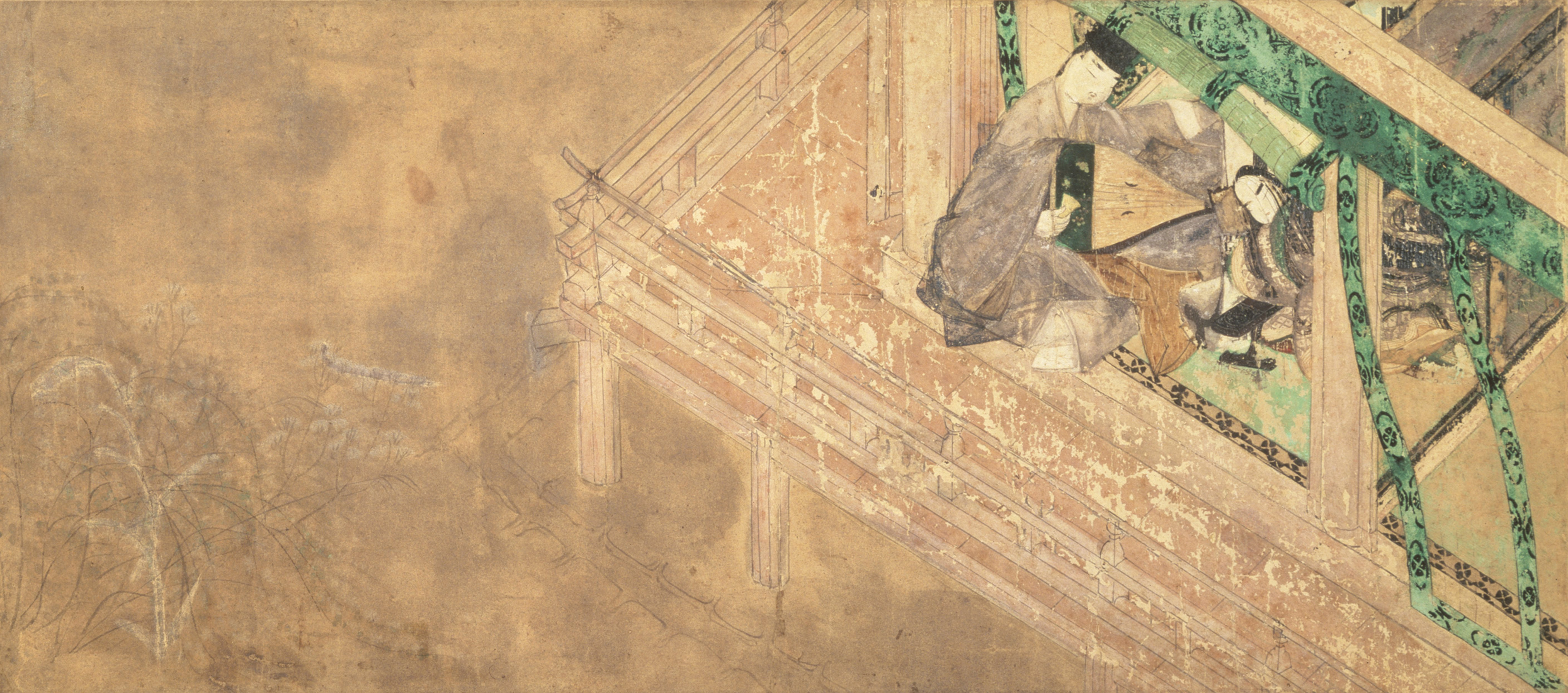
'I should like to play my lute for you ...'
She yearned for such another meeting and waited and waited for such a chance. But it never came.

The following year, on a quiet spring evening, she heard that he had come to visit the princess’s palace. She and her friend crept out of their room hoping to meet him but the veranda was bustling with people and the reception rooms were full of ladies-in-waiting so they turned back. She guessed that he too had chosen that night to visit thinking it would be quiet. But he had left without seeing her because of the crowds.

Regretfully she composed a poem:
Kashima mite Naruto no ura ni kogare idzuru kokoro ha eki ya iso no amabito
‘Burning with passion
I yearned to row my boat out
To Kashima on the Bay of Naruto.
Did you know that,
Fisherman on the rocky shore?’

And that’s the end of the story. He never enquired who she was. He was too much of a gentleman to pry. His personality was perfect and he was far from an ordinary man, she writes, but time passed and neither called out to the other ...

The gentleman with whom our heroine had this brief encounter was Minamoto no Sukemichi (1005 - 1060). She was thirty three and he was thirty seven. He was of very high rank, far too grand to mingle with ordinary court ladies like her, and a famous musician and lute player.

Later our shy heroine and her diary became famous. Her poems, particularly the passionate poem about rowing out her boat, were celebrated and included in the imperial anthology, an extraordinary mark of distinction. Today everyone in Japan knows The Sarashina Diary. Ironically, grand though he was, Minamoto no Sukemichi’s name has come down to us only because he was the object of Lady Sarashina’s unspoken passion.

Two ladies, one playing the biwa lute,
the other the
koto.


Lesley Downer is a lover of all things Asian and an inveterate traveller. She is the author of many books, including The Shogun’s Queen, an epic tale of love and death in nineteenth century Japan. For more see www.lesleydowner.com.

There are three translations of The Sarashina Diary:
in Diaries of Court Ladies of Old Japan by Annie Shepley Omori and Kōchi Doi (1934)
As I Crossed a Bridge of Dreams: Recollections of a Woman in Eleventh Century Japan, by Ivan Morris (1971)
The Sarashina Diary: A Woman’s Life in Eleventh Century Japan, by Sonja Arntzen and Itō Moriyuki (2014)

Illustrations:
I haven’t found any illustrations of The Sarashina Diary so have used illustrations of The Tale of Genji and other Heian works to give the mood of the period:

Picture 1: Murasaki Shikibu composing The Tale of Genji at Ishiyamadera by Yashima Gakutei (1786 - 1868), Gift of Charles Lang Freer, Freer Gallery of Art, Smithsonian, public domain, courtesy wikimedia commons and the Smithsonian.

Picture 2: Utagawa Hiroshige (1797 - 1858), Utsusemi from The Tale of Genji in 54 chapters, 1852, National Diet Library, public domain, courtesy wikimedia commons.

Picture 3: Genji monogatari emaki, 1130, owned by Tokugawa Art Museum Nagoya 1937, courtesy wikimedia commons

Picture 4: unknown author, Sei Shonagon, 17th century drawing, courtesy wikimedia commons

Picture 5: Fujiwara Takayoshi, Genji monogatari emaki, Yadorigi chapter, 1130, owned by Tokugawa Art Museum Nagoya 1937, courtesy wikimedia commons

Picture 6, Kobo Shunman (1757 - 1820), Two ladies, one playing the biwa lute, the other the koto, 1815, H.O. Havemeyer Collection, Bequest of Mrs H.O. Havemeyer, Met Museum, public domain


Tuesday, 14 November 2017

The World’s First Novel by Lesley Downer

One day, a little over a thousand years ago, a Japanese court lady picked up her writing brush. In those days Japanese noblewomen lived in seclusion. The only men they could expect to see throughout their entire lives were their fathers, brothers, sons and, if they had one, their husband. The woman - no one knows her name but she has gone down in history as Murasaki Shikibu - was a lady-in-waiting at the imperial court.
Lady Murasaki at her desk
by Utagawa Kunisada (1786 - 1865) 1858

Some time around 1006 - sixty years before the Battle of Hastings, a couple of hundred years after Beowulf and a couple of hundred years before Chaucer - she started writing a story to entertain her mistress, the empress. Like the sultan listening to The Thousand and One Nights or the readers of the instalments of Dickens’s novels, the court ladies clamoured for more.

Murasaki Shikibu was unlikely ever to have a love story of her own, so - perhaps a bit like Jane Austen - she dreamt up the ultimate man and fleshed him out. Prince Genji, the result of her imaginings, was handsome and charming, but also kind-hearted. He was human and flawed. As she told his story he developed and changed and grew older. He suffered terrible losses and tragedies. What Murasaki wrote was amazingly modern, all about relationships and character and feelings. It is moving and gripping and spellbinding and reads like the freshest of page turners. It was the world’s first novel.

In The Tale of Genji Murasaki recounts Genji’s adventures, travels, love affairs and tragedies. A breaker of hearts and fatally prone to falling in love, he’s an adept in the arts of perfume mixing, poetry writing and calligraphy. In his society court ladies keep themselves hidden inside their palaces. He exchanges poems with women he’s never seen and decides if they’re worth meeting on the basis of their handwriting and the quality of their poems. It’s a world quite Proustian in its delicacy and beauty and eternal leisure.
Ox carts - The Tale of Genji
by Tosa Mitsuoki (1617 - 1891) 

This was a society with a very different ethos from our own. Women were never openly seen by men. Noblewomen lived in vermilion-painted palaces (the aristocracy were the only people who counted, as far as Murasaki was concerned) and when visitors called, they received them hidden behind screens. When the women went out they trundled around the tree-lined boulevards of the capital, Heian-kyo, in magnificent ox-drawn carriages, hidden from view, though they made sure there was an exquisite silk sleeve dangling gracefully out of the window so the passing crowd could imagine just how beautiful and cultured the hidden lady was. There was much standing on tiptoe and peeping through lattice fences, not just by the men, trying to catch a glimpse of these elusive creatures, but also by women, when someone like Prince Genji passed by.

In The Tale of Genji men regularly enter ladies’ palaces at night, make love to them in the pitch dark without ever having seen their face and leave at daybreak. The servants, being well trained, studiously ignore the intruders though they are well aware of who they are, as each man wears a distinctive perfume which he has mixed himself.
Spot the lady - hidden behind the screens
Tale of Genji by Kano Hidenobu (late 17th/early 18th century)

Some of the most memorable episodes in The Tale of Genji are humorous. At one point, Genji hears about a princess who lives all alone (apart, of course, from her maids, who don’t count). One day he happens to hear her playing her zither with such skill he assumes she must be very beautiful. He sends her poems, but she is so shy she doesn’t answer, which only piques his interest further. Finally he sneaks in. There is a delicious scent of sandalwood emanating from her clothes, surely evidence of extraordinary beauty. But when he wakes up the next morning and finally sees her he discovers that, far from being beautiful, she has a huge red nose and, worse still, wears very old-fashioned clothes. He’s so horrified he doesn’t even send the customary morning-after poem until evening. But in the end his tender heart is touched and he takes her too under his wing.
Heian Shrine, Kyoto, modelled on Heian Palace 
(794 - 1227), which Lady Murasaki knew.

The early part of the tale is full of stories like these, poignant, sometimes humorous, sometimes tragic, detailing Genii’s youthful indiscretions and misadventures, at the end of which he has gathered a brood of women who each live in an apartment in his palace. But as Genji gets older, the story gets darker; in all it is some 54 chapters and 1000 pages long. He suffers, he has terrible failures and disasters and in the end loses the person dearest to his heart - Murasaki, after whom the author is named.

By the time I sat down and read the whole novel I’d been living in Japan for several years. I knew Heian-kyo, Genji’s and also Murasaki’s city, very well. It exists like a ghostly presence underlying the streets of Kyoto, its modern name. The vermilion buildings and green-tiled roofs of Heian Shrine are an exact replica, scaled down a little, of the imperial palace that Murasaki knew, which stood until 1227. In spring the gardens, lake and delicate pavilions are swathed in clouds of cherry blossom. And you can still imagine the ox carts with their huge wooden wheels rumbling up and down the long straight streets of the City of Purple Hills and Crystal Streams, as the poets called it.

The Tale of Genji suffuses Japanese culture and Japanese society. It features in everything from art to the incense guessing game, and episodes from it form the plots of many Noh plays. It enormously coloured the way Japan looked to me. Japanese, I should add, are usually amazed to hear that I’ve read and love The Tale of Genji. For them it’s like Beowulf, so difficult that they too can’t read it in the original and rely on modern Japanese translations.
Lady Murasaki might have glimpsed
yamabushi mountain priests like these from
 the window of her oxcart as she passed
Yasaka Shrine, Kyoto (first built 656 AD) 

As a postscript, if you’re inspired to read The Tale of Genji, you should borrow, buy or steal the Arthur Waley translation. Scholars will tell you it’s not impeccably accurate. Waley took liberties, he changed details. If what you want is a precise, perfectly accurate translation, you could try Edward Seidensticker’s version or Royall Tyler’s magnificent two volume set with copious footnotes and a very interesting introduction. But if you read either of those you won’t be swept off your feet and fall madly in love with Genji and be transported away and unable to stop reading. For that you’ll have to go to Arthur Waley.

Lesley Downer’s latest novel,The Shogun’s Queen, an epic tale set in nineteenth century Japan, is out now in paperback. For more see www.lesleydowner.com.


Friday, 2 January 2015

William of Orange - by Gillian Polack


I promised you a touch of romance and some stories. The story begins, of course, with 'Once upon a time...'

Once upon a time, a teenager fell in love with a character in a series of stories. Being a geekish type (before there were computer networks to shape this love) it was a quiet and gentle addiction. The character’s name was William. Or Guillaume. Or Guilhem. 

I met him first in 1980, when Anne Trindade introduced me to my very first Old French epic legends. 

Old French epic legends rock. They have so much going for them. They're politically incorrect, violent, funny, tragic, and addictive: I’ve never got over them. 

William appeared in a range of epics, so my teen self had a William for every mood. There was a politically incorrect William, who terrorised Saracens, and he was the violent William as well. There was the romantic William who won his bride and the humorous William who stood patiently outside the gate of the city trying to convince his wife to let him in “Why should I?” she asked, quite reasonably. “How do I even know you’re my husband? He’s been away so long I’m not sure how to recognise him.” There was the political and charming William, who was counsellor to an old king and supporter of a young one.

If I’d been a normal geek, I probably would have found Roland (with his stupid bravery) or Olivier (who was wise, but far too trusting) more interesting. When I was in my late teens I found that it was far more tempting to fall in love with someone who had his life under control and whose sense of humour was somewhat warped and who was complex. I wasn’t at all tempted by the simple idiot who died in the pass at Roncesvals because he was too vain to blow a horn for help. My hero was the miracle worker who defended himself against false-brigands by ripping the hind leg off his transport, and put the leg politely back on (no harm done to any except the thieves) when he was finished. William was a hero, with all the wrong (killing is still killing) and right (bravery, cunning, and a late-in-life tendency to miracle working) that made his legend what it was. He also had that wife to keep his ego in check. She mocked his nose and locked him out of his own town. She made sure his whole army knew that a marriage needed work from both sides. 

William wasn’t just a figment of the Medieval imagination. He was real, and the monastery he retired to is real, and I’ve visited it. Here, have a picture of it.


Who was the man who founded that monastery? Why did he inspire all those amazing stories?

In Languedoc, his name is Guilhem, and he is a saint (feast day, May 28). He did indeed found that monastery and, in just in a moment, I’ll give you a picture of his bones which can still be visited in the church he built.

Before he retired, he was one of the most important men in western Europe. He was part of Charlemagne’s big reform movement in Europe in the second half of the eighth century. He actually fought those Saracens: he was a leader of the Christians who fought back against the Muslim holy war. Still not politically correct (for it was outright war, on both sides), but he was one of the main leaders who drew the geographical border between Christianity and Islam. 

He did much more but this, and the founding of the monastery are what gave rise to the romantic and violent tales, a couple of centuries later. The first story about him is the English Song of Willame: the earliest bits of it may date as early as the eleventh century. It’s possible that one of the two wives apparently mentioned in his will (which I haven’t seen, and I’m curious about) was actually a convert from Islam and that the heroine who refused to let him enter his own home until he realised what an idiot he had been, was very real.

William (the real one) retired to Gellone around 806 and he died there. Let me introduce you to him. Reader, meet William.


I chose the location of my novel Langue[dot]doc 1305 purely so that I’d have an excuse to visit William. The town he founded is exquisitely beautiful. Sometimes our teen crushes are very fortunate.

Thursday, 4 April 2013

The Fall of the Red Cross Knights - Katherine Langrish


Two worlds collide.


Everyone’s mental picture of a Medieval Knight must owe something to the Knights Templar.  Here’s a picture of one.  With his distinctive white mantle and red cross, he seems the epitome of the gallant Red Cross Knight himself, or many another knight who lumbers into the joust in films of Ivanhoe or Robin Hood.

When I was a child I read and greatly enjoyed the historical novels of Ronald Welch, whose books followed the fortunes of the Careys, an imaginary branch of the D’Aubigny family, whom he placed in Llanstephan Castle on the Welsh Borders, and whose sons (always brilliant swordsmen or crack shots) manage to be present at nearly every moment of interest in English history, from the Crusades to the First World War.  The first of the series, Knight Crusader (Oxford, 1979) won the Carnegie Medal: it is a well researched, exciting, and remarkably well-balanced story about Philip, a young knight born in Outremer (as the crusaders called their heavily defended eastern kingdom). He fights in the Battle of Hattin against Saladin, is taken prisoner by a Turkish knight, Usamah, who treats him well, and eventually escapes to fight for Richard Lionheart, and to make his way to England for the very first time.

Krak des Chevaliers, Syria

One of the things that struck me about the book, reading it for the first time, was the contrast Welch draws between the Muslim-influenced luxury and cleanliness of the Outremer castles, opposed to the squalor of a smoky, draughty Borders castle of the same date.  Annoyingly, I seem to have mislaid my copy, but I recall Philip wondering why a recently-arrived comrade is so smelly (because he baths only once a year) – and so uncouth.

I now suspect Ronald Welch may have been indebted to a book I’ve discovered entitled ‘Memoirs of an Arab-Syrian Gentleman’, originally written by one Usamah ibn-Munqidh, who died November 16, 1188 (or the 23rd of Ramadan, 584) at the grand age of  96. Usamah’s reminiscences include fascinating stories of the clashes, not only military but cultural, between the invading and occupying Frankish forces and the Islamic armies.

Usamah regards the Franks with bemused wonder as ‘animals possessing the virtues of courage and fighting, but nothing else.’ Here are some of his accounts. Circa 1140, Usamah befriended an elderly Frankish knight who had come to the Holy Land on pilgrimage.  When it was time for him to return home, he asked Usamah to send his son with him to Europe.  It was the Western custom for noble boys to leave home and become squires, but a custom unfamiliar and unwelcome to Usamah, who needed a get-out:  
    
When he resolved to return by sea to his homeland, he said to me, "My brother, I am leaving for my country and I want thee to send with me thy son” (my son, who was then fourteen years old, was at that time in my company) “to our country, where he can see the knights and learn wisdom and chivalry.  When he returns, he will be like a wise man.”

Thus there fell upon my ears words which would never come out of the head of a sensible man; for even if my son were to be taken captive, his captivity could not bring him a worse misfortune than carrying him into the lands of the Franks.  However, I said to the man:

“By thy life, this has been exactly my idea.  But the only thing that prevented me from carrying it was the fact that his grandmother, my mother, is so fond of him, and … did not let him come out with me until she exacted an oath from me to the effect that I would return him to her.”

Thereupon he asked, “Is thy mother still alive?”  “Yes,” I replied.  “Well,” said he, “disobey her not.”

11th century Frankish medicine
Usamah provides examples of  the Franks' curious medication, both bad and good in effect: a knight with an abscess in his leg was being successfully treated with a poultice, until a Frankish physician arrived and asked the knight:  “Which wouldst thou prefer, living with one leg or dying with two?”  and proceeded to cut off the leg with an axe: gruesomely, “the marrow of the leg flowed out and the patient died on the spot.”  A happier outcome was that for a knight called Bernard, who…

was one of the most accursed and wicked among the Franks.  A horse kicked him on the leg, which was subsequently infected and which opened in fourteen different place.  Every time one of these cuts would close in one place, another would open in another place. All this happened while I was praying for his perdition.  Then came to him a Frankish physician and removed from the leg all the ointments which were on it, and began to wash it with very strong vinegar.  By this treatment all the cuts were healed and the man became well again.  He was up again like the devil.

Medieval amputation

The Knights Templar were so called because their headquarters were on Temple Mount in Jerusalem, in a wing of the royal palace close to the Al Aqsa Mosque. They became second and third generation expats, who as expats often do, adopted a number of foreign ways and, paradoxically, acquired some respect and tolerance for the Islamic culture which surrounded them, even though they were officially its enemies. Usamah has an interesting story to relate of different attitudes to prayer:

Everyone who is a fresh emigrant from the Frankish lands is ruder in character than those who have become acclimatized and have held long association with the Moslems.  Here is an illustration of their rude character.

Whenever I visited Jerusalem I always entered the Aqsa Mosque, beside which stood a small mosque which the Franks had converted into a church.  When I used to enter the Aqsa Mosque, which was occupied by the Templars, who were my friends, the Templars would evacuate the little adjoining mosque so that I might pray in it.  One day I entered this mosque, repeated the first formula “Allah is great,” and stood up in the act of praying, upon which one of the Franks rushed on me, got hold of me and turned my face eastward saying, “This is the way thou shouldst pray!” A group of Templars hastened to him, seized him, and repelled him from me.  I resumed my prayer. The same man, while the others were busy, rushed once more upon me and turned my face eastward, saying, “This is the way thou shouldst pray!”  The Templars again came in to him and expelled him.  They apologised to me, saying, “This is a stranger who has only recently arrived from the land of the Franks, and he has never before seen anyone praying except eastward.”  Thereupon I said to myself, “I have had enough prayer.”  So I went out and have ever been surprised at the conduct of this devil of a man, at the change in the colour of his face, his trembling, and his sentiment at the sight of one praying towards the qiblah [the direction of Mecca].

The Al Aqsa Mosque

The Templars’ full name was The Poor Knights of Christ and the Temple of Solomon. Originally they relied upon donations to survive, but on acquiring St Bernard of Clairvaux as a sponsor (and paying no taxes) they rapidly became rich, with financial networks stretching across Christendom. There’s an irresistable comment in the wikipedia entry on them, suggesting they represent the world’s first multinational corporation.  And we know how popular large multinationals are. 

That wealth and power, coupled with the xenophobic suspicion ‘back home’ that the Templars had become the degenerate and luxurious sympathisers of a foreign creed, led to their downfall. In 1307, Philip of France ordered the arrest of the Grand Master of the Templars, Jacques de Molay, along with many of his order.  The warrant opens with the words, “God is not pleased.  We have enemies of the Faith in the Kingdom.”  Charged with multiple offences from idolatry, homosexuality and obscene rituals, to fraud and financial corruption, the Templars were accused, tortured, convicted, and eventually many of them burned.  The order was broken up.  One of the saddest ‘confessions’ is this:

‘I, Raymond de la Fère, 21 years old, admit that I have spat three times on the Cross, but with my mouth and not from my heart.’


One wonders what young Raymond made of a world in which he could be tortured into making such a statement (is the ambiguity deliberate? - is he implying that not the act, but the admission of the act comes from his mouth, not from his heart?) when he came from a world in which Christian Templar Knights could rush to protect the sanctity of a Moslem gentleman at prayer. 


Picture credits: 

Knight Templar, image from Wikimedia Commons, author Vahakn
Krak des Chevaliers, Syria from Wikimedia Commons  posted to Flickr by james_gordon_losangeles at http://flickr.com/photos/79139277@N08/7435880868
11th century medicine Wikimedia commons
Medieval amputation (Kaiser Friedrich III, 1493) Wikimedia Commons
Al Aqsa Mosque: author Barbara Kabel Wikimedia Commons
Burning of Templars. (British Library, Royal 14 E V f. 492v) (wikimedia commons)

Saturday, 4 August 2012

The Flying Monk, and Other Aerial Characters - by Katherine Langrish

Our dog Polly, now two years old, was born near Malmesbury in Wiltshire, a sweet little hillside country town built around the remains of a huge medieval abbey. And I mean HUGE. It was founded around 676, built and rebuilt, and by 1180 possessed a 431 foot spire, taller than Salisbury Cathedral's. So it must have been pretty catastrophic when, circa 1500, the spire was struck by lightning and collapsed; and then the west tower also fell down fifty years later and – well, what’s left is impressive but nothing compared to past glories.

For a small place, Malmesbury has a colourful past. A gravestone in the churchyard commemorates the death in 1703 of a barmaid called Hannah Twynnoy who was killed by a tiger:

In bloom of Life
She’s snatched from hence
She had no room
To make defence
For Tyger fierce
Took life away
And here she lies in a bed of Clay
Until the Resurrection Day.

The tiger belonged to a travelling circus which parked in the inn yard. Like Albert in ‘Albert and the Lion’, it seems that Hannah could not resist teasing the animal - with fatal consequences.


A luckier and much earlier Malmesbury character was described by the chronicler William of Malmesbury, a monk of the abbey who wrote several books including a history of the Kings of Britain up to the Conquest. It is this book in which he details the magnificent escapade of the flying monk. Some time in the early 1000’s, the monk Eilmer of Malmesbury flew something like a primitive hang glider off the top of one of the abbey towers:

“He had by some means, I hardly know what, fastened wings to his hands and feet, so that he might fly like Daedalus, and collecting the breeze upon the summit of a tower, flew for more than a furlong (220 yards). But, agitated by the violence of the wind and the swirling of the air… he fell, broke both his legs, and was lame ever after.” Enthusiastic despite his injuries, Eilmer declared that he knew what had gone wrong: his glider needed a tail. He was probably right. And he wanted to have another go, but his abbot – who must have been a long-suffering and enlightened man to allow him to try in the first place – utterly forbade it.

My book ‘Dark Angels’ (‘The Shadow Hunt’ in the USA) is set in the late 12th century, and I spent months researching life in a monastery and in a (already old-fashioned in the twelfth century) palisaded motte-and-bailey castle. I wanted to immerse myself in the stories 12th century people told and sang, the legends they believed in. There is no better place to discover this than the medieval chronicles themselves. They are irresistible once you get going, full of colour and vigour and human emotions. Take an example from the Peterborough version of the Anglo Saxon Chronicle, the progressive year-by-year account of important events which was kept and copied up with some slightly different variants from 1042 to 1155. The thing to remember is that the Anglo Saxon Chronicle was written in the vernacular – in Old English, not in Latin. Hence the name. This meant that after the Norman Conquest, as far as newly appointed Norman French abbots were concerned, the Chronicle was effectively written in code. These abbots could read Latin and French; they couldn’t read English. So for the year 1127, the monk writing the chronicle is free to say exactly what he thinks about his new abbot, Henry of Poitou, who has been appointed by the King:

“Thus miserably was the abbacy given, between Christmas and Candlemas, at London, and so he [Henry] went with the king to Winchester and from there he came to Peterborough, and there he stayed exactly as drones do in a hive. All that the bees carry in, the drones eat and carry out, and so did he…”

So far, vivid enough – but this is merely the prologue to a piece of vituperation which has become famous as one of the earliest English accounts of an apparition of the Wild Hunt. The anonymous but angry chronicler continues:

“Let it not be thought remarkable when we tell the truth, because it was fully known all over the country, that as soon as he came… then soon afterwards many people saw and heard many hunters hunting. The hunters were big and black and loathsome, and their hounds all black and wide-eyed and loathsome, and they rode on black horses and black goats. This was seen in the very deerpark of the town of Peterborough… and the monks heard the horns blow that they were blowing at night…

“This,” our chronicler concludes darkly, “was his coming in – of his going out we can say nothing yet. May God provide!”

The Anglo-Saxon Chronicle's account of the Wild Hunt is entirely due to the Peterborough monks’ hatred of their new, foreign, and greedy abbot. It is a splendid piece of mud-slinging, which has preserved an even more splendid bit of folklore.


Picture credits:
Dalmatian dog - Katherine Langrish
Hannah Twynnoy's gravestone in the churchyard of Malmesbury Abbey: Greenshed at Wikimedia Commons
Malmesbury Abbey - Katherine Langrish
The Wild Hunt - Wikimedia Commons