
Which is more beautiful, spring or autumn? That was a question bound to stir the interest of any sensitive young woman at the eleventh century Japanese court ...
 |
| A Heian lady's day ... |
It was October 1042. Across the world Edward the Confessor had just come to the throne and commissioned the building of a royal burial church, later to become Westminster Abbey. Beowulf’s epic battle with Grendel had been set down in writing, as had The Song of Roland.
In Japan courtly gentlemen were studying and writing poems in Chinese, which was to Japan as Latin was to the west, the language of educated people. Women learnt kana, a simple alphabetical form of writing, just enough to read and recite the sutras, which was all that women needed, or so men thought. The ladies of the court, however, were smart, sophisticated and very witty and they used the flowing kana script to record their lives, feelings and the often amusing events that occurred, in glorious detail.
One shy young woman was whiling away her years in the provinces, reading, dreaming and writing poems. She wrote an introspective, astonishingly modern account of her thoughts, feelings, regrets and sadnesses, so vivid that we can almost step into her silken shoes and imagine ourselves back in Heian Japan. The diary she wrote - in modern terms, a memoir - is called The Sarashina Diary. She is known only as the daughter of Takasue or Lady Sarashina, though that certainly wasn’t her name.
After many years in the provinces, when she was twenty six, our heroine was invited to the court of Princess Yūshi. On that momentous occasion she wore eight layers of gowns of alternating dark and pale chrysanthemum shades topped with a flowing robe of crimson silk. Eventually she was offered a position as a lady-in-waiting there.
On such a night as this ...
 |
| Court ladies and gentlemen spoke separated by screens so that the gentleman couldn't see the lady. |
The proper thing to do would have been to slip away or summon ladies of the proper status but that would have been awkward. There was nothing for but to respond to his remarks.
Lady Sarashina listened while her friend chatted with the man. She noticed that he was quiet and thoughtful, not flirtatious or forward like other men. He spoke poetically of the brevity of life, mono no aware, the sadness of things. He was a perfect gentleman, in fact.
Then he asked, ‘And who is your companion?’
Lady Sarashina spoke up modestly and the gentleman responded, ‘So there is still a young lady in this palace whom I do not know?’ He showed no sign of wanting to leave, she writes.
It was a starless night and a slight drizzle pattered on the leaves with a charming sound.
‘How beautiful the darkness is,’ the gentleman said. ‘If there’d been a full moon it would have been too dazzling.’ It would also have meant that that they wouldn’t have been able to talk. They could only talk because they couldn’t see each other.
It was then that he turned to the very topic that struck a chord with her, comparing spring and autumn. He spoke of the beauties of spring, when the sky is overcast and the moonlight seems almost to float on the mist. ‘That’s the time when it’s lovely to hear the soft notes of a lute, set in the key of the Fragrant Breeze,’ he said. Then he spoke of autumn, then winter, then asked them which season they most loved.
Her friend spoke up in favour of autumn so Lady Sarashina decided to champion spring. She answered with a poem:
asa midori hana mo hitotsu ni kasumitsutsu oboro ni miyuru haru no yo no tsuki
‘Glimmering green,
Seen through mist,
Merging with the cherry blossom too,
Dimly seen -
The moon on a spring night.’
In those days educated people readily composed poems; it was an essential accomplishment. But our heroine was no ordinary poet but an exceptional one.
 |
| A Heian lady's room complete with kicho screen |
Then he spoke of how he had once gone to the great shrine at Ise to attend the coming-of-age ceremony of the virgin priestess. Awe-inspiring though that experience had been, he said, this dark rainy night that they had spent together was every bit as unforgettable.
With that he left. They still hadn’t seen each other. She had no idea what he looked like, neither did she care. What drew her to him and demanded a place in her heart was his sensitivity, his manner, his poetry, his voice.
Such a fine gentleman could have no idea who she was, which was only proper, or so she thought.
‘Why should you remember it so well?’
 |
| Behind the screen ... |
The following year, nearly a year after that first encounter, she went to the imperial palace again for an all-night entertainment. She didn’t know that the gentleman was also there and, being of a retiring disposition, stayed in her room.
At dawn she pushed open the sliding doors onto the corridor. The moon was glimmering, very faint and beautiful. Then she heard footsteps on the veranda and that voice she had yearned for, reciting a sutra. He stopped in front of the open doors.
‘I never forget that night of softly falling rain,’ he said, ‘not for a moment, and the precious time we spent together!’
There was no time for a proper answer so she replied with a poem:
nani sa made omohi idekemu nahozari no ko no ha ni kakeshi shigure bakari wo
‘Why, I wonder,
Should you remember it so well?
It was only
An autumn shower
Falling on the leaves.’
Then his companions joined him and she retired to the back of her room without waiting for his answer. That morning she had to leave the imperial palace with the princess and her retinue.
Later her friend brought his reply: ‘If we should ever have another such drizzly night, I should like to play my lute for you, every melody I know.’
She yearned for such another meeting and waited and waited for such a chance. But it never came.
The following year, on a quiet spring evening, she heard that he had come to visit the princess’s palace. She and her friend crept out of their room hoping to meet him but the veranda was bustling with people and the reception rooms were full of ladies-in-waiting so they turned back. She guessed that he too had chosen that night to visit thinking it would be quiet. But he had left without seeing her because of the crowds.
Regretfully she composed a poem:
Kashima mite Naruto no ura ni kogare idzuru kokoro ha eki ya iso no amabito
‘Burning with passion
I yearned to row my boat out
To Kashima on the Bay of Naruto.
Did you know that,
Fisherman on the rocky shore?’
And that’s the end of the story. He never enquired who she was. He was too much of a gentleman to pry. His personality was perfect and he was far from an ordinary man, she writes, but time passed and neither called out to the other ...
The gentleman with whom our heroine had this brief encounter was Minamoto no Sukemichi (1005 - 1060). She was thirty three and he was thirty seven. He was of very high rank, far too grand to mingle with ordinary court ladies like her, and a famous musician and lute player.
Later our shy heroine and her diary became famous. Her poems, particularly the passionate poem about rowing out her boat, were celebrated and included in the imperial anthology, an extraordinary mark of distinction. Today everyone in Japan knows The Sarashina Diary. Ironically, grand though he was, Minamoto no Sukemichi’s name has come down to us only because he was the object of Lady Sarashina’s unspoken passion.
Lesley Downer is a lover of all things Asian and an inveterate traveller. She is the author of many books, including The Shogun’s Queen, an epic tale of love and death in nineteenth century Japan. For more see www.lesleydowner.com.
At dawn she pushed open the sliding doors onto the corridor. The moon was glimmering, very faint and beautiful. Then she heard footsteps on the veranda and that voice she had yearned for, reciting a sutra. He stopped in front of the open doors.
‘I never forget that night of softly falling rain,’ he said, ‘not for a moment, and the precious time we spent together!’
There was no time for a proper answer so she replied with a poem:
nani sa made omohi idekemu nahozari no ko no ha ni kakeshi shigure bakari wo
‘Why, I wonder,
Should you remember it so well?
It was only
An autumn shower
Falling on the leaves.’
Then his companions joined him and she retired to the back of her room without waiting for his answer. That morning she had to leave the imperial palace with the princess and her retinue.
Later her friend brought his reply: ‘If we should ever have another such drizzly night, I should like to play my lute for you, every melody I know.’
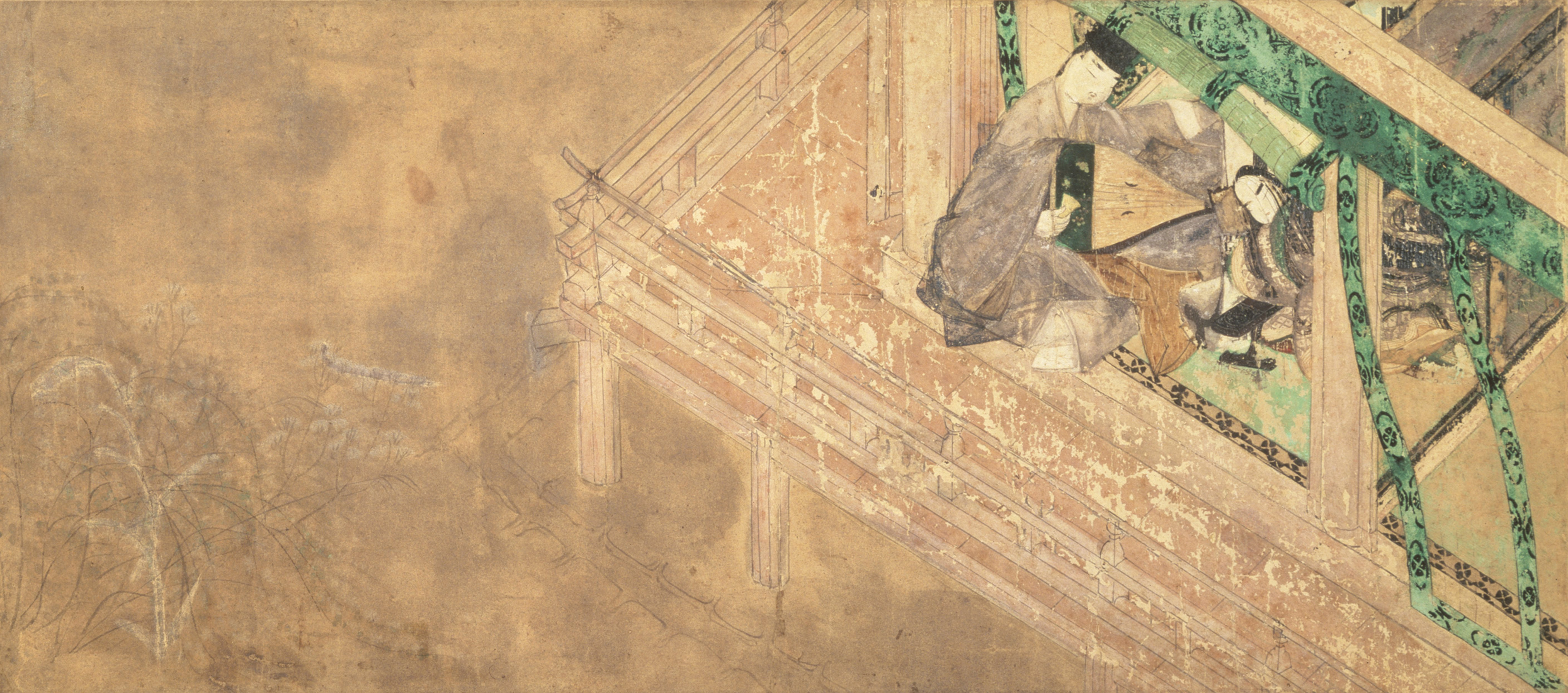 |
| 'I should like to play my lute for you ...' |
The following year, on a quiet spring evening, she heard that he had come to visit the princess’s palace. She and her friend crept out of their room hoping to meet him but the veranda was bustling with people and the reception rooms were full of ladies-in-waiting so they turned back. She guessed that he too had chosen that night to visit thinking it would be quiet. But he had left without seeing her because of the crowds.
Regretfully she composed a poem:
Kashima mite Naruto no ura ni kogare idzuru kokoro ha eki ya iso no amabito
‘Burning with passion
I yearned to row my boat out
To Kashima on the Bay of Naruto.
Did you know that,
Fisherman on the rocky shore?’
And that’s the end of the story. He never enquired who she was. He was too much of a gentleman to pry. His personality was perfect and he was far from an ordinary man, she writes, but time passed and neither called out to the other ...
The gentleman with whom our heroine had this brief encounter was Minamoto no Sukemichi (1005 - 1060). She was thirty three and he was thirty seven. He was of very high rank, far too grand to mingle with ordinary court ladies like her, and a famous musician and lute player.
Later our shy heroine and her diary became famous. Her poems, particularly the passionate poem about rowing out her boat, were celebrated and included in the imperial anthology, an extraordinary mark of distinction. Today everyone in Japan knows The Sarashina Diary. Ironically, grand though he was, Minamoto no Sukemichi’s name has come down to us only because he was the object of Lady Sarashina’s unspoken passion.
 |
| Two ladies, one playing the biwa lute, the other the koto. |
 |
Lesley Downer is a lover of all things Asian and an inveterate traveller. She is the author of many books, including The Shogun’s Queen, an epic tale of love and death in nineteenth century Japan. For more see www.lesleydowner.com.
There are three translations of The Sarashina Diary:
in Diaries of Court Ladies of Old Japan by Annie Shepley Omori and Kōchi Doi (1934)
in Diaries of Court Ladies of Old Japan by Annie Shepley Omori and Kōchi Doi (1934)
As I Crossed a Bridge of Dreams: Recollections of a Woman in Eleventh Century Japan, by Ivan Morris (1971)
The Sarashina Diary: A Woman’s Life in Eleventh Century Japan, by Sonja Arntzen and Itō Moriyuki (2014)
Illustrations:
I haven’t found any illustrations of The Sarashina Diary so have used illustrations of The Tale of Genji and other Heian works to give the mood of the period:
Picture 4: unknown author, Sei Shonagon, 17th century drawing, courtesy wikimedia commons
Illustrations:
I haven’t found any illustrations of The Sarashina Diary so have used illustrations of The Tale of Genji and other Heian works to give the mood of the period:
Picture 1: Murasaki Shikibu composing The Tale of Genji at Ishiyamadera by Yashima Gakutei (1786 - 1868), Gift of Charles Lang Freer, Freer Gallery of Art, Smithsonian, public domain, courtesy wikimedia commons and the Smithsonian.
Picture 2: Utagawa Hiroshige (1797 - 1858), Utsusemi from The Tale of Genji in 54 chapters, 1852, National Diet Library, public domain, courtesy wikimedia commons.
Picture 3: Genji monogatari emaki, 1130, owned by Tokugawa Art Museum Nagoya 1937, courtesy wikimedia commons
Picture 2: Utagawa Hiroshige (1797 - 1858), Utsusemi from The Tale of Genji in 54 chapters, 1852, National Diet Library, public domain, courtesy wikimedia commons.
Picture 3: Genji monogatari emaki, 1130, owned by Tokugawa Art Museum Nagoya 1937, courtesy wikimedia commons
Picture 4: unknown author, Sei Shonagon, 17th century drawing, courtesy wikimedia commons
Picture 5: Fujiwara Takayoshi, Genji monogatari emaki, Yadorigi chapter, 1130, owned by Tokugawa Art Museum Nagoya 1937, courtesy wikimedia commons
Picture 6, Kobo Shunman (1757 - 1820), Two ladies, one playing the biwa lute, the other the koto, 1815, H.O. Havemeyer Collection, Bequest of Mrs H.O. Havemeyer, Met Museum, public domain


