
Showing posts with label Kyoto. Show all posts

Friday, 7 April 2023

A Brief Encounter ~ by Lesley Downer

Which is more beautiful, spring or autumn? That was a question bound to stir the interest of any sensitive young woman at the eleventh century Japanese court ...
A Heian lady's day ...

Our story begins with some monks reciting Buddhist sutras all through a long, very dark night. Two young women had crept out of their quarters and lay down on the veranda outside the prayer hall to listen to their beautiful voices. Women were not supposed to be seen but it was dark enough that no one would see them.

It was October 1042. Across the world Edward the Confessor had just come to the throne and commissioned the building of a royal burial church, later to become Westminster Abbey. Beowulf’s epic battle with Grendel had been set down in writing, as had The Song of Roland.

In Japan courtly gentlemen were studying and writing poems in Chinese, which was to Japan as Latin was to the west, the language of educated people. Women learnt kana, a simple alphabetical form of writing, just enough to read and recite the sutras, which was all that women needed, or so men thought. The ladies of the court, however, were smart, sophisticated and very witty and they used the flowing kana script to record their lives, feelings and the often amusing events that occurred, in glorious detail.

One shy young woman was whiling away her years in the provinces, reading, dreaming and writing poems. She wrote an introspective, astonishingly modern account of her thoughts, feelings, regrets and sadnesses, so vivid that we can almost step into her silken shoes and imagine ourselves back in Heian Japan. The diary she wrote - in modern terms, a memoir - is called The Sarashina Diary. She is known only as the daughter of Takasue or Lady Sarashina, though that certainly wasn’t her name.

After many years in the provinces, when she was twenty six, our heroine was invited to the court of Princess Yūshi. On that momentous occasion she wore eight layers of gowns of alternating dark and pale chrysanthemum shades topped with a flowing robe of crimson silk. Eventually she was offered a position as a lady-in-waiting there.

On such a night as this ...
Court ladies and gentlemen spoke separated by screens 
so that the gentleman couldn't see the lady.
 
On that dark night, as Lady Sarashina and her friend were reclining on the veranda, a gentleman strolled by and stopped to engage the ladies in conversation. In the ordinary course of events our heroine would never have met a courtier of such high rank. She was far too humble to attend on high court nobles or senior courtiers, so lowly that such people would never even have known she existed.

The proper thing to do would have been to slip away or summon ladies of the proper status but that would have been awkward. There was nothing for but to respond to his remarks.

Lady Sarashina listened while her friend chatted with the man. She noticed that he was quiet and thoughtful, not flirtatious or forward like other men. He spoke poetically of the brevity of life, mono no aware, the sadness of things. He was a perfect gentleman, in fact.

Then he asked, ‘And who is your companion?’

Lady Sarashina spoke up modestly and the gentleman responded, ‘So there is still a young lady in this palace whom I do not know?’ He showed no sign of wanting to leave, she writes.

It was a starless night and a slight drizzle pattered on the leaves with a charming sound.

‘How beautiful the darkness is,’ the gentleman said. ‘If there’d been a full moon it would have been too dazzling.’ It would also have meant that that they wouldn’t have been able to talk. They could only talk because they couldn’t see each other.

It was then that he turned to the very topic that struck a chord with her, comparing spring and autumn. He spoke of the beauties of spring, when the sky is overcast and the moonlight seems almost to float on the mist. ‘That’s the time when it’s lovely to hear the soft notes of a lute, set in the key of the Fragrant Breeze,’ he said. Then he spoke of autumn, then winter, then asked them which season they most loved.

Her friend spoke up in favour of autumn so Lady Sarashina decided to champion spring. She answered with a poem:
asa midori hana mo hitotsu ni kasumitsutsu oboro ni miyuru haru no yo no tsuki
‘Glimmering green,
Seen through mist,
Merging with the cherry blossom too,
Dimly seen -
The moon on a spring night.’

In those days educated people readily composed poems; it was an essential accomplishment. But our heroine was no ordinary poet but an exceptional one.
A Heian lady's room complete with kicho screen

The gentleman savoured her lines, repeating them again and again. He replied with a poem of his own: ‘From this night on, so long as I have life, such a spring night will hold the memory of you and of our meeting.’

Then he spoke of how he had once gone to the great shrine at Ise to attend the coming-of-age ceremony of the virgin priestess. Awe-inspiring though that experience had been, he said, this dark rainy night that they had spent together was every bit as unforgettable.

With that he left. They still hadn’t seen each other. She had no idea what he looked like, neither did she care. What drew her to him and demanded a place in her heart was his sensitivity, his manner, his poetry, his voice.

Such a fine gentleman could have no idea who she was, which was only proper, or so she thought.

‘Why should you remember it so well?’

Behind the screen ...
The following year, nearly a year after that first encounter, she went to the imperial palace again for an all-night entertainment. She didn’t know that the gentleman was also there and, being of a retiring disposition, stayed in her room.

At dawn she pushed open the sliding doors onto the corridor. The moon was glimmering, very faint and beautiful. Then she heard footsteps on the veranda and that voice she had yearned for, reciting a sutra. He stopped in front of the open doors.

‘I never forget that night of softly falling rain,’ he said, ‘not for a moment, and the precious time we spent together!’

There was no time for a proper answer so she replied with a poem:
nani sa made omohi idekemu nahozari no ko no ha ni kakeshi shigure bakari wo
‘Why, I wonder,
Should you remember it so well?
It was only
An autumn shower
Falling on the leaves.’

Then his companions joined him and she retired to the back of her room without waiting for his answer. That morning she had to leave the imperial palace with the princess and her retinue.

Later her friend brought his reply: ‘If we should ever have another such drizzly night, I should like to play my lute for you, every melody I know.’
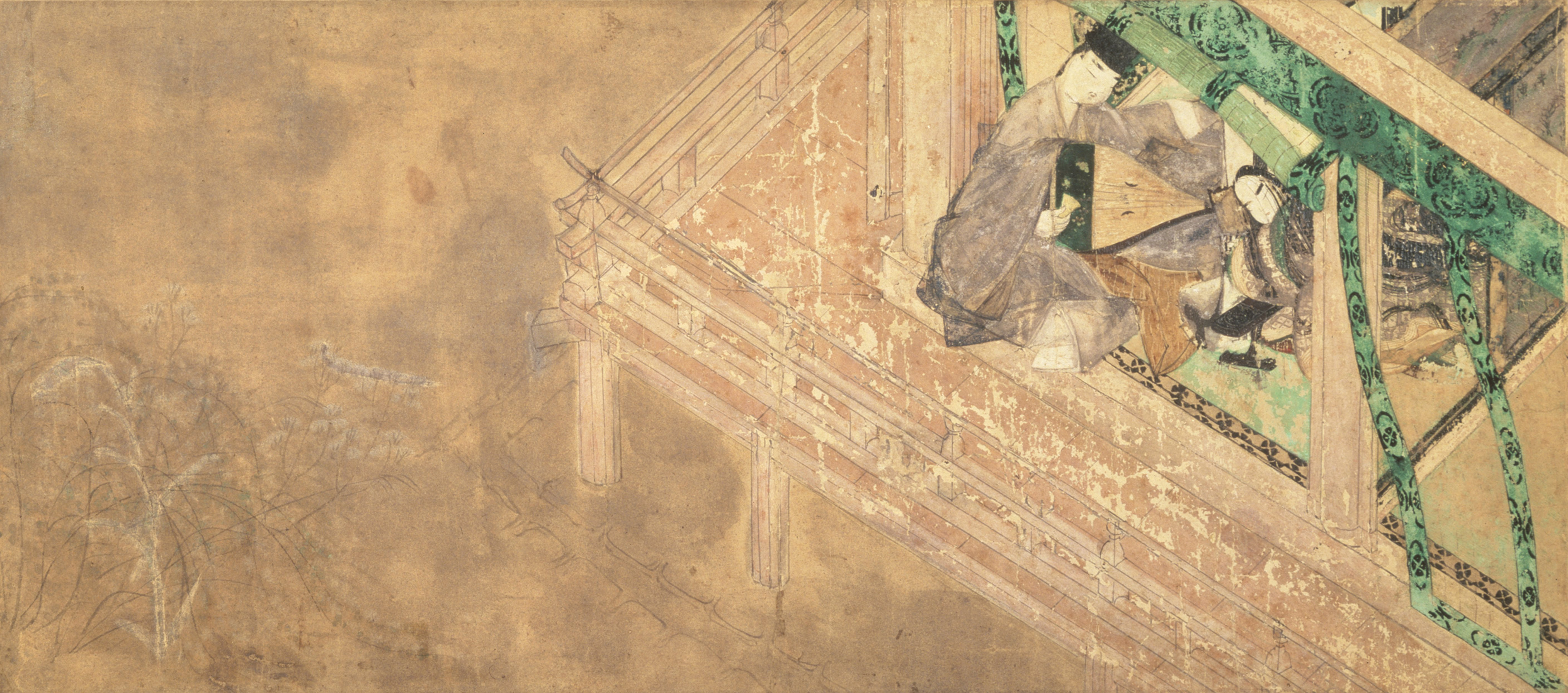
'I should like to play my lute for you ...'
She yearned for such another meeting and waited and waited for such a chance. But it never came.

The following year, on a quiet spring evening, she heard that he had come to visit the princess’s palace. She and her friend crept out of their room hoping to meet him but the veranda was bustling with people and the reception rooms were full of ladies-in-waiting so they turned back. She guessed that he too had chosen that night to visit thinking it would be quiet. But he had left without seeing her because of the crowds.

Regretfully she composed a poem:
Kashima mite Naruto no ura ni kogare idzuru kokoro ha eki ya iso no amabito
‘Burning with passion
I yearned to row my boat out
To Kashima on the Bay of Naruto.
Did you know that,
Fisherman on the rocky shore?’

And that’s the end of the story. He never enquired who she was. He was too much of a gentleman to pry. His personality was perfect and he was far from an ordinary man, she writes, but time passed and neither called out to the other ...

The gentleman with whom our heroine had this brief encounter was Minamoto no Sukemichi (1005 - 1060). She was thirty three and he was thirty seven. He was of very high rank, far too grand to mingle with ordinary court ladies like her, and a famous musician and lute player.

Later our shy heroine and her diary became famous. Her poems, particularly the passionate poem about rowing out her boat, were celebrated and included in the imperial anthology, an extraordinary mark of distinction. Today everyone in Japan knows The Sarashina Diary. Ironically, grand though he was, Minamoto no Sukemichi’s name has come down to us only because he was the object of Lady Sarashina’s unspoken passion.

Two ladies, one playing the biwa lute,
the other the
koto.


Lesley Downer is a lover of all things Asian and an inveterate traveller. She is the author of many books, including The Shogun’s Queen, an epic tale of love and death in nineteenth century Japan. For more see www.lesleydowner.com.

There are three translations of The Sarashina Diary:
in Diaries of Court Ladies of Old Japan by Annie Shepley Omori and Kōchi Doi (1934)
As I Crossed a Bridge of Dreams: Recollections of a Woman in Eleventh Century Japan, by Ivan Morris (1971)
The Sarashina Diary: A Woman’s Life in Eleventh Century Japan, by Sonja Arntzen and Itō Moriyuki (2014)

Illustrations:
I haven’t found any illustrations of The Sarashina Diary so have used illustrations of The Tale of Genji and other Heian works to give the mood of the period:

Picture 1: Murasaki Shikibu composing The Tale of Genji at Ishiyamadera by Yashima Gakutei (1786 - 1868), Gift of Charles Lang Freer, Freer Gallery of Art, Smithsonian, public domain, courtesy wikimedia commons and the Smithsonian.

Picture 2: Utagawa Hiroshige (1797 - 1858), Utsusemi from The Tale of Genji in 54 chapters, 1852, National Diet Library, public domain, courtesy wikimedia commons.

Picture 3: Genji monogatari emaki, 1130, owned by Tokugawa Art Museum Nagoya 1937, courtesy wikimedia commons

Picture 4: unknown author, Sei Shonagon, 17th century drawing, courtesy wikimedia commons

Picture 5: Fujiwara Takayoshi, Genji monogatari emaki, Yadorigi chapter, 1130, owned by Tokugawa Art Museum Nagoya 1937, courtesy wikimedia commons

Picture 6, Kobo Shunman (1757 - 1820), Two ladies, one playing the biwa lute, the other the koto, 1815, H.O. Havemeyer Collection, Bequest of Mrs H.O. Havemeyer, Met Museum, public domain


Friday, 7 October 2022

Rediscovering Shōgun - by Lesley Downer

‘In 1600 an Englishman went to Japan and became a samurai ...’               


In the late 1970s I lived in a provincial town an hour’s train ride from Kyoto. Most weekends I’d go to visit. Each time I’d look for a new temple to explore and spend the day there.

One day I wandered into a little temple called Kōtō-in. I sat on the veranda, gazed at the sand and rock garden and idly picked up the English-language leaflet. The temple, I read, had been founded in 1601 by Hosokawa Tadaoki, a samurai lord whose wife had been a Christian convert and who was a famous bowman. There in one of the paper shoji screens was the very hole through which he had shot three arrows - one after the other, with perfect precision.

Map of Japan with picture of Will Adams meeting
shogun, 1705, by Pieter van der Aa

I was staggered. It was the very story that I was reading at that moment in Shōgun. Hosokawa was Buntaro. This was Buntaro’s temple! Clavell had changed his name but not his story. Did that mean that all of Shōgun - despite the changed names - was true?

Reading it again more than forty years later, having spent much of that time absorbed in Japanese culture and history, I’m hugely impressed with how accurate it is, not just in the historical detail but in Clavell’s insight into how it feels to be Japanese.

James Clavell
Clavell led quite a life himself. Born in 1921 into a Royal Navy family, he was captured by the Japanese and interred in Changi prison throughout most of World War II. He went on to become a screenwriter and director in Hollywood. He wrote his first novel, King Rat, in 1960. Shōgun was published in 1975 and sold more than 15 million copies. Apparently it took him three years to research and write and he didn’t plan it out. Some of the plot twists, he said, were as much of a surprise to him as to the reader. He died in 1994.

Closeup of Will Adams meeting the shogun,
1705, Pieter van der Aa

For some reason everyone thinks that Shōgun is not literature. I was interviewed once by Mariella Frostrup and was supposed to speak on books on Japan. She was horrified when I began with Shōgun.

Literature or not, it is undoubtedly one of the most enjoyable books you will ever read and a brilliant source not just of Japanese history but of east west relations at the time, not to mention ships and nautical matters. Clavell’s skills as a screenwriter are readily apparent. Shōgun is dramatic, cinematic, a master class in historical fiction, immersing you in seventeenth century Japan and keeping you hooked from beginning to end.

William Adams the Pilot
Will Adam's ship Liefde lands in Japan -
monument  in De Liefde arrival memorial
park, Kurushima, Usuki City, by N. Tamada 

Clavell takes as his starting point the true and amazing story of William Adams (1564 - 1620), shipwrecked in Japan in 1600, the first Englishman ever to arrive there. Adams was a contemporary of Shakespeare, a ship’s pilot who under Sir Francis Drake helped repel the Armada and fought in the ongoing war against Spain and Portugal. The Japan in which he found himself was at an equally pivotal moment. It was the climax of the warring powers era, when samurai armies battled to control the country. The Portuguese had arrived half a century earlier and were making converts and sizing the place up for colonisation. The last thing they wanted was a Protestant Englishman turning up to tell the Japanese that the outside world was not as they portrayed it. Adams revealed their deceit and changed the course of Japanese history.

Clavell leaves the framework of history pretty much as it is. But he changes the names of the players which allows him to fictionalise freely, taking liberties with the details to make the story even more gripping and exciting. Readers are kept on their toes, anxious to find out how the characters will weather the next terrible ordeal that befalls them.

Tokugawa Ieyasu
by Kanō Tanyū (1602 - 1674)

The story begins in the stinking claustrophobic innards of Blackthorne’s storm-tossed ship, the Erasmus, ‘two hundred and sixty tons, a three-masted trader out of Rotterdam, armed with twenty cannon and sole survivor of the first expeditionary force sent from the Netherlands to ravage the enemy in the New World.’ Most of the Dutch crew are dead or dying of scurvy. The survivors are on the brink of mutiny.

Only one man can control them - Blackthorne, tough, competent, fearless and, as we soon discover, the best pilot on the planet. We learn about their nightmarish two year voyage, in which all the other ships in the fleet were lost, and the rough Elizabethan world that he comes from. As a Navy man, Clavell lards his tale with colourful and authoritative detail about ships, seas and how ships work, the job of the pilot, who commands the ship, and the importance of rutters - the annals which pilots kept, laying down their routes and recording their daily activities.

After the horrors of the tempest comes a complete change of pace. Blackthorne wakes up in a small house in a fishing village in Izu. We see Japan through his eyes - the neatness, cleanliness and occasional nakedness, the Portuguese priest who declares him a pirate and demands he be killed, the samurai casually lopping off a man’s head. Clavell has a lot of fun with cultural differences such as the bath, a daily necessity to a Japanese but a death sentence to an Elizabethan Englishman. The bath becomes a marker of how Blackthorne is adjusting, as he starts to compare the sparkling clean Japanese houses and cities with the disease-ridden filth back home.
 
Will Adams meets Shogun Tokugawa
Ieyasu - by William Dalton 1866

Like Gulliver in Lilliput, Blackthorne and his crew endure a series of humiliations and ordeals, which Blackthorne overcomes through sheer obstinacy, refusal to be cowed and the quickness of wit to fathom how to get by in this disorienting new world.

As the canvas broadens we meet an extraordinary range of people and start to see their world through their eyes as well as through Blackthorne’s. We also begin to discover how much goes on that Blackthorne knows nothing about.

We meet Mura the village headman, ‘small and lean with strong arms and calloused hands’ and a secret judo master; it’s many pages before we find out who he really is. Then there’s Omi, the handsome young samurai, who behaves with suitable disdain to Blackthorne and his crew and equally suitable deference to his uncle, Yabu, the daimyo of the region.

Yabu is a wonderful character, ‘short, squat and dominating,’ forever plotting who to betray in order to advance his own interests. He’s fearless and without scruples and finds death, his own and others’, both erotic and poetic. Early in the story he is trapped at the bottom of a cliff by the incoming tide. Having ascertained that there is no escape he sits down calmly to compose his death poem. Blackthorne meanwhile desperately seeks to rescue him even though Yabu has committed terrible deeds that make them deadly enemies. Yabu survives and continues to be a lethal yet strangely likeable and entirely untrustworthy presence throughout the book.

The women too are vividly portrayed. There’s Kiku the courtesan, exquisitely beautiful yet down to earth too. Her kimonos ‘sigh open’, ‘whisper apart’. Like a flower, her task is to rise above earthy reality, to laugh gaily and take men’s minds off whatever is going on around them, no matter how terrible. There’s also Gyoku-san, the Mama-san, who knows everyone’s darkest secrets, wielding them to advance her own position while appearing to be utterly humble, as a person such as she, on the bottom rung of society, has to be.

Will Adams with daimyo and attendants
by William Dalton 1866 

Meeting the Shōgun
The canvas expands to encompass the entire country as Blackthorne arrives in the giant metropolis of Osaka and is ushered into Osaka Castle, a gargantuan fortress which ‘makes the Tower of London seem like a pigsty.’

Here he meets Toranaga, Clavell’s name for the great warlord Tokugawa Ieyasu (1543 - 1616) who was to become shōgun, taking over the whole of Japan and bringing about 250 years of peace. Toranaga is a consummate politician and statesman who controls and manipulates whatever happens and gives nothing away. He’s also likeable, warm and funny.

Blackthorne also meets Mariko, the Christian convert, modelled on Gracia, the wife of the warlord famous for his archery skills. Buntaro, Clavell’s fictionalised Hosokawa, is rather a tragic character. ‘A short, thickset, almost neckless man’, he is a brilliant warrior and a poet with the bow, utterly loyal to his lord. But he is also a man of terrifying rages, driven mad by his hopeless love for his wife.

Mariko is tiny, beautiful and fearless, a true samurai, prepared to die for her lord. She becomes Blackthorne’s interpreter, confidante and ultimately lover. She shows him how to flourish in this alien world by becoming more Japanese, finding inner peace.

Tokugawa Ieyasu by
Utagawa Yoshitora (1836 - 1880)

Blackthorne communicates with his crew in Dutch and in Portuguese with Mariko, the Japanese Christians and the Portuguese fathers and seamen. With Mariko he also has a secret language of love - Latin; though the two have to be wary. There are always samurai around who may turn out to be secretly Catholic and to understand them.

At one point Mariko and Blackthorne are talking. ‘How childish’, she says to herself, ‘to speak aloud what you think.’ Like children, the westerners are what they appear to be. The Japanese conversely are eternally acting. Apart from Blackthorne, who is an outsider, they all know that this is how you play the game. Clavell gets a lot of fun out of the difference between what the Japanese say and what they’re thinking, let alone what they really intend to do. It’s a key distinction that Japanese recognise between one’s true feeling and the face that one chooses to present to the world.

As the story goes on the focus changes. Blackthorne slips into the background as we step more and more inside the fascinating and complex mind of Toranaga. Clavell spends a great deal of time unravelling the great daimyo’s innermost thoughts as he plays everyone like chess pieces in order to achieve his ultimate aim - to master and bring peace to Japan. Which is why the book is called quite accurately Shōgun.

There are occasional errors. Clavell confuses the shamisen (a lute) and the koto (a zither). He uses the wrong tea for the tea ceremony, and there are small mistakes with the Japanese language. Some of the names are a little odd. But none of this matters. The book is written with such verve that we are totally swept up in the excitement of the narrative and barely notice the occasional small hiccup.

To read Shōgun is to be picked up and thrown into Japan at one of the most exciting moments in its history. For Clavell totally gets Japan. He gets it right, it’s totally convincing, which makes it a great and very satisfying read even for a Japan hand after forty years of engaging with the country.


All pictures courtesy of wikimedia commons.

Lesley Downer is a lover of all things Asian and an inveterate traveller. She is the author of many books on Japan, including The Shogun’s Queen, an epic tale of love and death, out now in paperback. For more see www.lesleydowner.com.


Friday, 11 October 2019

A New Emperor for Japan - by Lesley Downer

Amaterasu Omikami, the Sun Goddess, by Utagawa Kunisada (1786-1865)
In Japan the accession of a new emperor initiates a whole new era. Year 1 of the Reiwa Era, the Era of Beautiful Harmony, began on May 1st this year, the day that Emperor Naruhito took the throne. His father, Akihito, abdicated the previous day.

The emperors of Japan are said to be descended in an unbroken line from the Sun Goddess, Amaterasu Omikami. For many centuries the emperors had a ritual rather than a political status; they were more like popes than kings. The emperor (and the occasional empress) acted as an intermediary with the gods, offering up prayers to protect Japan and ensure good crops, and at some periods they were worshipped as gods themselves.
Naruhito in his enthronement robes


As a result the emperor’s enthronement is a bit different from the coronation of a temporal monarch like Elizabeth II. There are no crown jewels, no golden carriage, no public procession.

There are three successive ceremonies.

Presentation of the Three Sacred Treasures
The first ceremony is the presentation of the Three Sacred Treasures - the sword, the jewel and the mirror - which were given by the Sun Goddess to her grandson when he descended to earth to become the founder of the imperial dynasty. All three once belonged to the Sun Goddess and date from legendary times.

The day Naruhito took the throne, he was formally presented with the sword and the jewel as proof of his rightful succession. The Sword is a replica. The original Grasscutter Sword is enshrined at Atsuta Shrine in Nagoya. The Jewel is an ancient and profoundly symbolic necklace. But the most important of the three, the Sacred Mirror, never leaves the Grand Shrine at Ise, Japan’s holiest shrine, akin to the Vatican or Canterbury Cathedral. Where western religions have an altar, at the heart of every shrine in Japan is a mirror, embodying the god. The Sacred Mirror embodies the Sun Goddess herself.

Enthronement Ritual
Emperor Jimmu (660-585 BC)
by Tsukioka Yoshitoshi (1839-1892)
The second ceremony, the enthronement ritual, will take place on October 22nd and international royalty, including Prince Charles, and heads of state will attend. Part is public and part seen only by the emperor and a few Shinto priests. The emperor, wearing full dress regalia, ritually informs his ancestors that he has ascended the throne. He then sits with the empress in a curtained octagonal pavilion topped with a golden Phoenix. The curtains swish open and he declares his ascension to the assembled dignitaries.

The Great Thanksgiving Festival
The third and most important ceremony is a religious one. It takes place in the middle of November. This is the legendary and tantalisingly secret Great Thanksgiving Ceremony, held by torchlight in dead of night deep in the imperial palace grounds in Tokyo.

It takes months of preparation. Special sacred rice has to be grown in paddies chosen and purified by elaborate Shinto purification rituals. Two thatched huts in the ancient native Japanese building style, preceding the arrival of Chinese influence, are constructed in the palace grounds. One represents the ancient style of houses in eastern Japan, the other of western Japan. The furnishings are also in ancient Japanese style. In one there is a vestigial straw bed and the other is for musicians.

Nintoku's tomb
The ritual takes place after nightfall. The emperor, dressed in the white silk robes of a Shinto priest, enters the first darkened hut at 6.30 p.m. Surrounded by chamberlains and assisted by court maidens he offers sacred rice and sake to the Sun Goddess, partakes of them himself and prays for bumper crops and national peace.

Then, after midnight, at 12.30, he enters the second hut. No one knows precisely what goes on, but according to some accounts he receives the soul of the Sun Goddess or even joins with her in sexual union, presumably symbolic, and thus assumes his divinity.

Descent from the Sun Goddess
Emperor Nintoku (313-399AD) by
Toyohara Chikanobu (1838-1912)
According to the story the first emperor of Japan was Jimmu, descended from Ninigi, the grandson of the Sun Goddess. Traditionally his accession is dated from 660 BC. He is famous for his long bow and the three-legged crow who accompanied him on his journey to Yamato, central Japan. The next 124 emperors are said to be descended directly from him.

Dotted around central Japan, mainly in the Nara area, are some 20,000 ancient burial mounds. Among them are 896 imperial tombs, including those of the 124 emperors, from Jimmu to right up to Hirohito, who died in 1989. Every year envoys arrive to conduct Shinto rituals at the tombs and to offer gifts from the emperor. Many of the most important are in and around the two ancient capitals, Nara and Kyoto. The biggest, a vast keyhole-shaped mound near Osaka, is the tomb of Emperor Nintoku, the sixteenth emperor (313 - 399 AD).

For many years it was forbidden to excavate the imperial tombs on the grounds that they are sacred religious sites. Then twelve years ago the Imperial Household Agency, that governs all matters to do with the imperial family, gave permission for archaeologists to enter the fringes of two of the tombs but not to excavate there. One suspicion is that the Agency fears that inspection of the tombs will reveal evidence that far from being descended from the Sun Goddess, the Japanese imperial family actually originated from China and Korea. 
Emperor Naruhito and Empress
Masako wait to greet President
Trump May 2019. Official White
House photo by Andrea Hanks

In 2001, on his 68th birthday, Emperor Akihito mentioned his Korean ancestry, saying, ‘I for my part feel a certain kinship with Korea, given that it is recorded in the Chronicles of Japan that the mother of [the Japanese] Emperor Kammu was descended from the line of King Muryong of Paekche [in Korea].’ 

The new Emperor, Naruhito, is very much a twenty first century monarch. He studied at Oxford University where he wrote a thesis on river transport on the Thames and went on to marry a multilingual diplomat, now Empress Masako. He knows Prince Charles and admires the way in which the British monarchy has made itself more accessible to the public. He has said that he wants to ‘stand close to the people’ and ‘bring a fresh breeze’ to the monarchy. Nevertheless he still has to begin his reign by paying his respects to the legendary founder of his dynasty - the Sun Goddess, Amaterasu Omikami.


Lesley Downer’s latest novel, The Shogun’s Queen, is an epic tale of love and death set in nineteenth century Japan and is out now in paperback. It tells the story of how the Emperor was transformed from a reclusive religious eminence to the figurehead of the new political order in the middle of the 19th century. For more see www.lesleydowner.com.

All pictures courtesy of Wikimedia Commons

Tuesday, 14 May 2019

The Warlord, His Wife and His Concubines - by Lesley Downer


'That bald rat.' Official court portrait of
Toyotomi Hideyoshi by Kano Mitsunobu (1561-1608)
Your beauty grows day by day. Tokichiro complains about you constantly and it is outrageous. While that bald rat flusters around trying to find another good woman, you remain lofty and elegant. Do not be jealous. Show Hideyoshi this letter.

So speaks the unexpectedly kindly voice of Oda Nobunaga in a letter addressed to Nene, Hideyoshi’s wife, around 1575. The imperious Nobunaga was, at the time, lord of half Japan and determined to conquer the rest of it in short order. 

Hideyoshi, ‘that bald rat’, also known as Tokichiro, was Nobunaga’s right hand man. As the adage went, if a nightingale refused to sing, Nobunaga’s response would be to kill it. Hideyoshi’s would be to persuade it to sing - and to sing the song he wanted.

I love the way the letter takes us all the way back to 1575 and gives us a sense of Nobunaga’s, Hideyoshi’s and Nene’s personalities. At the time Hideyoshi was 37 and famously had an eye for the ladies. Nene was 25 and they’d been married for 12 years.
Hideyoshi on his horse with his splendid headdress
(unknown artist)

Meanwhile in England, some 6000 miles away, Elizabeth I - born in 1533 and a near contemporary of both Nobunaga (b 1534) and Hideyoshi (b 1537) - was on the throne. That same year, 1575, Robert Dudley Earl of Leicester organised a magnificent three week party at his lavish palace, Kenilworth, as an extended marriage proposal to his queen. He failed, of course.

Wives of the Warlords, Part II

Monkey
Twelve years earlier, in 1563, Nene was thirteen, strikingly beautiful and vibrant with a wisdom and calm beyond her years. She was the daughter of a mid-ranking samurai and lived in the castle town of Kiyosu where Nobunaga was daimyo. She had plenty of suitors, handsome eligible samurai of high rank. But there was also Tokichiro, a short, scrawny 25-year-old with a face like a monkey. People called him ‘Monkey’, which didn’t seem to bother him.

Hideyoshi with some of his ladies by Sasaki 
Toyokichi - Nihon Hanazue, 1896 (Walters Art 
Museum; gift of Mr and Mrs C.R.Snell Jr.)
Tokichiro was low class, of farming stock, but had miraculously risen through the ranks to enter Nobunaga’s service. He’d been Nobunaga’s sandal bearer, stable boy, gardener and other menial jobs. He certainly didn’t seem to have many prospects. But Nene decided to marry him. One can only assume it was a love match - extraordinary in those days.

By the time Nobunaga sent his letter, Tokichiro had risen in rank to daimyo and was building his first castle. He was now a general with the name Hideyoshi. He was a superb strategist and a brilliant man. But his key quality was his golden tongue. He could talk himself out of the most hopeless of situations and charm people into doing practically anything he wanted. In fact he turned around battles just by his ability to use surprise tactics and his powers of persuasion. 

He was also genuinely likeable. Nobunaga became fiercer with age and was prone to terrifying rages. But whenever he heard Hideyoshi’s voice in the distance, a smile would twitch the corner of his lips. He’d be unable to carry on being angry no matter how hard he tried. Hideyoshi had the unfailing ability to make him relax and laugh.

The Power Behind The Throne
Lady Kodai-in - Nene in old age
(after Hideyoshi's death she took the tonsure)

As Hideyoshi was building his castle, a town sprang up around it. Being a kind-hearted man, Hideyoshi didn’t demand a huge amount of tribute from the townsfolk. But the people in neighbouring towns started to complain because they had to pay so much more tribute than the folk in Hideyoshi’s new town so he decided he’d better increase it. 

At this point Nene stepped in. Throughout their marriage he discussed everything with her and when they were apart they regularly exchanged letters. Very few of hers remain but his have been collected and translated. On the matter of tribute, he writes to her that he has followed her advice and decided not to raise it. ‘Because you refused I froze it. Although I issued a new order, because you refused it I decided to exempt their tributes.’

After Nobunaga’s shocking murder in 1582 Hideyoshi set to work to finish off his project of bringing Japan together under his banner, transforming it from 260 warring princedoms into a single unified peaceful country. While he was away campaigning it was Nene’s job to run the castle. She was in charge of the money and of taking care of his mother and their adopted children and of policing and punishing miscreants.
Hideyoshi cherryblossom viewing
with Lady Chacha

Nene advised him on everything - from how to run his military campaigns to how to run the empire. He in his turn wrote to her describing every political decision and every military action - hostages taken, heads taken, how he overcame this clan and that clan. He also wrote on projects he was just beginning to think about, like subjugating Korea and China. Nene always had wise advice to give.

Some of his letters to her are rather sweet. After describing his latest military campaign he writes that his skin is getting dark and his hair is turning grey and he’s afraid she might not like him any more.

Concubines

Then there were the concubines. Any sensible warlord’s wife knew perfectly well that her husband would have concubines - it went with the job. Hideyoshi did however take it rather to extremes. The Jesuit priest Luis Frois who was around at the time wrote that he had a hundred concubines - though as a Jesuit Frois probably wasn’t clear on exactly who was a concubine and who was a lady attendant. Nevertheless it was pretty good going for a short scrawny bloke with a face like a monkey.

Lady Chacha (Yodo Dono)
Nene put up with it all with good humour - until Lady Chacha came along. It’s impossible to imagine how people felt over four centuries ago. Nevertheless we can guess that Nene wasn’t happy. 

Nene never had any children and neither did all those concubines - until Chacha. When Hideyoshi was 52 Chacha (who was 23) gave him a son and heir, Tsurumatsu. Hideyoshi doted on him and wrote him many letters signed, touchingly, ‘Daddy’. But the ‘little prince’ died when he was two and Hideyoshi was distraught. Then Chacha gave him another son, Hideyori, who survived him and became his heir.

Chacha was a famous beauty and came from the most noble possible lineage. She was the daughter of Nobunaga’s sister, Lady Oichi, another famous beauty who had gone to her death in a blaze of glory, accompanying her husband in death when he fell foul of ... yes, Hideyoshi. While Nene was modest and down to earth, Lady Chacha was a prima donna and when she became the mother of the heir demanded her own castle. Hideyoshi had one built for her - Yodo Castle, half way between Kyoto and Osaka.
Hideyoshi with some of his women
by Kitagawa Utamaro (1753-1806)

Japanese Renaissance

In the end Hideyoshi reigned for twelve years after unifying Japan and ushered in a glorious golden age of the arts. He loved culture, perhaps because he had grown up without anything, in poverty. He studied Noh dancing assiduously and became a great aficionado of the tea ceremony. He once famously invited the entire populace of Kyoto to a ten day tea ceremony (though he got bored and it only lasted a single day) and he filled Kyoto with beautiful buildings and was a great patron of the arts. The Momoyama period has gone down in history as a Golden Age.

He died - not on the battlefield but in his bed - in 1598. Both Nene and Lady Chacha survived him. The question was, who would be his successor? Wisely, Nene backed Tokugawa Ieyasu - who, as the adage went, waited and waited for that stubborn nightingale to sing; and now finally it sang. Lady Chacha and her son Hideyori backed those who opposed him and, like her mother, Chacha ended in a blaze of glory, killing herself as Osaka Castle went up in flames around her.

For, as all students of Japanese history know well, the age that followed did not belong to Hideyoshi’s rather useless heir, Hideyori, but to the stolid, patient Tokugawa Ieyasu.

Lesley Downer’s latest novel, The Shogun’s Queen, is an epic tale set in nineteenth century Japan just as it was coming out of the Tokugawa period and is out now in paperback. For more see www.lesleydowner.com.

All pictures courtesy of Wikimedia Commons. Alas, there are no pictures of the young Nene. 
'Monkey.' Portrait of
Toyotomi Hideyoshi


Wednesday, 14 February 2018

Deconstructing Love - by Lesley Downer

Valentine’s Day comes round again and we spend a day or two thinking about love. But what exactly is it? Is it a feeling as specific as hunger or pain, common to people the world over?

‘Love - whatever that means.’

In Japan until the late nineteenth century, there was no word that matched our western conception of love. There was koshoku, meaning ‘desire’, ‘lust’, ‘passionate physical love’, the madness that sweeps you off your feet when you’re least expecting it. But there was no word for romantic love - the love that inspired a gentleman to woo a lady then drop to one knee and propose marriage, that sent couples fleeing to Gretna Green in defiance of their parents’ wishes. Love and marriage didn’t go together like a horse and carriage.

Nor was there anything akin to the courtly love of the troubadours, the pure love of chivalrous knights who put a lady on a pedestal, suffered torments of undeclared passion, rode into battle with her scented glove tucked into his breast plate and would never have dreamt of sullying her with anything as vile as carnal thoughts.
Manami as a geisha

Love and marriage

Falling in love wasn’t something you wistfully hoped would happen. No one expected to meet the perfect person and live happily ever after.

Once they reached adolescence, boys and girls seldom met. The only men a young woman of good family would ever meet would be her brothers and other family members. People assumed their parents would arrange a marriage for them and trusted them to find a suitable husband or wife.
'Wives dressed demurely'
Ex-geisha Manami, now a wife


Once married, love was not something a man expected to feel for his wife. That would have been disrespectful (though sometimes couples who had had an arranged marriage did fall in love.)

Wives did not expect to enjoy sex. That was for procreation and it pretty much stopped once the requisite number of children were born. Respectable women dressed demurely in sombre colours. The women depicted in woodblock prints in flamboyant kimonos, their hair studded with hairpins, are ladies of the night, not respectable women.

It was not that Japanese didn’t fall head over heels in love. But when they did, they knew it was all too likely to end in disaster. And that made it all the more fatally attractive. Love was the forbidden fruit.

Love in the pleasure quarters

In Japan under the shoguns there was a place for everything and everything had its place. The place for love was the pleasure quarters. That was where a man went in search of the love and romance that was missing from his marriage. That was where he went to enjoy recreational, not procreational, sex.
A dream of romance:
tea ceremony in the pleasure quarters

To the government of the day, love was so tempestuous a force that it needed to be kept tightly under control. The pleasure quarters were walled cities of pleasure which grew into centres of culture, where a man could go and enjoy an afternoon of refined entertainment, tea ceremony and so on, before moving on to the more colourful activities of the evening.

There were women for all pockets, tastes and levels of society, from prostitutes who flaunted their wares through the bars of latticed rooms to celebrity courtesans who held salons. A man would have had to be very rich, very interesting and very persistent to have even a chance of bedding one of those, added to which the courtesans often exercised their prerogative of saying ‘No’, which sent their price into the stratosphere. 

And all this took place in a fabulous setting, hung with brocades and kimonos, surrounded by exquisite artefacts .

For men it offered a dream of romance with no strings attached. The pleasure quarters were diametrically opposed in every way to the everyday world of work and family. Courtesans and geisha didn’t cook or clean or do anything that would pollute them with the ‘stink of domesticity’. It was a sort of never never land, where a man could say and do pretty much anything he liked and it would be washed clean the next day.
'Lavish clothes':
Actress dressed as Edo courtesan

The courtesan’s job was to make the customer fall in love with her so that he would visit more and more frequently and spend more and more money. They were beautiful, witty, brilliant, accomplished. They wore lavish clothes. 

They danced, sang, chatted, talked intelligently about politics if the man so wanted. They flattered and flirted, and, if the man ever got the chance to find out, he’d discover they were brilliant in bed - all things that decent women like his wife never did. He would have been horrified if his wife had behaved like that. 

In fact the courtesan was completely out of his league, were it not for the fact he was paying for it. Money would buy this extraordinary woman, her smiles, her caresses, her swooning interest in everything he said. This gorgeous creature would persuade him he was brilliant, handsome, that she was madly in love with him. What man wouldn’t go for that?


Everything was there to enhance a man’s pleasure. The pleasure quarters were where you went to find aphrodisiacs - charred newt, eel, lotus root, dried rings of sea slug to fit over the penis. Grilled viper was also an aphrodisiac, as was the toasted fin of the fugu, the famous blowfish whose liver, kidneys, ovaries and eyes are deadly poisonous. There was always a titillating link between sex and death.
Fugu by Kawahara Keiga (1786-1860)

Courtesans wrote beautiful love letters. Some would offer a lock of their hair or a finger nail as proof of her love. And when the customer left the pleasure quarters in the morning she would escort him to the gates and be wiping away tears as he turned at the Looking Back Willow to feast his eyes one last time.

The key rule for women: never fall in love


The women of course were working. For them the difficult tightrope they had to walk was between playing at love without ever falling in love. But sometimes they did fall in love and it was invariably a disaster. It was always the wrong man, not the rich client who’d become a woman's patron and support her but a poor young clerk or a son whose father had marriage plans for him and who would disown him and disinherit him if he disgraced the family by running away with a courtesan.

When that happened many couples decided that the only way out was to die together, to commit ‘love suicide’, still to this day considered the ultimate demonstration of love. 


Lesley Downer’s latest novel, The Shogun’s Queen, an epic tale set in nineteenth century Japan, is out now in paperback. For more see www.lesleydowner.com.

Picture at top: 'Lovers walking in Snow' by Suzuki Harunobu (1725-1770), courtesy of wikipedia commons. Fugu: courtesy of wikipedia commons. All other pictures by me. 

Tuesday, 14 November 2017

The World’s First Novel by Lesley Downer

One day, a little over a thousand years ago, a Japanese court lady picked up her writing brush. In those days Japanese noblewomen lived in seclusion. The only men they could expect to see throughout their entire lives were their fathers, brothers, sons and, if they had one, their husband. The woman - no one knows her name but she has gone down in history as Murasaki Shikibu - was a lady-in-waiting at the imperial court.
Lady Murasaki at her desk
by Utagawa Kunisada (1786 - 1865) 1858

Some time around 1006 - sixty years before the Battle of Hastings, a couple of hundred years after Beowulf and a couple of hundred years before Chaucer - she started writing a story to entertain her mistress, the empress. Like the sultan listening to The Thousand and One Nights or the readers of the instalments of Dickens’s novels, the court ladies clamoured for more.

Murasaki Shikibu was unlikely ever to have a love story of her own, so - perhaps a bit like Jane Austen - she dreamt up the ultimate man and fleshed him out. Prince Genji, the result of her imaginings, was handsome and charming, but also kind-hearted. He was human and flawed. As she told his story he developed and changed and grew older. He suffered terrible losses and tragedies. What Murasaki wrote was amazingly modern, all about relationships and character and feelings. It is moving and gripping and spellbinding and reads like the freshest of page turners. It was the world’s first novel.

In The Tale of Genji Murasaki recounts Genji’s adventures, travels, love affairs and tragedies. A breaker of hearts and fatally prone to falling in love, he’s an adept in the arts of perfume mixing, poetry writing and calligraphy. In his society court ladies keep themselves hidden inside their palaces. He exchanges poems with women he’s never seen and decides if they’re worth meeting on the basis of their handwriting and the quality of their poems. It’s a world quite Proustian in its delicacy and beauty and eternal leisure.
Ox carts - The Tale of Genji
by Tosa Mitsuoki (1617 - 1891) 

This was a society with a very different ethos from our own. Women were never openly seen by men. Noblewomen lived in vermilion-painted palaces (the aristocracy were the only people who counted, as far as Murasaki was concerned) and when visitors called, they received them hidden behind screens. When the women went out they trundled around the tree-lined boulevards of the capital, Heian-kyo, in magnificent ox-drawn carriages, hidden from view, though they made sure there was an exquisite silk sleeve dangling gracefully out of the window so the passing crowd could imagine just how beautiful and cultured the hidden lady was. There was much standing on tiptoe and peeping through lattice fences, not just by the men, trying to catch a glimpse of these elusive creatures, but also by women, when someone like Prince Genji passed by.

In The Tale of Genji men regularly enter ladies’ palaces at night, make love to them in the pitch dark without ever having seen their face and leave at daybreak. The servants, being well trained, studiously ignore the intruders though they are well aware of who they are, as each man wears a distinctive perfume which he has mixed himself.
Spot the lady - hidden behind the screens
Tale of Genji by Kano Hidenobu (late 17th/early 18th century)

Some of the most memorable episodes in The Tale of Genji are humorous. At one point, Genji hears about a princess who lives all alone (apart, of course, from her maids, who don’t count). One day he happens to hear her playing her zither with such skill he assumes she must be very beautiful. He sends her poems, but she is so shy she doesn’t answer, which only piques his interest further. Finally he sneaks in. There is a delicious scent of sandalwood emanating from her clothes, surely evidence of extraordinary beauty. But when he wakes up the next morning and finally sees her he discovers that, far from being beautiful, she has a huge red nose and, worse still, wears very old-fashioned clothes. He’s so horrified he doesn’t even send the customary morning-after poem until evening. But in the end his tender heart is touched and he takes her too under his wing.
Heian Shrine, Kyoto, modelled on Heian Palace 
(794 - 1227), which Lady Murasaki knew.

The early part of the tale is full of stories like these, poignant, sometimes humorous, sometimes tragic, detailing Genii’s youthful indiscretions and misadventures, at the end of which he has gathered a brood of women who each live in an apartment in his palace. But as Genji gets older, the story gets darker; in all it is some 54 chapters and 1000 pages long. He suffers, he has terrible failures and disasters and in the end loses the person dearest to his heart - Murasaki, after whom the author is named.

By the time I sat down and read the whole novel I’d been living in Japan for several years. I knew Heian-kyo, Genji’s and also Murasaki’s city, very well. It exists like a ghostly presence underlying the streets of Kyoto, its modern name. The vermilion buildings and green-tiled roofs of Heian Shrine are an exact replica, scaled down a little, of the imperial palace that Murasaki knew, which stood until 1227. In spring the gardens, lake and delicate pavilions are swathed in clouds of cherry blossom. And you can still imagine the ox carts with their huge wooden wheels rumbling up and down the long straight streets of the City of Purple Hills and Crystal Streams, as the poets called it.

The Tale of Genji suffuses Japanese culture and Japanese society. It features in everything from art to the incense guessing game, and episodes from it form the plots of many Noh plays. It enormously coloured the way Japan looked to me. Japanese, I should add, are usually amazed to hear that I’ve read and love The Tale of Genji. For them it’s like Beowulf, so difficult that they too can’t read it in the original and rely on modern Japanese translations.
Lady Murasaki might have glimpsed
yamabushi mountain priests like these from
 the window of her oxcart as she passed
Yasaka Shrine, Kyoto (first built 656 AD) 

As a postscript, if you’re inspired to read The Tale of Genji, you should borrow, buy or steal the Arthur Waley translation. Scholars will tell you it’s not impeccably accurate. Waley took liberties, he changed details. If what you want is a precise, perfectly accurate translation, you could try Edward Seidensticker’s version or Royall Tyler’s magnificent two volume set with copious footnotes and a very interesting introduction. But if you read either of those you won’t be swept off your feet and fall madly in love with Genji and be transported away and unable to stop reading. For that you’ll have to go to Arthur Waley.

Lesley Downer’s latest novel,The Shogun’s Queen, an epic tale set in nineteenth century Japan, is out now in paperback. For more see www.lesleydowner.com.