Showing posts with label Genghis Khan. Show all posts

Friday, 9 October 2020

Along the Silk Road to Bukhara - by Lesley Downer

The sands of Oxus, toilsome though they be,
Beneath my feet were soft as silk to me.
Glad at the friend's return, the Oxus deep
Up to our girths in laughing waves shall leap.
Long live Bukhara! Be thou of good cheer!
Joyous towards thee hasteth our Amir! 

                                                                                Rudaki (859-941)
                                                                    translation by A. J. Arberry, 1958.
The Escher-like domes of Bukhara 

With the nights closing in and lockdown looming, I offer a trip on my magic carpet to anyone who yearns for escape to another time and another place. And who better to start our journey with than Bukhara’s great poet, Rudaki, who became the court poet and companion of the Samanid king and left a wonderful legacy of Persian verse?  
Ishmail Samani Mausoleum -
burial place of the Samanids


For a couple of thousand years, until the middle of the 18th century, a network of Silk Roads linked Europe to China, crisscrossing Persia and Central Asia and the lands to the north of India. One of these highways led through the great city of Bukhara, the capital of the emirate of Bukhara of which Samarkand was a part. Bukhara had long been a centre of trade, culture, scholarship and religion. It was Central Asia’s holiest city, legendary for its wealth and beauty. 

It was said that while elsewhere daylight shone down from the skies, it radiated up from Bokhara to illuminate the heavens.

Central Asia’s Holiest City
A thousand years ago, when Anglo-Saxon bards were telling the tale of Beowulf and a Japanese court lady was composing The Tale of Genji, Islam was enjoying its Golden Age. Bukhara, under the rule of the Samanid dynasty (819 to 999), was the intellectual centre of the Islamic world.

The Samanids were patrons of scholarship and scholars. Bukhara was home to many of the greatest figures of the age - the brilliant court poet Rudaki (859-941), famous as a musician, player of the chang (harp) and declaimer of verse; Firdausi (940-1020), also spelt Ferdowsi, author of Iran’s epic poem, the Shahnameh or Book of Kings; and Ibn Sina (981-1037), known in English as Avicenna, physician, astronomer, thinker and author of seminal medical tracts.
Jester in Bukhara


In the years that followed Bukhara’s fortunes rose and fell. In 1220 Genghis Khan besieged the city for 15 days. He conquered it but spared the populace. Then in 1260 Marco Polo’s father and uncle stayed three years and learnt Tartar (Mongol). Eventually they went to Cathay and met Kublai Khan.

In the nineteenth century Bukhara was still the holiest city in Muslim Central Asia. To Europeans it was a mysterious but alluring place surrounded by a natural barrier of mile upon mile of impassable desert. It was the Emir’s capital from where he ruled over a kingdom almost the size of the British Isles.

The British arrive

George IV was on the throne when the first British caravan arrived in Bukhara in February 1825. They had travelled from northern British India across the Khyber Pass to the Oxus and across desert lands which snow had turned into quagmire, only to discover to their chagrin that the Russians had got there before them. One of these Russians, the German-born Dr Eversmann, had infiltrated the capital in disguise and reported among much else that in this city ‘all the horrors and abominations of Sodom and Gomorrah’ were being practised. Besides his harem the Emir had the ‘services of forty or fifty degraded beings,’ he wrote. Things went on which ‘even in Constantinople’ were taboo. 

The mammoth walls of the Ark, the Emir's palace

Alexander Burnes - later famous as Bukhara Burnes - arrived on June 27 1832. He visited the Grand Vizier at the Ark, the Emir’s fortress palace. He described him as a wizened old man with small crafty eyes and a long grey beard. Burnes was a charmer and got on well with the vizier who saw him as an invaluable source of information about the outside world. Burnes saw the minaret from which criminals were hurled to their deaths and visited the square in front of the Ark where beheadings were conducted with a huge knife. He also went to the slave market where ‘these poor wretches are exposed for sale and occupy thirty or forty stalls where they are examined like cattle.’ When he left the vizier asked him to bring him back a good pair of English glasses if he ever returned. Burnes’ three volume Travels into Bokhara, published in 1834, introduced the romance, magic and mystery of Central Asia to the British reader. 


Things did not always go well for the British in Bukhara.
A year after Queen Victoria came to the throne, on December 17th 1838, a daunty Englishman called Colonel Charles Stoddart rode through Bukhara’s great gates. He had been sent by the East India Company to try and forge an alliance with the Emir against the Russians, whom the British were convinced would storm across barren steppes, bandit-infested deserts and impassable mountain ranges down into British India and capture it if they weren’t held back. 

Nasrullah Khan 

Rather foolishly Stoddart arrived in full regimental uniform and didn’t even bother to get off his horse in the presence of the Emir, Nasrullah Khan, who had also heard rumours that he was a spy. He immediately had him arrested and thrown into a twenty foot deep pit known as the Black Hole, to which a rope was the only means of access and which he shared with three criminals and an assortment of vermin. 

Three years passed. Then on November 10th 1841 Captain Arthur Conolly arrived to try and negotiate his release. He too ended up in the Black Hole. Finally the two were executed in the grand square in front of the Ark.

In 1868 Russian troops captured the kingdom of Bukhara. It remained under Russian, then Soviet rule until the break up of the Soviet Union and became part of Uzbekistan when the country was given its independence.

Beautiful Bukhara
Of all Uzbekistan’s Silk Road cities, Bukhara most retains the flavour of its past. The city is full of domes of pink brick, built in geometrical designs like M.C.Escher’s drawings. You can ramble the lanes and explore the bazaars, lined with stalls selling silks, fabrics, goods from all the neighbouring countries - Afghanistan, Kazakhstan - or heaped with spices, filling the air with the scent of cumin. At the centre of the city is the Kalyan Minaret which dates from 1127, so tall that when Genghis Khan put his head back to look at it, his helmet fell off and he decided to spare it.
Kalyan Minaret 

You can gaze up in wonder at the Ark, a mammoth fortress whose formidable concave mud walls are impossible to climb. It broods over the city still, as it did in the days when Stoddart and Conolly met their end. You can even see a replica of the prison cell where they were incarcerated. The heart of the town is Lyabi Hauz pond, shaded by mulberry trees, where people sit all day drinking tea out of blue and white ceramic cups.

By pure chance we managed to arrive just as the city was celebrating the annual Silk and Spice Festival. People had come in from miles around, all dressed in their best. Musicians played lutes, fiddles, tambourines and drums, singers belted out folk songs, dancers undulated with intricate hand movements and a jester in a multi-coloured coat pranced about. The crowd raised their arms and danced too while an old man in a white turban leaned on a stick, observing. 

The moon's the prince, Bukhara is the sky;
O Sky, the Moon shall light thee by and by!
Bukhara is the Mead, the Cypress he;
Receive at last, O Mead, thy Cypress tree! 

One of Bukhara's many bazaars 


From Bukhara the Silk Road traveller went on to Samarkand, which I’ll tell you about in my next post.

For the whole thrilling story of the opening of Central Asia, please read The Great Game by Peter Hopkirk - a wonderful book.

Lesley Downer is a lover of all things Asian and an inveterate traveller. She is the author of many books on Japan, including The Shogun’s Queen, an epic tale of love and death, out now in paperback. For more, much more, see https://www.lesleydowner.com/

The picture of Nasrullah Khan is courtesy of Wikimedia Commons. All other pictures are mine.


Sunday, 29 April 2018

Genghis Khan's Girls by Katherine Roberts


Our April guest is Katherine Roberts. Not only was Katherine one of the first History Girls; the book she talks about here, Bone Music, is published by The Greystones Press, the independent publisher set up by Mary Hoffman and her husband. Here is a photo that Katherine posed for on the occasion of the virtual launch of Bone Music and The Sword of Ice and Fire by John Matthews.


If that doesn't whet your appetite enough, here is a bit more about Katherine:
Katherine Roberts won the inaugural Branford Boase Award for her debut novel Song Quest (Chicken House/Scholastic 2000). Since then she has written many more fantasy and historical books for young readers, including the Seven Fabulous Wonders series based on the Seven Wonders of the Ancient World, and I am the Great Horse, telling the story of Alexander the Great from the horse's mouth. She lives in Devon and is currently a Royal Literary Fund Fellow at Penryn in Cornwall.

A recent study of the genetic legacy of the Mongols suggests that 1 in 200 males alive in the world today are direct descendants of Genghis Khan. If you consider the infamous Mongolian warrior lived well into his sixties and took several wives as was the custom of his people, who between them bore him 11 legitimate children, and that he no doubt sired an unspecified number of illegitimate children as he built an empire four times the size of Alexander the Great's, this is not as surprising as it first seems. So who were the women in Genghis Khan’s life, and what did they think of the small boy, originally named Temujin, who grew into such a ruthless conqueror?
The quotes below are from my novel Bone Music, which is in turn based on a 13th century Mongolian text known as The Secret History of the Mongols (Chinese: Yuan Ch'ao Pi Shih) that combines legend and history to tell the story of Genghis Khan's early years.

Princess Borta (or Borte) – Genghis Khan’s childhood sweetheart and first wife.
We first meet the Khan's first and most important wife when she is 10 and Temujin is just nine. Temujin's father Yesugei the Brave, leader of the Mongol Alliance, rides with his eldest son across the steppe in search of a suitable girl. They find her in Dei the Wise’s camp, a chief blessed with beautiful daughters and rich herds. At this stage, Temujin and Borta's betrothal has the flavour of a royal wedding, with the camp's shaman joining the young people’s hands and calling on the spirits of their ancestors to bless the match:
 “As the two chiefs linked our hands together with a chain of flowers, a strange shiver went through me and I wished they would let me have a drink, too. Our shaman blessed the union with his horsetail staff, which tickled, making me want to giggle. Apart from that idiot Jamukha throwing a stone at Temujin when he tried to kiss me, we got through it without too much embarrassment.” (‘Bone Music’, Borta’s Story)
Jamukha later becomes Temujin's blood brother, or anda. I used artistic licence in having Jamukha here at the start of the story, but historically the two boys became bitter rivals for the leadership of their people and, however their rivalry started, it was never going to end well.
In Bone Music, Borta also has a pet deer called Whisper, which she rescued from the forest and that later becomes her shaman-animal, carrying her spirit in reflection of the Mongol people's ancestors, Blue Wolf and Fallow Doe. Later, she fashions a violin from the skull of her deer and plays it in battle to call down a storm to frighten Jamukha's forces, while the other shamans play an imaginary version of the Mongolian horse-head fiddle known as a morin khur:
Behind the old men, my beautiful wife stood on a rock against the sky, her black hair loose to her waist, holding her delicate deer-bone violin. (Bone Music, Temujin’s Story.)
Horse head violins are still an important part of Mongolian culture, although these days the sounding box is usually made of wood rather than covered with horse hide, and the traditional horsehair strings have been replaced by nylon, leaving just the carving of a horse’s head on the neck of the instrument as a reminder of its legendary origin.
Mizu basyo at Japanese Wikipedia, CC BY-SA 3.0
 Lady Hogelun – Genghis Khan’s mother.
Yesugei the Brave originally stole Temujin’s mother from the Merkid tribe when she was travelling to her wedding and made her his first wife, at the same time making bitter enemies of the Merkid people. When Yesugei is poisoned on his way back across the steppe from Temujin and Borta's betrothal ceremony, Hogelun immediately recalls her son from Dei the Wise’s camp and tries to get the Mongol Alliance to accept the boy as their new leader. But an ambitious chief called Kiriltuk takes advantage of Temujin’s youth to seize control of the Alliance, and drives the family out of his camp to die of starvation over the winter. However, Lady Hogelun (who is pregnant with Yesugei’s daughter at the time) has no intention of letting her sons die, and orders Yesugei's second wife to help her gather berries and dig for onions, until their boys are strong enough to bend their bows and hunt for meat. She also takes on the unenviable task of raising her sons to be honourable warriors - a job made difficult because Temujin and his eldest half-brother Begter are always at each other’s throats. When Temujin kills Begter after a violent quarrel that started over some fish their younger brothers had caught, a furious Lady Hogelun gives the boys the ‘old bundle of arrows' lesson:
“Snap it!” Mother said, handing Khasar one of my arrows. Khasar gave me an apologetic look, but obeyed. The shaft broke at once, and I groaned inwardly at the thought of having to whittle another one. Then Mother took five of my arrows and held them together in a bundle, which she passed to me. “Now you, Temujin,” she said, knowing very well I wouldn’t break them even if I could, because making good arrows to replace them would have taken me ages. After the bundle has been passed around all the boys, who in turn fail to break the arrows, Lady Hogelun presses her lips together and tells them sternly: “The broken arrow is Begter. These five are the rest of you, strong only if you stick together. Up here, we have no friends except our own shadows, and no whips except our horses’ tails, so you ungrateful horde of savages had better stop fighting each other if you want to live to see your children grow up!” (‘Bone Music’, Temujin’s Story)
This is a lesson Temujin takes to heart, and he later makes alliances with the other tribes in order to defeat his enemies.
Old Khoga – Borta’s servant.
When Temujin finally arrives to claim his bride, Borta’s mother (no doubt worried about her daughter in the young khan’s war camp) gives Borta one of her most trusted servants. Khoga is devoted to her young mistress and tries to save her when the Merkid raiding party attacks their camp while Temujin is away, after Borta falls off her horse and breaks her arm:
Old Khoga turned out to have more sense than any of us that morning. She had been following us along the track, seen me fall, and came puffing up the slope to help. She took one look at my arm, bundled me into the yak cart and pulled the sheepskins over me to hide me from the raiders. (‘Bone Music’, Borta’s Story).
Khadagan –warrior girl.
Some Mongol girls trained as warriors so they could ride and fight alongside their brothers. When Temujin is captive in Chief Kiriltuk’s camp awaiting punishment for killing his half-brother Begter, he persuades one of the braver girls to help him escape. Her name is Khadagan, and later she joins the rebellion among the Alliance families who defect to join Temujin. Towards the end of the story, Khadagan is entrusted with a message by the increasingly desperate Jamukha:
I needed a messenger who could get into Lady Borta’s yurt alone, someone Anda Temujin would trust. “Is that girl still around?” I asked Yegu. “The warrior girl who came to my tent the winter we spent with Kiriltuk’s Alliance? Send her to me.” Jamukha hopes to win Borta's aid by returning the skull of her pet deer, which he rescued from Temujin's camp following her capture by the Merkids but lost to a wolf. Needless to say, this does not go down well with Borta: The gift of the deer’s skull didn’t work out quite as I’d planned. Khadagan returned with news that Borta had given birth to a son, together with Borta’s threat that if I came anywhere near her or her child, she’d tell Temujin that I was the wolf. (‘Bone Music’, Jamukha’s story.)
Temulun – Temujin’s little sister, given a boy’s name to protect her from the evil spirits who steal babies from their mothers in the night.
Temulun was born in exile and grows up in a rough camp with her four brothers and remaining half-brother. She thinks she is a boy, but as the Khan’s sister she will be valuable for making alliances with other tribes through marriage when she grows up. Jamukha recognizes this and, in one of his attempts to remain in Temujin’s camp (and close to Borta), he asks his anda for the girl's hand in marriage.
“I was thinking of your sister, actually,” Jamukha said into the silence that had fallen between us and threatened to divide us again. “She’s strong and pretty, rides well too.” Temujin, who is still thinking of which Merkid bastard might have got his wife pregnant during her captivity in their camp, is caught completely unawares: “Be serious!” I said, realizing what he meant. “Temulun’s only nine!” (‘Bone Music’, Temujin’s story).
Upon which, Jamukha points out that Temujin was only nine when he was promised to Borta, rubbing salt into the still-raw wound. It might actually have been a good match when Temulun was old enough to marry, but by then the rivalry between Temujin and Jamukha had escalated beyond repair.
Genghis Khan and three of his four sons

Bone Music ends when Temujin becomes Genghis Khan and ruler of all the people who live in felt tents at a large gathering of the clans in 1206. After that, he goes on to conquer many other people, from the Chinese Kin and Sung people to the east, the ancient Tanghut people of northern Tibet, and the Moslem kingdoms to the west as far as Hungary and the Mediterranean coast. Along the way, he took other wives to cement alliances:
Yesugen and Yesui  - Tartar sisters, who became good friends with Borta.
Ibaka - Kereyid girl, later given to one of Temujin's generals Jurchedei as a reward for service.
Gurbesu - Naiman girl.
Khulan - Merkid girl who accompanied the Khan on his western campaign.
Chaka - Tanghut girl.
Genghis Khan died in 1227 on campaign, possibly of sickness after a hunting accident when he took a fall from his horse. But there is another, more colourful, version of his death involving the wife of a Tanghut chief, whom he seized as spoils of war after killing her husband on his (second) Tanghut campaign.
Gorbeljin the Fair - Queen of the Tanghuts.
Ashamed that she has been violated by her people's enemy, she sends a message by bird to her father vowing to drown herself into the Black River. But first she washes herself until her beauty returns and shares Temujin's furs one last time, thus 'passing a mortal illness into his blood'. When the old Khan eventually falls asleep, Gorbeljin slips away and throws herself into the river as she has promised to do - although, in true legendary fashion, her body is never found.

Thursday, 6 February 2014

Year of the Wood Horse - Katherine Roberts


No, not the one stuffed full of Greeks that destroyed the ancient city of Troy, although war is meant to be one of the wood horse's characteristics! This is the Chinese Year of the Wood (or Green) Horse, which began earlier this week and heralds a year of similar nature to that of 60 years ago, when the element of wood last coincided with the animal sign of the horse. (1954, if my calculations are correct... anyone remember that one?)

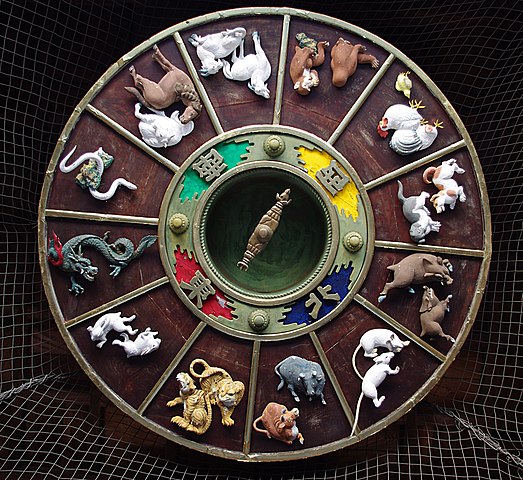
Chinese zodiac wheel (picture thanks to wikipedia)

The Chinese zodiac dates back to the Han dynasty of 206-220BC and works on a 12-year cycle, rather than the 12-month cycle associated with our western zodiac. Each year is named after an animal:

Rat
Ox
Tiger
Rabbit (Hare)
Dragon
Snake
Horse
Goat
Monkey
Rooster (Hen)
Dog
Pig

In addition, the Chinese believe that the universe is made up of five elements – earth, water, fire, wood, metal – which interact with the 12 animals to influence the year ahead.

a tiger galloping along the water?

As a horse lover, I've got a natural fondness for horse years, although it seems I was not born in one - I am a tiger (a water tiger to be accurate), but that's ok since tigers can apparently get on well with horses... which is maybe just as well, since I enjoy riding them! You are a probably a horse if you were born in 1918, 1930, 1942, 1954, 1966, 1978, 1990, or 2002 although if your birthday falls in January or early February you might be a snake instead. Famous historical figures born in the Year of the Horse include (rather appropriately) the Mongol leader Genghis Khan, the artist Rembrandt, French scientist Louis Pasteur, and US president Franklin Roosevelt.

If you want to check which Chinese zodiac sign you were born under and discover your horoscope for 2014, try this site.

According to the Chinese, this is a year to be bold. There is a lot of fire involved, and may be battles, since the wood aspect means people will stick to their guns this year and not be prepared to negotiate. I imagine it as a rather stubborn horse, digging in his toes when forced to carry a rider where he does not want to go, but galloping keenly in his chosen direction. I have decided it will be a good year to get my Genghis Khan novel out of its drawer and into the world, since my fascination with the Chinese zodiac began while I was doing the research for that book a few years ago... and, of course, it has horses in it!

In the meantime, some other YA books you might like to explore in this Year of the Wood Horse are:

I Rode a Horse of Milk White Jade by Diane Wilson - an award-winning young adult title set in the time of Kubla Khan, a delightful story for readers young and old.

The Fire Horse Girl by Kay Honeyman - which I haven't read yet, but the title caught my eye.

I am the Great Horse - the story of Alexander the Great told (with a little help from me) by his warhorse Bucephalas, who left some of his hoof prints across territories later crossed by Genghis Khan.

Troy by Adele Geras - not Chinese, but it contains the famous wooden horse of Greek myth.

Please feel free to add your own recommendations in the comments, and maybe we'll build a History Girls list of titles for this Year of the Horse!

*

Katherine Roberts writes historical fantasy/legend for young readers. Her latest series is the Pendragon Legacy quartet about King Arthur's daughter, available from Templar Books in hardcover, paperback or ebook, which comes complete with magical mist horses from the enchanted land of Avalon. Look out for the free e-prequel - "Horse of Mist" - coming soon!

More details at www.katherineroberts.co.uk