
Showing posts with label York. Show all posts

Friday, 28 June 2019

Rooted out, destroyed and abolished? From the Inquisition to a cosy English Bed and Breakfast. By Ruth Downie

“These poisonous growths in the church of God must be torn up by the roots lest they spread themselves further.” - Pope Urban VIII 

Mary Ward’s idea for a female religious order inspired by the Jesuits was not popular in Rome. It wasn’t popular in her native England either. The Gunpowder Plot was still within living memory, and two of Mary’s uncles had been amongst the plotters. They're shown in the engraving below: Christopher and John Wright, third and fourth from the left. Suspicion of Roman Catholics was rife. This was an age of secret Masses: of underground priests, of spies, tortures and executions.

Engraving of the conspirators in the Gunpowder Plot

Mary originally escaped the turmoil in England by joining a convent in St Omer, but found herself dissatisfied with the cloistered life that was demanded of women devoted to the church. She was convinced that God wanted her to do more.

“There is no such difference between men and women,” she wrote, “that women may not do great things.”

Returning to London, she established an undercover group of women who offered education, encouragement and practical support to persecuted Roman Catholics both in and out of prison. Confident that God wanted her to create an order of women who were free to travel and do his will wherever they went, she and a small group of sisters walked all the way to Rome to seek the Pope’s approval. Here’s a replica of the hat she wore for the journey:

Wide-brimmed black hatUnfortunately Mary was not skilled in church politics, and the church was not skilled in communication. Not realising that the long silence from the Pope meant ‘no’, she went ahead, setting up groups of “Jesuitesses” who ran schools and communities in several European cities. Upon hearing rumours that the Church did not approve and that her groups were being disbanded, she wrote urging her colleagues in Trier, Cologne and Liege to ignore any orders of suppression. She was certain the Pope could not have authorised any such instruction.

The letter was more naïve than heretical, but the damage was done. This was disobedience, and disobedience had to be dealt with. The Inquisition was called in, and Mary was imprisoned while the church decided what should be done with her.

Mary seems to have been remarkably longsuffering in her imprisonment. But while she co-operated with the authorities on the surface, she also kept up a secret correspondence with her friends on the outside. As every schoolchild knows, but apparently Mary’s guardians didn’t, lemon juice dries invisible but can be revealed by warming the paper.

In the end she was not convicted of heresy, but neither was she fully freed. Her groups of “Jesuitesses” were ordered to be broken up and banned forever. As Urban VIII put it in his Papal Bull of 1631, they had been guilty of wandering about at will, “and under the guise of promoting the salvation of souls, have been accustomed to attempt and to employ themselves at many other works which are most unsuited to their weaker sex and character, to female modesty and particularly to maidenly reserve.” Furthermore they persisted in such activities, and were “not ashamed”.

Mary died with her life’s work apparently in ruins. However - some of the communities she founded managed to hang on by the skin of their teeth, although they were not allowed to acknowledge her as their founder.

Georgian-fronted brick building.
The Bar Convent
With no official support they were desperately poor, so it was a great relief to the group in York when Thomas Gascoigne, a member of the local Catholic gentry, declared, “We must have a school for our daughters,” and put up £450 to fund it. Mother Frances Bedingfield, acting in the true spirit of Mary Ward with the lemon juice, purchased a building under a false name, and thus established the first convent in England since Henry VIII’s dissolution of the monasteries.

The Bar Convent is still there: just around the corner from York station and close to the city walls. The sisters who live there belong to an order now called the Congregation of Jesus. They and their predecessors ran the school for almost 300 years, surviving the suspicious searches of officials, a rampaging mob (St Michael was apparently instrumental in seeing them off) and the threat of prosecution for non-attendance at Holy Communion in the local Anglican church. (The case failed when it turned out that the vicar hadn’t bothered to hold a service on the day in question.)

Ornate chapel with white and gold decorationThe convent has given sanctuary to refugees fleeing the French Revolution, to Belgian children and convalescing soldiers in the First World War, and to Bosnian children during the Balkan conflict.
It has also provided a discreet place of worship for Roman Catholics unwilling to surrender to the Church of England. The chapel, built in the 1760’s, is invisible from the outside of the building. I can vouch for the fact that its eight exits (in case a quick escape was needed) are very confusing to outsiders. There's also a hiding-place for the celebrant - a “priest’s hole” - which I never found.

The convent has now survived the departure of the school, which moved elsewhere in the 1980’s. Seeking a new use for the building that would allow it to cover its costs, the Congregation of Jesus hit upon hospitality - and this is where people like me come in.

The Bar Convent now offers a Bed and Breakfast refuge for visitors to the beautiful but exhausting city of York. It’s a peaceful haven with enclosed gardens, a stunning glass-roofed Victorian courtyard, a guests’ kitchen, a teashop, and a museum that’s well worth a visit. I stayed there earlier this month for the York Roman Festival and have already booked again for next year.
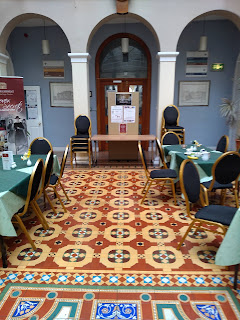
Dining area with spectacular Victorian tiled floor
The Victorian glazed courtyard dining area
As for Mary Ward - the orders she established were finally allowed to acknowledge her as founder in 1909. A hundred years later, Pope Benedict XVI published a decree recognising her “heroic virtue”. She is, apparently, on the path to sainthood.

Finally, Mary Ward’s time has come.


Sources -
Bar Convent Heritage Centre website 
Bar Convent information leaflet 

Mary Ward - Under the Shadow of the Inquisition, by M. Immolata Wetter 
The History of the Bar Convent by Sister Gregory IBVM, 
Mary Ward by Sr Gregory Kirkus CJ 
Any and all errors are Ruth's own!

Ruth Downie writes murder mysteries set in Roman Britain - find out more at www.ruthdownie.com

Eboracum Roman Festival is a splendid weekend for anyone interested in anything remotely Roman. Ruth's account of it is here. The next one will be held in York on 29-31 May 2020. If you want to stay at the convent, book now!


Friday, 15 March 2019

Book Review: Susan Major, Female Railway Workers in World War II - by Fay Bound Alberti

In last month's blog I interviewed Susan Major, the author of the book I am reviewing today: Female Railway Workers in World War II. Readers also had a chance to win that book, by answering what two jobs were banned to women on the railways. The answer was engine drivers and firemen - the latter being responsible for stoking the engine.


Women's exclusion from those roles brings us to the heart of the story of Susan's book: women were required to work traditional men's role during the war, just as in other sectors, but ideas about gender and femininity held sway.

On 9 March 1941, the Minister of Labour Ernest Bevin appealed for 100,000 women to enrol for war work in Britain, in fields, factories and railways - to replace the men who had been sent off to war. In 1940, the railway companies and the National Union of Railwaymen had already agreed to employ women, albeit at 4 shillings less per week for the same jobs. Support for childcare was available, with government contributions to allow women to work outside the home as well as keep the home fires burning; the presumption was that two women would be needed for every one man. By the end of the war the reality was almost reversed.

This wasn't the first time women worked the railways, Susan points out - there were female railway labourers recorded in the 1851 census; others policed turnpike gates. But the roles that women took on during World War I had been mainly public roles: goods and passenger porters, parcel porters, ticket collectors, carriage cleaners and clerks. Cleaning carriages had traditionally been viewed as men's work, even though cleaning was gendered; interestingly another reason women were not employed as carriage cleaners was that the role was usually 'the first step on the ladder to be an engine driver' (p.3), a carefully guarded male role.

Gang of plate layers at Bristol West 1943 (from University of Leicester special collections)

By the time World War I ended, there were nearly 70,000 women in the railway workforce and some came back during World War 2. In 1942 the number of women on the railways was over 80,000.

Susan's book weaves together some wonderful anecdotes about women on the railways - taken from the National Archive of Railway Oral History - with media reports of the time to explore the tensions between perceptions of femininity, economic necessity and war time need. Whether women could carry heavy loads for instance, was discussed in the Nottingham Evening Post (1942), when a local fishmonger complained his kippers were about to be condemned by the government inspector. Though they had been cured in the north of Scotland, transport delays had led to their deterioration - he said it was because women worked as porters yet couldn't manage heavy loads.

In December 1940 the London Midland and Scottish Railway (LMS) reproduced a poem by Robbins Millar that used the term that 'porteress' to marvel, rather patronisingly, at the new phenomenon of women carting suitcases:

The Porteress
She'll be spry as a sparrow
At hurling a barrow
An absolute ace
At yanking a case
You'll never get waxy [bad-tempered]
She'll find you a taxi 
Respond to your yell
Like a dashing gazelle;
And charge no extortions
For chipping large portions 
In lumps and in chunks 
Of your holiday trunks. 

Women porters loading parcels onto a train, 27 February 1941 (Daily Herald Archive/Science & Society Picture Library)

These observed accounts are set against lengthy extracts from women's own stories in Female Railway Workers, under chapter headings that track the women's own journeys: Getting in; Learning the Job; working with Men; Doing a Man's Job to 'Surviving Air Raids', 'Tricky Situations' and - of course - 'And then the Men came Back'. Nellie Nelson, for instance, a London and North Eastern Railway (LNER) porter at York, told the story of an 'awful parcel foreman:

He was a bit of a nuisance, so we cured him one day. you know, laxative chocolate you can buy in Boots? Well, we bought him some of that. we was all on number nine platform and we asked, 'Give you a bit of chocolate Tommy?' 'Aye' and he got some of this and said, 'You're a nuisance you lot I'm having no more chocolate off you lot'. 

Women talk about their love lives, the lack of toilets, their friendships, the dangers they encountered, and the families they lived with. Women working on the railways were subject to the same hard work as men, alongside juggling life on the domestic front, and challenges specific to their sex and the inequalities of the time: sexual harassment, unequal pay, media sensationalism and precarious employment. There were positive things too: a sense of camaraderie with other women, interesting and diverse work, control - to some extent - over their rhythm of work (at least compared to women in munitions factories) and the acquisition of a wide range of skills.

The idea of the 'railway family' also created a paternalistic sense of belonging, and of commitment and obligation to its fellow members. Many went on to marry railway men, continuing their association with the 'railway family' even after they had left their roles.

There had been local union resistance to the idea of female labour in the early part of the war, with concerns about the role of men and the nature of the hierarchy that was in place. But the Restoration of Pre-War Practices Act 1942 laid down that women would be required to give up 'men's jobs' in order to accommodate returning soldiers.


Hard physical labour in 1941 for Southern Railway (Planet Pix Ltd - Planet News/Science & Society Picture Library)

Susan's book brings us the voices of women in an industry previously overlooked by most historians. Women working on the railways challenged myths of femininity and weakness and demonstrated their ability to learn new skills, work together,  undertake hard physical labour and endure difficult, often dangerous conditions.

This book is an important addition to the history of women in wartime and beyond.

Female Railway workers in World War II is available at Waterstones and all good book shops.

Friday, 15 February 2019

Women and the Railways in World War 2: an interview by Fay Bound Alberti

Susan Major, pictured at York Railway Station
For this week’s blog I talked to Dr Susan Major, who has written a fabulous book about women working on the railways during World War 2. This book is important because although we know that women took on many traditional men’s roles during the war, very little has been published on women in the railways. Railways were a reserved occupation, so in theory men continued to work on the railways while their counterparts in other industries were sent off to war. In reality, the men working on the railways were often old and disabled. The issues confronted by women workers were those that existed in other activities:  economic, sexual, social and temporal, their lives being changed by the new habits and relationships brought by the war, as well as its ending. Susan’s book is a welcome addition to our understanding of the lives of working women in the Second World War, as well as its gender politics. 

About Susan Major
Susan Major completed a PhD with the Institute of Railway Studies & Transport History at the University of York in 2012. Drawing upon material from the National Railway Museum and the British Library, she focused on early railway excursions. Her book based on this research, Early Victorian Railway Excursions, was shortlisted for the Railways and Canal Historical Society Book of the Year Awards 2017. Her latest book, Female Railway Workers in World War II, was published by Pen & Sword in 2018. Susan was a programme consultant for the BBC series Railways: the Making of a Nation, taking part in the episode on leisure. She is retired and lives in York.

Fay: “So Susan, what drew you to the subject of women on the railways?” 

Susan: “Well I completed my doctorate, which later became a book, on Victorian railway excursions. Later, when doing some research about railway voices I discovered the National Archive of Railway Oral History at the Railway Museum, which contains many different  interviews with  people working on and associated with the railways. Quite a lot of this material has been digitised and indexed and transcribed. Among all the men recorded, there were some women and I realised that their voices had not really been listened to. And there were enough women talking about the wartime period, and about working in what were commonly perceived as ‘men’s jobs’, to form the basis of a book. And remember that even so-called ‘women’s’ jobs in those days, like working as a clerk, had been men’s jobs when in the railway context. And I wanted to know not only what everyday life was life for those women, but also how they were looked at by other people, by the companies who were employing the women as well as commentators in newspapers of the time.” 

Fay: “ Are there any particular women that stand out for you?Any stories that were especially memorable?” 

Susan: “There was a female porter at York station, when it was bombed in 1942. A train was also bombed on its way into the station, and these were terrible conditions to work in. The social conditions could be difficult too; she tells a story of a parcel foreman that the female workers had problems with and they sorted him out by giving him some chocolate, which happened to be laxative chocolate.”

(Pause for laughter!)

Fay: “What can you tell us about the kind of women in these roles, their age or class for instance?”

Susan: “Well it’s a very select sample, dependent on who was chosen to interview. And these women would all have been young at the time, because the older women would have died by the time the stories were recorded. And they described liking the companionship of other women, the responsibility, and, unlike factory, work the variable and different activities involved.”

Fay: “Were the women all unmarried? I’m thinking about other roles of the time, which had very strict union rules”.  

Susan: “Yes. If you got married you had to leave. Most of these women were aged between 16 and 22 and often they met a railway man and got married and that was the last we hear of them. By contrast the newspaper reports were keen to tell readers about those women who might have 12 children and still carried out a role. And there was a sense that a woman wasn’t quite acceptable in publicity unless she had some link to a railway man. Women were not treated as individuals in their own right.” 

Fay: “Were most of these women working class women?”

Susan: “not necessarily. Many were working class though there were also reports of quite posh women working on the railways. The ones that were interviewed were mainly ordinary women, who had a clear sense of their roles and their relationships with other women and you get a real sense of the culture of the workplace through the stories that they tell. Compared to other work, like factory work, the duties could be varied and interesting”.

Fay: “What do these interviews say about how it was to be a woman in a traditionally male environment?”

Susan: “There is some discussion about workplace harassment, much of which was taken for granted. For instance one of the accounts describes the experience of a typistThey had to go down and check their work with one of the men in the office. She said “And there were never enough chairs. So we used to share a chair with a man. And I think the feminists these days would be horrified. They'd probably be having all the men done for harassment. But we used to call it fun”

Fay: “Ah. So these women would have to sit on their boss's lap.” 

Susan: “Yes, or share the chair. And there are a lot of examples of that. And women would talk about how they worked all day while their male supervisors stood around talking about sport. And at the end of the working day the women would get ready to go home and the men would say “overtime now”. And the men got paid more for the overtime, while the women had often families to get home to.There was also this concept of the “railway family”, which other historians have written about. Employees were encouraged to think of the railway as a family, and there were magazines prompting this image. And there was a sense that you could only get a job in the railways if your father put you forward, for instance, and while that wasn’t necessarily so in practice, it was how people thought about the railways as paternalistic employers”. 

Fay: “After the war did these women get sent away from the jobs, as they did in other industries?” 

Susan: “They were dispensed with, yes. Although I’ve focused on women working, the last chapter of my book is called: “and then the men came back”, which draws attention to the way women workers were dismissed. One woman, a guard, was sent a letter thanking her for her service. Only it wasn’t sent to her but to her boss. She had to travel a long way on the train to get to his office after a long shift, where she was shown this piece of paper, which he then kept, before trekking all the way home again”. 

Fay: “Thank you for a fascinating introduction to the book, which one of our lucky readers will win”. 

Prize Question: 

What TWO jobs were women railway workers NOT allowed to undertake during World War Two?
  1. Engine drivers 
  2. Porters 
  3. Switchboard operators
  4. Firemen
  5. Parcel workers 
  6. Signal operators 
  7. Manual labourers 

Please answer in the comments below. The lucky winner will be drawn at random. 

***
UPDATE: Competition results 

Thank you to all who entered the competition. 

The answer to the above question is: 1 Engine drivers and 4. Firemen. The winner drawn from a hat was Susan Price, who also happened to be the first person to answer the question. Congratulations, Susan. Please email me with your full name and address at: fay@fayboundalberti.com and I will send the book to you. 

Since Susan was a founding member of the award-winning Clements Hall Local History Group in York, and remains very active in the local community, I couldn’t let her go before asking her about her book on Bishy Road, a bank of independent shops whose success has caught the eye of The Guardian and other national publications. 

Fay: “Before we finish I wonder if you could say something about your work on Bishy Road, which is another subject you have written about?” 

Susan: “When I started looking at the shops for a local history project, I was surprised that nobody had looked at their history. So I started with local directories, census records, and oral history accounts to build up a picture of their development over 150 years. And though the name “Bishy Road” is quite controversial for some people, who think it is disrespectful to the name “Bishopthorpe Road, the local shops, which are still mostly independent, are regarded quite affectionately by the people who live and work there.”

I particularly enjoyed the way Susan records the social history of York through the shops that populated Bishy Road. From Chinese laundries to Teddy Boy tailors, the history of the shops is a history of social, political and economic change of the country as a whole. Which is the best kind of local history!

Bishy Road 2018: A Shopping Street in Time is available at Waterstones

Saturday, 17 December 2016

THE BELLS, THE BELLS! by Penny Dolan


Last week, meeting friends in York for lunch, I heard the clock chimes ring out from the Minster, reminding me that York, like many old cities, once resounded with the ringing of bells, which grew from the simple marking of the liturgical day to the complex change-ringing that became a popular practice after the Reformation. 

Only half-heard in our noisy world, church bells can still punctuate our lives and calendars. From my Harrogate garden, I hear a variety of bells: a single bell calling out a service, joyful wedding peals or a solemn official ringing for whom or why I may never know. Soon, when the last day of December comes, I will stand on my doorstep, breathe in the cold night air and hear the church bells ringing in the New Year, a proud chorus still audible among the brisker tattoo of exploding fireworks.

How the New Year celebrations will sound in York is uncertain. A disagreement between the Minster and the Minster Society of Change-Ringers – a tale that almost has echoes of Trollope or Hardy – has resulted in this news that no bells will ring out at this ancient Minster for Christmas, or to ring the New Year in.

Bells are a beautiful sound in the imagination, but people don’t always welcome the sound of bells chiming constantly. Often there are records of newcomers and visitors protesting about historic bells ringing outside their home or hotel , even though inhabitants have lived with the sound for years and hardly notice it, though it will have seeped into their souls. 

In response to an incomer’s legal complaint about the quarter-chimes at Old Saints Church, Wrington, A.N.Wilson once wrote:

“For more than 100 years, the bells have marked the quarter hours. The people of the village have absorbed the striking of the church clock into the inner music of their hearts. Anyone who has lived within the sound of such chimes knows how this happens.

On the rare occasions when I spend a night in Oxford, the keeping of the hours by the clock towers in New College, and Merton, and the great booming of Tom tolling 101(sic)  times at 9pm at Christ Church are inextricably interwoven with memories and regrets and lost joys. The sound almost sends me mad, so intense are the feelings it evokes. . . .  

We are a people "summoned by bells", to quote the title of John Betjeman's autobiography, and both the chiming of the hours and the complex art of bellringing are the inner music of our lives in towns and villages all over the land.”

The sound of bells rings out in several stories and poems, singing out their hidden messages. In Dorothy L Sayers “The Nine Tailors”, Lord Peter Wimsey’s knowledge of campanology solves the mystery of the jewel theft and murder.  Change ringing came in after the Reformation, when the simple bell, spindle and rope of earlier centuries was gradually replaced by the new technology where the new bells were mounted on whole wheels in the bell tower, and rung with ropes from below. You can find out more about the history of bells here.

Bells, in literature, carry poignant messages.  Thomas Gray’s famous elegy in an English country churchyard opens as “the curfew tolls the knell of parting day”. That curfew bell was an age-old law-and- order signal for people to return home: only an outlaw or thief would be out wandering at night. Moreover, that hour, that day, and that time itself had passed and gone.

Bells are there to warn travellers  of alarms and dangers, especially at sea.

In Robert Southey’s poem (1820) Ralph the Rover, having cut free the bishop’s bell, meets his own well-deserved doom when his ship wrecks on the Inchcape Rock. 


Sir Ralph the Rover tore his hair,
He curst himself in his despair;
The waves rush in on every side,
The ship is sinking beneath the tide.
But even in his dying fear,
One dreadful sound could the Rover hear;
A sound as if with the Inchcape Bell,
The Devil below was ringing his knell.

The Victorian poet Jean Ingelow, writing “High Tide off the Coast of Lincolnshire 1571,” created a fictional name for the ring change that alerted the inhabitants of on-coming danger. Although  ”set” in 1571, Ingelow drew on her own knowledge of the 1815 floods at Fosdyke, Lincolnshire, where a servant girl drowned while out looking after cows.
The old mayor climb'd the belfry tower,
The ringers ran by two, by three;
"Pull, if ye never pull'd before;
 Good ringers, pull your best," quoth he.
”Play uppe, play uppe, O Boston bells!
 Ply all your changes, all your swells,
 Play uppe, 'The Brides of Enderby.'"
  Men say it was a stolen tyde--
  The Lord that sent it, He knows all;
  But in myne ears doth still abide
  The message that the bells let fall.

Over the centuries, bells were a one sure way of sending reliable news to a great many people and, during WWII, all church bells were silenced, their chimes reserved as a warning of sea-born invasion. 

When peace came, the bells rang out but often over different landscapes. Betjeman, writing his Monody on the Death of Aldersgate Station, a station bombed in 1941, described London’s “steepled forest of churches” ringing again on a Sunday:

 
Sunday Silence! with every street a dead street,
Alley and courtyard empty and cobbled mews,
Till “ tingle tang “ the bell of St. Mildred's Bread Street
Summoned the sermon taster to high box pews,

And neighbouring towers and spirelets joined the ringing
With answering echoes from heavy commercial walls
Till all were drowned as the sailing clouds went singing
On the roaring flood of a twelve-voiced peal from Paul's.

Yet, despite the bells, the poem ends with Betjeman grieving at the sight of the new brash city architecture arising out of the ashes. 

It was from London, too, that the sad news came that inspired my thoughts for this post today. That most admirable blog, Spitalfields Life, (which arrives by email daily once you have signed up) had a post at the start of December about the closure of the Whitechapel Bell Foundry, which was started in 1570. Do take time to read the post, and the interview, which you'll find here, as well as several excellent photographs of bells.

Ever since I first heard of that Whitechapel Foundry, it has formed part of that vague and oddly-made creation: my personal mind-map of London, an imagined collage of all the good and interesting things about that huge city that was once my home. Furthermore, the Whitechapel bell foundry is closing because, apparently, there is not enough commercial demand for bells in the modern world for the Foundry to stay where it has been all these years.  How very sad. How very silent. 

Meanwhile, back to York Minster to end with some joyous sounds:


I’d like to close my last post of 2016 by sending good wishes to all the History Girls, past and present, whose varied posts inform, amaze and inspire me every day - and to wish all History Girl readers a happy holiday.  Ring out, wild bells - and good wishes for a better New Year.
Penny Dolan

Sunday, 8 June 2014

'Pluck this white rose' by Karen Maitland

Photographer: focusmycamera
The birthday flower for the 8th June is the white rose. Although seasonal flowers were used in Roman times to celebrate the festival days of the gods, the linking of specific flowers to each date in the year was probably only formalized in Victorian times. But the white rose has more ancient symbolic significance in our history.

The modern lapel button of the US National
Intelligence Joint Duty Service,
incorporating the white rose, ancient symbol of secrecy,
and the compass showing they operate anywhere in the world.
In legend, Cupid gave a white rose to the god Harpocrates, the god of silence, to bribe him not to divulge the amorous adventures of his mother Venus and in early medieval times the white rose became the symbol of silence and secrecy.

White roses were worn in the hair, hung from beams or carved onto the ceilings in meeting rooms and over dining tables as a sign that anything discussed beneath them was to remain strictly confidential and not to be whispered beyond that room. Even today we still describe a meeting as being sub rosa or 'under the rose', when it’s held in secret behind closed doors. And from 1526, the symbol was placed in churches over confessional boxes.

According to the 14th century travel-writer Sir John de Mandeville, roses first appeared in Bethlehem when a virgin falsely accused of a crime was sentenced to be burned to death. When she prayed for divine help, the blazing wood on her pyre was transformed into red roses and the unburned wood into white and so she was saved.
Elizabeth of York holding the House of York White Rose.

The House of York adopted the white rose, symbol of the Virgin Mary and a host of saints, a century before the Lancastrians' took the red rose as their emblem. As Shakespeare says in Henry VI part 2 -
I love no colours: and without all colour
Of base insinuating flattery
I pluck this white rose with Plantagenet.
The rose chosen by the House of York was said to be the 'Dog Rose'. Some claim 'dog' meant worthless while others that it came from ancient belief that its pounded root could heal someone bitten by a mad dog. The white Provence or cabbage rose was adopted by the House of Stuart when the Duke of York became James II in 1685. It was said to flower on 10th June, the day the Jacobites celebrated ‘James the Rover’.
Photographer: Stanley Howe

To dream of a red rose meant you would be lucky in love, but to dream of white rose or any white flower was thought most unlucky even before its adoption by the ill-fated House of Stuart. Perhaps this was because it was associated with girls dying before their wedding day, for it was frequently planted on the grave of virgin.

If a girl wanted to make a faithless lover return to her. She had to pluck three white roses on Midsummer’s Eve. The first she buried under a yew tree, the second in a new grave and the third she placed under her pillow. On the third night she burned the rose and from that moment her errant lover would be tortured with desire for her until he was finally forced to go crawling back to her.

Of course, the Elizabethans would have claimed her lover wouldn’t have strayed in the first place had the girl regularly risen at dawn to wash her face in the dew on rose petals or anoint her face with an ointment made from rose water, which was said to be the miracle serum for a youthful complexion. It was very expensive – so it seems nothing changes. Beauty always comes at a price!


Sunday, 17 June 2012

A TIME FOR TRAVEL: Penny Dolan


There wasn’t quite enough light to see in through the window, but one could glimpse the pretty blue blinds, a touch of gold fringing and an ornate gilt light fitting. This was once a very fine coach indeed.

 Did Victoria enjoy travelling in her own special railway carriage? Was she impressed with the magnificent coat of arms on her engine or did she, barely notice it was there?


Still, it wasn’t Victoria’s Jubilee that was being celebrated at National Railway Museum in York that weekend. The historic Royal Carriages are all kept in a siding within the main building. Instead, tying in nicely with the current Queen’s 60th anniversary, the museum was holding its 2012 Railfest, and how.


The deserted acres of the old railway yards –  those not now covered by new housing -  were full of engines, carriages and a variety of maintenance machines. At the edge of the festive crowds and bustle were the weeds and broken sheds and disused tracks of this once-mighty railway hub: the shadow behind the air of nostalgic celebration.


Some of the most important and record breaking exhibits – the Mallard, the Sir Nigel Gresley, the Flying Scotsman, and more -  had been brought out from the Museum Hall.

 They stood in the sunshine, surrounded by staff and volunteers, admirers, photographers, enthusiasts and general hangers-on.  


 The display ranged from the start of the railway era with a Puffing Billy replica,   

Stephenson’s bright yellow Rocket was there with its duo of carriages, both closed and open, as well as a large coal truck from the Middelton Works, near Leeds, one of the earliest industrial railways.


More recent beauties included the sleek art deco maroon-and-gold Duchess of Hamilton engine, a style with echoes of Poirot and VIP stabbings in first class carriages.


For now, the elegant silver-blue Battle of Britain Memorial Flight train was named and honoured with a flypast of its own that very afternoon. People gazed at the sky, with memories and tales of memories of their own, while children played happily on the climbing frames and swings, as they should.


It was a busy day. Here and there, engines in full steam puffed up and down short stretches of allocated track. 

All around, men in out-of-date railway uniforms shovelled coal into boilers – ready for Richard Hannay to leap on to the footplate - or brandished oily rags and cans at their iron horses or just hurried around like so many Perks’s from The Railway Children.


The volunteers sauntered about, grinning with casual authority, employed as perhaps they once had been. They took turns refusing entry, offering safety advice and gathering in small, select gangs exactly where they could interrupt keen photographer getting a clear shot of their engines.

The day was an enjoyable romp, but what will I take away from it? One or two plot possibilities but mostly the kind of memories that, when taken with a pinch of imagination, makes time-travelling fiction read more believably. 

The hard wooden benches in the third class carriage. The black billowing smoke choking the chest. The tarry reek in the air, everywhere. The faint covering of dirt everywhere: on the handkerchief, underfoot, on the now unveiled face and ungloved hands. The constant noise. The heat and the cold. The waiting around and watching out for the unfamiliar. The continual labour and toil that bound teams of men together. The god of the timetable and the lists records broken, often in a kind of vanity. 

And of course, for a certain era, the small particle of grit in the eye.


My Railfest time travel will be useful but was not very adventurous. Now I’m wondering what “real research” transport experiences are out there for History Girls and Boys? Do tell.

Penny Dolan

A Boy Called M.O.U.S.E (Bloomsbury)


Thursday, 22 March 2012

What do you teach in a workshop on historical fiction? - Emma Darwin

This time last year I was asked to give a workshop on writing historical fiction at Guildford Book Festival, and although as ever I was amazed by how much you can do in two hours with twenty keen writers, as ever I also came away with my head buzzing with all the other things we could have done if we'd had more time. So when the good folk running the York Festival of Writing asked what I'd like to teach for one of their four-hour mini-courses, I said immediately, "Please may I do Historical Fiction?", and they kindly said, "Yes, of course". The consequence is that at two o'clock on Friday 7th September, an as-yet-unknown number of aspiring writers will sit down, and I will stand up, and we'll be off. And with any luck, by the time the bar opens at six... well, I'd love to think that all the writers would skip the bar to go straight back to their rooms and get scribbling, but I know I'll be badly in need of a drink by then, so I should think they will too.

But now, of course, I've got to work out what to do in that four hours. The only qualification for attending a workshop like this is that you want to, so that's all that I'll know about them. What exercises, what ideas, what discussion, are most likely to lead each of them to what they need of greater confidence, understanding, excitement and knowledge about writing historical fiction? It's not just that there will be a wide range of writerly experience in the room (let alone a wide range of talent, which is the elephant in the room on all writing courses). Is that experience/talent in writing historical fiction, or simply fiction, or even just writing?

And although I've no easy answer for people who ask me what period of history I write in, you do have to have one, for the current project at least. I've had writers for whom their history is a period I remember; I've had others determined to set their novel in 12th Century China when they've never been further east than Vienna. Then there may be one or two, as at Guildford, who are writing historical non-fiction, but who feel that thinking like a novelist will make their history-writing better. That doesn't make a huge difference... or does it? What if your characters don't talk English - is that easier or harder than when they talk English, but it's Chaucer's? What if you can find very little material to draw on? What if you find too much? It can be even more paralysing: like trying to catch a waterfall in a cup.

I don't actually believe that, at bottom, writing historical fiction is any different from writing any other kind of fiction: characterisation, structure, prose, plot, process... We're writing for readers now, and so all those things must work for witers and readers Now. But the usual challenges come in different proportions, because of the fundamental definition of historical fiction - at least that of Margaret Atwood, which is the only definition which is useful for a writer.: "fiction set in a time before the writer came to consciousness."

It's useful for us because it's centred on the writer's relationship to what they're writing: a time, a place, voices, manners, mores, spirits and innumerable practical details that we can't know directly. Even if you're fifty and your historical novel is set in in 1946, your ninety-year-old neighbour who would love to help is not, quite, the same person now as he was when he was a bright young sergeant under Monty, or a file-clerk at the Nuremberg trials, so you can't quite borrow his knowing either. And his wife is - sadly - no longer with us.

So the first challenge is to learn to imagine - to inhabit - places you've never been (Victorian London, pre-Colombian Chile); to get inside faiths or morals you've never held (original sin, sun-worship); to hear voices that you've never heard (what would a tape recorder have picked up in Tudor Old St Paul's, or in St Paul's own study?)...

Places - from the hanging gardens of Babylon to a Jarrow privy (whether used by the Venerable Bede, or by Ellen Wilkinson) - aren't so hard: research helps - and we'd talk about how to do it. Google Earth helps too, along with old maps and contemporary accounts... and yet, would you only include what the people of the time would see or think of? Are we not 21st century visitors to that time and place? But still, if you add a substantial helping of common sense, you then just need a willingness to dream in all six senses.

Faith and morals are harder, perhaps. An unquestioning knowledge that God exists and has his eye on you is hard for some modern writers to truly live inside, so they find it hard to make their readers live inside it too. And if you're to write convincingly historical worlds you can't just export our manners and ethics - our understanding of sexuality or asceticism, say - backwards in time, unchanged. But it's difficult to strike the balance between your need for your sixteenth-century pickpocket or duke to be believably honourable and upright in his way, while giving him the views about Jews or dogs or Catholics or Protestants which are at least verisimilar to the real thing: convincing, if not (strictly) authentic. Many good decent, honourable men, and plenty of their wives, thought that errant wives should be beaten, for example. But if you want your reader to actually like your good, decent honourable man, and still more understand why his wife regards being beaten as no more than an occupational hazard (as their children also do) then you've got even more of a problem of balance. And yes, there was another split infinitive in that last sentence. It's only the late Georgians and Victorians who decided that splitting infinitives was a crime... and that's another thing that we'll need to touch on in my workshop: how do you deal with things you know are right, but which run counter to everyone's perceptions of history. All the research in the world won't make your novel come alive if your reader's trust in you is shaken, because you've failed to keep them willing to believe you.

The last thing, voice, is perhaps the hardest. It's partly because we don't know how people talked - Shakespeare's mechanicals are as stylised in their dialogue as his kings are, even if to a different end. For anyone whose novel is set before the novel itself came along, with its intention to be naturalistic, we have no models of how people actually talked, in conversation. And if we did, would it help? Voice in historical fiction is both message - part of the reader's sense of the historical world and its inhabitants - and also medium: it has the job of conveying the story, as well as being part of the story.

So a workshop on historical fiction has the dual focus of Now, and Then, because, as I argued a few months ago, the historical novel is in some ways the ultimate novel: it embodies all the opportunities - and so difficulties - of writing fiction, but in peculiarly acute form. Between now and September I've got to sharpen my pencil (or my keyboard) and plan exercises to tackle these things: how you research... and let go of the research; how you find the voices of history... and make them come alive to the modern reader; how you make us care so passionately about your characters that we'll stay up late reading about this strange and long-ago world... and yet be all wobbly by the end because these people we've lived with aren't Now, they're Then.
 
It's just as well that I've got several months in which to work it out but this is, sadly, my last post as a member of The History Girls. Before I take up a Royal Literary Fund Fellowship at Goldsmiths, next October, I've got a novel to finish, not to mention the workshop, and lots of other commitments of writing and teaching. I've loved being a History Girl, and I've been so delighted to see the blog going from strength to strength - I'll be reading everyone's future posts with pleasure and interest.