Monday, 7 May 2012

KITCHEN STUFF part two. by Adèle Geras

Goodness me, is there no end to the trouble I would go to in order to put up an interesting post? Last week, I decided to make my paternal grandmother's cauliflower dish and also to take photos of it to put up here. I have no photos of Messoda Weston and so the cauli will have to stand as a kind of emblem for her.

When I knew her, she lived in a small three up, two down house in a village near Cardiff called Rhiwbina. She shared the house with my aunt and my two cousins and I used to go there during school holidays. She had one frying pan with no handle, and used a folded-up teatowel to hold the edge of it while she cooked. She always ate after everyone else and would never sit down at the table with us. When she was a young woman, she lived in Port Said, Egypt with my grandfather who worked at Simon Artz, the Harrods of the Middle East. My father and his three siblings swam daily in the Suez Canal.

It's been years since I made this dish and as soon as I started frying up pieces of cauli I understood why. You do have to keep adding more and more oil as it does get absorbed and I try to avoid too much of the stuff for obvious reasons. Still, there's nothing nicer you can do with a cauliflower so for an occasional treat, it's well worth going to to the trouble.

Start with the cauliflower cut up so as to create as many flat planes as possible as shown above. It's difficult to fry the curvy bits to a satisfactory brownness, so the more surfaces you can create that can be brown, the better. Put the leaves into a big casserole dish to line it and add a few bits of garlic in between the leaves so:

Then shake some flour on to a plate thus and season it well with salt and pepper. Mix well to distribute seasonings:

Beat an egg in a dish wide enough to allow you to dip the cauliflower florets. No picture of this.Dip each floret first into the egg and then into the flour, then fry the cauli in vegetable oil. I used rapeseed but sunflower or olive would be okay too. You do have to keep adding a bit more oil to the frying pan so do not put bottle away in the cupboard after your first glug.

When they're nice and brown, lay them on the leaves in the casserole.

Then squeeze the juice of a lemon into about a quarter of a pint of hot water and pour over the cauliflower in the casserole. Simmer the whole thing for about twenty minutes or until a knife goes easily into the white part of a floret.

When cooked to your satisfaction, transfer to a nice dish and serve. It's also wonderful cold the next day if you happen to have any left over.

I hope some of you will make this and come back to this post and tell me how you liked it.

Sunday, 6 May 2012

Ancient Egyptian Adventures – Katherine Roberts

I’ve been fascinated by the mysteries of Ancient Egypt ever since I read these immortal words in H Rider Haggard's "She" as a child:

I, Amenartas, of the Royal House of the Pharaohs of Egypt, wife of Kallikrates (the Beautiful in Strength), a priest of Isis whom the gods cherish and the demons obey, being about to die…

and plunged into an adventure that still stirs my blood today. Later, I devoured Wilbur Smith's historical novels, and have since enjoyed countless other books and films inspired by Egypt's mysteries.

Any society that can inspire so many stories after 5000 years must have had serious X-factor! So what would the judges make of the ancient Egyptians?

Pyramids. The largest of these was the Great Pyramid of Khufu, one of the Seven Wonders of the Ancient World. Undoubtedly magnificent, it still stands at Giza more than four thousand years later, although it has lost its dazzling white limestone render and the gold peak that possibly crowned its top. The pyramids have inspired many books, including Terry Pratchett's alternative Discworld version. A solid 10 points for the pyramid builders!

Mummies. The ancient Egyptians had embalming down to a fine art. By extracting the organs and storing them in jars, and wrapping the body in bandages, they managed to preserve their dead for thousands of years, giving Egyptologists plenty of material to study and inspiring films like The Mummy.
8 points to Tutenkhamun for being the most famous mummy (he loses 2 for being rotten when he was unwrapped).

Book of the Dead. A collection of spells written in hieroglyphs on the walls of tombs, this is the ancient Egyptian handbook for guiding the souls of the deceased into the afterlife. Used to be called the “Book of Coming Forth by Day”, which is much more optimistic in my opinion!
9 points to the priests (they lose one because nobody has come forth to tell us if their spells worked... yet).

ankh
Amulets. The ancient Egyptians wore amulets such as the ankh (= "life") and the Eye of Horus to ward off bad luck. You can read all about Ancient Egyptian magic in EA Wallis Budge's book.
1 point for being superstitious plus 9 points for luck.

Gods. The Egyptians liked their gods! From jackal-headed Anubis who guided the souls of the dead on their journey, sexless Hapi of the Nile, the ugly dwarf-god Bes, beautiful Isis the mother of Horus, Khnum who created children and kas on his potter’s wheel, to the sun god Re/Ra... there’s a whole pantheon of them to choose from, inspiring books such as Rick Riordan's Kane Chronicles series for children.
10 points to Osiris for being king of the coolest gods in the ancient world.

The River. Without the Aswan dam, the Nile flooded every year. Sometimes high, sometimes low, the floodwater carried fertile black silt across the banks, and when it receded the ancient Egyptians farmed the narrow strip of land between the river and the desert, and grew enough crops for the Romans, later, to treat Egypt as their bread basket. The height of the annual flood was so crucial to the economy that Pharaoh, after dreaming of seven fat cows and seven thin cows, freed a Hebrew slave called Joseph to handle the crisis.
10 points to Joseph for food rationing.... and a bonus point for inspiring Andrew Lloyd Webber’s Amazing Technicolour Dreamcoat.

Alexandria. The city founded by Alexander the Great on the coastal delta was the home of Cleopatra, the last queen of Egypt, and the setting for Shakespeare’s play about the doomed lovers Anthony and Cleopatra. This city may not be as ancient as the pyramids, but it was home to the Pharos lighthouse (another of the Seven Wonders of the Ancient World), and its crossroads became Alexander’s resting place after his body was brought back from Babylon.
9 points to Alexander for visionary city planning (he loses one point for not returning alive to see it).

Two of my Seven Fabulous Wonders books are set in Ancient Egypt:


Alexandria provides the setting for The Cleopatra Curse, where the Romans persuade lighthouse slave Zeuxis to drive their chariot in the Hippodrome with the aim of creating a diversion while they invade Queen Cleopatra's Egypt. Two thousand years earlier, in The Great Pyramid Robbery, the workers building the second pyramid at the Giza hatch a plan to steal the treasure buried inside the great pyramid and persuade young Senu and his otherworldly ka Red help them get past the curse on the tomb:

"I, Khufu, Lord of the Two Lands, made this tomb in a pure place where no-one had a tomb, in order to protect the belongings of one who has gone to his ka. As for anyone who might enter the tomb unclean and intending to do evil, the Great One will judge against him..."
(Hmm, maybe H Rider Haggard had more influence on my work than I thought!)
It's impossible to do justice to a five thousand year old society in a single blog post, and I expect you've got your own favourite Ancient Egyptian book/film… tell us below.

Katherine's website: www.katherineroberts.co.uk
Blog: www.reclusivemuse.co.uk
Latest book: Sword of Light, Book 1 of the Pendragon Legacy (Templar hardcover)

Saturday, 5 May 2012

The Bones of History : N M Browne

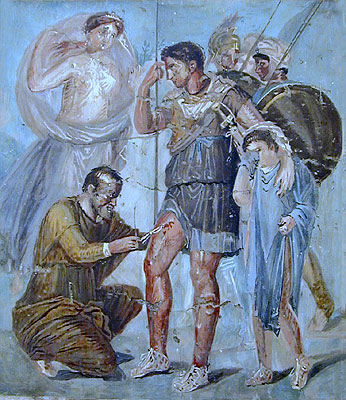
Since my last post I have been exercised by the history of medicine. I don’t intend to write a book about it, but since my youngest son broke his tibia and fibula I have had the opportunity to observe the devastating impact of such an injury at first hand. The first thing to note is that it hurts - a lot. It always has. Juice of the poppy was known to the Romans, and more morphine based drugs still seem to be the most effective form of relief for really serious pain. Anaesthesia is new however. Apparently ether was first synethised in the eighth century, was known to cause chickens to fall asleep in the thirteenth, but it wasn’t until the nineteenth that it was put to use as an aesthetic even though even though such eminent scientists as Boyle, Newton and Faraday explored its properties; it goes without saying that none of these men experienced childbirth perhaps none of them ever broke their leg either. It was a similar story for nitrous oxide: Humphrey Davy writing in 1798 noted that it destroyed physical pain and ‘may probably be used with advantage during surgical operations.’ It was the best part of the century before anyone did. Apparently no one is entirely sure how anaesthetic works - only that it does - thank God. Bone setting has been going on for centuries and has always hurt!
A druid's pack discovered in Colchester contains implements for bone setting while the Romans regularly reset bones and built prosthetics - such regular conquest does tend to produce injury. Some of the approaches seem unlikely to be successful: as Cato the Elder wrote in de Agrigultura,160 'Take a green reed four or five feet long and split it down the middle, and let two men hold it to your hips. Begin to chant: "motas uaeta daries dardares astataries dissunapiter" and continue until they meet. Brandish a knife over them, and when the reeds meet so that one touches the other, grasp with the hand and cut right and left. If the pieces are applied to the dislocation or the fracture, it will heal. And none the less chant every day, and, in the case of a dislocation, in this manner, if you wish: "huat haut haut istasis tarsis ardannabou dannaustra." 
 Resetting bones when powerful muscles contract requires strength as well as power and the village blacksmith apparently often doubled as the bone setter. Complex fractures however would have resulted in the amputation of the affected limb in every century as there was no way of preserving blood flow, which is why I am particularly grateful to one Abramovich Ilizarov who designed a new kind of treatment in the 1950s inspired by the shaft bow of a horse carriage.
Although this looks like an instrument of torture from the middle ages I am assured that it is a very effective treatment for the repairing of complex breaks...

Friday, 4 May 2012

The Ghost That Spoke Gaelic - by Katherine Langrish

'An Incident at the Battle of Culloden' by David Morier, oil on canvas.

It was 1749, just four years after the failed Jacobite rising, and the defeat of Bonnie Prince Charlie and the clans at the Battle of Culloden. Reprisals had been severe; the wearing of kilt and tartan was forbidden; the rising was still fresh and sore in everyone’s minds and by no means necessarily still over. Messages (and money) flew between the Prince in exile and his loyal supporter Cluny MacPherson, in hiding on Ben Alder.

Into this volatile, still smouldering arena marched, in summer of 1749, the newly married – and, it has to be said, completely and complacently naïve – Sergeant Arthur Davies of ‘Guise’s Regiment’, in charge of a patrol of eight private soldiers, heading over the mountains from Aberdeen to Dunrach in Braemar, for no more interesting purpose than to keep a general eye on the countryside.

This kind of countryside...


Sergeant Davies was a fine figure of a man, but not at all sensibly dressed considering what he was about. He carried on him a green silk purse containing fifteen and a half guineas which he had saved; he wore a silver watch and two gold rings. There were silver buckles on his brogues, two dozen silver buttons on his striped ‘lute string’ waistcoat; he had a silk ribbon to tie his hair, and a silver-laced hat. Thus attired he said goodbye to his wife, who never saw him again, and set off – encountering on the way one John Growar, in Glenclunie, whom he told off for carrying a tartan coat. And shortly after this, the over-confident Sergeant left his men and went off alone over the hill, to try and shoot a stag.

And ‘vanished as if the fairies had taken him’. His men and his captain searched for four days, while rumours ran wild about the countryside that Davies had been killed by Duncan Clerk and Alexander Bain Macdonald. But no body was found…

Until, in June 1750, a shepherd called Alexander MacPherson came to visit Donald Farquharson, the son of the man with whom Sergeant Davies had been lodging before his death. MacPherson, who was living in a shepherd’s hut or shieling up on the hills, complained that he ‘was greatly troubled by the ghost of Sergeant Davies’ who had appeared to him as a man dressed in blue and shown MacPherson where his bones lay. The ghost had also named and denounced his murderers – in fluent Gaelic, of which in life, Sergeant Davies had of course not spoken a word… But Farquharson accompanied MacPherson, and the bones were duly found in a peat-moss, about half a mile from the road the patrol had used, minus silver buckles and articles of value. The two men buried the bones on the spot where they lay, and kept quiet about it.

But of course the story spread. Nevertheless it was not till three years later, in 1753, that Duncan Clerk and Alexander Bain Macdonald were arrested for the Sergeant’s murder on the testimony of his ghost. At the trial Isobel MacHardie who had shared shepherd MacPherson’s shieling during the summer of the ghost, swore that ‘she saw something naked come in at the door which frighted her so much she drew the clothes over her head. That when it appeared, it came in a bowing posture, and that next morning she asked MacPherson what it was, and he replied not to be afeared, it would not trouble them any more.’

Apart from the ghostly testimony, there was plenty of circumstantial evidence to convict the murderers. Clerk’s wife had been seen wearing Davies’ ring; after the murder Clerk had become suddenly rich. And a number of the Camerons later claimed to have witnessed the murder itself, at sunset, from a hollow on top of the hill: they never volunteered an explanation of what they themselves had been doing up there – doubtless engaged in the illicit business of smuggling gold from Cluny to the Prince.

Things looked black for the accused murderers. Yet a jury of Edinburgh tradesmen, moved by the sarcastic jokes of the defence, acquitted the prisoners. They could not take the ghost story seriously - not necessarily because it was a ghost: though scepticism was on the rise, ordinary people were still superstitious: the last Scottish prosecution for witchcraft had been only in 1727.  But they could not believe in a ghost which had managed to learn Gaelic.

Andrew Lang, in whose ‘Book of Dreams and Ghosts’ I came across this tale, adds a postscript sent to him by a friend: the words of an old lady, ‘a native of Braemar’, who ‘left the district when about twenty years old and who has never been back’. Lang’s friend had asked her whether she had ever heard anything about the Sergeant’s murder, and when she denied it, he told her the story as it was known to him. When he had finished she broke out:

“That isn’t the way of it at all, for… a forebear of my own saw it. He had gone out to try and get a stag, and had his gun and a deerhound with him. He saw the men on the hill doing something, and thinking they had got a deer, he went towards them. When he got near them, the hound began to run on in front of him, and at that minute he saw what it was they had. He called to the dog, and turned to run away, but saw at once he had made a mistake, for he had called their attention to himself, and a shot was fired after him, which wounded the dog. He then ran home as fast as he could…”

But at this point, the old lady ‘became conscious she was telling the story,’ and clammed up. No more could be got out of her.

What a skein this is of tangled loyalties and hatreds, of secret goings-on in the heather, of rebellion and politics, of a murder where the whole countryside knew straight away who’d done it, but wouldn’t - or dared not - say; of a ghost’s evidence, and of poor, foolish Sergeant Davies in the middle of the Highlands, four years after the ’45, behaving as though it was an adventure playground through which he could strut in his finery and shoot at stags... What a lesson for more recent times too, in places where foreign troops attempt to patrol wartorn countrysides riven by conflicting loyalties and fears.

And how ironic that the very ghost story which brought the murder to light – almost certainly devised by Alexander MacPherson in order to denounce the murderers without bringing unwelcome attention upon himself – seemed so incredible to a Lowlands jury that they would not convict.


Photo credit: Glen Clunie & Clunie Water, the road from Braemar  © Copyright Nigel Corby

Thursday, 3 May 2012

Falling in Love - with 20s/30s fashions - Eve Edwards

I have a confession to make - I am not a fan of Downtown Abbey.  I know this might get me hounded off The History Girls site but I just didn't take to the first series (it was the three sisters plot and the 'evil' servants that annoyed me, I think).  I was rather more partial to the rebooted Upstairs and Downstairs but largely because I fell in love with the outfits worn by Lady Holland (sadly absent from series 2).  I am not yet in my golden years but, when I get there, I will not 'wear purple' but long embroidered shrugs over generously cut dresses - surely the best look from any period for older women.  All I need is the charming secretary (Art Malik), a pet monkey and title to go with the look.

Recently I have been expanding my historical research to the interwar period for a couple of writing projects.  So I have had reason to study more seriously what exactly was worn.  This has become a daily visual feasting on the pages of Fiell and Dirix's Fashion Sourcebook 1920s.  My character is going to such and such an event - I flick through the book and mentally dress her in the appropriate outfit.  The subdivisions are fascinating.  They had dresses for day, evening, bridge, tennis, afternoon, sports, 'the country', city, travelling, 'Spa Towns', Easter, cocktail, walking, for the races, mourning, bathing, motoring, as well as the more obvious seasonal wardrobes.

I think what draws me to these clothes falls into three parts.  First, the clothes frame either the wearer or the fabric - it is fashion as artist's canvas.  The hats - especially the famous cloche - do a great job in setting off the features of the models, emphasising character in the expression, not overwhelmed by a fussy hairstyle or wig.

Secondly, they seem so wearable.  Perhaps this is the first period in history where I wouldn't mind having to live in the clothes.  The brassiere was invented around then, saying goodbye to that old favourite of female torture-by-fashion: the corset.

My grandmother, Aline, photo from 1933
Thirdly, my grandmother.  Please note the fashionably bobbed hair with shingle.  She was a shopgirl in the 1920s working at the premier London department store, Dickins & Jones, serving - as she liked to claim - the stars of the silver screen and occasional royal.  She worked in a variety of departments, including the wonderfully evocative 'haberdashery', and used to regale me with tales about a time of dancing down the Ilford Palais, beaus, courting, Lyons Tea Houses, tennis parties - the Great Gatsby life lived at lower middle class level (or is it upper lower??).  I think in truth it was a hard life but she didn't dwell on that, remembering instead the romance.  When I stayed with her I was intrigued by her old fashioned clothes - the fiddle of suspenders, the oddity of 'French knickers' rather than Marks and Spencer cotton briefs.  She had a fur stole - something with head attached - that lurked in the wardrobe.  She feared to wear it in case the animals rights people took umbrage (the fact that it had died before WWII would not be a defence).  She carried the atmosphere of the 1920s and 30s with her like that stole thrown around her shoulders.  I already know this book will be for her in so many ways.

Do you have a favourite period for fashion?  Do leave a comment and let me know.

Eve Edwards

P.S.  Want to win a free copy of one of my books? Just tell me who you would choose from history to join you on a round the world balloon journey.  Post your suggestions here.  Closing date 31 July 2012.

Wednesday, 2 May 2012

Tolstoy, Dickens and Woolf go to the Pictures


Linda Buckley-Archer

Leslie Wilson’s post on War and Peace last month set me thinking about adaptations and the historical connections between film and the novel.  I think several contributors to this blog write or have written in different media, and I wonder if they, like me, have gained insights about one medium through working in another.  I’ve heard Helen Dunmore talk about how poetry has helped her pace her novels and the poet Kate Clanchy has spoken of her short stories benefiting from the dialogue skills she gained in writing radio drama.  As for me, I have attended many scriptwriting courses, but have often found what I learned relevant and highly valuable in relation to novel-writing.   As a consequence, I am very drawn to the relationship between film and the novel.
Of course, the history of film has been linked to the novel from the start, even though, as renowned ‘script doctor’ Linda Seger points out, literature tends to resist film during the adaptation process.  Likewise, George Bluestone (I love his name) – an early writer on adaptation – talked about “the fitful relationship” between the word and the image, and memorably declared the film and the novel to be “overtly compatible” but “secretly hostile.”
Writing novels, clearly, is a one-person cottage industry, whereas  film is collaborative and produced on an industrial scale.  Even in the 1930s Erwin Panovsky was likening the process of making a film to that of building a medieval cathedral.  But what links them is stories.  Once the film-going public got used to seeing moving pictures (early audiences were perfectly happy to watch depictions of galloping horses or railway engines or simple street scenes), and once film’s potential as a story-telling vehicle became evident, the search for narratives began in earnest.
And where did they look for their stories?  To the novel, of course.  Virginia Woolf was a regular cinema-goer, and was scathing about the manner in which cinema had appropriated narratives from, predominantly, the nineteenth-century novel.  She wrote (Woolf did scathing terribly well): “The cinema fell upon is prey with immense rapacity and to this moment largely subsists upon the body of its unfortunate victim.” 
Unsurprisingly, the work of Dickens, in particular, was seized upon as suitable material: around one hundred different adaptations of his novels were produced in the era of silent film.   And not only did Dickens’s stories inspire the early filmmakers, his writerly techniques, too, were influential.  As any film students will tell you, Sergei Eisenstein, in a seminal essay, “Dickens, Griffith, and the Film Today,” describes how Dickens’s prose fiction was the inspiration behind early director D. W. Griffith’s attempts to create the basics of a film grammar:  parallel montage,  the close-up, the dissolve, the panning shot, and so on.
Virginia Woolf remained distinctly underwhelmed by the early language of film and compared it to the subtle poetic imagery at the novelist’s disposal. In film, she complained, “A smashed chair is jealousy.  A grin is happiness.  Death is a hearse.’  Other aspects of cinema, though, clearly attracted her.  “The most fantastic contrasts,” she wrote, “could be flashed before us with a speed which the writer can only toil after in vain.”   And, after labouring all week on writing an action scene that would take fifteen seconds to watch on film and (dare I say it?) would probably be more effective in that medium (though obviously the novel trumps film in many other respects), I have to agree. I’ve also seen it argued, at least, that Woolf’s own experimental writing might have been influenced by cinema – montage and the shifting of camera angles and distances.
Coming back to Leslie’s post on War and Peace, I was fascinated to come across Leo Tolstoy’s 1908 take on cinema.  He is impressively positive and forward-looking about the birth of a rival art form:
“[…] it is much better than the heavy, long-drawn-out kind of writing to which we are accustomed.  It is closer to life.  In life, too, changes and transitions flash by before our eyes, and emotions of the soul are like a hurricane.  The cinema has divined the mystery of motion.  And that is its greatness.”
Some great novelists have turned to the cinema to make a living in at various points: F. Scott Fitzgerald, for example, did a stint Hollywood, though not very successfully; William Faulkner fared better and worked with Howard Hawks on The Big Sleep and To Have and Have Not.  Graham Greene famously wrote the screenplay for the The Third Man.  Nowadays, with cinema an established, if not dominant, art form, few novelists would be trusted to put their inky fingers on a screenplay, and it is most likely to be through buying the film rights that the film industry pays for the novelist’s bacon (if she’s lucky!). Although there are exceptions:  Deborah Moggach springs to mind, and William Boyd.  But I should have loved to have seen what innovative thing Virginia Woolf might have come with up for the big screen.  Art house cinema without a doubt.   And as for Leo Tolstoy – what might the author of War and Peace have done with a long-running political drama for television?  Such a shame you can’t commission dead writers.  Now there’s an idea for a movie...

Tuesday, 1 May 2012

Beltane by Mary Hoffman

What else can I write about on my first First of May? Beltane (spelt in a rich variety of ways) is one of the four great Celtic Festivals, the other three being: Lughnasadh (1st August), Samhain (31st October), and Imbolc (1st February). They are all "cross-quarter days" falling between equinoxes and solstices and each has its own special significance.


This is may-blossom, in other words, hawthorn and this is a particularly fine pink specimen. Since Beltane is linking to dancing and fertility rituals, the heavenly scent and blush-tinged appearance of the blossom contribute to the theme. (Incidentally "cast ne'er a clout till May be out" means "don't shed any clothes till the hawthorn is in bloom" not, as a schoolfriend of mine thought, "don't hit anyone till the beginning of June." I think this year that the real advice of the saying is good, at least in the UK).

It is no coincidence that Arthur's  queen, Guinevere, was out "a-Maying" when she was ambushed and kidnapped by an amorous knight. Tennyson might have been on to something when he made that Mordred in his Idylls of the King but Sir Thomas Malory says, in his sublime Morte d'Arthur, that it was Sir Meliagaunce.

A beautiful queen gathering may-blossom with her retinue of ten women is captured by a knight who has long lusted after her but been afraid to come near her, not because of her lawful husband but because of her champion Sir Lancelot. Now, Guinevere has knights in her train but not Lancelot.


Still, Guinevere gets a message to her champion, he fights Meliagaunce but is betrayed into falling through a trapdoor into a dungeon; he escapes by wrenched the iron bars out of the window and bloodying his hands. He comes to Guinvere's chamber where next day blood is discovered on her sheets and her honour impugned (Meliagaunce, the jealous and frustrated beast, accuses her publicly of having slept with one of her wounded knights).

Lancelot of course eventually kills  Meliagaunce for such unknightly behaviour and his lack of courtesy is recorded on his tomb.

Are we a long way from Beltane fires and fertility rituals? I think not. All these festivals are times when the gates to the Other World are easier to penetrate and the story of the flower-picking queen and her abduction is very close to the myth of Hades and Persephone. Guinevere is imprisoned and released, not by her mother but interestingly not by her husband either. She doesn't have to stay half the year with Meliagaunce but she must have eaten something during her confinement in his castle.

Anyway, she is released and the flowers can bloom again; all is right with the world.

Aubrey Beardsley


What Guinevere or the ancient Celts would have made of Morris dancers and Maypoles would be interesting to know.


 I live near Bampton, a village rich in Mayday traditions, with many "sides" as Stephen Fry told me on QI we are supposed to call them, of Morris Men. There is intense rivalry between them and on May 1st much beer is consumed from the many local pubs. The dancing becomes less and less inhibited as the day goes by but that's the only link with fertility I know of (though what goes on behind closed doors is another matter).

The Folies Bergères opened in Paris on a May 1st, which seems appropriate (1869).

Saint Walpurga was canonised on this date and because of her associations as a "grain mother" the Eve of her celebration has become paganised as "Walpurgisnacht" in Teutonic countries. I wonder what this Christian saint would make of her festivities becoming a Witches' Sabbath?
(I've actually sung Die Erste Walpugisnacht, a cantata by Felix Mendelsohnn)