Friday, 20 March 2020

Culture and Society at Lullingstone Roman Villa by Caroline K. Mackenzie


Caroline K. Mackenzie with her book, Culture and Society at Lullingstone Roman Villa.
© Archaeopress.

Many of us have had our first introduction to Roman life through a visit, perhaps as a child, to one of the well-preserved villa sites in the UK. Here, Caroline Mackenzie tells us the background to her thorough survey of life at Lullingstone. (Caroline is joining us as a History Girl and this is her first post for us).

2019 was a rather special year for Lullingstone Roman Villa - it marked the 70th anniversary of the commencement of the excavations. The first clues as to the existence of a Roman site in the vicinity of Lullingstone in the Darent Valley, Kent had been recorded in about 1750 when the fence around Lullingstone deer park was being renewed and diggers of the post holes struck a mosaic. However, it was not until 1939 that an archaeological survey undertaken by Ernest Greenfield and Edwyn Birchenough of the Darent Valley Archaeological Research Group concentrated on the Roman finds and that the remarkable story of the discovery of Lullingstone Roman Villa properly began.

The Second World War halted the 1939 survey which had to be put on hold until 1947 when the archaeological team was joined by Lieutenant-Colonel Meates, recently retired from the Royal Artillery and by this time resident in the gatehouse at Lullingstone Castle. Excavations formally commenced in 1949 and these revealed the remains of a Roman villa which boasted much evidence of a luxurious lifestyle: mosaics, sculpture, wall-painting, a hypocaust and baths. By 1955, Meates had become leader of the excavations and he oversaw them until their completion in 1961, documenting the finds in a series of publications.

The excavation team included numerous volunteers, some of them still schoolchildren, who dedicated much time and effort to uncovering the site. Many of these volunteers, now in their 70s and 80s, returned to the villa in July last year to celebrate the anniversary at a special reunion. I was fortunate to be invited to meet them and their families and it was fascinating hearing their stories.

Caroline K. Mackenzie presenting her research at Lullingstone Roman Villa, July 2019. 
© Claire Lowe Photography.

I, too, visited the villa as a schoolchild. By this time the excavations had been completed and the site was being managed (as it is today) by English Heritage. I was inspired by the beauty of the mosaics and enthralled by the thought that this had been someone’s home over 1,500 years ago. I became fascinated by the Greeks and Romans and went on to study Classics at university. Many years later, and after a career as a solicitor, I visited Lullingstone again. Within months I had become a Classics teacher at a local school in Sevenoaks. I believe Lullingstone may have had some influence on this decision!

A few years later, when I began studying for an MA in Classical Art and Archaeology at King’s College London, the choice of topic for my dissertation was obvious. I lived near Lullingstone and visited it often, and I wanted to learn more about its history. I decided to focus on two main aspects: first, the villa within its landscape setting and the role of topography in the owner’s self-representation; second, the choice and use of mosaics in the fourth century villa and how the patron presented his cultural identity and status through pavements. Two modern television programmes sprung to mind: Location, Location, Location and Grand Designs! I started to wonder whether modern criteria for choosing a home have changed much from Roman times.

In assessing the landscape setting, I realised I would need to explore the vicinity of the villa on foot. This was an approach first adopted by Tilley in his innovative 1994 book. I also wanted to research the ancillary buildings which included a circular shrine, a temple-mausoleum and a granary. I used the experience of exploring the area to examine the relative prominence of the villa and its ancillary buildings; for example, were they highly visible in the landscape? I also considered how the architects combined the setting with the layout of the villa to create a conspicuous display of the owner’s standing and worth.

Lullingstone Villa in its landscape in the later fourth century AD
(illustration by Peter Urmston). © Historic England Archive.

By way of comparison, I decided to examine some other Romano-British villas. I had recently visited the Isle of Wight and the magnificent site of Brading Roman Villa. Themes such as the four seasons in Brading’s stunning mosaic provided direct comparisons for Lullingstone and helped me to answer questions such as what might have been represented in the part of Lullingstone’s mosaic which had been accidentally dug up in the 1700s. Chedworth Roman Villa, now managed by the National Trust, provided a particularly interesting case study in the context of its landscape setting.

In addition to Lullingstone’s central room which boasts the seasons mosaic framing Bellerophon killing the Chimaera, the adjacent apsidal dining room is celebrated for its mosaic of Europa riding the bull. The Europa mosaic is accompanied by a Latin inscription and in this context, I studied Classical literature in other Romano-British villas to see if Lullingstone is what we would expect or whether it is exceptional.

In this blog, I shall set out the main themes of the book and hope you will be inspired to learn more!

Landscape setting

Wall-paintings from Lullingstone now on display at the British Museum indicated that Christian worship had taken place in the villa. The evidence of religion has been exploited and applied to the mosaics in the adjacent rooms. However, I interpreted the evidence in other ways and asked questions based instead on the use of space, landscape setting and architectural context of the mosaics. Wallace-Hadrill’s work in Pompeii and Herculaneum focused on the use of domestic space and the public and private spheres of a home.[1] Scott subsequently applied a similar concept to the interior space of Romano-British villas and extended it by placing more emphasis on the landscape setting.[2] I applied Scott’s methods to examine how Lullingstone’s inhabitants used domestic space to assert their status and cultural identity. A key example for Scott was that, by alluding to knowledge of Graeco-Roman culture, owners expressed their paideia: their appreciation of literature, philosophy and mythology enjoyed by the Roman élite.[3] In my research, I examined the practices of the inhabitants primarily during the late third and fourth centuries AD and how they adopted Roman culture in their domestic space.

Lullingstone Roman villa is in the Darent Valley in west Kent. It sits on a terrace cut into the hillside 55m west of the west bank of the river Darent, whose valley cuts through the North Downs, and was around 20 miles from Londinium (London). Lullingstone was a favourable site because of its access to varied resources and agricultural riches.

In total there are around sixty known/suspected villas in Kent, most of which are in north Kent. Lullingstone was therefore part of an intensively exploited and agriculturally rich landscape. The Darent Valley villas probably supplied food and other agricultural produce to London and provided residences for the London elites.

A symbolic dimension of the owner’s appropriation of the landscape and its resources was the establishment of a cult room apparently relating to water deities complete with a niched wall-painting of three water-nymphs. This was created c. AD 180, contemporaneous with the baths, and demonstrated the owners’ reverence for water. It was located at the northeast of the villa, where the slope had been excavated to create what is known as the ‘Deep Room’.[4] The niche was later blocked up and could have easily escaped the excavators’ notice but, in a twist of fate, the site flooded mid-excavations and dislodged the plaster concealing the water-nymphs.[5] The villa-owner who created the water cult room might have seen this as a sign!

Reconstruction of ‘Deep Room’ shown at underground level, c. AD 380
(illustration by Peter Dunn/Richard Lea). © Historic England Archive.

Visitors today may appreciate the tranquil setting and the view from the villa. While modern subjective assessments of ‘a lovely setting’ must be qualified, we know from Roman authors that observers then were sensitive to the aesthetics of views and this is not just a modern phenomenon (Ausonius: Moselle; Pliny the Younger: Epistulae 2.17).

Modern view of Darent Valley, taken from modern road approaching the Villa.
© Caroline K. Mackenzie.

In c. AD 100 a circular building was constructed on a prepared terrace 24.4.m northwest of the villa. A flint and mortar construction with a thatched roof but no windows, it is thought to have been used for cult purposes until c. AD 180. The slope is steep and the elevated shrine must have made an imposing statement.[6]

It is believed to have fallen into ruin following disuse in the third century. However, the terrace on which it stood was extended to receive a temple-mausoleum in AD 300. This stood prominently around 6m above the ground to the west of the villa[7] and exemplifies skilful use of the hill-slope to create monumentality and visibility. The building took the form of a 12.2m square Romano-Celtic temple.[8] Beneath this was a tomb chamber with two lead coffins and various grave goods. We do not know the identity of the couple buried but it may be the villa-owner and his wife, and the temple-mausoleum seems to have been created for this double burial.

The date of construction of the temple-mausoleum coincides with a major refurbishment to the villa and its surroundings, all of which demonstrated the wealth and aspirations of the owner. The bath complex had been rebuilt and extended in around AD 280 and in AD 293-297 a large granary was constructed to the northeast of the villa,[9] a statement of agricultural prowess. The temple-mausoleum was a necessary part of the refurbishment for a villa-owner who wanted to make his mark on the landscape, in death as in life.

The large granary would have complemented the architecture and positioning of the villa. The granary may also exemplify ‘the conspicuous display of agricultural production, processing and storage’. Taylor argues convincingly for more detailed studies of entire rural settlements and not just domestic buildings, the latter which attract scholarly analysis due to the existence of their mosaics, hypocausts and baths.[10]

The use of landscape to create immediate impact on visitors was used to similar effect in the villa at Great Witcombe in the Coln Valley, which was built into a steep hillside with the main part of the complex highest up ensuring that the most important visitors and household members were, quite literally, placed above everyone else.

Chedworth Roman Villa merited a more detailed discussion in my book: its landscape setting and display of wealth and status provide significant comparisons with Lullingstone. Chedworth Roman Villa was constructed in a small steep-sided valley of the river Coln, Gloucestershire.[11] Visitors to the late fourth century villa would have been struck by its impressive stature in its landscape setting.

The mosaics at Lullingstone

The central room at Lullingstone was a part of the villa which had been in use in every phase of its occupation but in c. AD 330-60[12] it was given a face-lift with the instalment of a lavish mosaic. It depicted Bellerophon mounted on the winged horse Pegasus and killing the Chimaera. Surrounded by a cushion shaped guilloche, this part of the mosaic also contained four dolphins and two shell-type objects. Around the guilloche was a plain, square border, the four corners of which each contained a roundel depicting one of the four seasons, represented by female busts.

Detail: Bellerophon on Pegasus, spearing the Chimaera. c. AD 330-60.
© Historic England Archive.

The location and size of this room suggest that it served as an audience chamber, like the atrium in Italian villas, where the aristocrat held his morning salutatio (greeting) by his clients. The British equivalent might have been the farm workers coming to the villa to receive instructions for the day, or tenants coming to pay their rent.[13]

Detail: Summer. c. AD 330-60.
© Historic England Archive.

Seasons were a popular mosaic choice in Roman Britain (c.f. Brading and Littlecote) and the rest of empire. In my book, I discuss several possible interpretations of the seasons including them reflecting the liberality of the owner;[14] this might be exactly the message the Lullingstone patron had in mind, at a time when he was investing finances in his property.

Bellerophon could represent a heroic model for the patron’s own hunting exploits[15] and an allusion to power.[16] It was comprehensible to most viewers familiar with Homer’s Iliad in which the story was first told (6.155-202). The Homeric reference therefore reflects Lullingstone’s owner’s classical learning, a message consistently conveyed in all the mosaics he chose.

The apsidal room at Lullingstone was added as part of the overall embellishment of the villa c. AD 330-60.[17] A 23cm high step led from the audience chamber to the apse’s entrance, providing a natural extension to the space used for receiving clients and entertaining guests.[18]

Reconstruction of Lullingstone’s audience chamber and apse. c. AD 330-60
(illustration by Peter Dunn). © Historic England Archive.


Reconstruction of Lullingstone's apsidal dining room with stibadium c. AD 330-60
(illustration by Peter Dunn). © Historic England Archive. 

The figure scene in the apse portrays Europa riding on a bull (Jupiter in disguise) over the sea, accompanied by two cupids with a Latin inscription above. The allusion is to Book 1 (50) of Virgil’s Aeneid and plays on the story of Juno’s anger at her husband Jupiter’s infidelity. Ovid’s Metamorphoses 2.846-75 recounts Jupiter’s transformation into a bull to trick and seduce Europa. As with Bellerophon, the overriding message that the owner wanted to convey was his paideia, his wealth and, by the inscription, his wit.

Europa mosaic. c. AD 330-60.
© Historic England Archive.

Concluding thoughts

My book sets out to demonstrate how the ensemble of the architecture, the mosaics and the exterior space worked to persuade visitors of the owner’s wealth and status. This included his right and ability to tame the landscape. The choices of mosaics provide compelling evidence of a traditional Classical education and sophisticated knowledge of Virgil and Ovid. The inscription is a remarkable paradigm of paideia. The Lullingstone owner acted out his role as a powerful and influential individual, displaying his cultural identity and status. We are fortunate that the landscape which served the owner’s purposes in Roman times has also performed a service for us in the years since, by washing soil and debris downhill and thus preserving much of the villa and its mosaics for us to explore 1,600 years later.

Acknowledgements

First, thank you to Mary Hoffman and all the History Girls for inviting me to join their blog and also to Caroline Lawrence for introducing me to the History Girls. Sincere thanks to Dr. John Pearce at King’s College London for his invaluable help and guidance during my research of Lullingstone Roman Villa and for his supervision and all his support during my MA in Classical Art & Archaeology. Thank you also to all the following: Historic England for permission to use their images; Dr. Will Wootton and Dr. Zena Kamash; Friends of Brading Roman Villa, David Reeves, Bob Pitt and Jasmine Wroath; Kent Archaeological Society and Dr. Gerald Cramp; DROP (Discover Roman Otford Project), Kevin Fromings and Gary Bennett; Rod Shelton; and Rob Sherratt. Last but certainly not least, thank you to everyone at Archaeopress and in particular to Dr. David Davison, Ben Heaney, Patrick Harris and Dan Stott.

Scale model of Lullingstone Roman Villa.
© Rod Shelton. 

Caroline K. Mackenzie is a writer, tutor and lecturer.

Her first book Culture and Society at Lullingstone Roman Villa is available direct from Archaeopress (free PDF included with the purchase of the printed edition) or from Amazon.co.ukBlackwell'sBook Depository; and Waterstones.


[1] Wallace-Hadrill 1988: 52-55.

[2] Scott 2000.

[3] Scott 2000: 126-8.

[4] Meates 1955: 59.

[5] Meates 1979: 17 and 33.

[6] Meates 1979: 119.

[7] Meates 1979: 17.

[8] Meates 1979: 122.

[9] Meates 1955: 114.

[10] Taylor 2011: 180.

[11] Esmonde Cleary 2013: 14.

[12] Meates 1979: 84.

[13] Ellis 1995: 166.

[14] Ellis 1995: 175.

[15] Ling 1997: 278-9.

[16] Ellis 1995: 175.

[17] Meates 1979: 73.

[18] Barrett 1978: 310.

Friday, 13 March 2020

How to read a painting of the plague - Michelle Lovric

Today I should be flying from London to Venice. But obviously I won't be. And even if I could get there, I would be confined to my home, required to fill out a form if I wanted to cross the city to see my friends. I could not go to the library or to see an exhibition. I could not go to my local bar for a cappuccino. A Venetian friend told me yesterday morning, 'It's as if we've all been sent to jail.' 

I wish I was on my way, though. I'd love to see Venice without the crowds and most of all without the cruise ships: restored thereby to the beauty of a Canaletto painting. Without the cruise ships, the air of Venice must be safer to breathe, paradoxically, than it has been ever since the cruise ship blight fell on the city.

So, yes, beauty, but at what cost? 

Northern Italy is now paralysed not just by the corona virus but by fear of the corona virus.

This is not a new condition for la Serenissima. She is a city to some extent shaped by epidemics. As the crossroads and crucible of trade for centuries, Venice was also the place to which all major diseases eventually made a pilgrimage.

Plague, of course, was the sickness that terrified Venice above all others. When the disease struck in April 1464, the senate decreed that prayers should be said continuously in all the convents, monasteries and churches – for the plague was seen as a divine scourge. Two major plague outbreaks, in 1575 and 1630, killed off between a quarter and a third of the population each time. In 1575, one in two Venetians fell sick.

Historically, Venetians liked to portray their city as healthy in body and spirit. So it was a matter of scrupulous record that plague always arrived from the outside. The 1630 plague was said to have been imported via an ambassador of the Duke of Mantua when he was staying on the island of San Clemente. The ambassador seems to have contaminated a carpenter from Dorsoduro who happened to be working on San Clemente. That carpenter’s family were the first Venetian victims of this incarnation of the disease, one of the worst visitations on the city. (I noted this week that a Veneto politician has been keeping up the xenophobe blame tradition by asserting that corona virus was caused by Chinese people eating live mice. He himself is eating humble pie now, fortunately, and perhaps choking on it.)

Apart from plague, Venice was also subject to typhus, smallpox and cholera epidemics. Every ten years or so, sickness crippled the city. Sometimes, cruelly, two diseases arrived at once. Typhus and the plague were often twinned in the winter months. So it’s hard to write historical novels set in Venice without having your plots being contaminated by one illness or the other. Thus far, I’ve kept the plague fairly peripheral in my books, partly because it’s been done before and partly because the mechanics of the Venetian health measures were so detailed that they are laborious to explain and therefore somewhat fatal to novelistic pace. (Some things, like pageantry, are almost impossible to keep alive in words). However, I’ve needed to get closer to Venetian plague over the last couple of years when devising medical history tours of Venice for London’s Worshipful Society of Apothecaries, founded by Royal Charter in 1617 to promote the healing arts. (To this day, 85 percent of members are professionals in medical fields).

During last year’s visit, the Apothecaries were lucky enough to catch the end of Tintoretto’s 500th birthday party, magnificently celebrated in the Palazzo Ducale, the Accademia, various churches. The Scuola Medica at SS Giovanni e Paolo – always on our itineraries – hosted an excellent exhibition entitled Art, Faith and Medicine in Tintoretto’s Venice, which was also recorded in a superb book of essays by the same name (see left).

I saw the exhibition several times. From the first, I was captivated by a painting I’d never seen before. It’s by Domenico, son of the more famous Jacopo Robusti Tintoretto. Although Domenico’s work is generally decried as more workmanlike and of less combustible genius than his father’s, I think that this particular painting touches on greatness because of the simple pathos of its storytelling. You can read it like a book. And that's what I propose to do in this post.

Below is the painting, reproduced courtesy of the Web Gallery of Art (https://www.wga.hu).

The emotional message and story arc are very clear. Yet there is also so much going on here in the detail. Even its title is a short story in itself: Venice supplicating the Virgin Mary to intercede with Christ for the Cessation of the Plague, 1630–31.

This painting was commissioned for the congregation members at San Francesco della Vigna in Castello. Incidentally, at this church, the apothecary-priests made Four Thieves Vinegar, which they promoted as a cure for the plague. The apothecary shop there was so popular that the priests had to construct a separate entrance so that the customers did not disturb the prayers of the religious order. 
The striking central banner (above) reads: “Pray for me, I pray to your son for health, with the highest pity give aid to us against this cruel wound that devours us – placate His wrath, ceasing our sighs.” This banner separates the composition into two parts. Below, we see Venice personified, as usual, in a blonde, beautiful woman. She holds her arms open, showing both her considerable bosom (another Venetian trope) and her utter vulnerability. 
At her side is the lion of Venice’s patron saint, the healer Mark. The lion’s darkened face is contorted with grief. 
Above, in the heavens, the figure of Venezia finds her counterpoint in that of the Madonna, who in turn begs God to intercede on Venice’s behalf to close the ‘cruel wound’ of the plague. The city’s wound is of course spiritual and physical – she is haemorrhaging citizens; moreover, the plague manifests in the wounds known as buboes.

This painting shows also the practical side of mass death. Venice was supremely organised during episodes of plagues. Rules were laid down by the Magistrato alla Sanità and they worked all the way to street level. When it came to carrying away the dead, only licensed bearers, known as pizzegamorti, were allowed to handle the corpses. And so the painting fades to a miserable brown in the background behind the feminine personification of Venezia. Here you see the pizzegamorti at work, wearing their distinctive tunics marked with long red crosses. 

One of the essays in the exhibition's book explains how this painting developed. The modello or sketch (above) portrayed sprawled and splayed corpses piled up in the foreground. The final version replaced that grim sight with images of two female donors, whose beautiful faces (one of which is seen at left) show signs of graceful grief, echoing that of their patron saint. The essay theorizes that perhaps the donors had something to do with the sanitizing of the art.

Indeed other painters did not scruple to or were not prevented from showing the harrowing details of Venice in the grip of plague, as in this painting by Antonio Zanchi from the Scuola di San Rocco (courtesy of the Web Gallery of Art (https://www.wga.hu). It shows bodies being unloaded into boats and scenes of graphic distress and chaos that echo contemporary written accounts of the disaster.


The exhibition revealed that the words on the central banner of the Tintoretto painting were also adopted in litanies composed by Claudio Monteverdi who was the musical director of the Basilica San Marco in 1630, the time of this plague.

Paintings invoking Christ and the Madonna to intercede against disease were thought to have health-giving qualities. They were carried around the plague-plagued streets to sanitize them while such litanies were chanted by the priests. A miracle-working painting, the Madonna Nicopeia (looted from Constantinople in 1204), was borne around the piazza of San Marco in times of severe plague. It’s likely that Domenico Tintoretto’s painting was also paraded around the parish of San Francesco della Vigna. The shape and size of the painting makes this easy to imagine.

At that same time, the year of Domenico Tintoretto’s important painting, the city promised to build a votive church and establish a procession if the Madonna would intervene to save them from the plague.

The church of Santa Maria della Salute (Our Lady of Good Health) was the result. And in 1575, a similar prayer, this time to Christ the Redeemer, had already led to the construction of the church of the Redentore, or Redeemer on Giudecca. The festival of the Redentore is still celebrated today every July with a votive bridge for processions built in front of the church and massive fireworks at night.

When planning for the Apothecary tour last year, I was very excited at the prospect of showing them both the exhibition and the Domenico Tintoretto painting. So imagine my despair when I discovered that the Londoners would arrive in Venice one day after the closing of the exhibition. I couldn’t quite bear to deprive them of this painting. So I began to speak to people I know, working my way through a series of Venetian ‘no’s’ until I was directed by the eminent art historian Patricia Fortini Brown to Melissa Conn, the on-the-ground director of Save Venice, where she has thirty years’ experience overseeing the works of this American charity devoted to the restoration of buildings, monuments, manuscripts and more in the city. You can see Melissa here, talking about the restoration of Carpaccio’s Saint Ursula Cycle, also explaining modern philosophies and techniques of art conservation.

Save Venice had funded the Art, Faith and Medicine exhibition and the scholarship that was put into the book of essays, as well as restoring sixteen Tintoretto works in Venice. To my enormous relief, Melissa agreed to open the exhibition privately, two days after its official closure so that the London Apothecaries could witness the plague painting for themselves, the day before we set off in a boat to see for ourselves the mist-shrouded lazzaretto islands in the lagoon that once housed those afflicted with the plague or suspected of it.

Melissa not only arranged for us to see the painting, but accompanied us. As Managing Curator of the exhibition, not to mention a noted art historian, she was a font of wonderful insights into this picture, some of which I have recorded above.

So did this votive painting have effect? The 1630/1 plague did indeed dwindle. The sighs of the city ceased. Life returned to normal, for a while. 

In our current difficulties, it does not appear that anyone is commissioning any art, votive or otherwise, to represent a hope of redemption from the corona virus. If someone did so, I wonder what it would look like? A collage of selfies? An internet meme? So far I have seen a photo of a cake cooked in the shape of the virus and a few not-very-funny cartoons to do with a brand of beer.

And even if there were a meme that caught this moment and the world’s anxiety with any accuracy, would it have the staying power, profundity and beauty of Domenico Tintoretto’s painting? 

And is this because we no longer join faith, art and medicine as Venetians did in Tintoretto's day?

Perhaps.

The churches of the Veneto are now closed by corona virus, along with the bars and shops. However, there's one parish priest on the Venetian mainland who has found a way to revive the trinity of faith, art and medicine.
Don Andrea Vena with his 'furgoncino dai fideli'
A video here shows Don Andrea Vena travelling around Bibione with a statue of the Madonna in a van, broadcasting prayers for all those affected by the virus, including the worried tourists. A modern priest, Don Andrea posts his itineraries on Facebook and keeps in touch with his parishioners that way too. Father Andrea pauses in front of cross-roads, shops and also the homes of the elderly, so they may be brought out to hear his comforting corona virus invocation to the Madonna, patron saint of Bibione. (Picture courtesy of Veneto Vox).

'Forte!' observes a man in the video, as Father Andrea finishes his prayer. 'Just great!'


Michelle Lovric’s website

Save Venice’s website

Friday, 6 March 2020

'The Cure for Every Plague and Poison' by Karen Maitland


The Apothecary (circa 1752)
Artist: Pietro Longhi (1701-1785)
Of all the dangers that daily surrounded our ancestors the one that seem to strike dread into the hearts of the upper classes was the fear of being poisoned, and throughout history the search for a universal antidote against poison obsessed them as much the search for gold, the alchemist's stone or the Holy Grail.

Legend has it that the first universal antidote, known as Mithridate, was invented by Mithridates VI, King of Pontus (NE Turkey), who reigned from 120BCE, enthroned when he was just thirteen. He was terrified of being assassinated by poisoning, as other members of his family had been, and attempted to create an antidote to all poisons and venoms, as well as to the ‘systemic poisons’ which developed inside the body and were thought to be the cause of illness.

He first experimented with a number of single ingredients as antidotes to individual poisons by trying them out on condemned criminals. Then combined all the effective substances into one antidote, to produce a universal prophylactic against poisons and plagues, which he consumed daily. He believed that the interaction between the blended ingredients as they matured resulted in far greater healing properties than consuming any of the individual antidotes alone. Legend has it that it proved so effective that when, in 63BCE, he eventually tried to commit suicide using poison to avoid the humiliation of being taken prisoner, the poison had no effect and he was forced to ask his bodyguard to stab him.
Image on a coin of Mithridate VI


His records fell into the hands of the Roman conquerors of Pontus and Roman medici began to use them. Mithridate contained opium, myrrh, saffron, ginger, cinnamon and honey, along with some forty other ingredients including many herbs, roasted copper, sea squills and beaver castoreum. Andromachus, Nero's physician, is said to have removed some ingredients such as lizard from Mithridates’ concoction and added others, particularly viper's flesh. He called his new recipe ‘Galene’, ‘tranquillity’. Galene became known as ‘theriac’. Andromachus ‘improved’ upon mithridate by bringing the total number of ingredients to sixty-four.

Theriac took at least forty days to make and was supposed to be left for twelve years to mature, though the Emperor Marcus Aurelius apparently couldn’t wait that long and consumed after it had matured for only two months without any harm.
Sea Squills or Sea Onion (Drimia maritima)
Photo: Zeynel Cebeci


Theriac was usually swallowed with wine or dragon water (distilled from dragon-wort, polygonum bistorta, also known as Snake-weed or Bistort), but could instead be rubbed on the skin or eyes, which was advised particularly when being administered to babies and young children. It was used to treat malaria and also a plaster to heal venomous stings or bites. The 11th century Saxon leech book of Bald claims that in 9th century, Abel the Patriarch of Jerusalem sent theriac to King Alfred the Great and the book also includes a recipe for theriac.

The writings of the Greek and Roman physicians and alchemists re-emerged in Italy via Islamic scholars, who introduced them to the great medical universities such a Salerno. By 12th century, theriac was being produced in Venice and exported all over Europe. In England, it was called ‘Venetian treacle’, treacle being a corruption of theriac. It was used widely in Europe in the Middle Ages in an attempt to ward off or cure the Black Death.
Dragon-wort (Polygonum bistorta)
Photo: Muriel Bendel


But the cities of Bologna, Constantinople (Istanbul), Cairo, Genoa, Padua and Milan also competed to produce the best theriac from their own recipes and such was its value and importance that theriac was prepared in public with elaborate ceremony, so that potential customers could be assured that all the ingredients claimed to be in it had been added. If it failed to cure, the apothecary who had made it was held responsible for not having prepared it correctly and could be punished by the authorities.

Mummy’ made from ground-up human corpses mummified in Ancient Egypt was added to many theriac recipes during the Middle Ages, as that too had come to be regarded as a universal panacea and the tombs of Middle East were ransacked by Syrian merchants to keep up with the demand. When these became scarce, merchants and apothecaries were forced to use modern cadavers. The herbalist, John Parkinson, (1567-1650) maintained that the best mummy was obtained from bodies embalmed in the Egyptian manner, but Oswald Croll (1580-1609) recommended making mummy from hanged felons, preferably of ruddy complexion and around 24 years old.
Egyptian Mummy - Louvre Museum
Photo: Dada


In London in July 1586, during the reign of Elizabeth I, the Master and Wardens of Grocers Hall discovered ‘Jeane Triacle’ (Genoa treacle) being sold, which they found to be
‘unwholesome, being compounded by certain rude and unskilful men.’
As a result, they petitioned that the recipe for theriac’s proper manufacture should be kept on record at Grocer’s Hall and preparation of this treacle in London was entrusted to only one of their members, William Besse, an apothecary. He had the monopoly for the whole of London and seven miles around. This attempt at regulation by the Grocer’s guild had the effect of stimulating a flourishing illicit trade in unlicensed mithridate and theriac, and a great many more ‘unwholesome’ treacles were sold behind the backs of authorities. Human nature never changes, nor does our ending search for the wonder drugs which will cure all.
'The Village Apothecary' (who keeps his face masked)
Artist: David Tenier the Younger (1610-1690)


Friday, 28 February 2020

The Rajah Quilt and I....by Adèle Geras

There will be very little by way of illustration in this post. I am unsure of what's in copyright and what's not, so unless I'm quite certain of  not contravening any laws, I'm going to leave this piece with no pictures of the very thing I'm writing about: The Rajah Quilt.  Below is a photograph of the cover of a  book I have, published by National Gallery of Australia and given to me by Carolyn Ferguson, of whom more later.... 


In 2009, I visited an exhibition called QUILTS at the V&A in London. Among the many astonishing and beautiful pieces of patchwork, there was one that particularly caught my attention. This was a coverlet made by some of the transported female convicts on the ship Rajah, which set off from London in April, 1841 bound for van Diemen's Land (modern Tasmania).  I stood in front of it for a long time, amazed at its beauty and struck by its interesting  history.

On this voyage, the convicts were accompanied by Kezia Hayter, a young woman of 23, who was a relative of George Hayter, one of Queen Victoria's court painters. She had been helping the Ladies of the Prison Committee to make life for women prisoners in London's gaols more bearable and she was appointed as a Matron to accompany the women on the Rajah and help them acquire  needleworking skills which would come in  useful in their new lives on the other side of the world. 

I realised, as soon as I left the V&A, that one day I would write about this story: the voyage and the making of the patchwork.  

More than a decade later, in early 2021, a novel by me, called DANGEROUS WOMEN, will be published simultaneously by Michael Joseph in UK and Berkley in the USA. It will, however, not appear under my name but under my pseudonym: Hope Adams.

I have three reasons for adopting a pseudonym for this book. The first is: it's not the sort of book I have ever written before (a historical novel for adults, inspired by a real event) Secondly, Hope Adams is the name I used to submit the book to publishers. I didn't want anyone who read it at that stage to be influenced one way or another by knowing about my other books.  And thirdly, it feels right to have a new name for what has been a kind of reinvention of the sort of book I write. I chose Hope because I was living in hope all the time I was writing the book over the last few years, and Adams because it's at the beginning of the alphabet and because, unlike Geras, you don't  have to tell people how to pronounce it. The pseudonym is not a secret. I've already done events under that name, and I will be putting up tweets from and about Hope Adams' progress and the publication of the novel on Twitter. 

Between 2009 and 2017, I thought about the book and picked it up and put it down from time to time. In 2010 we moved from Manchester to Cambridge. I wrote two novels Cover Your Eyes and Love or Nearest Offer (pub Quercus pbk) which could be described as 'women's fiction.'
In 2018, I wrote the first 20,000 words or so of what became Conviction. I submitted it to an agent (Nelle Andrew) under my pseudonym and felt very lucky that she offered to represent me. 

A lot of hard rewriting then followed and in early 2019, the novel was bought in a two- book deal. This is a link to the  piece about it in the Bookseller: 


I was much relieved to see this appear, because almost from my first sight of the Rajah Quilt, I've been worried that someone might beat me to it, and write a novel about this historical event before my own book appeared.  My next novel, which I hope to be writing this year, is inspired by the  work of the  Scottish artist, Phoebe Anna Traquair.

I said I would mention Carolyn Ferguson again. When we moved to Cambridge, I met her again after not seeing her for several decades. We were at school together but had lost touch entirely. Then she emailed me and it was a happy coincidence that we'd both ended up in Cambridge. But even better....and ever so slightly spookier...Carolyn is not only a gifted quilter herself but also an expert on 19th century textiles who has written quite extensively about ... the Rajah Quilt. I felt as though I'd been gifted a cross between a wonderful resource and a special guiding light for the novel: someone who was as struck with Kezia Hayter's achievements as I was. I cannot overstate what a  great help to me she's been. If the book has any historical authenticity, it's thanks to Carolyn.

I've not said much about what happens in the story, apart from the one fact we know: that the patchwork coverlet was made. I've  is constructed a fictional narrative around what is known about this very well-documented voyage. I hope that readers will enjoy the book and give Hope Adams  a welcome when she appears in the shops next year. 

Friday, 21 February 2020

'No News but Flu': The Spanish Flu Pandemic, 1918 by Sheena Wilkinson


In real life I’m the world’s most squeamish person. Cough beside me on public transport and I guarantee we won’t be companions for long. But for some reason I can cope with almost anything on the page, which came in very handy when, several years ago, I decided to set a novel, The Greater Malady,  during the 1918/19 influenza pandemic.  

Why the fascination with the so-called Spanish Flu? It grew out of my long-held obsession with World War One, whose ending overlapped with the flu, perhaps one reason why this crisis – the single worst demographic disaster of the 20 century – has been comparatively overlooked. Again and again I consulted histories of the period, to find the pandemic passed over in a paragraph or two. Yet it killed at least 50 million people worldwide, and its after-effects were felt for years by many survivors. 

Despite the name, it didn’t start in Spain, nor was Spain affected more than anywhere else.  Theories disagree as to whether it began in China or India, or possibly in America, where it attacked thousands of soldiers in training camps. Germans called it ‘Tommy flu’ at first, and the English called it ‘German flu’. But Spain was neutral in World War One and therefore not bound by the same reporting restrictions as the fighting powers. When morale was already so low after four years of war, the last thing governments could afford was people panicking about infection.


And at first there seemed no need to panic. The flu came in three waves, and the first one, in spring 1918, seemed no worse than the usual seasonal flu.  But by the autumn, doctors were horrified and puzzled by this illness, described in The Lancet as ‘flu, but not as we know it.’ As well as the common symptoms of fever, cough, and severe aches, many people were stricken by
dysenteric and haemorrhagic symptoms, with many choking to death on their own blood as their lungs disintegrated. The characteristic marks of cyanosis turned the faces of oxygen-starved sufferers dark blue, which led to its being called the blue flu, or the black flu. It resembled and was sometimes referred to as ‘plague’, and it killed many more people than the Black Death, but it was ‘only’ flu nonetheless. It could strike so suddenly that many people got up feeling perfectly well, only to collapse and die by nightfall. 

It infected 1/3 of world’s population, about 500 million, with a death toll of 10-20% depending on conditions. Unlike most infections, it killed the young and fit disproportionately. The death toll of c.50 million is probably a conservative one, as people often died of after-effects, related complications etc. From about 1920 war memorials started to go up in towns and villages round the world, but there are no memorials to the flu dead. It’s hard to imagine the scale – but think of how difficult it would be for life to go on with one in three people ill. Life did go on, by and large, in a population hardened by years of war, but even so, there are widespread reports of coffins piled up in the streets, the dead lying unburied, and children starving to death because their parents were lying dead in their beds. On one day in October 1918, at the height of the second wave, sixty people dropped dead in the street in London alone. 


 Why was it so bad?  I’m not an epidemiologist or scientist, but people in 1918 were often living in close quarters, in filthy trenches, army camps, and at home in factories and overcrowded housing conditions.  There was a great deal of movement of troops and support personnel. Think of how often today we get sick after travelling. On the home front, there were food shortages, low morale, and crucially a severe shortage of doctors and nurses, 50% of medical personnel on military service. Nobody was equipped to deal with a pandemic on this scale. 

Why isn’t it better known? I’ve described it as a horror story but we choose to remember other horrors – indeed remembering horror is important in helping us not to repeat the mistakes of the past. But this was horrific in a different way from war, and maybe people were scared to remember it because they knew how powerless they were to prevent its happening again. The medical profession had made improvements in public health and infection control in the 19th and early 20th C, and the war led to great strides in wound treatment, mental health, brain surgery, cosmetic surgery etc. Powerlessness against flu doesn’t fit that narrative of medical progress and confidence, and it was accepted that there was very little doctors could actually do. Nursing -- and luck -- played the greatest role. 


Another narrative it doesn’t sit easily with is that of heroism, so important at the time. While death in battle could be seen – however grim the reality – as noble and sacrificial, death from a disease was simply bad luck. It’s also very hard to romanticize – the symptoms were so disgusting. And maybe, after over four years of the most terrible war, people simply couldn’t bear any more horror. 

We know now that, like most influenza pandemics, the 1918 flu lasted for about a year and then petered out, but those living through it had a great deal of uncertainty. What exactly was it? When would it end? Would they get it? Would they die? Was it in fact the end of the world? Was God punishing humanity for the devastation of the war? These are the questions people were almost afraid to ask at the time. They must have felt like they were living through a medieval plague, and who wants that to mess up the sense of 20th century modernity?


Funnily enough – I didn’t think it funny at the time – The Greater Malady, which I spent two years writing, was never sold. Clearly the publishing world did not share my fascination with this pandemic. But when I wrote Star by Star, set at the end of World War One, I knew that the flu would be a central issue in the book, and all that disgusting, horrific research would come in very handy. And in my forthcoming novel, Hope against Hope, set in 1921, the heroine’s family has also been bereaved by flu, not because I was being lazy and repetitive but because, a hundred years ago, with one third of the world’s population affected, there can have been very few families immune. 


Friday, 14 February 2020

Creative Non-Fiction, into the Past - Joan Lennon


I'm a History Girl.  I'm an advocate of fiction as a way into the past.  And non-fiction as a way into the past.  Then, in-between them, there's creative non-fiction.  When asked - which doesn't happen a great deal - what creative non-fiction is, I tend to flounder, usually ending up with something like "It's, um, factual, but, er, written up pretty.  Er."  Online definitions are more elegant, but the comment by critic Chris Anderson that it is a genre "currently defined by its lack of established conventions" is very much on the money.

I think maybe we know it when we read it.  I certainly knew it when I read Linda Cracknell's The Beat of the Heart Stones.  In this tiny, beautiful book, there is a conversation, between the present and the past, between a walker and a wall.  The Dyke was built up the side of Schiehallion in the late 18th century, and in The Beat, the writer begins to climb the mountain, following along the path of the wall.  More quickly than you'd think, the idea that the dyke can speak becomes completely believable.  Here is a snippet of their conversation:

So they used whatever was close by?  Here's a block of quartz, the glitter of mica schist.  Here a seaweed green section, here bare grey.

What the Earth spits out.  Would you want to heave it far across the hills? ...


It was weans and women and tinkers hauled these rocks - left them in a rickle each side of the line, within reach of the hands that built my long slow uphill spine.


Whose hands?


One craftsman each side.  Raising two inward-leaning walls that kissed just before they were capped.  Think of the men as you walk ...


They saw at a glance how one stone would nudge and slide against another, the shape and ache of a gap ...


They made it a rule - never pick up a stone more than once.  Assess them where they lie.


The author's line drawings of the wall climb across the pages and intermingle with the words.  For me, it was a way in to the past that wasn't fiction or non-fiction, but both.  

The book ends with a question, as the present overtakes the past.  I wanted it to be longer, except it is the perfect length.


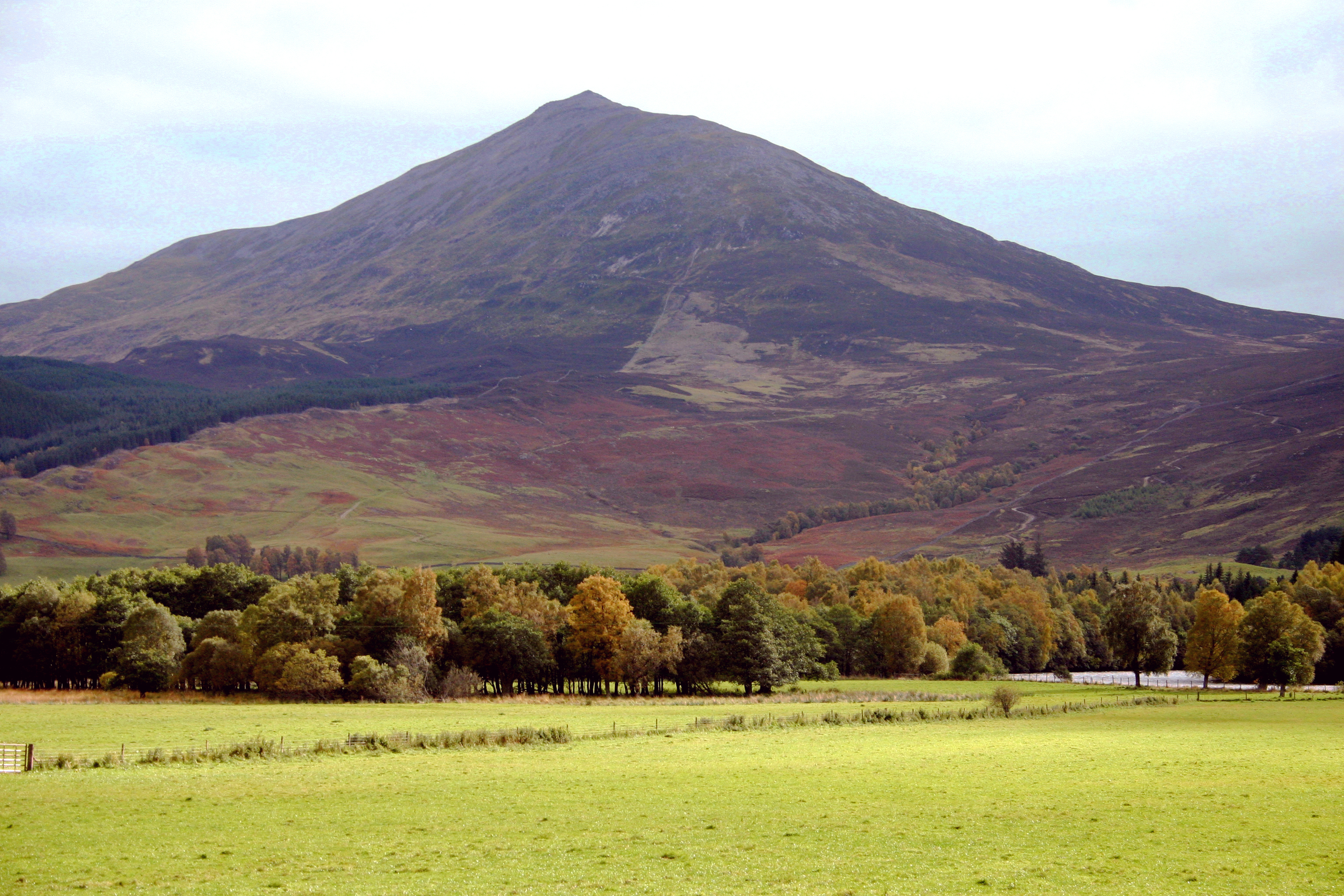
Schiehallion (1083 metres), viewed across the River Tay 
(wiki commons)


P.S. This little gem of a book, and Linda Cracknell's other fiction, non-fiction and creative non-fiction can be bought here.


P.P.S.  A short distance from the Dyke, the slopes of Schiehallion had also been the site of Maskelyn's Observatory.  "The Schiehallion Experiment" of 1774 aimed to estimate the weight of the earth.  (In the process, it also gave us what became known as contour lines.)  You can watch a short video here that describes the basics of what happened, before the whole thing came to a dramatic end.  As Wikipedia tells us,

"During a drunken party to celebrate the end of the surveying, the northern observatory was accidentally burned to the ground, taking with it a fiddle belonging to Duncan Robertson, a junior member of the surveying team. In gratitude for the entertainment Robertson's playing had provided Maskelyne during the four months of astronomical observations, he compensated him by replacing the lost violin with a Stradivarius."


But that's a bit of creative non-fiction for another day.


P.P.P.S. When you read this, I will be in the middle of a month's writing residency on Fair Isle.  I think I will be working on historical narrative poetry, but who knows?  Maybe I'll be busily engaged in historical creative non-fiction.  Time will tell ...


Joan Lennon's blog.
Silver Skin.

Friday, 7 February 2020

The Best Historical Fiction for LGBT History Month - chosen by Anna Mazzola


February is LGBT History Month in the UK and therefore an excuse to pull together my favourite historical fiction novels that explore gender and sexuality throughout the ages.


THE SONG OF ACHILLES BY MADELINE MILLER


An exquisitely-written reimagining of The Iliad, told from the point of view of Patroclus, Achilles’s lover. An entirely fresh take on the Trojan War and its heroes by the author of that other extraordinary novel, Circe.


AS MEAT LOVES SALT BY MARIA McCANN


McGann’s thrilling and erotic debut is a tale of obsession and murder set during the violence of the English Civil War. Dark, complex and unflinching. Everyone should read McCann’s novels immediately.


DAYS WITHOUT END BY SEBASTIAN BARRY


Set in the 1850s and ’60s, during the wars the U.S. fought against the Sioux and the Yurok, and the Civil War, this is a stunning and deeply moving story of two soldiers—an Irish immigrant, Thomas McNulty and his brother-in-arms, John Cole.


THE SEALED LETTER BY EMMA DONOGHUE


The Sealed Letter explores the story of a divorce trial that scandalised mid-Victorian London, focussing on the reluctant involvement of Emily Faithful and her relationship with the seemingly less-than-faithful half of the marriage, Helen Smith Codrington. An intriguing and cleverly-written mystery.


FINGERSMITH BY SARAH WATERS


Really I could have included most of Sarah Waters’ books here, but Fingersmith remains my favourite: a glorious mystery and love truly with a truly gripping plot.
Also featuring a wonderful cast of villainous characters, brilliant use of 19th century slang (‘Pigeon, my arse!’) and the best twist in the business.


REGENERATION BY PAT BARKER


The Regeneration trilogy is an incredible fictionalized account of the relationship between army psychiatrist Dr Rivers and a group of interconnected patients, including Siegfried Sassoon and Wilfred Owen. It blends brilliantly the horrors of war with gay life in Edwardian England and the newly emerging science of psychology.


THE COLOUR PURPLE WALKER


An epic and heart-breaking tale of perseverance as well as an exploration of race, gender, family, and sexuality in 1930s Georgia. The novel is, among many other things, a story of love between women.


MUSSOLINI’S ISLAND


In 1939 a series of Sicilian men were taken from their homes and imprisoned on the island of San Domino in the Adriatic Sea. Their crime? They were gay. Out of this little-known slice of history, Sarah Day has created a fascinating and beautifully written novel.

And coming soon...


Do also look out for Neil Blackmore's The Intoxicating Mr Lavelle, sauntering your way in April 2020: a dark and funny romp through the Grand Tour - The Favourite meets the Talented Mr Ripley in 18th century Europe.


_____________________________________

Anna Mazzola is a writer of dark historical fiction. 

https://annamazzola.com
https://twitter.com/Anna_Mazz