Tuesday, 17 April 2012

Moving along the Timeline by Penny Dolan.


I have just come back from Florence. Although I had an image in my head of that great dome, my pre-trip study barely allowed time to note our hotel was near the Ponte Vecchio. I decided Florence could create its own surprise, and went clutching my Rough Guide’s densely packed pages and a variety of maps, some deocrative, some useful. Wonderful it was - and perhaps because the visit was so dominated by architecture, my History Girl thoughts are about one of the ways we arrange history.
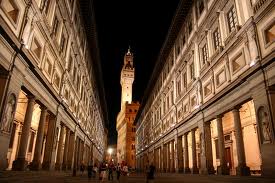
 
As I left the Uffizi Gallery, slightly stunned by all the acres of art, I felt that at last I had understood something about the development of Italian art history. I could see it as I hadn’t when visiting London's clustered galleries. I decided it was because of the shape of the Uffizi building itself.


Architecturally, the gallery is set out like, as a friend said, “a tuning fork”. It consists of two long, thin corridors (with small rooms off) that link at a midway point facing the River Arno. 


The linear procession of the rooms and paintings had somehow helped me to see the pattern of those Italian centuries, whether the changes came from Constantinople, the Low Countries, Austria or elsewhere, or in the dreadful guise of  personalities like Savanarola, Napoleon, Hitler or Mussolini. All that day I was walking through a timeline and I came out a little wiser.

I have liked timelines ever since seeing one in my own children’s encyclopaedia. They are such a useful way of gathering and displaying historical information even though they need to be approached with caution. They can be annoyingly simplistic, lacking the kind of precise detail one wants and are almost by definition heavily biased. I always peer into my copy of a strongly American timeline book with a suspicious English eye. Just who invented what, where and when, sir?

Timelines are ever popular educational devices. Most primary school classrooms display history timelines, usually just below the ceiling where they can’t be touched or followed with the finger. (Surely that's one of the pleasures of the timeline?) 

Then, only last weekend, at the Federation of Children’s Books Annual Conference, I met a man totally devoted to a timeline. Christopher Lloyd was talking about his pictorial timeline book “What on Earth?”with extreme enthusiasm. 


A gigantic version of Christopher Lloyd’s timeline was displayed on the South Bank by County Hall about a year ago and a new one will be posted in the same position in a few weeks called, unsurprisingly, The History of Sport.  

Making one's own timeline can be a useful task. Writers, especially historical novelists, often put together some form of timeline to ponder about how a story works and/or to check a fictional plot against the pattern of real world events.  In fact, that is what I iam about to do.

Meanwhile, before I leave Florence, I must add that by mid-afternoon at the Uffizi I was starting to wonder just what ailments each Madonnas or Bambino was suffering from, or imagining dialogues along the lines of “Try that again, sonny boy, and you’ll be sorry!” or “Do I have to?” or “Seen one magus, you’ve sent them all.”

The Uffizi  painting that charmed me most was a small, dark painting by Fra Angelico called The Thebiad. It showed a landscape filled with tiny images of the Thirteen Hermits who lived around Thebes. If you squint enough, you can see them all doing wondrous or saintly things, This painting has no logical time-line at all and the events are happening almost higgledy-piggledy at the same time as if Thebes was a vibrant, holy theme park. Here's a small section.


I recall another painting too: the face of a saintly nun, probably by Andrea Della Robbia, inside the new Museo Nationale Alinari Fotografia, which is opposite the Church of St Maria Novelli. We called in there late one afternoon to see an exhibition of photographs by Duffy, one of the Sixties street-kids-with-cameras gang that included David Bailey and Don McLean. 

The wall painting was set above an arch, over the intersection between two areas of the gallery display space. As I recall, the nun's calm saintly gaze looked down on black and white portraits of a young Michael Caine, a boldly naked model and Reggie Kray play-boxing with his grandfather in a cramped East End living room. They seemed strange company for such a person, but then this peaceful nun was used to very odd company. 

For centuries, the place had been the Dominican hospital of St Paolo, caring for the sick and destitute and following the 1780 Suppression, became a home for poor girls and unmarried women. When World War II arrived, the Fascists emptied out the orphans and turned it into a prison where state suspects were detained.  Despite that lovely peaceful face, I felt a shiver reading that fact.  

Meanwhile, back to the big sheets of paper and pencils and my own struggling tome. Just where should I begin my timeline?

Penny’s most recent children’s novel is A BOY CALLED M.O.U.S.E, published by Bloomsbury.

I have just finished reading “Long Lankin” by Lindsey Barraclough, copy and recommendation from HG Catherine Johnson, and “Gillespie and I” by Jane Harris, recommended to me by Adele Geras. Two novels that offer more shivers.


Monday, 16 April 2012

All Fall Down, by Sally Nicholls: reviewed by Sue Purkiss

All Fall Down is subtitled A Story of Survival, and the event which our heroine, a thirteen year-old girl called Isabel, has to survive is a truly formidable one: the Black Death of 1349, the deadliest plague in human history. In Sally Nicholls' helpful historical note, she points out that: '...the First World War - the worst disaster Britain has suffered in living memory - killed around 1.55% of the British population. The most recent estimates put the victims of the Black Death at around 45%.'

It's a chilling comparison, and Sally's novel explores in .rich detail what it was like to live through that time - or indeed to die during it: she doesn't flinch from detailed accounts of the exact ways in which the three different forms of plague ravaged their victims.

The novel begins with an introduction from Isabel, in which she looks back to the year the plague came: 'We knew then that 1349 would be terrible. But nobody could have imagined quite how terrible it was going to be.' (So we do know that Isabel herself will survive.) After that, the story is told in the present tense. It begins on an ordinary day, a beautiful June morning: by the end of the morning, and the end of the chapter, the villagers have heard that the plague is close by. We meet Isabel's family as they awake: her much-loved stepmother Alice, her baby brother Edmund, nine year-old Ned, and little Margaret. There are two older brothers: Richard, who is married, and Isabel's favourite brother, Geoffrey, who is in a monastery. Her father is relatively well to do, but he still belongs to his lord, and has to work his land as well as his own. Sally easily sketches a picture of a hierarchical society where everyone knows his or her place and is confined to it.

She's also very good at creating a vivid picture of how this world looks, how it works: 'Father built our solar, a triangular loft space under the roof of our house. It's almost exactly the right size for our mattress, which is made of sacking stuffed with hay...' Much later in the book, when Isabel finds herself in a wealthy man's house and is told she can wear his dead daughter's dresses, we hear that she cannot put them on because she has no-one to help her, and it's impossible to tie all the fastenings by herself. This kind of detail makes a far distant world very real, almost tangible; we can absolutely imagine what it would be like to live in it.

She makes us see too how closely the lives of the villagers are bound up with the rhythm of the seasons; and so we see how appalling it is, how unnatural, when the crops are ready in the fields, yet there are not enough people left to harvest them. And towards the end of the book, when the plague has almost run its course, it is easily understandable that the effects of the disaster on society will be profound. The plague cut a swathe through noblemen just as much as it did though the poor: some estates were left without a lord, and none had enough workers to keep the estates going. So power shifted: instead of having no choice but to work for someone else, workers could sell their labour. Land became cheap, and men of enterprise - like Isabel's brother Richard - could lay the foundation for a new, more prosperous way of life: at the cost, however, of desperate human tragedies: t the beginning of the book, Sally quotes from someone who lived through the plague, Agnolo di Tura: 'I buried with my own hands five of my children in a single grave... No bells. No tears. This is the end of the world.'

It makes some of the recently manufactured dystopias seem a little frivolous. Why create an imagined world of stunted survivors of a terrible catastrophe, when if we look back, we can see a real one?

This is a very powerful novel. I particularly like the fact that it explores the lives of ordinary people - historical fiction so often concerns itself with the doing of the great, and fascinating as these are, the reality is that if we had lived in the medieval world, most of us would have been in the shoes of Isabel and her family. Sally Nicholls shows us exactly how this would have felt, looked, smelt, tasted and sounded like..

Overall I think this is a terrific novel, gripping and thought provoking; but I'm slightly uncertain about the character of Isabel. She is clearly meant to be attractive; she's certainly loved. And yet somehow there's a lack of warmth about her. However, this may be partly because the story is told in the first person; if you're writing about yourself, it's difficult to convey how others see you. Or perhaps it's intentional; perhaps the point is that Isabel isn't a heroine in the ordinary sense. There was nothing in anyone's character that made them survive or fail to survive the plague; it was just luck. Isabel is an ordinary girl dealing as best she can with an unbearable situation.

It's a gripping and thought-provoking novel. All Fall Down, by Sally Nicholls, is published by Scholastic at £7.99.

Sunday, 15 April 2012

Soops and Syllabubs

by Marie-Louise Jensen

Looking into early Georgian-era food for The Girl in the Mask and next year's book Smuggler's Kiss has been a delight. I discovered all sorts of gems, not all of which could be fitted into the stories.
 Syllabub


First of all, I took a look at which foods were specifically popular at Bath at this time. Bath was famous for its mutton; this was a staple served in all the lodging houses. Hardly surprising when you consider this area's importance in the wool trade.
Soups (or, according to Eliza Smith's Compleat Housewife, 1858, 'soops') were many and varied. The gravy-soop sounds terribly rich; rather like a bowl full of beef and gravy. And the Fasting-day soup sounds a bit of a mixed bag: I love the sound of a whole onion stuck with cloves being dropped into the soup, but am less sure about the chopped lettuce (really? Cooked lettuce?) and spinach.
In the cook shops and bakeries and at the evening balls too, ladies were tempted by jellies and syllabubs. Jellies were boiled from the four bones of calves feet, spiced with nutmeg, mace and clove and coloured (sometimes in layers as 'ribbon jelly') with cochineal, spinach, saffron or syrup of violets. The instructions, to 'take out the bones of four calves feet' would daunt most present-day cooks, I imagine.
Syllabubs (pictured above) were basically double cream, sugar and lemon served with biscuits. I don't even like to think about how rich that must have been, but I'm no longer surprised that ladies at the Bath rarely took luncheon. In fact many of the dessert recipes seem to include several gallons of cream, including jelly posset; besides the ubiquitous calves feet, it was made with cream, pounds of sugar and pints of 'sack' or sweet sherry.

Sally Lunn's teashop
Modern Bath buns
The other great temptation that fell in guests' way at Bath was buttered rolls. These were considered unhealthy by the local physicians, but many guests found them irresistible and they seem to have been served everywhere. They are thought to have been first made by Sally Lunn, a Frenchwoman, and based on a recipe for brioche. Less like the rather sickly 'Bath bun' that is sold in Bath today and more like the Sally Lunn bun.

Later in Bath's history, Dr Oliver invented a supposedly healthier alternative, the Bath Oliver biscuit, but that wasn't yet around at the period I'm writing about. However, they can still be found today if you're lucky.

When I looked further afield for Smuggler's Kiss, I found a few real delights. The most popular French dish at the time was 'ragout' - or, as the British called it, 'ragoo'. This stew often contained all manner of delights such as lamb's stones. I had to look that up. The private parts of male lambs - what a treat! Another treasure: pulled chicken. So-called because you 'pulled' all the raw meat from the bones, minced it finely, mixed it with herbs and breadcrumbs, and then (the mind boggles) apparently put it back on the bones and boiled it in a large bladder in a pot. I imagine this was a favourite dish for people who had cooks. Perhaps I'll stick with the syllabubs after all...

What I'm reading at the moment:

Friday, 13 April 2012

Heard It All Before? Catherine Johnson


I started this blog thinking about the play I saw last week, The Recruiting Officer, at The Donmar Warehouse, a wonderful restoration comedy that does silly wordplay, crossdressing, big truths and even bigger liars. The performances were brilliant, the actors included six actor musicians who sang and played wonderful 18th century tunes (as well as a very original request to turn your mobile off before the performance).
Then I saw a thread on Facebook concerning historical fiction, about how we are all mired in nostalgia because we are terrified of the present, let alone the future. That the vogue for historical novels and bonnets and bustles on TV is all part of a greater malaise which sees no decent current TV drama (Homeland anyone? OK that's American but it is quality) or theatre (I'll get back to this). That historical fiction is about comfort and safety.

We are all nostalgic. I think it's hard wired. Especially since we have been thrown off the land and forced to scour the world looking for ways to earn a living. It might be because we crave reassurance sometimes but the best historical stories and drama can be just as thought provoking, intelligent and shocking as anything modern.


And we've always made our own myths. The Welsh, like all Celts, are very good at this, think of Iolo Morgannwg and his drug taking, literary mates, dressing up as Druids on top of Primrose Hill in 1792 and resurrecting the Gorsedd of the Bards. Think of the annual Eisteddfod today with it's unreconstructed flower girls dancing barefoot in front of the golden Arch Druid, (no boys! why no boys?) and the (Welsh) great and the good done up in green, blue and white sheets as druids.

But I do think there is more point to historical novels, plays, and dramas than comfy cosy safeness, at least when they are done well. The best novels - Hilary Mantel's Wolf Hall for me - plunge the reader into strange, vivid worlds you can practically smell, but the politicking and the personal relationships are very familiar. Just like the best speculative fiction in fact. It's not just the frocks and the scenery, like every story, it's the people. And costume drama on TV doesn't have to be the visual equivalent of Ovaltine. The Devil's Whore on Channel Four a few years ago is a good example, and I cannot wait for Red Tails, the new George Lucas film about the regiment of African American WW2 pilots, to tell me stuff I don't know and (I hope) to surprise and challenge cinema goers.


Back to The Recruiting Officer. It was written by George Farquhar in 1706, three hundred years ago, and it talks about the way soldiers are perceived as heroes when needed and louts when not, as well as ultimately, their disposability. Not cosy or safe at all.

One of the tunes used in the play was Over The Hills and Far Away, and this reminded me of another play. A parallel. Set in the present, well in the recent Iraq War, using the same tune, and saying many of the same things about life in and out of the army; The National Theatre of Scotland's production of Black Watch which also had me blubbing like a baby at the end.


EXILED! by Mary Hooper


I’ve just finished a YA historical (not due out until Spring 2013) which originally
was going to be about a milkmaid, Susannah, fresh from the country, who committed
a minor offence and was sentenced to imprisonment on one of London’s ghastly
hulks (the decommissioned warships which were moored in the Thames). Whilst
researching what life was like aboard a hulk in the early 1800s, however, I
discovered something rather intriguing: that sometimes the hulks were used
as a holding bay for prisoners who were going to be transported.


So maybe, I thought, it would make a better story if Susannah were to miss out on
the hulk experience and be sent to Australia instead.
English gaols at this time were fearfully overcrowded, and to be exiled was a popular
punishment for both major and minor crimes from early seventeenth century until
1868. Until the 1770s criminals were deported to the United States, but following the
American Wars of Independence they began to be sent to Australia. It was seen
as a useful and humane alternative to execution, which would probably have been
the sentence of many if transportation had not been introduced.
A sentence could be for life or for a minimum of seven years, and convicts would
typically be expected to work in the colonies by farming, mining or helping to
build roads. When they had served their sentence – or most of their sentence –
they would be granted certain freedoms: to marry and raise a family, to work and
live where they pleased. In the unlikely event that they could raise the fare, they
could return to England.

I read more. Throughout the eighteenth century, women and their children were
regularly among prisoners deported to Australia, but in 1789 a cargo consisting
of about 230 women and children were sent to Botany Bay aboard a ship called the
Lady Julian. Some of these women were prostitutes, others had been convicted of
quite minor crimes, but their main reason for being transported was to enable them
to marry male prisoners already living in Australia and increase the population.

But first there was the year-long journey, during which they were encouraged to
become - ahem - friendly with the sailors.


In THE FLOATING BROTHEL, Sian Rees’ fascinating account of the Lady Julian’s voyage, she
tells how each shipmate was encouraged to choose a woman for the voyage. Sets
of baby clothes were part of the provisioning for the ship, for (as The Times
put it) it was hoped that “the salubrity of the sea air may, during the long
voyage, produce babies to every honest woman”. How the women felt about this,
and if they had any choice in the shipmates’ choosing of them, is not recorded.

So my main character misses out on being imprisoned on a hulk, but instead is sentenced
to be transported. Gaol fever was rife and life on board ship was harsh; what happens to
her on the way to Botany Bay? Does she even get there? You’ll have to read the book to find
out! I wish I could give you a title so that you’ll know it when you see it, but this hasn’t yet
been decided on. Suggestions gratefully received!

Thursday, 12 April 2012

SNAGGLE-TOOTHED BEAUTY by H.M. Castor


Last week I returned, not to the county of my birth, but to the county of my growing-up: Warwickshire. In terms of castles and stately homes, the county has an embarrassment of riches, including Warwick Castle, Charlecote Park, Ragley Hall, Baddesley Clinton, Coughton Court, Upton House and Kenilworth Castle. This last is a ruin; having been a fortress palace of great importance for many centuries, used by monarchs from Henry II to Henry VII, and famous as the place where Robert Dudley played host to Elizabeth I for an exceptionally long visit (19 days) in 1575, it was then ‘slighted’ by the Parliamentarians during the Civil War – and descended gradually, thereafter, into a fully ruined state.

(‘Slighted’, incidentally, seems to me a rather marvellous term - it retains a whiff of the drawing-room faux pas while in fact meaning here the partial destruction of a building so as to make it useless as a stronghold. Poor Kenilworth Castle had its battlements, parts of its outer bailey and one wall of its great tower destroyed.)


I have visited Kenilworth many times over the years, and have always felt keenly what a shame it is that that castle is a ruin. I have spent my visits reconstructing it in my mind, putting in floors where none now exist…


…and viewing the bits of detailed decoration that do remain as grief-inducing indications of just how much we have lost:


Which, of course, they are. However, on last week’s visit, I decided to adopt a different attitude. I decided simply to look. Not at what Kenilworth would have been, or ought to be, but at what it is. At art exhibitions, I am a great one for conscientiously reading all the labels and somehow not giving myself enough time or mental relaxation to look properly at the pictures. So to look – for once – at the castle, as far as possible without interpretation, was my task.

Thus, this blog is something of a photo journal. And a photo journal without labels. I didn’t want to concern myself with which bit was built by John of Gaunt and which by Robert Dudley. (Though if you are interested in finding out more, there is a very full article on the castle here.)

I noticed, instead, the shapes made on the surface of the stone by centuries of exposure to the elements:


…and how the depredations of the weather have turned a set of worn steps into a water-smoothed cascade:


I looked at the rhythm of shapes:


I thought how, in some places, it was as if a hungry monster had simply bitten bits off the building:


And I marvelled at what a ruin gives you: a view of the secret textures of the building’s fabric – it’s like a cake or a loaf that’s been torn open, so that you can see beneath its crust:


Finally, of course, I looked at the unavoidable graffiti. In doing so I was reminded of Eleanor Updale’s comments in her recent blog here about the different values we place upon things depending on their age. For, while the recent graffiti gave me an outraged shudder, some of the older examples had me peering in fascination:


…and had they been still older they would have positively entranced me (show me 16th century graffiti & I swoon!). Even so – and it must be the bibliophile in me – I admit I do always tend for fall for a nice font:


H.M. Castor's novel VIII - a new take on the life of Henry VIII - is published by Templar in the UK (where it is newly available in paperback - whoop!), and by Penguin in Australia.

H.M. Castor's website is here.