Friday, 28 October 2022

CATHERINE CALLED BIRDY by Penny Dolan

Ever since opening Karen Cushmans’ Catherine Called Birdy novel back in 1996, I have remembered the freshness, energy and rebellious joy of that first page. Her determined character has been stuck in my mind:

12th Day of September. I am commanded to write an account of my days: I am bit by fleas and plagued by family. That is all there is to say.

13th Day of September. My father must suffer from ale head this day, for he has cracked me twice before dinner instead of once. I hope his angry liver bursts.

14th Day of September. Tangled my spinning again. Corpus bones, what a torture.

15th Day of September. Today the sun shone and the villagers sowed hay, gathered apples and pulled fish from the stream. I trapped inside, spent two hours embroidering a cloth for the church and three hours picking out the stitches after my mother saw it. I wish I were a villager.

And so on. 

                                         Catherine, Called Birdy by Karen Cushman

The diary begins in September 1290 but it does not focus on the intrigues of royal courts or famous historical figures, Instead, it gives us the thoughts of the writer: fourteen-year-old Catherine, nicknamed Birdy because of the number of pet birds she keeps in her chamber.

Birdy is the only daughter of Lord Rollo and Lady Aislinn, who live in a small manor house in Lincolnshire. She comments, with humour, puzzlement and rage upon her family, her friends, her everyday life and the annoying fact that her father intends to marry her to the wealthiest bidder.

Birdy does not want to be a lady, nor married. She prefers spending time with Perkin the goat-herd and her “heart’s brother”, and her other young friends in the village. She hates the needlework, restrictions and all the boring “lady-lessons” she is given by her nurse Morwenna, her mother and by various tutors.

However, her sympathetic brother Edward, a young monk in the scriptorium at the nearby abbey, has convinced their mother that Birdy should learn to read and write, even if she has to give up some of her needlework time. Reflecting on her daily life, he suggests, will help Birdy improve her character - and so the diary has begun.

Gradually, between one September and the next, Birdy’s diary shows her learning about the uses of herbs and the making of manuscripts, as well as experiencing love, jealousy and heart-break. She discovers the true story of where babies come from and drives away several suitors by tricks and bad behaviour. She sees the effects of sorrow, poverty and death and senses what her future role might be – even if early entries are laced with jokes about jakes, farts and bums, amounts of silly pranks and a quantity of curious information on odd saints. Catherine Called Birdy is an exuberant joy of a book with a character that was wonderfully “feisty” before publishers had even heard of the now overused word.

My copy of the novel had been sitting quietly on its shelf for over two decades when suddenly I heard that title again: Catherine Called Birdy has now been released as a full length film which, after a short cinema run, is streaming on Prime. 

                            Catherine Called Birdy Trailer

Written and directed by Lena Denham and starring Bella Ramsay as Birdy, the film a glorious medieval coming-of-age romp. Though there are moments of seriousness, the story is not solemnly told. I was reminded of “Will”, the film about young Shakespeare from the Horrible Histories team, and felt that Birdy might create a similar interest in that period of history for a young teen audience, in addition to much older persons.

Birdy, the film, starts with impact: before the opening credits, our heroine appears splattered in mud at a wild wattle-and-daub village cottage-raising, an incident shifted some way from its place in the original plot. In general, the film creates a picture of a close-knit medieval community, its seasonal festivities and the hard realities of life. This manor is a place where candles gutter, food runs scarce or goes rotten, where the privy is a public necessity, where parents expect to beat their children and Birdy’s bed is shared by her nurse Morwenna and any visiting females.

Although the film avoids the public hanging of the original book, Denham does focus on menstruation as the important indication of marriageability. Birdy’s first monthly flow is shown as a turning point in her life. Innocently fearing she might be dying, she is horrified by the kindly Morwenna’s practical explanation and determines to conceal her womanhood from her father. For a while Birdy’s ruse works but eventually, she is discovered. 

After she amusingly dissuades many suitors, Lord Rollo becomes determined and accepts the offer of a man she calls Shaggy Beard, a rich much older suitor from Yorkshire, who gives Birdy a purse of silver coins, By accepting the money, she is accepting her eventual marriage, although it is agreed that Birdy can stay with her mother until the newr baby is born. In the book, Birdy gives the money to Meg from the dairy so she and her husband can swain pay the death tax and live, with Perkins in his grandmothers cottage. In the film, the money is used in another way and has a different impact.

The film reshapes and slightly restructures the book, using modern multiracial casting, a modern soundtrack as well as making the ending larger and more emotional. Birdy’s father is given a stronger role and the ending is slightly adjusted (no doubt as a reflection of the star status of the actors Andrew Scott and Billie Piper) to allow for a couple of bigger scenes, which give Birdy a true insight into the complexity of adult life and relationships.

Although I enjoyed the film very much, and loved its energy, and sense of life and laughter, certain moments felt much more "unhistorical" than others. Though not enough to overpower the pleasure or fun, I had problems with film-Birdy’s attitude to religion, to books and to writing.

In the original, Birdy has a valued book of saints, a precious item that belongs to her mother, whose family was once wealthy. Her diary entries open with a reference to the saint of that day. For example, randomly I found:

27th Day of November. Feast of Saint Fergus, an Irish bishop, who condemned irregular marriages, sorcerers and priests who wear their hair long and

17th Day of December. Feast of Saint Lazarus who was raised by Jesus and afterwards went to France.

These headings were both based on facts I found elsewhere so I am assuming that many of Cushman's references might be accurate too. They are important as indicators of the strongly religious culture and mindset of the age. In the novel, although Birdy does not reveal a great devotion to the saints or religion, she does experience it as an everyday part of her life.

Yet the film, however, pushes this attitude almost too far. When Birdy goes on an errand, in her mother’s place, to her brother Edward’s monastery, she is overcome by the sight of the young monks. She stands, eyes wide, clutching at the body of a life-size crucifix in the middle of the cloister lawn. While this image was amusing enough in its way, that scene felt total at odds with what I imagine as the spiritual frame of the age. Even knowing of the wealth of almost erotic religious literature created by certain saints, for a moment, the gap in the “history” of the film felt too large. Was it simply my response to the blatant modern mix of sacred and profane? Yet the following scene, where Birdy goes to her brother’s cell amusingly concealed beneath his cloak, did not feel seriously confrontational at all. Is there a limit to how far modern historical fiction can be stretched on screen?

This leads me to my second problem: the reverence for the act of writing and the cultural value of books. In the novel, Cushman showed Birdy absorbed in the work of the scriptorium, deciding that she would like to be a monk.

“To spend the rest of my life making pictures instead of mending and weaving would be heaven indeed!”

This book-Birdy is interested in the process, noting the monks’ desire for lapis lazuli and other long-lasting colours and inks for their manuscripts. In her enthusiasm, she tries to make her own.

“I made a paste from bilberries that looks as blue as a robin’s egg but it grows sour and so sticky that I must add a task that the brothers have never dreamed of: picking bugs out of the heavenly sky or the Virgin’s veil.”

The book-Birdy would, I felt, have had a care in the way she used her diary and did her writing, even if the results were not perfect.

However, in the film version, Birdy’s pages are covered in careless scrawlings, even allowing for the difficulties of a quill pen. They look like the jottings of a modern child who believes that more sheets of paper or another exercise book will always be available. In my – yes, opinionated - opinion, her pages do not look like the work of a girl who has handled vellum and observed monks working on illuminated manuscripts or the reverence with which these books were treated. Birdy's scrawl and sketches clashed against my ideas of the respect for writing at that time - but am I wrong? Certainly, badly-done homework might be more meaningful to any of the young viewers than exquistite lettering and they will have time,ifthye choose, to form their own views on life in the medieval England.

Ignore my worries, because Catherine called Birdy is a treat, in either or in both its appearances. Do search them out, for yourself or your teens if you like history mixed with humour. 

Even better news: Karen Cushman, the original author is still alive. I do hope she is celebrating her memorable Birdy’s bright new flight

Penny Dolan

@pennydolan1

Friday, 21 October 2022

Cawdor Castle: by Sue Purkiss

 In the early summer of 2022, we were staying in the Cairngorm National Park. It was our first time in the north-west of Scotland, and we were wowed by the ancient Caledonian Forest, the gaunt hills, the sparkling rivers, and the variety of wildlife. However, on a day that was forecast to be wet and windy (in fact it was the latter but not the former), we decided to find somewhere that would offer shelter if necessary. So we went to Cawdor Castle.

All we knew about the place was that Macbeth, at the beginning of Shakespeare's play, was told by the witches that he would become Thane of Cawdor - and thereafter, of course, King of Scotland. So we were expecting somewhere dark and forbidding, probably half-ruined, and naturally haunted by ravens croaking in a doom-laden sort of way.


But the castle turned out to be none of those things. Built of grey stone, with a turreted square tower at its centre, the house is softened by the lawns, gardens and woodland that surround it. Inside, it has the feel of a comfortable home, in which you can imagine a family living happily - though reminders of a dark and bloody past do emerge. And in fact, we were told that the Dowager Countess, who manages the house, does live there in the winter, and even sleeps in the centuries-old scarlet four-poster. "Sooner her than me," commented the volunteer who told us this with a shudder. 


You enter through the drawing room, which is warm and colourful, with comfortable looking chairs and sofas and lots of lamps. There are also lots of portraits, which of course you don't tend to find in the average family home. In an alcove on a staircase there is a bold piece of wall-art, which at a second glance you see is a fan-shaped arrangement of nineteen rifles. (Why only nineteen? What happened to the twentieth?) I imagine these are a consequence of the aristocracy's strange desire to kill great quantities of wildlife, rather than earlier generations' propensity for killing their enemies, or sometimes their relations. But I could well be wrong...


The house is filled not only with interesting objects which generations of Campbells have collected on their travels - pictures, ornaments, sculptures, porcelain - but also with family photographs and some very lovely modern art. The tower is the oldest part of the castle, and was built with a view to defending the castle against enemies and marauders; but now, the top floor is a relatively small, very pleasant living room.

But go down the narrow winding staircase, and you will find this reminder of the building's long history. The castle was founded round about the end of the fourteenth century. Tradition has it that the site was chosen - bizarrely - by a donkey, which was set free and allowed to wander where it would. In the place where it stopped, there the castle would be built. And so it was.

I suppose it's just possible that this may not be entirely true - but what is certainly true is that the tower was built around a tree. The evidence is in the picture below - the tree is still there. It was said to be a hawthorn, but when samples were analysed recently, it was found to be a holly. This seems to make more sense: holly has a place in myth and legend. Certainly it has been credited with protecting the castle from destruction at various dangerous times in its history.


And dangerous times there certainly were. Cosy and comfortable as the castle seems now (apart from this basement, which has a bijou little dungeon tucked away on one side - just the place for unwelcome visitors), the family that lived there were, over the centuries, involved in some very nasty goings-on indeed. For example - in the early sixteenth century, the heiress was a child called Muriel. She was kidnapped by the Earl of Argyll, and, the guidebook tells us: 'For future recognition, she was branded on the hip by her nurse with a key. and the top joint of the little finger of her left hand was bitten off.' When she was twelve, she was married off to Argyll's younger son, Sir John Campbell. Surprisingly, the marriage was apparently a happy one. But this wasn't the end to the drama: Sir John's sister was married to one Lachlan Maclean. Wearying of his wife, he had her chained naked to a tidal skerry; she was supposed to drown, but was in fact rescued by passing fishermen. Sir John then knifed his brother-in-law to death in Edinburgh. He was pardoned, but deemed it a good moment to retreat to Muriel's far-distant ancestral home in Cawdor.

And that was only the beginning. There's far more blood-letting, feuding and killing people in hideously brutal ways - much too much to include in this post.

And talking of blood-letting, what of Macbeth? Was he really the Thane of Cawdor? We asked a guide. She sighed. One might almost have thought she'd been asked this question a million times before. "No. Macbeth was a real person - but he lived long before the castle of Cawdor was built, long before there was even a thane. What's more, there's quite a lot of evidence that he was a VERY NICE PERSON. He and his wife were very well-loved."

So there.

We certainly shouldn't leave Cawdor without a visit to the gardens, which are quite beautiful -see also the top picture. And the woodlands are lovely too, with rhododendrons and some very old trees, and a stream running through. Times have changed since the castle's founding - and in some ways - though not all - very much for the better. (I do wonder how the peasants were getting on while the aristocrats were whirling around killing each other...)


PS For anyone who's enjoying the new Netflix series, The Empress, you might be interested in this post which I wrote about her six years ago, after we'd been to an exhibition about the Empress Sisi in Vienna.

Friday, 14 October 2022

Round the Mulberry Bush by Laurie Graham


The song we all know from childhood doesn’t make a lot of sense but neither does Gathering Nuts in May nor, indeed, many other nursery rhymes. I’m told the Scandinavian version is Here We Go Round the Juniper Bush.


Not on a cold and frosty morning but on the hottest day (so far) of the century, we honoured a Charterhouse tradition: presentation of our first mulberry harvest of the year to the Lord Mayor of London. When did this practice begin, and why? We don’t know. But during Covid lockdown we turned our mulberries into jam and sent a jar round to the Mansion House.

Were there mulberry trees in the Charterhouse gardens during our 160 years as a monastery? The nearby Priory of St Bartholomew certainly had a mulberry garden next to its infirmary, suggesting that the tree was considered to have medicinal value. The Carthusians, as a closed order, wouldn't have been engaged in ministering to the sick, but perhaps they cultivated mulberries for in-house consumption.

We currently have several mulberry trees at The Charterhouse, of varying ages. The one plundered so its fruit could be presented to the Lord Mayor is a parvenu, dating from only the middle of the 19th century and is allegedly a cutting from a tree in the Fellows’ Garden of Christ’s College, Cambridge, known as Milton’s Mulberry. Why so called? It was planted around the year of Milton’s birth so would certainly have existed when he was a student there. Did he sit beneath it, versifying? Once again, we don’t know.

What we do know is that in the early 17th century a lot of mulberries were planted in England. They were part of James I’s doomed initiative to create a vibrant silk industry. Doomed because silkworms feed on the leaves of the white mulberry, Morus alba, a tree which requires a mild climate, and England at that time was still in the throes of a Little Ice Age. However, the black mulberry, Morus nigra, thrived and, for want of anything tastier, the silkworms fed on the leaves, but the silk they produced was coarse and brittle.

So, our silk industry may have failed but we gained an abundance of mulberry trees up and down the country, and rather lovely they are, with their generous leaves and sinuous branches that lean and bend low to the ground. They provide excellent cover for toddler hide-and-seek and perhaps for a bit of grownup outdoor nookie too. 

Mulberry Day 2022 dawned. The Lord Mayor and his consort arrived. Yet another arcane ceremony for them to attend, probably a typical engagement in their year of office. July 19th was the day the temperature in London reached 36 Celsius so no velvet or ermine was worn. Speeches were delivered and the berries were presented in a bowl fashioned from the wood of a fallen mulberry tree. Strictly speaking, they weren't the first fruits. The birds had had first dibs, as witness the indelible purple splatters of pigeon poop along our garden paths.


The assembled Charterhouse Brothers snacked on the surplus mulberries that, lacking perfection, hadn’t made it into the final presentation cut. I can vouch for the intense deliciousness of the fruit. It is the racy, lipstick-wearing cousin to the maiden aunt blackberry. Sadly, it doesn’t keep. You must harvest the berries and eat them within hours, a point we emphasised to the Lord Mayor but he confided that he had the Chancellor of the Exchequer dropping by for a banquet that evening and the chef was already at work on dessert. Maybe the kitchen staff got to eat those mulberries. I very much hope so.


Friday, 7 October 2022

Rediscovering Shōgun - by Lesley Downer

‘In 1600 an Englishman went to Japan and became a samurai ...’               


In the late 1970s I lived in a provincial town an hour’s train ride from Kyoto. Most weekends I’d go to visit. Each time I’d look for a new temple to explore and spend the day there.

One day I wandered into a little temple called Kōtō-in. I sat on the veranda, gazed at the sand and rock garden and idly picked up the English-language leaflet. The temple, I read, had been founded in 1601 by Hosokawa Tadaoki, a samurai lord whose wife had been a Christian convert and who was a famous bowman. There in one of the paper shoji screens was the very hole through which he had shot three arrows - one after the other, with perfect precision.

Map of Japan with picture of Will Adams meeting
shogun, 1705, by Pieter van der Aa

I was staggered. It was the very story that I was reading at that moment in Shōgun. Hosokawa was Buntaro. This was Buntaro’s temple! Clavell had changed his name but not his story. Did that mean that all of Shōgun - despite the changed names - was true?

Reading it again more than forty years later, having spent much of that time absorbed in Japanese culture and history, I’m hugely impressed with how accurate it is, not just in the historical detail but in Clavell’s insight into how it feels to be Japanese.

James Clavell
Clavell led quite a life himself. Born in 1921 into a Royal Navy family, he was captured by the Japanese and interred in Changi prison throughout most of World War II. He went on to become a screenwriter and director in Hollywood. He wrote his first novel, King Rat, in 1960. Shōgun was published in 1975 and sold more than 15 million copies. Apparently it took him three years to research and write and he didn’t plan it out. Some of the plot twists, he said, were as much of a surprise to him as to the reader. He died in 1994.

Closeup of Will Adams meeting the shogun,
1705, Pieter van der Aa

For some reason everyone thinks that Shōgun is not literature. I was interviewed once by Mariella Frostrup and was supposed to speak on books on Japan. She was horrified when I began with Shōgun.

Literature or not, it is undoubtedly one of the most enjoyable books you will ever read and a brilliant source not just of Japanese history but of east west relations at the time, not to mention ships and nautical matters. Clavell’s skills as a screenwriter are readily apparent. Shōgun is dramatic, cinematic, a master class in historical fiction, immersing you in seventeenth century Japan and keeping you hooked from beginning to end.

William Adams the Pilot
Will Adam's ship Liefde lands in Japan -
monument  in De Liefde arrival memorial
park, Kurushima, Usuki City, by N. Tamada 

Clavell takes as his starting point the true and amazing story of William Adams (1564 - 1620), shipwrecked in Japan in 1600, the first Englishman ever to arrive there. Adams was a contemporary of Shakespeare, a ship’s pilot who under Sir Francis Drake helped repel the Armada and fought in the ongoing war against Spain and Portugal. The Japan in which he found himself was at an equally pivotal moment. It was the climax of the warring powers era, when samurai armies battled to control the country. The Portuguese had arrived half a century earlier and were making converts and sizing the place up for colonisation. The last thing they wanted was a Protestant Englishman turning up to tell the Japanese that the outside world was not as they portrayed it. Adams revealed their deceit and changed the course of Japanese history.

Clavell leaves the framework of history pretty much as it is. But he changes the names of the players which allows him to fictionalise freely, taking liberties with the details to make the story even more gripping and exciting. Readers are kept on their toes, anxious to find out how the characters will weather the next terrible ordeal that befalls them.

Tokugawa Ieyasu
by Kanō Tanyū (1602 - 1674)

The story begins in the stinking claustrophobic innards of Blackthorne’s storm-tossed ship, the Erasmus, ‘two hundred and sixty tons, a three-masted trader out of Rotterdam, armed with twenty cannon and sole survivor of the first expeditionary force sent from the Netherlands to ravage the enemy in the New World.’ Most of the Dutch crew are dead or dying of scurvy. The survivors are on the brink of mutiny.

Only one man can control them - Blackthorne, tough, competent, fearless and, as we soon discover, the best pilot on the planet. We learn about their nightmarish two year voyage, in which all the other ships in the fleet were lost, and the rough Elizabethan world that he comes from. As a Navy man, Clavell lards his tale with colourful and authoritative detail about ships, seas and how ships work, the job of the pilot, who commands the ship, and the importance of rutters - the annals which pilots kept, laying down their routes and recording their daily activities.

After the horrors of the tempest comes a complete change of pace. Blackthorne wakes up in a small house in a fishing village in Izu. We see Japan through his eyes - the neatness, cleanliness and occasional nakedness, the Portuguese priest who declares him a pirate and demands he be killed, the samurai casually lopping off a man’s head. Clavell has a lot of fun with cultural differences such as the bath, a daily necessity to a Japanese but a death sentence to an Elizabethan Englishman. The bath becomes a marker of how Blackthorne is adjusting, as he starts to compare the sparkling clean Japanese houses and cities with the disease-ridden filth back home.
 
Will Adams meets Shogun Tokugawa
Ieyasu - by William Dalton 1866

Like Gulliver in Lilliput, Blackthorne and his crew endure a series of humiliations and ordeals, which Blackthorne overcomes through sheer obstinacy, refusal to be cowed and the quickness of wit to fathom how to get by in this disorienting new world.

As the canvas broadens we meet an extraordinary range of people and start to see their world through their eyes as well as through Blackthorne’s. We also begin to discover how much goes on that Blackthorne knows nothing about.

We meet Mura the village headman, ‘small and lean with strong arms and calloused hands’ and a secret judo master; it’s many pages before we find out who he really is. Then there’s Omi, the handsome young samurai, who behaves with suitable disdain to Blackthorne and his crew and equally suitable deference to his uncle, Yabu, the daimyo of the region.

Yabu is a wonderful character, ‘short, squat and dominating,’ forever plotting who to betray in order to advance his own interests. He’s fearless and without scruples and finds death, his own and others’, both erotic and poetic. Early in the story he is trapped at the bottom of a cliff by the incoming tide. Having ascertained that there is no escape he sits down calmly to compose his death poem. Blackthorne meanwhile desperately seeks to rescue him even though Yabu has committed terrible deeds that make them deadly enemies. Yabu survives and continues to be a lethal yet strangely likeable and entirely untrustworthy presence throughout the book.

The women too are vividly portrayed. There’s Kiku the courtesan, exquisitely beautiful yet down to earth too. Her kimonos ‘sigh open’, ‘whisper apart’. Like a flower, her task is to rise above earthy reality, to laugh gaily and take men’s minds off whatever is going on around them, no matter how terrible. There’s also Gyoku-san, the Mama-san, who knows everyone’s darkest secrets, wielding them to advance her own position while appearing to be utterly humble, as a person such as she, on the bottom rung of society, has to be.

Will Adams with daimyo and attendants
by William Dalton 1866 

Meeting the Shōgun
The canvas expands to encompass the entire country as Blackthorne arrives in the giant metropolis of Osaka and is ushered into Osaka Castle, a gargantuan fortress which ‘makes the Tower of London seem like a pigsty.’

Here he meets Toranaga, Clavell’s name for the great warlord Tokugawa Ieyasu (1543 - 1616) who was to become shōgun, taking over the whole of Japan and bringing about 250 years of peace. Toranaga is a consummate politician and statesman who controls and manipulates whatever happens and gives nothing away. He’s also likeable, warm and funny.

Blackthorne also meets Mariko, the Christian convert, modelled on Gracia, the wife of the warlord famous for his archery skills. Buntaro, Clavell’s fictionalised Hosokawa, is rather a tragic character. ‘A short, thickset, almost neckless man’, he is a brilliant warrior and a poet with the bow, utterly loyal to his lord. But he is also a man of terrifying rages, driven mad by his hopeless love for his wife.

Mariko is tiny, beautiful and fearless, a true samurai, prepared to die for her lord. She becomes Blackthorne’s interpreter, confidante and ultimately lover. She shows him how to flourish in this alien world by becoming more Japanese, finding inner peace.

Tokugawa Ieyasu by
Utagawa Yoshitora (1836 - 1880)

Blackthorne communicates with his crew in Dutch and in Portuguese with Mariko, the Japanese Christians and the Portuguese fathers and seamen. With Mariko he also has a secret language of love - Latin; though the two have to be wary. There are always samurai around who may turn out to be secretly Catholic and to understand them.

At one point Mariko and Blackthorne are talking. ‘How childish’, she says to herself, ‘to speak aloud what you think.’ Like children, the westerners are what they appear to be. The Japanese conversely are eternally acting. Apart from Blackthorne, who is an outsider, they all know that this is how you play the game. Clavell gets a lot of fun out of the difference between what the Japanese say and what they’re thinking, let alone what they really intend to do. It’s a key distinction that Japanese recognise between one’s true feeling and the face that one chooses to present to the world.

As the story goes on the focus changes. Blackthorne slips into the background as we step more and more inside the fascinating and complex mind of Toranaga. Clavell spends a great deal of time unravelling the great daimyo’s innermost thoughts as he plays everyone like chess pieces in order to achieve his ultimate aim - to master and bring peace to Japan. Which is why the book is called quite accurately Shōgun.

There are occasional errors. Clavell confuses the shamisen (a lute) and the koto (a zither). He uses the wrong tea for the tea ceremony, and there are small mistakes with the Japanese language. Some of the names are a little odd. But none of this matters. The book is written with such verve that we are totally swept up in the excitement of the narrative and barely notice the occasional small hiccup.

To read Shōgun is to be picked up and thrown into Japan at one of the most exciting moments in its history. For Clavell totally gets Japan. He gets it right, it’s totally convincing, which makes it a great and very satisfying read even for a Japan hand after forty years of engaging with the country.


All pictures courtesy of wikimedia commons.

Lesley Downer is a lover of all things Asian and an inveterate traveller. She is the author of many books on Japan, including The Shogun’s Queen, an epic tale of love and death, out now in paperback. For more see www.lesleydowner.com.


Friday, 30 September 2022

Women of the Road - Real-Life Highwaywomen

by Deborah Swift


There is something very appealing about the highwayman’s disguise – the tricorne hat, the cloak, the breeches and boots – and even more so when this disguise is worn by a woman. Contrary to popular belief, records show that there were women who risked the noose, to make their living on England’s rutted and treacherous roads, and who showed their own unique brand of ruthlessness and courage.

Double – Crosser Joan Phillips

Joan was the daughter of a rich and well-established farmer. Her beauty (and wealth) brought her to the attention of Edward Bracey, a small-time crook, who planned to seduce her, persuade her to marry him, and then abscond with her dowry, leaving her flat. 

Joan was intelligent enough not to fall for this plan, and though allowing herself to be seduced, foiled the rest of the plan. Edward Bracey, according to the Newgate Calendar ‘was very agreeably deceived; for Joan was as good as he … she consented to rob her father, and go along with him on the pad; all which she accordingly accomplished.’ 

So Joan was determined to gain an upper hand, and they never did marry, but Joan and Edward frequently robbed together on the highway, though it seems Joan was always the one in control.

Joan had a long criminal career including running an inn, but eventually, the Law caught up with her and she was arrested in 1685 after robbing a coach.  She was tried under the name Joan Bracey, found guilty, and executed the same year in Nottingham. Records diverge on how old she was when she died, some saying she was as young as twenty-one. 

Watch a video about her 

BBC Criminal Histories "The Highway Woman"

https://www.youtube.com/watch?v=YnuYdL4TrO4

Tudor Highwaywoman Mary Frith


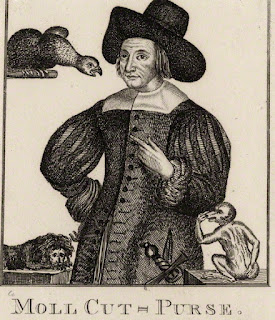
Mary Frith (nickname - Moll Cutpurse) was the daughter of a shoemaker and lived in Aldersgate Street near St Paul’s Cathedral. From an early age she was often in trouble with the law for stealing. To try to reform her, a minister tried to ship her off to New England in America, but Mary dived off the ship and swam back to shore.

From then on, she was arrested frequently for robbery and was held in various prisons - The Old Bridewell, the Compters and Newgate. She was branded on the hand on several occasions – this was a common punishment for thieves. Her stamping ground was St Paul’s Church (now the re-built Cathedral) where she would cut the strings of purses, (hence her nickname) and she also traded as a ‘fence’ for stolen goods and a pimp for younger women. Victims of pickpockets who had lost jewellery or valuables would come to Mary, and she would trade with the criminal underworld to return the items for a cost.

Mary was nearly always dressed as a man, drank in taverns and carried a sword. She is also credited with being the first woman to smoke a long clay pipe. She had a long association with the theatre and by the turn of the century she was performing on stage in men's clothing at the Fortune Theatre. On stage she bantered with the audience, fenced in mock fights, and sang, accompanying herself on the lute.

She was a keen horsewoman and was once bet twenty pounds that she wouldn’t ride from Charing Cross to Shoreditch dressed as a man. Of course she won the bet, and made it all the more entertaining by doing it on Morocco, the most famous performing horse of the day. Her riding skills enabled her to turn highwaywoman during the English Civil War. A staunch Royalist, she robbed the Roundhead general, Sir Thomas Fairfax by holding up his coach on Hounslow Heath.

We know a lot about her because The Life of Mrs Mary Frith of 1662 was one of the first biographies of a female criminal to be published in England and was highly influential in bringing women’s lives to the public interest. It is thought that Defoe’s book, Moll Flanders, was based on her life.

Heiress and Highwaywoman Katherine Ferrers

Lady Katherine Ferrers was the inspiration for the 1945 film The Wicked Lady, starring Margaret Lockwood and James Mason, which tells the story of a 17th century aristocrat and heiress who turns to highway robbery. Katherine was supposedly persuaded to a life of crime by her highwayman lover Ralph Chaplin, but he was caught and hanged on Finchley Common. After his death she worked alone, but was caught when she held up a coach and shot the driver; unfortunately it was a trap, and two of the occupants of the coach were armed and shot back. Fatally wounded, she galloped home to Markyate Manor, where she was found lying on the front steps - dead, but still dressed as a highwayman.

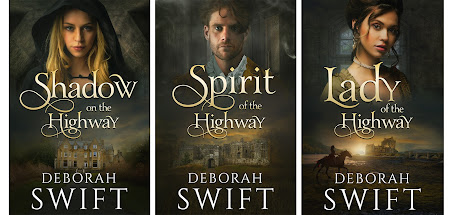
This of course is not the real story. The real story is one of plunder and possession in The English Civil War, and a time when rural farmers were trying to keep their lands out of the pockets of the aristocrats and were experimenting with new ways of communal living. In my young adult books about the life of Katherine Ferrers I explore these themes, and I enjoyed deconstructing and reconstructing the legend.

Sources:

Outlaws and Highwaymen - Gillian Spraggs 

The Elizabethan Underworld – Gamini Salvado

Dunstable History Society

Pictures: Wikipedia, East End Women's Museum, Project Gutenberg

Find me and my books on my website www.deborahswift.com


Friday, 16 September 2022

‘Veni, Vidi, Vocab’: the story behind my Pocket GCSE Latin Etymological Lexicon by Caroline K. Mackenzie

When in Rome… Photo © Caroline K. Mackenzie

I have a confession to make: although I loved Latin at school, I didn’t enjoy learning vocab. In fact, I usually left it to the last minute and would end up revising while on the school bus on the morning of a test. [Note to any Latin pupils who may be reading this - this is not a good idea!] Fortunately, I had a lovely teacher who encouraged me and eventually I looked forward to discovering new Latin words and the access they gave me to some amazing Latin literature, such as Virgil and Ovid.

Years later (after a Classics degree and a decade as a lawyer in which I regularly used Latin), I found my true vocation (or ‘calling’, as ‘voco’ means ‘I call’). I became a Latin and Greek teacher. Vocab was something I taught (and still teach) each day. Some of my pupils found the long lists of words at the back of textbooks rather daunting. Together we created some fun ways to approach these lists. One idea was to think of an English derivative from the Latin, e.g. ‘dormio’ (I sleep) gives us ‘dormitory’ and ‘dormouse’. Likewise, ‘nox, noctis’ (night) gives us ‘nocturnal’ and when combined with ‘ambulo’ (I walk) produces ‘noctambulation’. That’s a great word for ‘sleepwalking’!

‘insula’ illustration © Amanda Short

‘insula’ in Latin means an island or a block of flats. It gives us words such as ‘insular’, ‘insulate’ and ‘peninsular’ 

Some pupils drew pictures in their vocab books to help them memorise tricky words. So when I decided to write a Latin vocab book I asked the artist Amanda Short to create 20 special illustrations to help bring the book to life. Amanda (whose name appropriately derives from ‘amo’ (I love) !) carefully researched Roman life and mythology before producing her beautiful designs. Of these, if asked to choose a favourite I am tempted to say the ‘tandem’ one as it is so ingenious and witty [see my earlier blog on my first Latin Lexicon: http://the-history-girls.blogspot.com/2020/09/a-latin-lexicon-by-caroline-k-mackenzie.html ]; another contender is the ‘insula’ illustration which cleverly depicts two different meanings in one image. However, the gorgeous dormouse (for ‘dormio’, mentioned above) steals the show for cuteness!

‘dormio’ illustration © Amanda Short

Bloomsbury and I wanted to create a book that would help students and teachers whichever GCSE syllabus they are following, so we have included every word on each of the vocab lists for the two exam boards. The book includes notes to help explain some grammar and a glossary of Latin words and phrases in common use. Some of these appear in this blog, such as ‘e.g.’. Also, I couldn’t resist this more unusual one: ‘quidnunc’. It refers to an inquisitive, gossiping person - the Latin literally means ‘what now?’.

The word entries are spread out with lined spaces next to each one for readers to add their own notes or more derivatives. I hope students will really enjoy the Lexicon and that it makes learning vocab a fun and fascinating part of their Latin studies. Of course, the book is not just for GCSE pupils - it may also be useful for anyone interested in languages and etymology generally. It could be your secret weapon when tackling the daily crossword or even playing Scrabble. Did you know you can even buy a Latin version of Scrabble?

Latin Scrabble, anyone? Photo © Caroline K. Mackenzie

As its name suggests, the Pocket GCSE Latin Etymological Lexicon is small enough to fit into a schoolbag - so it can even be read on the school bus. However, for any GCSE pupils still reading this, a caveat: unlike I did, don’t leave it until the last minute! When it comes to learning your Latin vocab, don’t delay: seize the day. As the Romans would say, ‘carpe diem!’


Pocket GCSE Latin Etymological Lexicon by Caroline K. Mackenzie is now available to order from the Bloomsbury website:

With thanks to: everyone at Bloomsbury Academic, Amanda Short, Professor Paul Cartledge, Dr John Taylor, Caroline Lawrence and Dr Daisy Dunn.

Twitter: @carolinetutor
www.carolinetutor.co.uk

www.amandashortdesign.com

Post Scriptum

Given the historic events of this week following the sad death of Queen Elizabeth II, it seems only fitting to conclude this post with the following addendum. 
The Lexicon happened to be published on the day that Queen Elizabeth II died. When someone contacted me to say their copy had strangely fallen open on page 107, I looked at the entries on that page to check the significance. I shall let the page speak for itself (‘res ipsa loquitur’).


Extract from Pocket GCSE Latin Etymological Lexicon


Friday, 9 September 2022

Ghosts on a Wire by Linda Wilkinson

We welcome Linda Wilkinson as a guest to our blog today. Her play, Ghosts on a Wire, opens at the Union Theatre on 21st September.


Linda Wilkinson by Tony Hutchings

Drama and Industry in Blackfriars

The Bankside in Southwark has been home to many innovations of note, not least of these being the first steam powered grain mill in the world and then the largest gas fired electricity generator, the Pioneer, which in a later incarnation stands as Tate Modern.

From the 18th century onwards, this area was a place of “dirty” Industries. It was a cash cow for City of London businessmen, who were happy to keep the filth over the river on the south side and rake in the profit.

The Pioneer, built to serve the square mile, resulted in the decimation of swathes of streets and communities. The pollution it unleashed was monumental. It physically destroyed the sole remaining pub, the Waterman’s Arms, which was next to this smoke, heat and vibration spewing leviathan.

It also saw some of the earliest attempts by Victorian philanthropists to address the resulting air-pollution. One of these being Octavia Hill, who has a long history in the area, which is present up to this day.

In 2019 Southwark Council under its Blackfriars Stories stream commissioned a play about the Albion Mill, the aforementioned steam powered grain mill, which was performed at the Union Theatre, a stones’ throw from the site of the Mill itself.

In 2020 a second play, this time about the Pioneer and its historical impact on the environment and peoples of Southwark was planned. Little did anybody know then then that Covid would see this endeavour, and the production of the play that became Ghosts on a Wire, halted for two years.

London is awash with history and this particular part of the south bank of the Thames is particularly rich in Industrial heritage and also the presence of some intriguing characters.

30 August 2022 was the 225th anniversary of the birth of Mary Shelley, who features as one of the ghosts in the new work. She, like Michael Faraday, the putative inventor of electricity, and William Blake the visionary were habitués of Blackfriars where the historical events enacted in the drama take place.

Germane to the plot is the Leverian Museum. This natural history and ethnographic collection stood for some years at 3 Blackfriars Road, not far from Michael Faraday’s later workshops.


Leverian Museum © Adrian Chappell

It was a place of curiosities and strange skeletons and fed into the growing interests into the natural world and inexplicable phenomena, such as lightning, which in turn led to early experiments into electricity. Here at the Leverian, luminaries of the period would gather to watch demonstrations and hear readings from works. Blake would most certainly have been an attender of this collection, which was famous in its day.

In the late 19th and early 20th centuries when the industrial pollution of Blackfriars was at its height, Octavia Hill, co-founder of the National Trust, was working on building some of her model cottages in Southwark. This inventor of social-casework, was also an early proponent of the clean-air-movement who fought to keep London’s open spaces clear and free for the working population to use freely as they wished. With a group of like-minded women, she also founded the Blackfriars Settlement, which functions to this day, its ethos unchanged during the 130 years of its existence, to create and provide community services and support.


Octavia Hill's Blackfriars Settlement © Adrian Chappell

Given this multifarious series of events, endeavours and notable people, all of whom circulated around a small area of Blackfriars, it shouldn’t be surprising that modern echoes come through. In 2020, when the play was mooted, the cost-of-living crisis was not a consideration. The Housing crisis was already upon us, but not the choice between heating, eating, cooking or indeed washing. That energy prices would rise by thousand-folds and that the poor might die as a consequence was not on any agenda.

A play about the poor versus the wealthy, about electricity profiting one sector of society whilst the lack of it causing others to go hungry and become homeless, one had hoped to be something for the historical records, but sadly no.

However, it’s always amazing to find the resilience, joy and hope that people find in their lives, even when facing adversity. The Publicans of the destroyed Watermans’ Arms being of note. The court case which they took “Shelfer versus the City of London Electric Lighting”, stood for over a century. Life went on, even for the Watermen who did the final “Bovril” runs on the Thames who found work in newly Unionised industries. Octavia Hill, whose fight for the disadvantaged seemed endless, in the end gave the Nation one of its greatest gifts.


Interior The Waterman's Arms © Adrian Chappell

London’s rich and varied history is cyclical, always winners, always losers. Places of dearth, become places of wealth until the pendulum reverses. Today St Paul’s cathedral looks over the river at the Tate Modern where, if you can but imagine it, a pike-pond once provided fish for Mediaeval Royal Tables. Ghosts of the past exist everywhere in our great City, you need not look far to find them.


Linda Wilkinson

http://uniontheatre.biz/show/ghosts-on-a-wire/